Author Archives: yachtcamomile
Bundaberg, Australia
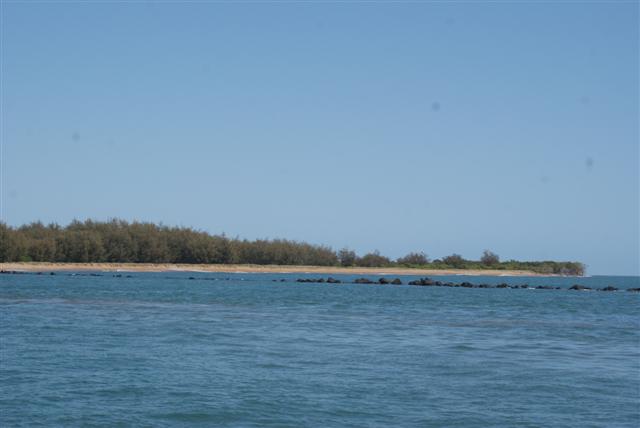
The entrance to Bundaberg
Our position on 19th October 2012
24º 45.4 South
152º 54.6 East
Bundaberg, Australia
As we approached the outer buoy the sea changed from Pacific blue to sea green. The entrance reminded us of a big Littlehampton with its training wall and beautiful orange ‘sandcastle sand’ beach. We were very excited to be in Australia at last.

Charlie the cormorant
We arrived on the 19th with this shag (we think that’s what it was), which had landed on the boat the day before and roosted on the solar panel all night, flying off as we arrived at the outer entrance buoy. There were 2 other boats on the quarantine dock, Aurora B with Mike and Liz from the UK and Yellow dog with Oliver and Daniel from Switzerland, both of whom we had met up in the islands. We also discovered Lorrigray is here, an ex blue water rally boat. The marina prices here are similar to the UK so we dropped our anchor in the bay outside.
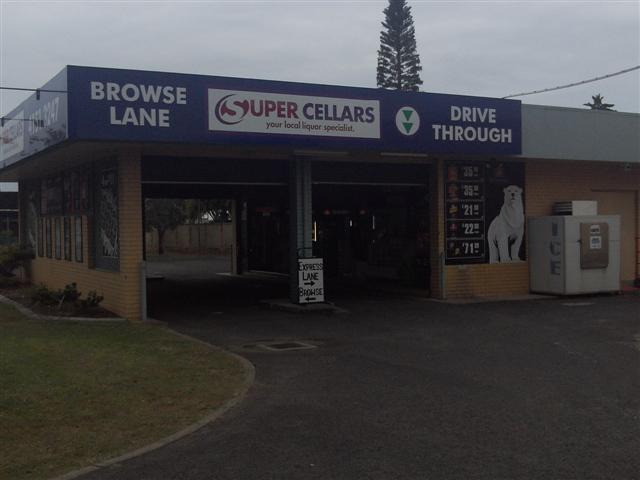
The drive-through liquor store
Bundaberg marina is outside the town near a village called Burnett heads with the town of Bundaberg a further 8 miles up the river. Burnett heads is a pleasant 20 minute walk along the waterfront. There’s a hairdressers, where I had a much needed hair cut, a bakers, chemist, small hardware shop, a fish and chip shop, a pub selling good food and a ‘drive through’ drink shop. This is an amazing concept where you literally drive in, give your order at the window, it’s put together, put in the back of your car and you drive off without even needing to get out!

The Bundaberg barrel
The supermarket next door was my first stop to restock the boat after the customs had relieved me of the last of my meat, fruit & veg. It was wonderful to be able to enter a supermarket with a list and get every thing on it. The cost of living here is quite high but the prices aren’t as bad as I was expecting. They also offer an excellent service of a free minibus ride back to the marina. The Port2port rally that we have joined has been busy organising various drinks evenings, barbeques, pot luck suppers, chart marking sessions and outings. This is the Bundaberg barrel where the local ginger beer is made that we visited one afternoon on Judy’s free tours of the area.
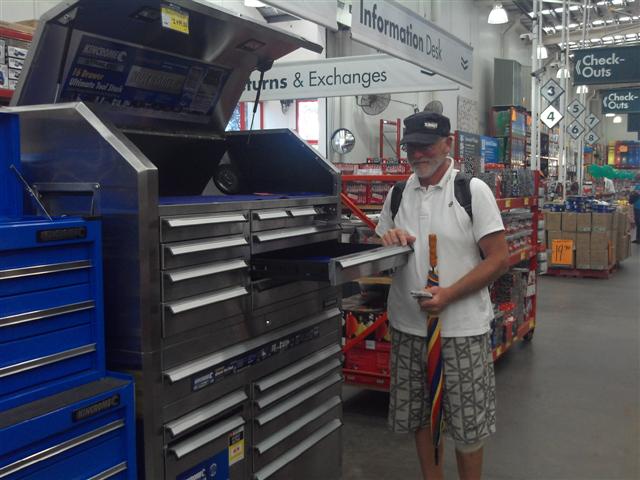
“I want that one”
We also went to Bunnings, the Australian version of B&Q where Bill spotted this toolbox. “No you can’t have it”
We’ve kept ourselves busy doing washing, interneting, sorting out the boat, although fortunately we didn’t have any major breakages on the trip down, socialising and generally getting used to living in a first world country again.

Didgeridoos being played
On Saturday 27th we went to the Lighthouse festival organised by the Burnett Heads rotary, which was a bit like a summer fete. This guy was playing Didgeridoos and they were giving off an amazing sound. We spent the morning wandering around the stalls and listening to local bands playing on the stage. In the afternoon we lifted the anchor and sailed upstream into the town, a distance of about 8 miles. The surrounding area reminded us of the east coast of England because it’s very flat and as we floated up the river it was possible to see Bundaberg across the flood plains.
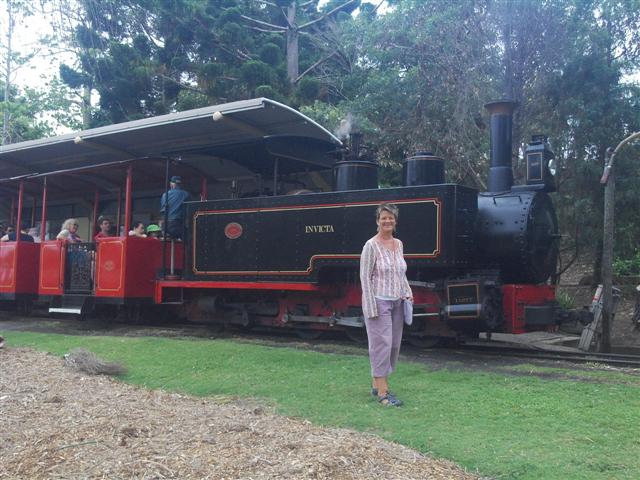
Invicta the steam train
On Sunday we walked to the botanical gardens a pleasant oasis of tropical shrubs, towering trees and flowering gardens surrounding a few small lakes. There is a little steam train running around the perimeter that is maintained by a local preservation society. It formally spent it’s working life transporting sugar cane that is grown prolifically in this area to the sugar mills. I’ve loved steam trains since I was a little girl when my Dad often took me to see them and the ride brought back happy memories.
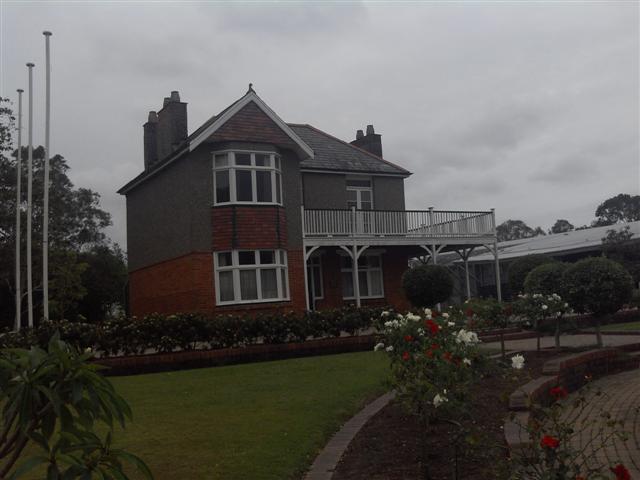
Hinkler house
The gardens are also home to the Hinkler House museum set inside the house of Bunderberg’s famous son, aviator Bert Hinkler, who made the first solo flight between England and Australia in 1928. The house was painstakingly relocated from Southampton in 1983. As it’s so totally different from normal Australian houses it looked very strange in it’s setting. We had coffee in the railway café then returned to Camomile anchored in the river.
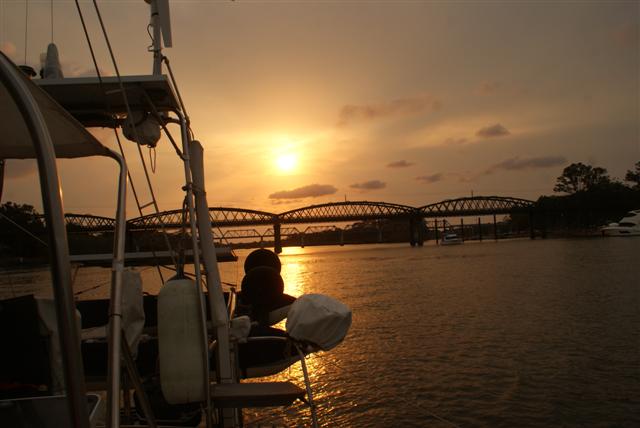
Camomile anchored by the bridge in Bundaberg
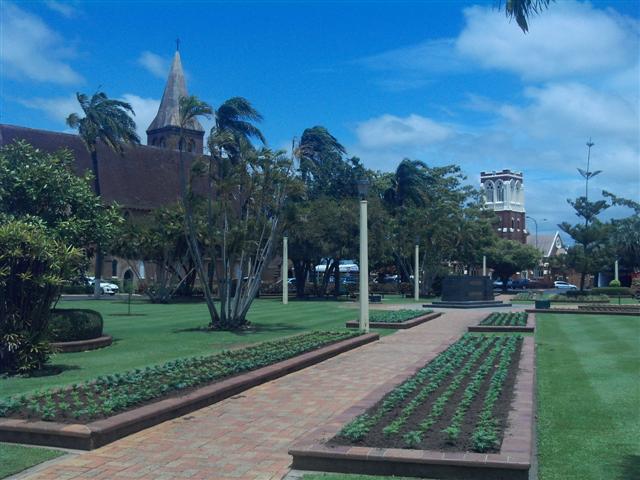
Bundaberg gardens in the town
We spent 2 days in the town wandering around the shops, it seems you can buy just about any thing here; Bill even managed to get a new battery pack for his cordless drill so he was happy. The town looked very similar to many we saw in NZ, being laid out in blocks it’s easy to get your bearings. The gardens in front of the town hall had been freshly planted with summer bedding. We discovered the RSL club (returning servicemen league) similar to the British legion in the UK, where, for one dollar, it was possible to join and enjoy the delicious, reasonably priced meals while sitting in an air-conditioned lounge overlooking the river.
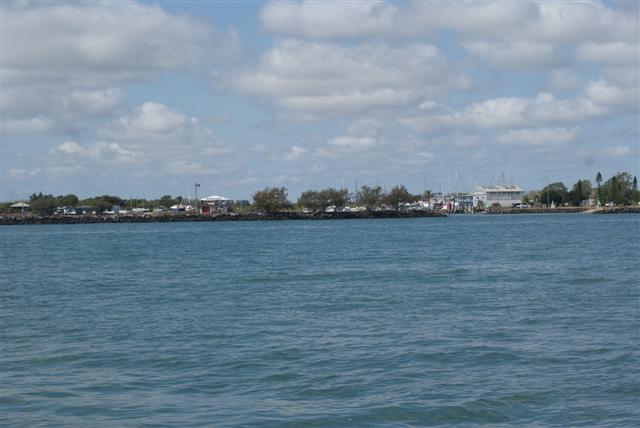
A view of Burnett heads as we left
On Wednesday 31st we motored back down the river to Burnett heads in time for the Halloween/pirate/pizza night organised by the Port2port people before leaving the next day to start our journey south.
The final blog from the Solomons
This is Bill’s last blog on the Solomons.

Our Dolphin escort
On the 28th September it was with little regret that we left Honiara port. We headed out towards Rodrick Bay in the Florida group of islands about 28 miles to the North. Motoring until the heat of the sun struck up a sea breeze we ploughed through the biggest pod of dolphins we have ever seen. The water was thick with them. Soon the sails were unfurled and we were creaming along for 2 hours with a fresh breeze on our beam.
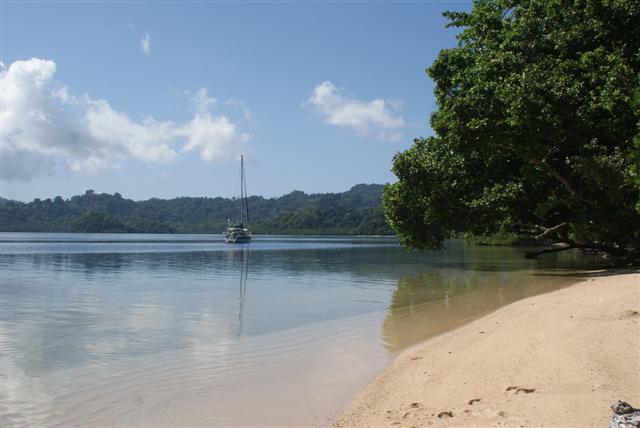
Camomile settled by the beach at Rodrick bay
Approaching the bay the wind dropped as we slipped into the lee of the land under the cooling cloud cover overhead. The 33’ yacht Tomboy with Janice and Tom on board was already in the anchorage and Tom, rowing from the shore in his dinghy, helped David and Nathanial in their dugout canoe make Camomile fast to buoys fore and aft not far from the shore. Looking down into the 20 metre depth of crystal clear water I could clearly see the coral growth on the bottom and was glad not to have my anchor down there in it.

The wreck of the World Discovery
David, the son of one of the three brothers at the head of the extended village family, explained that we were welcome to use the buoys at no charge for as long as we wanted. We were also welcome to come ashore, swim, snorkel and generally roam around. We had been impressed by the wreck of a cruise ship beached on the shallow reefs close to the shore. This had apparently been holed and was sinking but managed to disembark her passengers before being beached to save her for salvage. David explained that the local chief of the next village had claimed her, after he had repelled attempts to salvage the vessel, and he now charges a fee to visit the slowly rusting hulk.
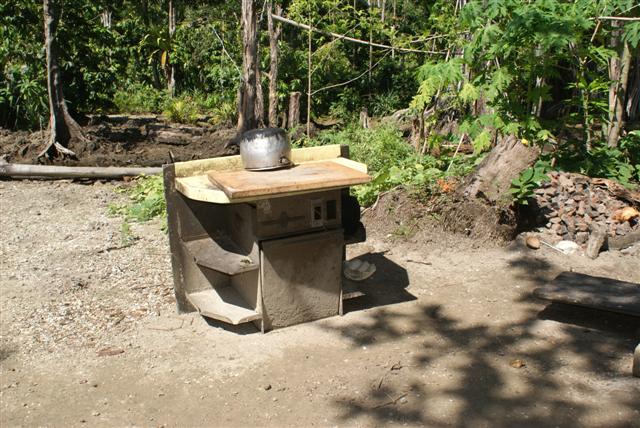
Old vanity unit
Needless to say, pilfered bits of cruise liner showed up throughout the villages in the bay. This vanity unit was being used as a work top.

Lillian on her way home from her garden with fresh produce
John the chief of their village and the youngest of the 3 brothers was away from the village and Lillian, his wife, was in charge and could be heard on the shore haranguing the remaining two brothers, Nathanial and David even though she was about 4’6″ tall
Very soon this diminutive, doughty and eloquent lady who brought us a gift of shells and fruit visited us. She explained that they liked to welcome newcomers with what we would call a “pot luck” dinner and would we like to come ashore tomorrow evening to meet the whole family.

Lillian’s kitchen
Even from the boat we could see that this village was tidy and well looked after but even more primitive than anything we had come across to date. This is Lillian’s kitchen which has an open fire in the corner. The fire serves two purposes, it has a large cooking pot over it for boiling vegetables but also rocks are heated in the fire which in turn are used to form an oven to roast fish or veggies (they rarely have meat) covered with old sacking and banana leaves.
Tom and Janice came on board for drinks that afternoon and we chatted about their time here. It turned out that Janice, although a vet, was running a free clinic for the local tribes and Tom was teaching various subjects to some of the local children. Their selfless generosity was humbling and makes you realize that the more people like this we have on the planet the better the place becomes.
I was embarrassed, though grateful, when Janice insisted on treating my knee injury that had recently flared up. She introduced me to something she called acupressure, a treatment manipulating pressure points, which she explained, controlled the flow of energies through the body. Decades of cynicism dropped away as the treatment started to relieve the painful symptoms but I still felt a bit of a fraud because, compared to the ailments she was seeing at the clinic, mine was trivial.
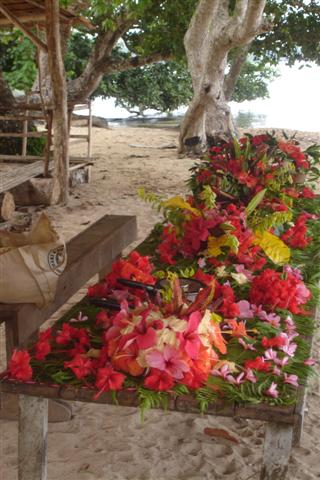
The table prepared for the food, my saucepans are tucked in amongst the decorations
The following afternoon Sue made a large chili-con-carne with rice on Camomile and Tomboy prepared a huge pasta dish and a banana cake all of which was ferried ashore at the appointed hour.
I was bowled over by the preparations that the villagers had been making during the day. Every inch of the huge table under the palm fronded roof was covered in brightly coloured hibiscus petals and leaves.

Sue decorated with the beautiful flower garland and the decorated drinking coconut.
The ladies presented us with beautiful garlands and offered us green coconuts decorated with petals and fine bamboo straws to drink the fresh coconut milk. The men had been out fishing in the lagoon, returning with clams for the chowder starter and reef fish for the main course. This along with the vegetables from their gardens and the contributions from the boats served up on hand made plates freshly woven from palm leaves made the best welcome feast we have been treated to on our travels. How extraordinary that it should also come from probably the poorest people we had yet encountered.

The children enjoying popcorn.
Everyone ate well but the star of the show as far as the kids were concerned was Janice’s popcorn, which they ate in huge volumes for starters. Some of these little girls are wearing tops that Sue had handed out that afternoon and which they were very proud of.
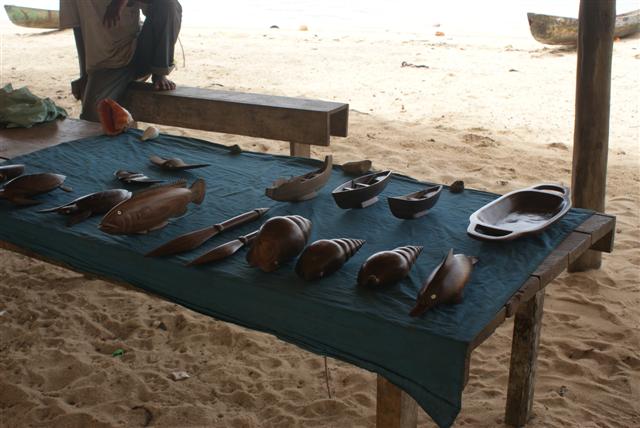
The wood carvings
The woodcarvers from a village across the bay set up their stall for us to view and I spent an entertaining hour bartering a head torch, twist drills, hacksaw blades, and a few Solomon dollars for some carvings. We choose a wooden shell and a war club, not sure if we’ll get them past the Australian customs.

Enjoying island hospitality

Coral waiting to be burnt
My knee had improved enough now to take a walk to the end of the next village so we trekked off into the bush only stopping to admire the work of a local man building his home from materials straight from the surrounding jungle, and wonder at the heaps of coral on pyres of logs being prepared to burn down into the lime dust taken by beetlenut users to intensify their hit. Hmmm.

Chiefs and Elders on board Camomile
Sue ventured further afield with Janice to visit the chief in the next village and we also received a visit on board Camomile from Ben the paramount chief of the area who wanted to show us the DVD he had of the recent festival at Roderick bay. It turned out that Lillian and the brothers had not seen this recording either so we all piled below to watch it on Janice’s PC. All thought our home really lovely. It’s amazing to think they don’t have anything like the facilities we have on board.

Repairing dugout canoes
I noticed when we were visited by Lillian and some of the kids that they spent almost as much time bailing as they did paddling so offered to do something about it. They hauled their canoes out of the water for a couple of days to let them dry out and then I set about them making repairs to the sizable holes that had eroded their way through the wood of the aging craft. Sue discovered that Lillian had a hand controlled sewing machine and a little bit of fabric but no patterns. She spent an afternoon with her tracing patterns onto some thin card that Lillian had and cutting them out followed by instructions on how to use them. It felt good to help and it was well received by the village whom by now felt like really good friends.
We snorkelled the surrounding lagoon and among the myriad of smaller fish we spotted a grouper, as large as he looked grumpy, the first we’ve seen and some small string rays.
All this time I had been downloading GRIP files from the SSB and keeping an eye on the weather systems careening up the eastern seaboard of Australia, our next destination.

Sad goodbyes to the family and Janice
It became clearer that we should move off before the tougher November weather set in and after 12 days in this beautiful place we said our sad goodbyes and headed back off to the armpit of Honiara to check out ready for the 1,100 mile beat to the shores of the first continent we would landfall since arriving in Panama from the Caribbean.
Comment from Sue

All these children are under 6
We will be sad to leave the south Pacific after 2½ years. During that time we have visited some stunning places, stopping at many islands, and met some wonderful people from different civilisations whose generosity has been very humbling. At times I’ve been a little nervous when the boat has been approached by dug out canoes or small launches but that’s soon dispersed when faced with welcoming, happy smiling faces, particularly on the children.

A thoughtful little chap

A lovely boy called Frank

This little chap is sitting on the washing and the washing-up!!
Most of these people have no hope of having any thing like the sort of life styles we take for granted but do you know, they don’t seem to miss it one bit, they are so rich in their surroundings. The freedom they enjoy is so liberating and I’m not sure which one of us are the lucky ones.

Faces of the South Pacific
2 days in Honiara
Our position on 28th September 2012
09 25.6 south
159 57.2 east
Honiara port, capital of the Solomon Islands
We did an overnight motor from Tavanipupu. After waiting almost 2 weeks for the wind it still didn’t arrive and we were really short of everything so we had to leave. On our last but one day another boat arrived. After seeing only one other boat in the whole of September I was like Robinson Crusoe running round the deck calling ‘There’s a boat coming, there’s a boat coming’. They had come from Fiji and were on their way to the Philippines and stopped for a few days on a ‘yellow flag’ stopover but I still managed to extract their life story out of them!

Camomile anchored next to the Solomons navy boats
We arrived in Honiara at first light and found to our surprise 4 other cruising boats there, one of them a catamaran from Jersey who were equally excited to see another British boat. There was a second catamaran, an Aussie boat that had seen better days and Tomboy, an American boat who we had heard on the Namba net several times. Tomboy were just heading out to Rodderick bay so we agreed to see them in a few days.
Our expectations of Honiara were low and they weren’t exceeded. We spent 2 days in and around the city but found it noisy, dirty and the rough sidewalks (you couldn’t call them pavements) covered in red betel nut spit. We traveled in little ‘jump on jump off’ minibuses for about 30p a ride, not one of them, without exception, would pass an MOT but the taxis didn’t look any better and were much more expensive. We had to pay our harbour dues to the customs and our immigration fee which amounted to about US$200! These third world countries are becoming aware that there are more and more yachts sailing around the world these days and they are cashing in on it. You can’t blame them; I wouldn’t mind paying it if it was getting to the people who need it but it isn’t. We managed to find a ‘supermarket’ which had most of the things we needed but Bill saw a huge cockroach walking across the floor and some of the pasta had weevils inside the packets, what I wouldn’t give for a Sainsburys!

Honiara fish market
The market, as always, was good, full of friendly smiling people chatting and calling to each other while selling home grown produce really cheaply. None of it would get past the ‘Tesco straight banana’ brigade but the odd shapes taste the same. The eggs are delicious, completely free range with bright orange yolks, no wishy washy battery eggs here. Bill made several trips to the fuel station with the jerry cans for diesel and petrol, he had our gas canister refilled and he even found a tube of mastic in a big hardware store. We found an internet cafe but were only able to check our emails, I’m sorry but no chance of downloading any pictures until we get to OZ. We discovered a little oasis called the Lime lounge (bright green, easy to find) which was run by an Aussie and sold western food and fattening cakes with really good coffee but best of all, it was air conditioned. It was quite expensive but full of white people so we joined them. We were told about a good wine shop which was also air conditioned so we took a while choosing some wine to replenish our stocks, and a butchers called Meatlovers which had good quality meat served in a clean environment, difficult to find here. We spent as little time as possible on shore because there were lots of strange looking people hanging around street corners, I think they were harmless but wouldn’t want to meet one of them in a dark alley. We left the dinghy in the safety of the Point Cruz yacht club, another little oasis that had the BBC world news beamed in on a satellite TV along with cold beer, they knew what yachties liked.
Honiara was very hot and humid so we were glad to leave and join Tomboy in Rodderick bay. I’ll write again soon
Prince William and Kate come to the Solomons

Waiting for William and Kate to arrive, it was very hot.
Our position on 21st September 2012
09 49.7 south
160 51.1 east
Tavanipupu island, Marau sound, Guadalcanal island, Solomons
Great excitment here, we’ve just a royal visit from Prince William and Kate. On Monday at 4pm local time we joined a very excited group of locals at the little airfield to watch them arrive being the only white faces on the plebs side. While we were waiting we were interviewed by the Daily Telegraph. The first to arrive were 2 helicopters with special forces in them (we’ve had more police launches than we’ve ever seen in the islands buzzing around for the last couple of days) and a little plane with a few journalists and members of their staff.

Will and Kate were met off the tiny plane by the prime minister
Half an hour later a little plane with the Royal couple in arrived. We were all kept behind a fence although it was only waist height and only about 4 or 5 metres away from them. A conch shell was blown as they arrived which is the tradition warning signal that there could be ‘enemies’ approaching.
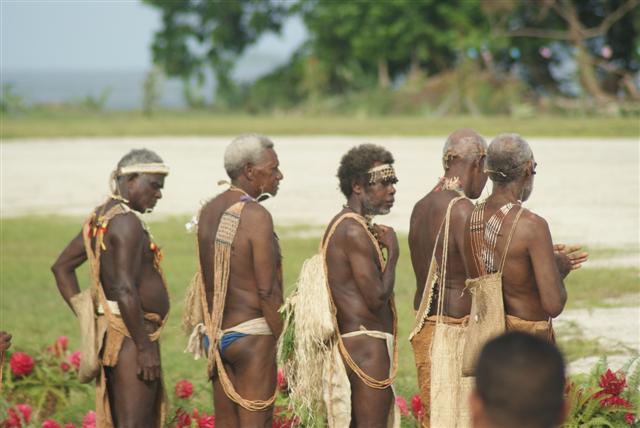
Local warriors
Some local men dressed as warriors or shall we say not wearing very much, performed a little war dance because the Prince could have come ‘in anger’. Once it was established that he was a ‘friend’ he was bestowed with gifts and traditional shell money.

The local children sang God Save the Queen to them
The local school children sang a beautiful rendition of God Save the Queen in English and in Bislama, their language.

Some local women danced for the Prince
William and Kate were walked down the airfield on a coconut mat, not red carpet as the locals wanted to point out, and onto a waiting motor boat to take them to the island. As they walked down the mat I called to William and waved our boat ensign and said we were English and he smiled and waved back. We joined a flotilla of local launches for the twenty minute trip across the lagoon to the island of Marapa. We had been told we could put the dinghy by the village but on the day there were lots of police in launches keeping the area free. We all put dinghies, motor boats and canoes around the corner and ran through the jungle path to the village.
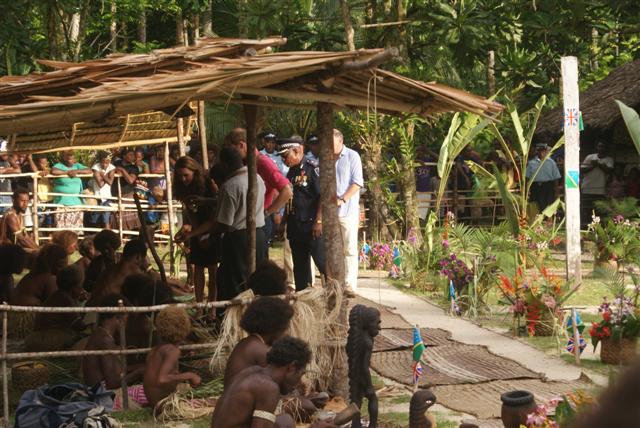
William and Kate visiting the custom village
A corral had been built again at waist height where there were lots of things going on for them to look at. William had a go at getting a fire going and Kate tried her hand at the basket weaving. Again everyone within the corral was dressed in traditional dress which didn’t to amount to very much for the men. After about half an hour of chatting to the locals the children sang a beautiful farewell song while the older women were in the water performing water music with their hands (very clever).
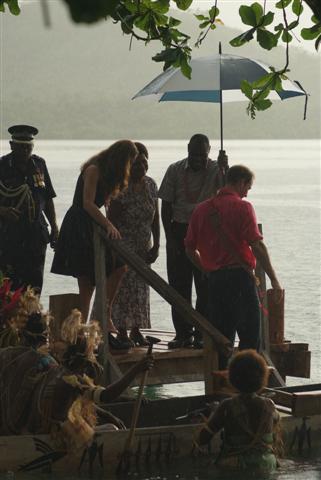
William and Kate getting into the war canoe, unfortunately it started raining
Kate slipped her shoes off to get into the war canoe.
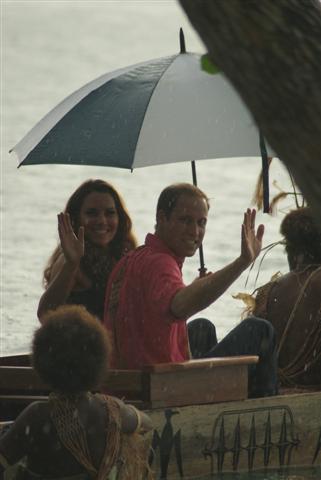
They turned and waved goodbye to us
William and Kate got onto a beautifully carved war canoe with some local warriors who paddled them across about 100 metres to the island of Tavanipupu to the posh resort where they stayed the night.
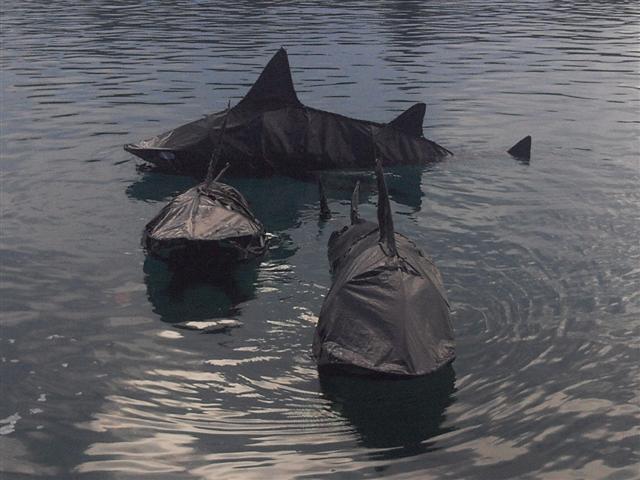
The ‘sharks’
The locals had made ‘sharks’ to float in the water alongside them.
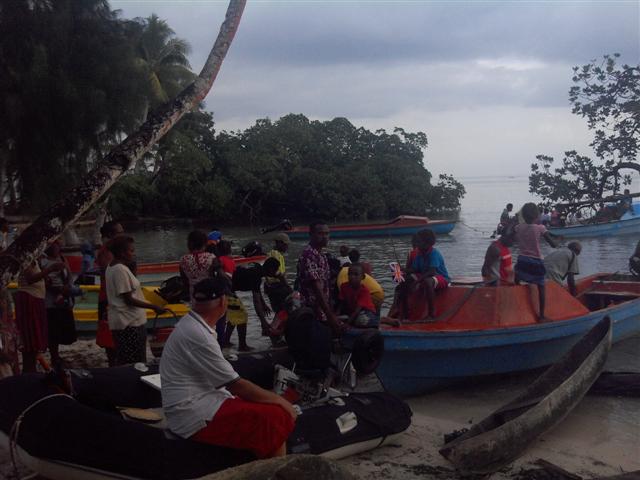
Local canoes ‘parked’ behind us
When we went back to the dinghy it was blocked in by local canoes. This must be the equivalent to having your car blocked in after a gig!
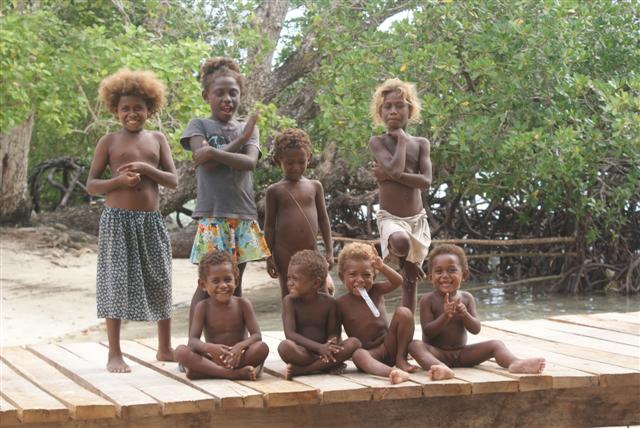
The local children on the jetty the next day
The next morning we tried to anchor Camomile near the airfield to wave goodbye but we were turned away so we dressed the boat overall and hovered on their course and as they came past in the motor launch we waved again. So fairly exciting although didn’t get to actually shake their hands because they were kept in a ‘bubble’ while they were here but Kate looked very well and pretty.
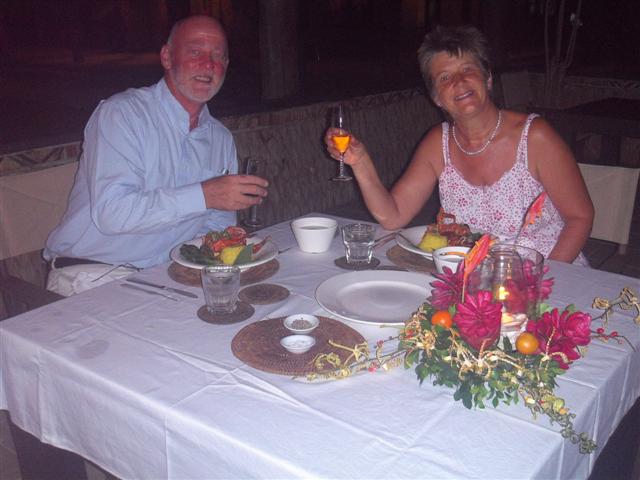
Happy Anniversary
Now we are anchored next to the same island they stayed on and as they opened up the resort again the next day we went to see where they stayed and treated ourselves to a belated Anniversary meal there. I had a lovely chat with the American owner and she said they looked so happy and in love and she still can’t believe they choose to stay on her island. We think she’s now sitting on a goldmine once word gets out in the celebrity world.
It’s an amazing location, we have the village on our starboard side where they still live as they have done for thousands of years very happily, with the children playing carefree in the water all day, and on our port side is the resort where for the price the guests pay for just ONE night it would educate ALL the children in the village for a whole year, it’s a strange world we live in.

Camomile dressed overall for a Royal visit
September Update – moving onto the Solomon Islands
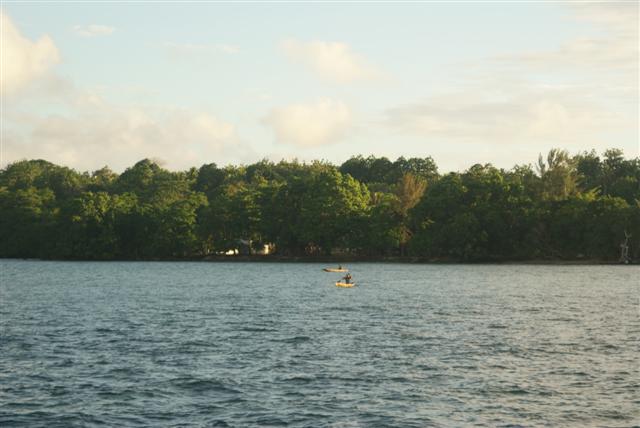
Anchored in the Solomons
Our arrival in the remote Santa Cruz group in the Solomons was on the back of a deep trough that had treated us to strong gusty squalls and kicked up a nasty short sea well beyond what could be expected from the wind strength. But the sky was the most dramatic thing I have ever seen, clouds of every size, type and colour paraded across the brightest blue backdrop; an effect of the South Pacific Convergence Zone that we had entered. After the choppy sea we were relieved to motor gently into the lee of Vanikoro island’s deep and sheltered anchorage.

A local family came to visit
Our arrival seemed to be the signal for dugouts from miles around to come and introduce themselves and find out what we had on board to trade for their local produce. The dugouts here differ from the Polynesian outrigger style by being beamy enough to sit inside, being equipped with crude downwind sails similar to the Egyptian felucca and a pole for punting through shallow reefs. They are also monohull making them less stable but this didn’t stop them from standing up to fish with bows and arrows.

Fishing with a bow and arrow
Although we were unsettled by all the warnings we had received about being here, the only disturbing thing we had found so far were the blood red toothy smiles from those addicted to the locally grown narcotic betelnut. This is chewed after lime is taken for a more intense “hit”. It leaves stained and damaged teeth not to mention its more sinister carcinogenic effects.
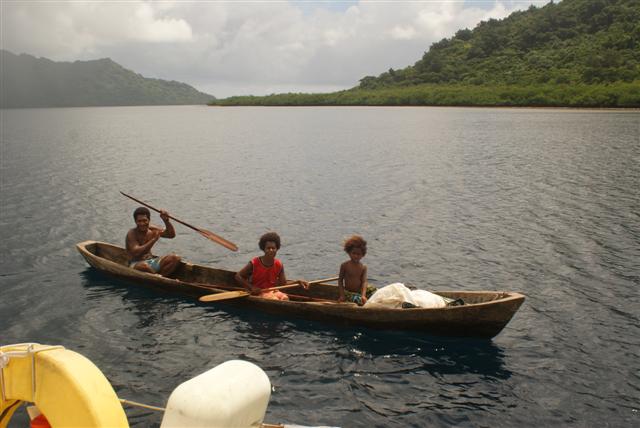
Another family in their canoe
The people though were lovely and traded fresh produce like eggs, beans and tropical fruit for the clothes, writing materials and other paraphernalia we had brought for this purpose. Some requests we could not help with; we had to explain that it was not normal for a yacht to keep roofing nails suitable for their church on board. Even when a large boat full of fierce looking men turned up wanting to know if we could help to fix their SSB set (no mobile phones here yet) they were polite and did not make us feel uncomfortable. I even gave away my last tube of Araldite epoxy glue to the local chief, he was over the moon with it!

Selling fish at Lata
Onwards to Ndendo where we anchored up in Graciosa Bay to check in at the town of Late, an unremarkable collection of ramshackle buildings with some shops but where the bank was unable to change any money. Sue managed to persuade a local shopkeeper to exchange a few American dollars for some Solomon dollars.

Sue with some of the children
We stayed five days before continuing on to the next island. After a 40 hour passage we arrived in Santa Ana in a deluge of rain but were delighted to see another yacht in the anchorage skippered by Feri, a Swiss Turk, travelling the “wrong way” from the Med with his crew Deniz. The next couple of days the rain shrieked down on us filling our water tanks to the brim.
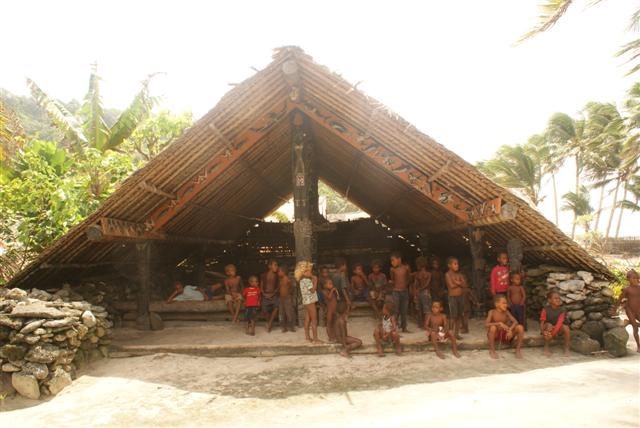
The custom house
When it finally got dry long enough to go ashore we met Chief John who welcomed us to his village. We mounted an expedition to the other side of the island together with the Turkish contingent to inspect a “custom house”, where the bones of past chiefs were interred, and to a lake in the centre of the island which was responsible for their reliable water table supply.

A village house
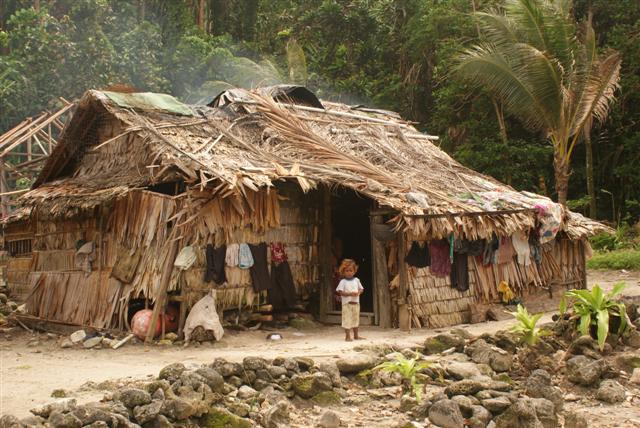
Another village house
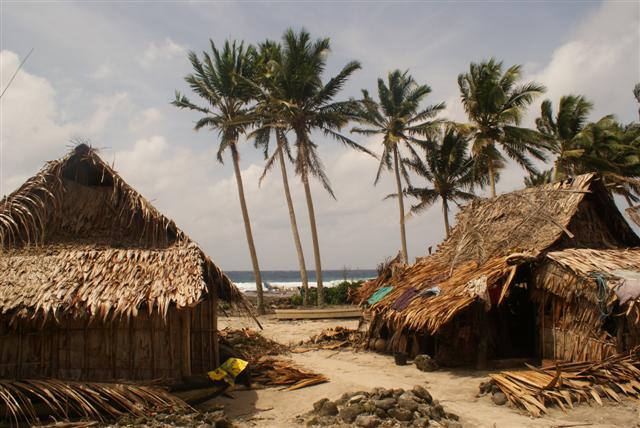
Beautiful views through to the ocean
The village was very tidy and there seemed to be children everywhere but their houses were made from all local materials with wonderful views through to the ocean.
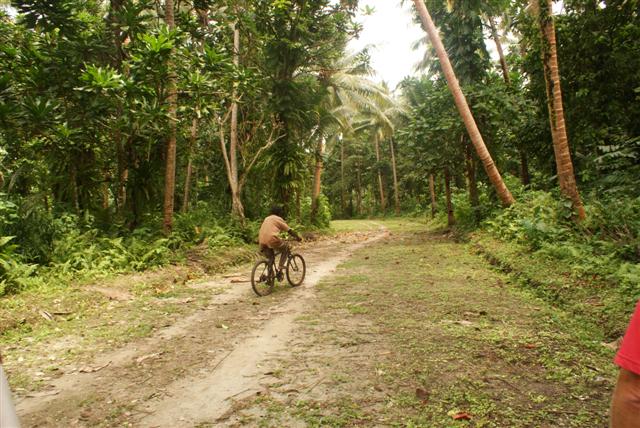
A lone bike
This was the only form of transport from one side of the island to the other on the road cleared by the Americans during the war
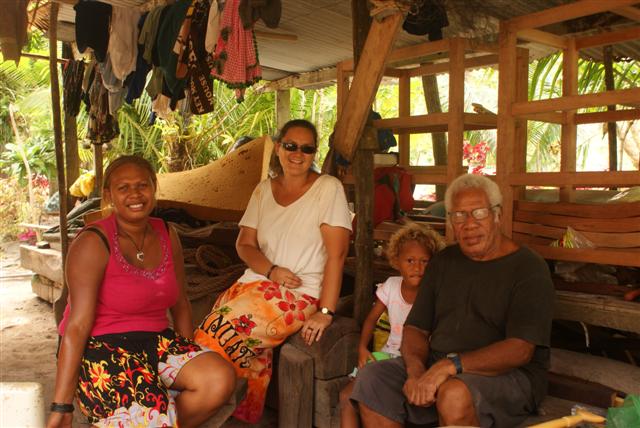
Olive, chief John’s daughter, Karen the missionary, Chief John’s grand daughter and Chief John
We met Karen the missionary who was teaching the local people how to write down their local language then teach it to others.
We moved on with trepidation when a fair wind arrived. The brisk wind 25 knots from square astern and with the twizzle poles on our double 135% genoas drove us along all day towards the eastern end of Guadalcanal Island where we arrived shortly before 18:30 which is “lights out” around here. We anchored up alone again in a quiet bay but the holding was good first time, it was flat calm and we were both tired from an exhilarating day sail.
Waking in this jungle anchorage was a joyful experience and it wasn’t long before the local characters started to make themselves known. The canoes started coming out to the boat again but this time with stories of Prince William and Kate coming to the Solomons. We thought we had missed them but it turned out they were arriving in a couple of days time.
We’ve checked into the Solomon Islands
Our position on 1st September 2012
10 45.5 south
165 49.3 east
Lata, Ndendo island, the eastern most Solomon island to check in.
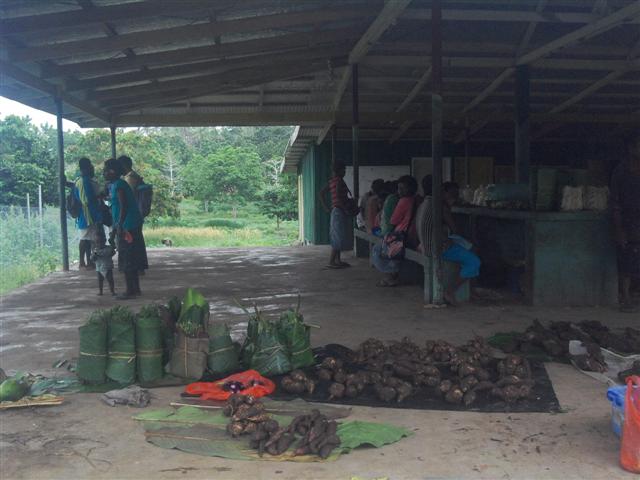
The market in Lata
Finally achieved an odd ambition of being the only white person on an island yesterday. Walked around the little town with everyone looking at me but they were friendly. Even with my tan I looked white next to the Melanesians. When they smile at you they have red teeth and gums from sucking betel nut, it looks very odd. We have only seen one other boat in the past week and only one other English boat on the 21st August, the first for weeks. Saw quite a few Aussie and US boats in Vanuatu and a few kiwis but it’s very remote here. We know of a few boats ahead of us in the Solomons, hopefully meet up with them soon. It’s an amazing thing to see the little canoes coming out to us. The children are gorgeous, lots of hair but no clothes. Their faces light up when I produce even the simplest things like a bit of chewing gum or a t-shirt. It makes you realise how materialistic the western world is! We’ve got lots of photos but no chance of putting any thing on the website until we get to Oz. Love to everyone
Sue
August update in Vanuatu
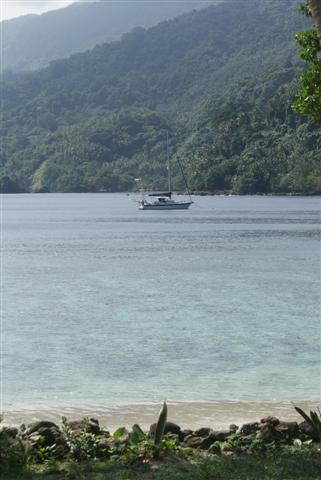
Camomile anchored in Lamen bay, Epi
After spending a week in Port Vila re-provisioning, re-fuelling and a false start because of the weather we finally left on the 3rd of August. A little heavy of heart we sailed the 16 mile hop around Devil’s Point, where the trade winds kick viciously at the opposing current twice a day, and into the shelter of Port Havannah for an overnight stop and a pre-dawn start the following day to sail the 65 miles north to the island of Epi. We anchored up in Lamen Bay after an easy but long day sail. This sandy bottomed bay is a good but rolly spot but we had been here before and knew that by putting out a stern anchor we would be much more stable. We spent a couple of days chilling, snorkelling over sea turtles grazing on the sea grass below the boat that could not have been less concerned by our presence. Dugongs inhabit this bay but they are shy creatures and failed to make an appearance for us much to Sue’s disappointment.
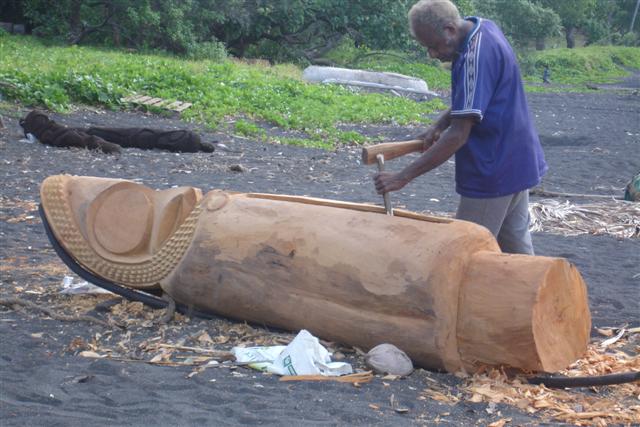
One of the Ambrym carvers
The volcanic island of Ambrym is the next large island and will forever be remembered to us as the place, last year, where Camomile nearly succeeded in running away from us when she dragged her anchor at Ranon while we were ashore with a local man’s broken generator in pieces trying to repair it for him. The fine, light black sand simply let go and she was ¼ mile out to sea when the alarm was raised by Silver Fox, a rally boat, who wondered how we could be anchored in 200 meters of water!
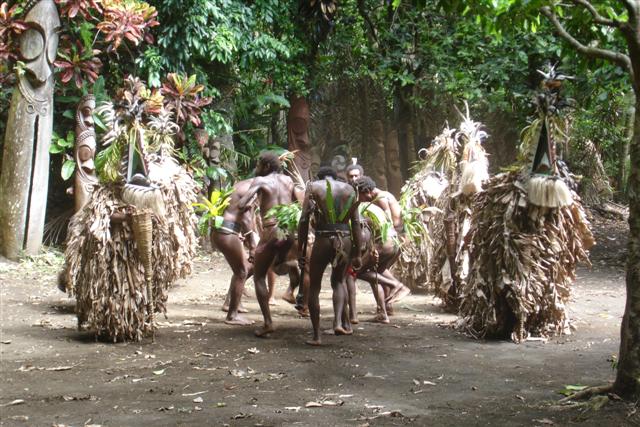
The Rom dancers at Ambrym
We were also lucky enough to see a traditional Rom dance with the men dressed in small Namba’s, which is a penis sheath attached to their belts, and nothing else! It involves a lot of foot stamping and shuffling.

The sacred Rom site
Woman aren’t allowed near the Rom site but they made an exception for the cruisers.
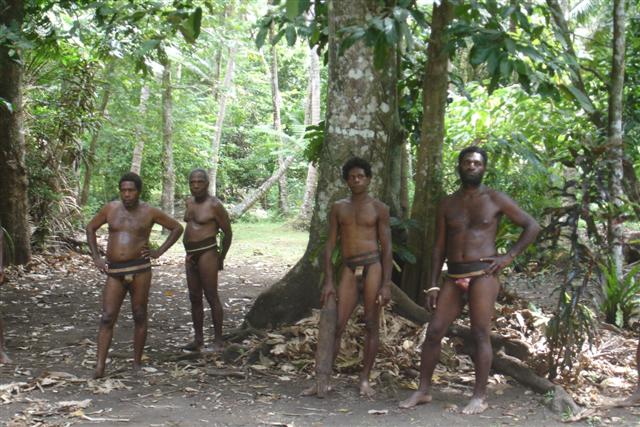
The tribesmen of Ambrym
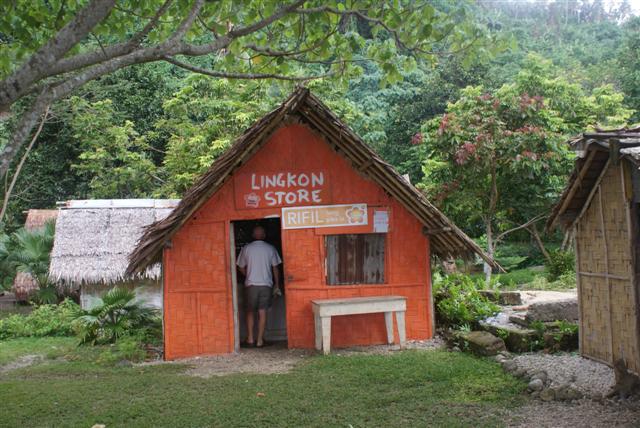
The little store in Batnavni
We sailed past to Pentecost Island stopping at the village of Batnavni. The next day we went ashore to discover a really friendly village. There was a tiny store selling a few essentials along with delicious freshly baked bread. The chief offered to show us his village, which we happily accepted.
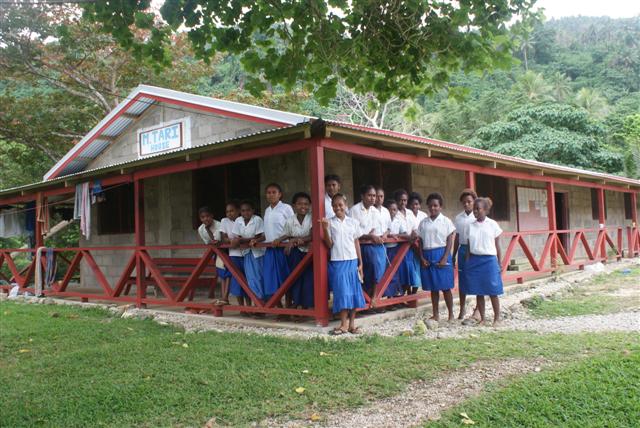
The girls outside their classroom
The village contained the senior school for the whole island. Many of the children boarded because it was too far to return home each evening. Their facilities were basic to say the least.

The bunk beds in the cramped dormitory
The bunk beds were very close together
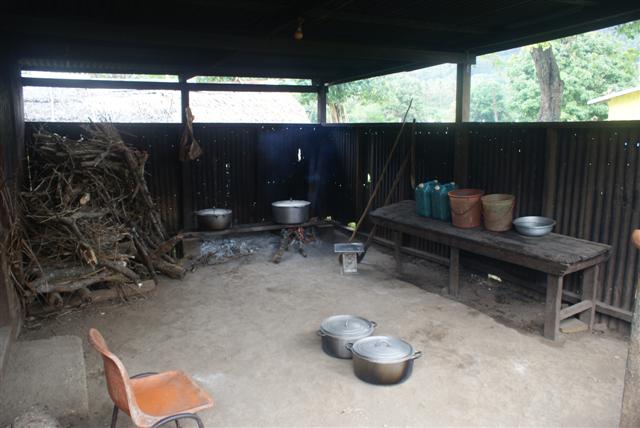
The school kitchen, the pile of wood in the corner is for the open fire
and the school kitchen consisted of an open fire with a few pots and pans containing some strange liquids bubbling away in them.
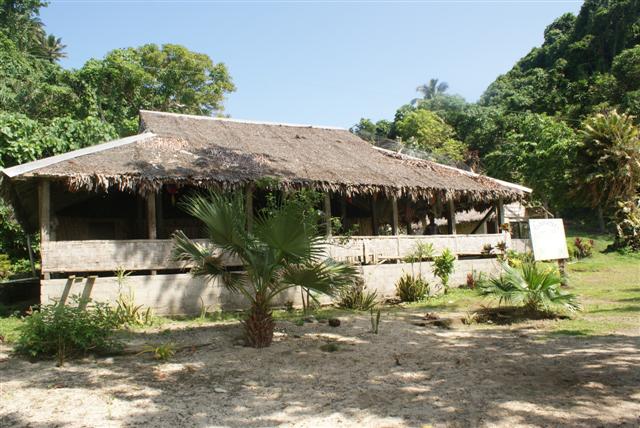
The Asenvari ‘Yacht club’
On the 10th we continued on to the southern tip of Maewo and the picturesque village of Asenvari where Chief Nelson and his tribe live. The way of life here is untouched by western influence as testified to by an out of commission hydro generating plant and a “yacht club” which was also not in operation i.e. bring your own everything and they provide a table. The Chief encourages yachts to come to his village and treats them all like VIPs. The villagers enjoy trading their fruit, veg and handicrafts for every day goods.

One of the little village houses totally made from natural materials
Nelson soon established that I knew what a generator was and suddenly a broken one appeared. After an hour or so of tweaking it was working but when I asked to test it on an appliance nothing could be found that was not already defunct, not even a light bulb. This just goes to show that if the very few modern gadgets are removed from this environment village life simply goes on as it has since time immemorial.
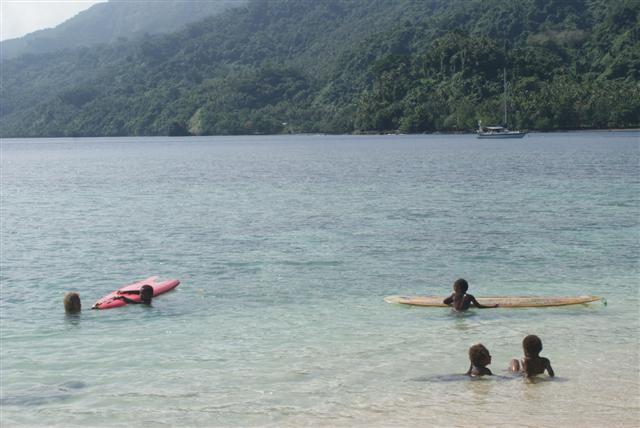
The village children playing with their salvaged broken surf boards
In the evening we enjoyed our sundowners listening to the children frolicking in the sea, naked, without a care in the world.
On the 13th we made the 16 mile passage west to another volcanic island named Ambae and anchored off the black beaches of Vanihe Bay for a couple of nights visiting the village of Lolowai.
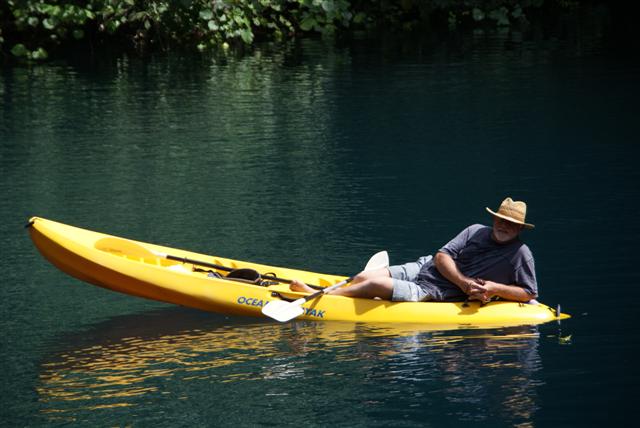
Bill in the kayak at the Blue Hole
From here and onto our favourite resort in Vanuatu, “Oyster Island” on Santo. A small but very yottie friendly place with a western style restaurant, cold beer and a lovely still “hurricane hole” anchorage. The little over water bungalows were charming, the surrounding coral is colourful and there are a number of WW2 aircraft wrecks that are interesting to snorkel. A kayak trip up the nearby river to swim in a “blue hole”, the deep limestone sink that feeds the river with fresh clean water, is a great way to spend an afternoon.

Sue on the internet at Oyster Island
The resort was the first and only place we found a limited wifi signal north of Port Vila, and Sue was amazed by the loos!
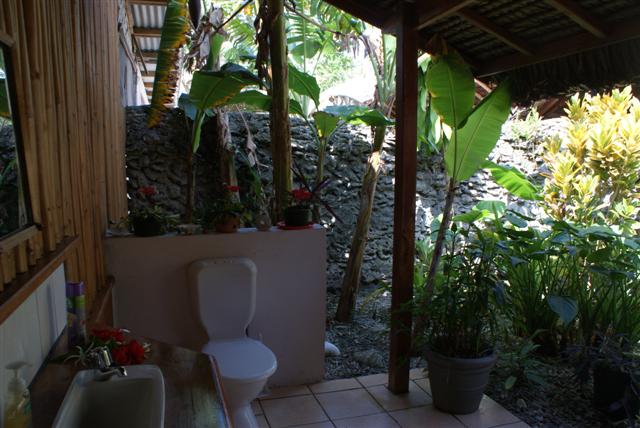
The bathroom enclosed within it’s own garden
This anchorage is about
20km from Luganville, the regional capital where we had to check in before moving north, do some shopping and sniff out some nice coffee (Sue has a talent for this type of detection). We decided that, instead of using an expensive resort taxi we would walk to the main road and thumb a lift. Most of the road traffic will stop for a hitchhiker as it is understood that you will pay 200 vatu each (about £1.50) the equivalent of the bus fare (if you can find a bus). Riding in the back of the ubiquitous pick up truck worked really well on the first day when we made the return journey in a Taxi loaded up with shopping. The second day a Toyota crew cab pick-up pulled over with four burley men in it. Sue took one look in the back and blanched. There was a very large and very dead cow in it with its severed head and guts all over the place. Apparently it was on the way to be butchered. Those of you who know her will also know that Sue is infrequently lost for words however this was one of those rare moments. The driver, perceiving the imminent loss of a fare however, promptly turfed two of the lads out of the cab and we were saved. I have rarely regretted more the absence of a camera in my hand to capture a tableau such as this.
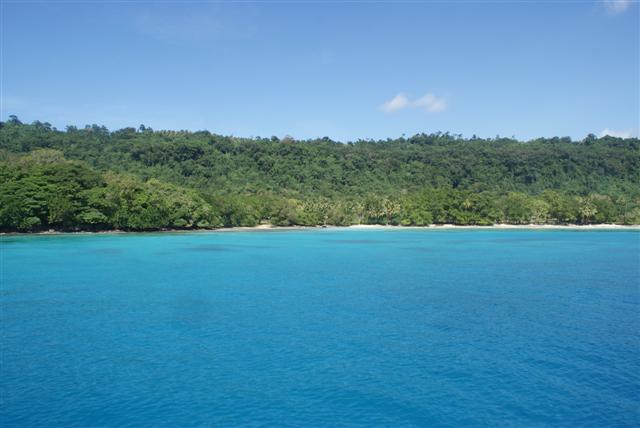
Champagne beach
Leaving the luxury of a resort island behind us on the 21st we headed 25 miles north to Hog Harbour and a visit to Champagne Beach, so named because the white sand is so fine that it bubbles each time a wave washes its way up the beach. A further 8 miles to the North we dropped our hook for the night in the shelter of Port Olry where we shared the anchorage with Quicksilver a yacht from Poole in Dorset and had a nice time nattering and drinking tea with Mike and Hilda, the last English boat we would see before Australia.
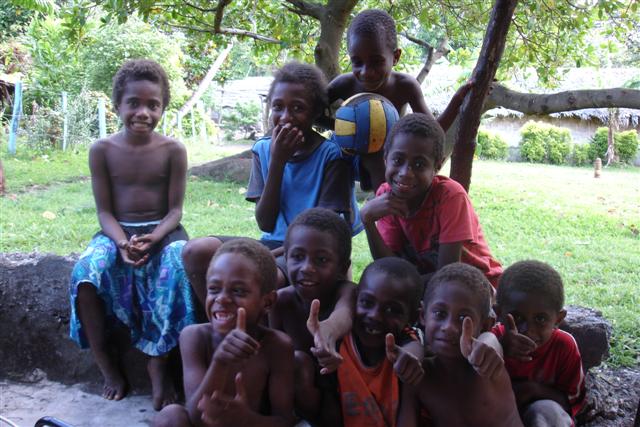
Faces of Vanuatu
Next a 45 mile passage to the first of the Banks archipelago and the island of Santa Maria where we tucked ourselves into the west side of the island away from the increasing south east trade winds and chattered to the locals who were preparing for a festival in a few days time.
Sadly we did not have time to stay with them because we needed to make our way to Port Paterson on Vanua Lava to check out before our 28 day visa expired. While in Port Paterson we came across the wood built square rigged ship the Soren Larsen which was used in the filming of the Onedin line in the 70s. We had been invited aboard her for a tour the year before when we were anchored near her in Port Vila, then she was in Opua and now again here.
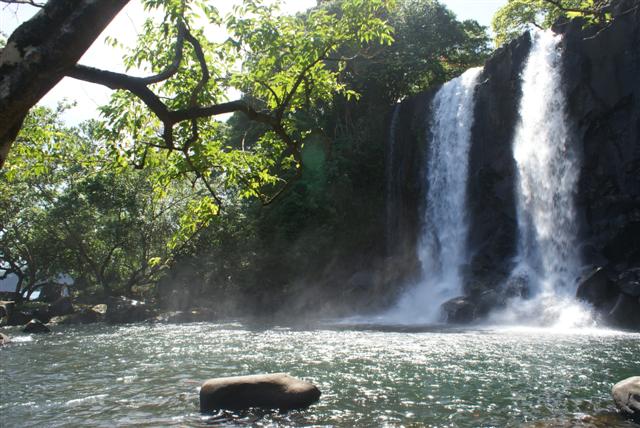
The beautiful waterfall in Double Waterfall bay
The following day we moved to the shelter of the west side of the island to Double Waterfall Bay and the village of Chief Kerely, an urbane, educated and intelligent man. He greeted us warmly and explained that we were free to anchor, swim, snorkel and generally were to make ourselves at home. If we were bothered by too many visitors in canoes then just ask them to come another time and that he preferred that any spare goods we had were traded for something useful to us rather than just given away. We felt well at ease anchored in the bay with the distant roar of the twin waterfalls in the background.
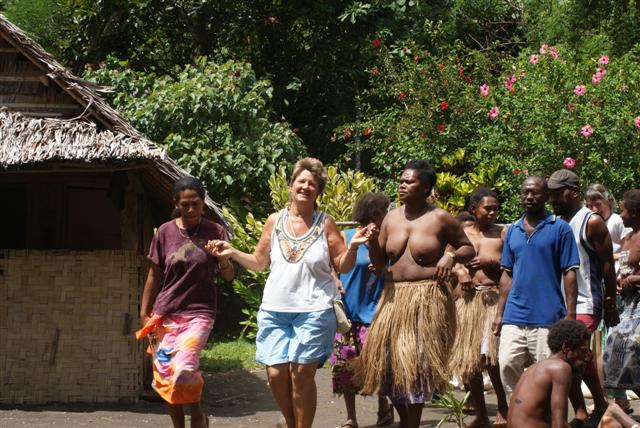
Sue joining in the custom dancing
Later that evening who should arrive at the anchorage but the Soren Larsen. The next day the village set about organising custom dancing, water music and all the other things that were normally done for them. This led to a great day’s entertainment ashore with the passengers and was really capped off when we were invited aboard the square-rigger for a pasta supper.
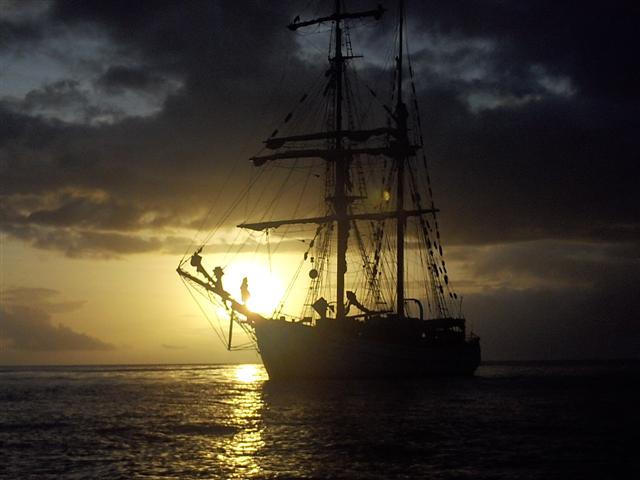
The Soren Larsen at anchor in the sun set
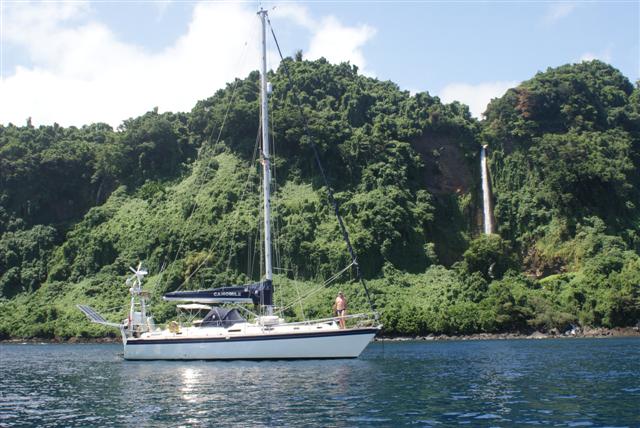
Camomile by the waterfall
By about this time our laundry bags were bulging so we needed to find plentiful fresh water to have a washing day. We moved to Single Waterfall Bay an uninhabited bay just a few miles up the coast and took our washing, our shampoo our shower gel and a picnic lunch to the base of the waterfall and spent the afternoon getting clean. Best washday ever!
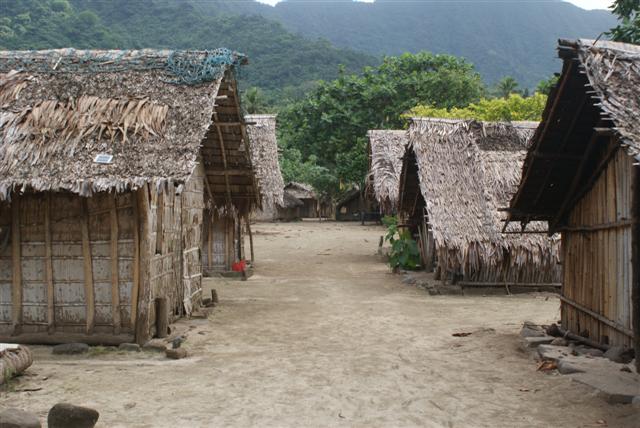
The main highway on Uraparapara
20 miles north Ureparapara was the last of the Banks islands we visited and is an extinct volcano with a flooded caldera forming it’s anchorage. It is a special thing to drop the hook knowing that at one time this bay was a vast version of Tanna’s inferno.
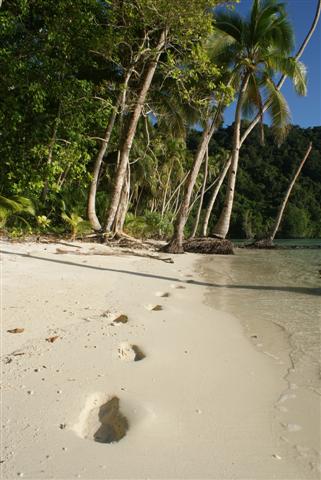
Just one set of footsteps in the sand
The Torres islands are the most northerly islands of Vanuatu and about 50 miles down wind of Ureparapara. We headed to Hayter Bay on Tegua. A quintessential tropical beach, palm fringed, white sand, jungle backdrop and multicoloured coral reefs under the softly lapping crystal clear water. Best of all, uninhabited so we had it all to ourselves until the following morning when our friends on the Soren Larsen hoved into the bay and dropped their anchor.
That evening, the 30th, we left Hayter bay and Vanuatu to head ever further north to the Solomon islands.

Beautiful Hayter bay
July update with James on board – part 2 Vanuatu
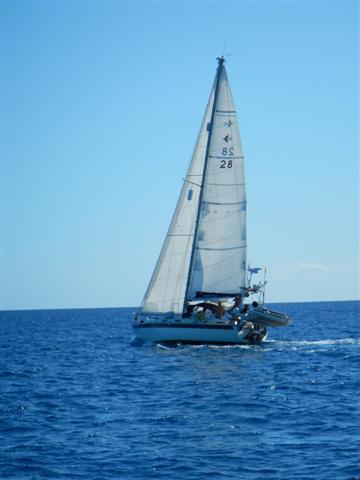
Camomile sailing to Vanuatu
The passage from Fiji to Vanuatu took 3 1/2 days, it was James’s first blue water ocean passage. We motored out of the reef with Norman and Sara on Norsa and Geoff on Seafauke who took some great pictures of Camomile with her sails flying. I ran a net in the evening and had about half a dozen boats to call and take their positions and weather reports.
 We had a good wind but unfortunately the sea was a bit lumpy and James took to his bunk. By the third day he was getting really bored but fortunately he managed to catch a yellow fin tuna, he managed to catch a second one but it got away. On the forth day James spotted land first and by 3pm we had motored around the south side of the reef and anchored in Anatom, James jumped straight in the water for a swim.

James trying out an outrigger canoe
Anatom is the most southerly island of the Vanuatu group and has for a long time been overlooked by many yachts because it lacked any check-in authorities and the sail back from further up the chain against the prevailing South Easterly would be a hard flog at the best of times. This has now changed so we waited quietly at anchor in the protected lagoon behind Mystery Island and recovered from the passage until the following morning when the local policeman came to process us. We had several local people approach the boat in dug out canoes offering fruit and veggies and James couldn’t resist having a try out in one of the outrigger canoes. It was more stable than he was expecting.

Presentation of the leis
There were enough yachts in the anchorage for the local tribe to roll out their recently conceived welcome evening, which started with a presentation of leis, a welcome song, and displays of traditional skills like making fire with a stick and tinder.
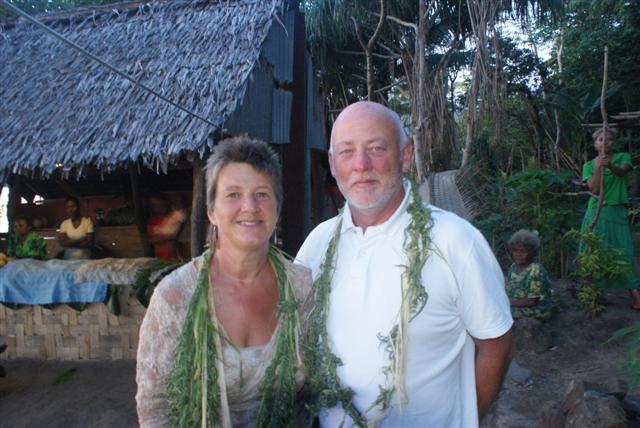
Tribal evening in Anatom

James joining in with the traditional dancing
This was followed by traditional dancing, after which we were encouraged to join in, and a banquet of locally prepared food. This was their first and so we were the guinea pigs but it was an honest and enjoyable evening that was a great success.

We couldn’t resist getting in the cooking pot
Mystery Island turned out to be a contrivance for the occasional cruise liner but despite this there was good snorkelling to be had and a pleasant walk around the perimeter of this small sand cay with an airstrip down it’s middle. We found this set up in the middle of the ‘market’ square.
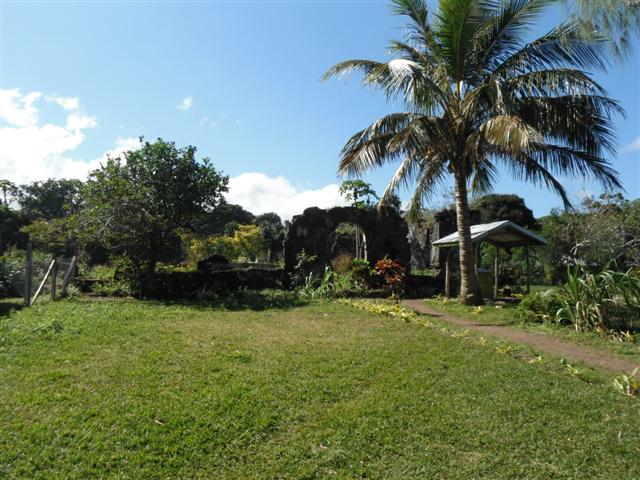
Monument to the missionaries
Meanwhile, on the mainland, the village featured a church ruined by an earthquake while, in front of it stood a “reconciliation” monument to missionaries killed shortly after their first arrival in these islands. And, yes, without cast down eyes, shuffling feet or mumbling we were told, “they were eaten”. Interesting if slightly worrying for the casual visitor that there are those in the community who can recount this heritage entirely without trepidation.

Our first view of the volcano at Tanna
After a long day sail we arrived at the island of Tanna and it’s active volcano, which was the highlight of this leg both for Bill and for James who is interested in geology as part of his Open University work.
The anchorage at Port Resolution was thought by Captain Cook to have promise as a harbour because when he named it, less than 200 years ago it was deep. We anchored in good holding in about 7 meters, which due to the land being pushed upwards, is a lot less than the captain found on his lead line. As we approached we observed seawater steaming in some areas and could hear the roar of regular eruptions. Tanna was talking to us at level 3 of 5 where a 5 means evacuate or get hurt.
The trip to the crater is a 40 minute 4×4 pickup ride along tracks which look like something from the set of an extreme off-roader commercial. The ladies swiftly ensconced themselves in the cab, leaving the four men in the back where low hanging boughs swept just inches above our heads, the torrential rain, full of black grit, permeated every crevice of our clothing, and the ride bucked and rolled in a spirited attempt to liberate itself of the human cargo hanging on to it for grim death.

Think safety
At last, and quite suddenly, the rain stopped, the jungle gave way to a vast black ash plain and the driver pulled over and parked. I don’t really know what I expected, barriers, informative multiple signage, a briefing on how to avoid getting hit on the head by descending molten magma perhaps. None of the above were present, just a solitary sign proclaiming “Think Safety”.
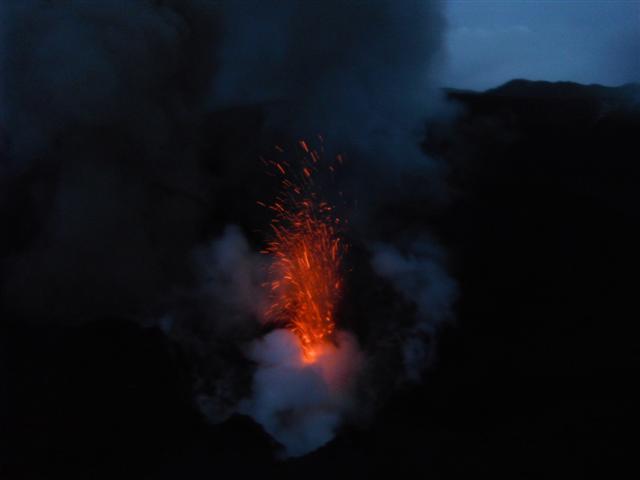
Tanna volcano
The driver told us to walk up the slope to the crater and then turn right but to avoid the choking fumes we turned left and went higher and higher to the accompaniment of nerve grinding booms which we could now feel through our feet.

Tanna volcano
Awesome is a word that has been hijacked by generations of comic books finally becoming an adjective applied to the latest and perfectly banal mobile phone or a new ipod case. These things are not awesome but looking straight down into a crater watching lumps of magma half the size of a car being hurled hundreds of feet into the air certainly is awesome.

Tanna volcano
James was suddenly 5 years old again. Shrieking and yelling he took off at a run, hundreds of feet right up to the highest point of the crater. Sue and I, clinging to each other for moral support with me pretending not to be scared witless, made our way up about half way before we realised that the splodge shaped rocks strewn around the gravelly ash slope we were picking our way through could only have been created in one way. We stood our ground however and, as darkness gradually shrouded us, the explosive emissions of glowing molten rock gave us the show of our lives.
We returned to Camomile in darkness and shed our wet and gritty clothing hoping that the heavy rain would get the black ash out of it. Wrong, the following morning our decks were covered in this abrasive grit, which had got everywhere. We spent 3 hours sluicing the boat down in attempt to get it away from winches and cars. Even the nearly new stainless rigging was showing orange streaks in the acid rain and I could swear that the Treadmaster deck looked even more threadbare than before.
It was definitely time to leave though sadly we had to part company with our good friends Norman and Sara as they made their way back to Oz and a flight home to the UK.
Our next and even more poignant goodbye was to James who picked up a flight from Port Vila three days after we checked in at the capital. He had recharged his batteries, eaten lots and was set for some skydiving in Fiji as he passed through there on his way back to the UK.
July update with James on board – part 1 Fiji

James behind the wheel

Boys and engines
We turned up at the hot and humid arrival hall of Fiji’s Nadi International Airport with at least 2 hours to spare but we were both so excited about the arrival of James that we were far too keyed up to sit around Port Denerau where the boat was moored. This would be the first time I had seen my son in 3 years and though Sue had seen him just last year on a brief visit home this was the first time he had been on the boat since well before we left. We also knew that he needed the well-earned 6 week break he was taking from his busy life. We took a pause to purge the jet lag and reacquaint ourselves with each other. Both of us being engineers, work on the diesel’s cooling system for which James had brought some much needed new parts with him from the UK and then we were off.

Enjoying a meal together
We started with an overnight stop in Vuda point to take James to the First Landing resort and our favourite place to eat. Our waiter friend Norman (name) found us a good table and served us with the usual delicious fare we had enjoyed before. James agreed the food was wonderful.
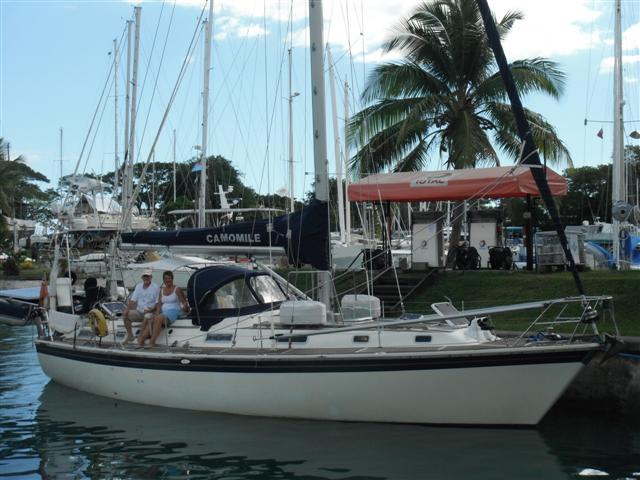
Camomile at Vuda point marina
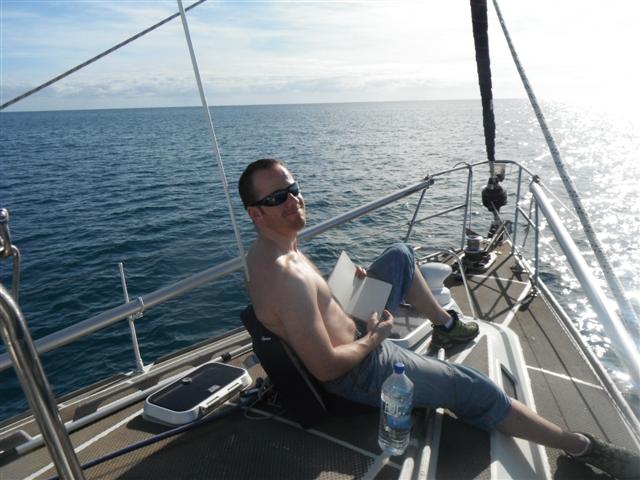
James relaxing on deck
We had visited this western side of Fiji and the Yasawa group of islands twice before and were dying to take James to see all the best bits. Having rendezvoused with Norman and Sara on their Malo 36, just before sunrise we gently motored out of a quiet bay near to Lautoka and made the day passage northwards skirting Bligh Water. This stretch of water was named after the infamous captain who, in his open boat, was chased through here by war canoes, into the Tamasua Passage.

James playing football with the village children
After a long day sail we arrived at our first village anchorage at Nabukaru sheltering from the trade winds behind Sawa I Lau island. Anchoring up over night we went ashore the following morning with the traditional offering of Kava root (a pepper with a mild euphoric effect when ground and mixed with water) for the village chief. This gesture is always well received as it marks a sign of respect by the visitor for their culture and, though the days are long gone where protection is needed, grants you their blessing to freely visit their homes and territory.
The lifestyle here is basic and though the houses are often block work with corrugated iron roofing some traditional huts, made with local materials from the surrounding jungle can still be found among the overcrowded living conditions of the newer buildings. Fijians have the readiest smiles of all the peoples we have met yet on our travels. They are fun and love you to join in. James had a blast playing football with kids on the beach and touch rugby with the men, who were keen followers of the World Cup via radio, on their improvised pitch at the school.

Inside the cave
A visit to swim one of the nearby limestone caves ducking under a flooded passage to emerge in a creepy chamber with a vertical shaft letting in just a dim vestige of sunlight to penetrate the gloom was a first for Sue. Underwater caves and spiders, well done her!
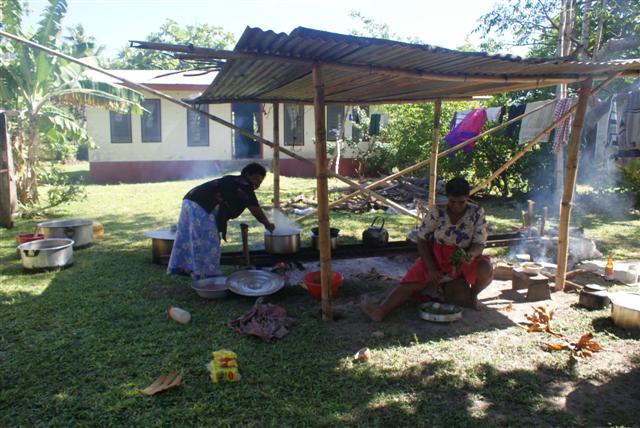
The village women cooking the dinner
Sailing south now and starting mid morning ensured that the sun was high and behind us so that we could navigate the reefs by eyeball. The charting for the outlying islands is crude, inaccurate and incomplete so this is the only reliable method to use although I have found that Google Earth with its detailed photographic images, which clearly show the reefs, is incredibly precise if you can arrange to download the area you are in.
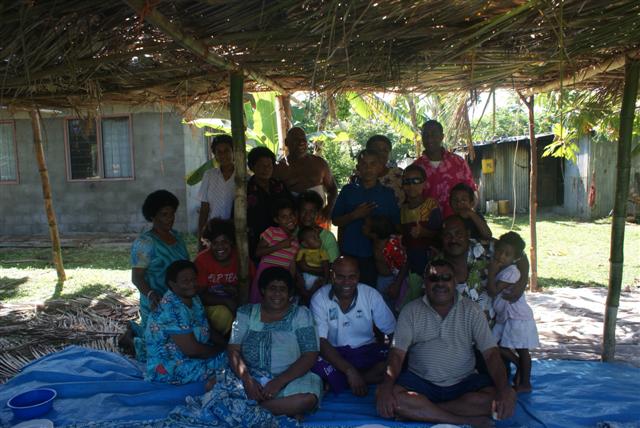
Sani and her family
After the 11 mile hop we anchored up in Blue Lagoon named after the original movie of the same name that was filmed here. We had come to pay a visit to Sani and her lovely family who had been so kind to us on our last visit almost 2 years ago. We all received a warm welcome though sadly Ratu Saleem, the old chief who had so impressed us before with his worldly wisdom and intellect, had passed away.

We joined the villagers for Sunday lunch
We stayed for Sunday and went to church which is an uplifting experience by the sublime and enthusiastic harmony of the congregation’s singing. Sunday lunch was prepared and eaten in the open air together with the whole of Sani’s extended family and James, who had been scuba diving off nearby reefs, turned up to regale us with tales of his latest adventure instantly disappearing under a host of small black bodies wanting to swing from his arms as he spun them in circles.
There was a sad goodbye to this kind and generous family, as this was likely the last time we would see them but time pressed on and we sailed another short hop south to anchor in Narewa Bay surrounded by miles of curving white sand beach against a backdrop of jungle and swooping mountainous ridges.

The view across Narewa Bay from the top of the hill James climbed.
The jungle and hills were too much for James and pack readied he made off with a machete to plough through the jungle and on up the steep slopes beyond while his old man looked on from the deck of the boat and wondered how many times he would run out of puff if he tried to do that. Across the narrow isthmus, in a lagoon, a WW2 plane wreck can be found in around 3-4 metres of water on a sandy bottom.
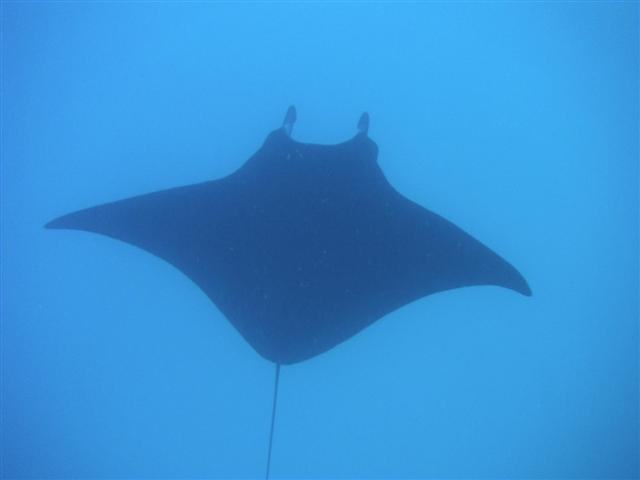
A beautiful manta ray
After we had inspected this we sailed south again to the nearby Manta Ray pass. As the name suggests the huge rays, often more than 4 meters across, are sometimes seen here. They are gentle, graceful creatures that come to feed on the small organisms carried by the currents sluicing through the pass and can be safely shadowed at a respectful distance with just a snorkel and mask. We were in luck and James was treated to the rare and exciting experience of swimming and free-diving with these amazing fish.
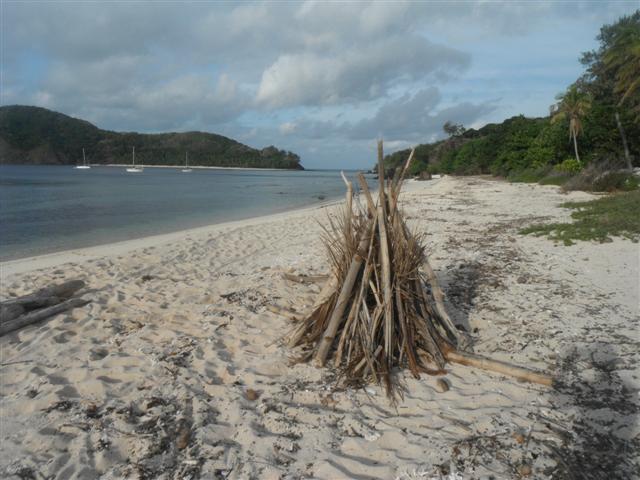
A birthday bonfire
Our next stop was south of the Yasawas in the Mamanutha group, by the island of Navandra, uninhabited except for a goat. Some of Fiji’s best coral lies beneath the stunningly clear sea in the bay and exploring the deserted beach here and on the island next door was a lovely adventure. James decided to build a big fire in honour of my birthday, which we celebrated while there, but decided not to light it. It was to be our last taste of the rustic outlying islands with our next stop being the Musket Cove resort on Malolo Leilei. With Camomile med moored stern to a modern pontoon which forms a bridge to a tiny palm covered sandy island with a bar and a range of driftwood fired BBQs we put our feet up for a few days after our recent adventures. Civilisation is welcome when it comes in this form.
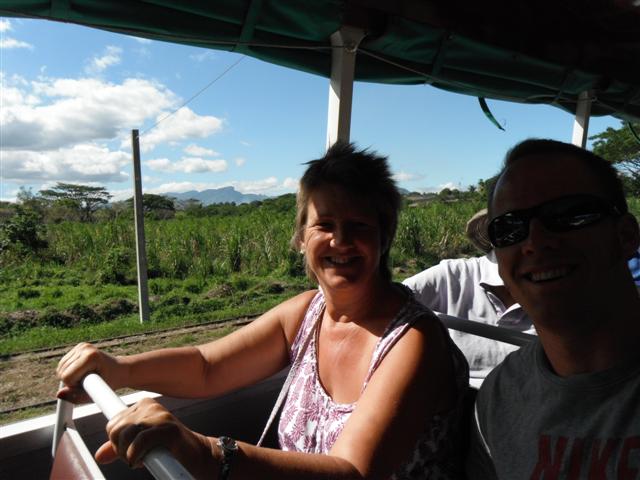
Sue and James on the local bus
We returned to Vuda point where Sue and James decided to go into town on a local bus, windows aren’t necessary.
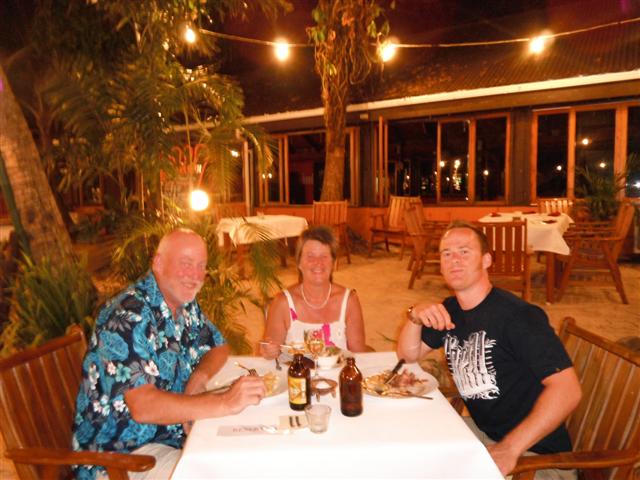
A final meal at First Landing
We had a final meal at First Landing followed by a dance show performed by some locals with a wonderful photo opportunity afterwards for James.
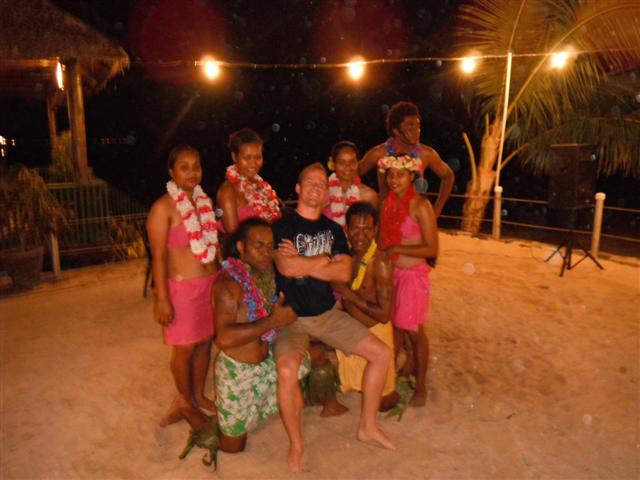
James with the dancers
Time was moving on and so should we. Sadly it was time to bid a fond farewell for probably the last time to Fiji’s shores, one of the most beautiful countries on our travels so far.

Goodbye Fiji
June Update
I haven’t had a chance to write anything on the website for ages so here is a summary of June. (This has taken 2 days on a wifi hotspot to just post!)
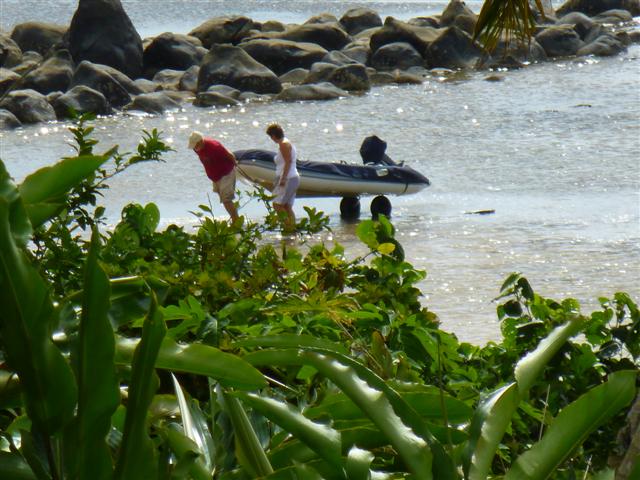
Trying to get the dinghy ashore
We left Vanua Balavu on 1st June and headed for Taveuni which is an island on the eastern side of Fiji. There were some nice restaurants where you could take the dinghy to. Unfortunately on this day it was low tide and we struggled to get it ashore.
The next day Sara and I went ashore to try and get some much needed fresh veggies. We got a few bits but also met a really nice lady who organised for someone to take us to visit the Bouma national park and waterfall, which was where the last Blue lagoon film was shot.
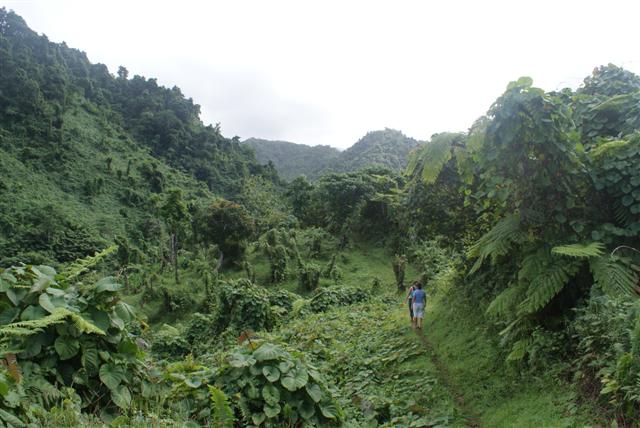
Sara and I walking along the jungle path
The next morning we went ashore to meet the car and after a 2 hour drive we arrived at the national park. We had a lovely walk to the waterfall, which took another 2 hours.

The ladies from the village doing their washing in the stream
The path took us through a village and these ladies were using the water from one of the streams to do their washing. I wished I’d brought mine so I could have joined them.
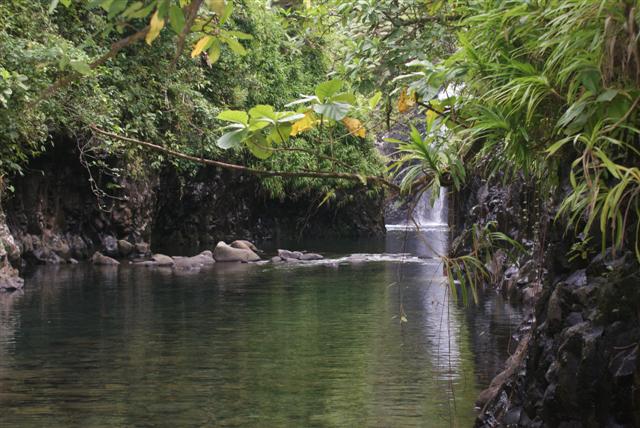
The top of the river led to the inner pool with the waterfall in it.
We reached the waterfall only to discover we had to wade and swim to the inner pool to see it, lucky we had brought our swimmers. We got in and discovered the water was really cold, although we were grateful for the cool down.

Bill jumping into a smaller waterfall
We had the pool to ourselves and Bill climbed the rocks several times to jump into this smaller waterfall. We tried to swim under the main fall but the force was too strong, it was like being hit by a hammer. We dried off and ate our picnic and walked back to the park entrance where our driver was waiting patiently in the car.

O
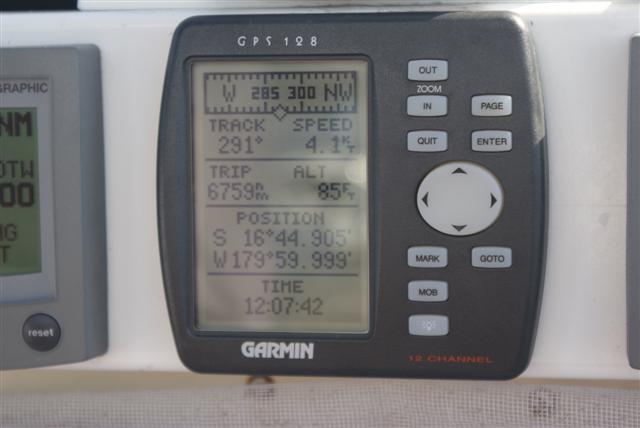
The GPS changed from west …….
On 6th June we motored south. The island of Taveuni is the only place in the world that the 180 degree meridian line crosses. It’s possible to stand with one foot either side of the ‘line’. We really wanted to go ashore and do that but the wind picked up and we couldn’t anchor.
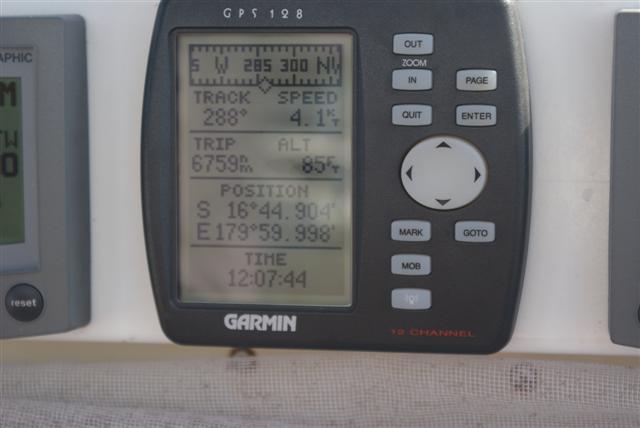
… to east
Instead we watched the GPS change from west to east. We’ve been crossing the Meridian line back and forth over the last year or two but this is the last time. As the Red sea is now a no go area the next time we see the GPS change back from east to west will probably be off the coast of South Africa.
We continued down to Viani bay on the south east corner of the Northern island of Fiji. We met up with Aurora B an English boat we met in NZ at the end of 2010. Camomile and Norsa were invited on board for drinks. The next day we snorkeled the Rainbow reef and can honestly say we have never seen such a beautiful reef with so many fish swimming around it. We drifted over the reef with the current and the scenery below us was spectacular.
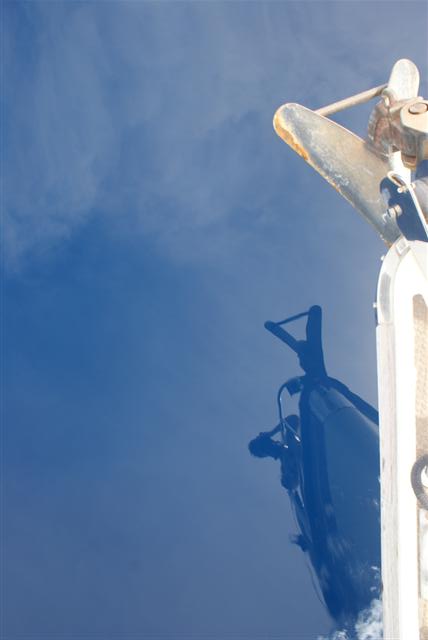
Beautiful blue water
The 8th June saw us motoring without a breathe of wind to Savu Savu. I took this unusual photo on the way. It’s me looking into the calm water over our bow. The water was like a millpond.

Camomile moored at the Copra Shed marina
We arrived in Savu Savu on the 8th June (Happy Birthday Thomas) and caught up with lots of boats we had met in NZ. We feel we have come full circle in the South Pacific because Savu Savu is where we checked into Fiji with the Blue water rally 2 years ago and having crossed the meridian line for the last time we are now on our way home.
We stayed in Savu Savu over a week with Norsa enjoying a few nice meals together and restocking the boat after our stay in the outer islands.
We left on Saturday 16th on the inner passage between the reefs south of the North island, across Bligh water, then north of the South island, with Norsa following us.
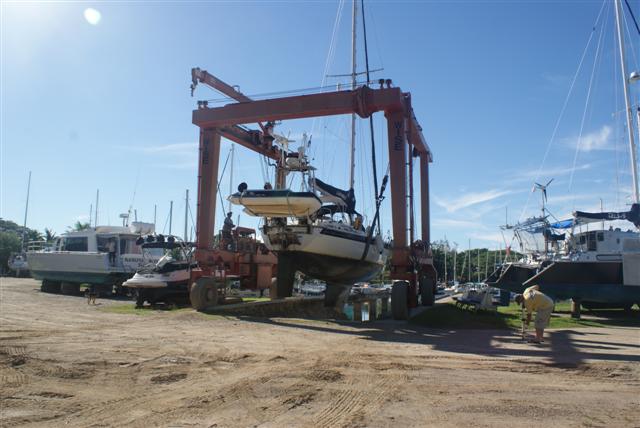
Lifting Camomile at Vuda point marina
Tuesday 19th we arrived at Vuda point marina ready to lift Camomile. Bill wanted to repair some patches on the Cuprotect and also we wanted to check the keel after hitting the reef in Kadavu. We lifted Camomile at Vuda point two years ago and found them very reliable but we were still a bit apprehensive.

The scrapped keel
The damage to the keel wasn’t that bad, just a bit of the antifoul scrapped off.

Boat maintenance in the sun
We were put next to some beautiful palm trees for a few days while Bill and Norma worked on the boat. Sara and I went into town to sort out the Australian visas and more shopping in Lautoka. Vuda Point is next to First Landing resort which has a fantastic restaurant. We had some nice meals while we were there. It was too hot to cook on board while we were on the side – that’s my excuse any way.
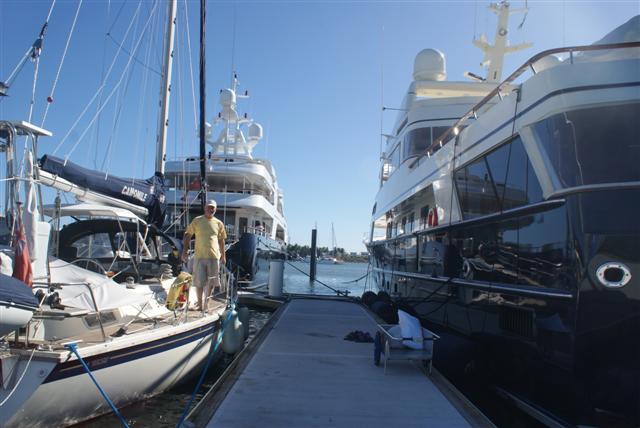
Camomile among the Superyachts
We went back into the water on 22nd and on Saturday 23rd we motored across to Port Denerau where we motored among the superyachts. Port Denerau is only a short drive to the airport where we eagarly waited for our son James to arrive on Sunday 24th.
If I can get the wifi to stay online I can post James in Figi blog.
 Camomile