Author Archives: yachtcamomile
Huahine, Raitaia & Bora Bora
I’ve written an article for the Westerly Owners Association magazine which included a report on Raitaia and Bora Bora so I’m posting it on the website for you to read. I’ll leave it at the top for a day or two before correcting the date.

Archaeological site of the royal Maeva
We sailed overnight to Huahine, the least touristy of the Society Islands, and anchored close to the village of Fare just inside the reef. Hiring a car for the day with two American friends we were able to explore the island and visit the famous archaeological site of the royal Maeva, seat of the island’s eight chieftains. The backdrop of a beautiful blue lagoon enhances this interesting collection of aligned stone slabs, paving and terraced platforms.

Bill feeding the Sacred Eels
Driving on to visit the village of Faie, home to a colony of sacred eels; an amazing sight as they wriggled out of the holes in the bank of the river for the fish food we bought to feed them. Some were more than a metre long and came right up out of the water to eat. One of our days was used to explore the reef behind us that had some beautiful coral and lots of fish.
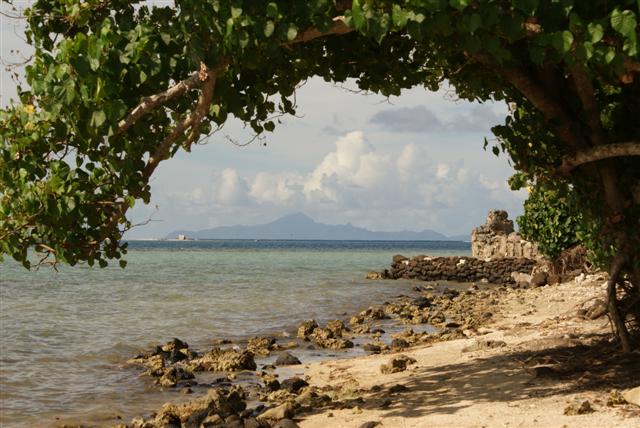
The reef off of Raiatia
The next island we sailed to was Raiatea. Mooring on the main town quay of Uturoa was easy and it turned out to be a nice town with some good shops and an excellent market. It was great to get away from the normal tourist centres to discover a more remote and enjoyable South Pacific. The pace of life was getting much slower.
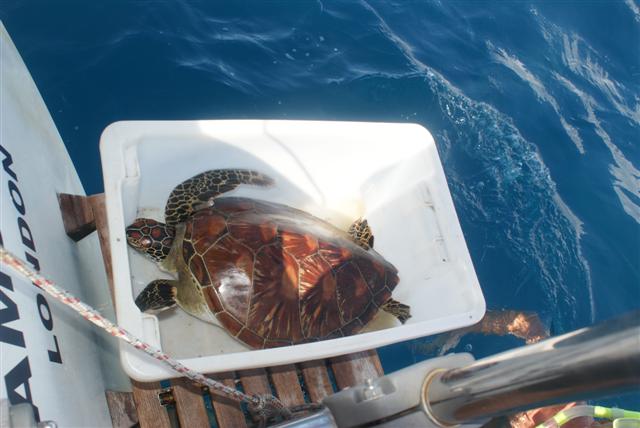
Nike the Turtle
Raiatea shares a transparent lagoon with its neighbour and sister island, Tahaa. We Motored across the lagoon and picked up a buoy outside the Turtle sanctuary. While in French Polynesia we heard that our beloved spaniel Nike had died. Our goodbyes had all been said before leaving but it was still hard to accept. We wanted to do something to commemorate him and decided to ‘buy’ a turtle. The turtles are rescued from local fishermen and nursed back to health. When they are ready to release back in the wild they are tagged and measured and ‘sold’. One was a beautiful reddish brown, the same colour as Nike, so we chose that one and called him Nike. We took him out to one of the islands that surround the lagoon to release him; it was a very emotional moment. Nike lives on.

Vanilla plantation on Tahaa
Tahaa is known as the Vanilla Island. The potent pods of this orchid species produce 80% of the famous Tahitian vanilla. Joining a tour with some other cruisers it was explained how the flowers are pollinated and the pods are selected for quality and dried. The aroma of vanilla was intoxicating. On the north west corner of the lagoon surrounding Tahaa was the most amazing snorkel site. It was very shallow so care was needed but the colours of the coral and the amount of fish life was amazing. We anchored off the site for several days watching the sun go down over Bora Bora each evening and pinching ourselves to make sure it was not just a dream, being surrounded by such beauty.
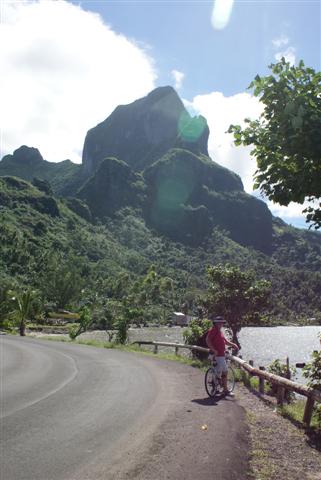
Cycling around Raiatia
Our standing rig had further problems in French Polynesia, which may have been a result of the jury rig we had to set up after our lower shroud broke on the way to the Galapagos Islands. During a routine rigging check Bill discovered a loose strand of wire close to one of the upper terminals of the lower shrouds, which meant that all three had to be replaced before we could put to sea again. They had to be sent for from Tahiti both delaying us and preventing us from continuing on with the rally for the time being. We took Camomile carefully back across the lagoon to a small marina on the other side of the island of Raiatea. While waiting for the rigging to arrive Bill unpacked our bikes for the first time since the Caribbean. We “enjoyed” several bike rides around the island one of which was 60kms long though when invited onto an Australian boat for drinks that same evening I took my soft cushion to sit on! After a week the rigging turned up but unfortunately the upper terminals were the wrong shape and Bill had to spend a further day modifying them. Finally they were fitted and Camomile was safely able to set out for Bora Bora.
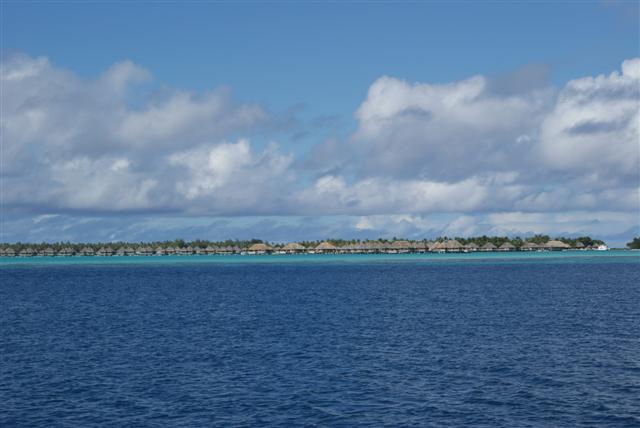
The over commercialised hotels surrounding the Bora Bora lagoon
We were disappointed with Bora Bora; it’s very commercialised and expensive. It was a day sail from Raiatea and we picked up a buoy at the Bora Bora yacht club. The lagoon is a dazzling blue with beautiful coral reefs but the surrounding ‘motus’ were all covered by hotel complexes with over water bungalows, many of which have closed down during the recession and the main town of Vaitape mostly consisted of shops selling tourist tat or they were empty.

'Bloody Mary's' on Bora Bora
We cycled around the island and enjoyed lunch at ‘Bloody Mary’s’ where the film stars eat and drink. Despite the wall being covered in photos of ‘celebrities’ eating there we didn’t see any one famous.

The bathroom at Bloody Mary's
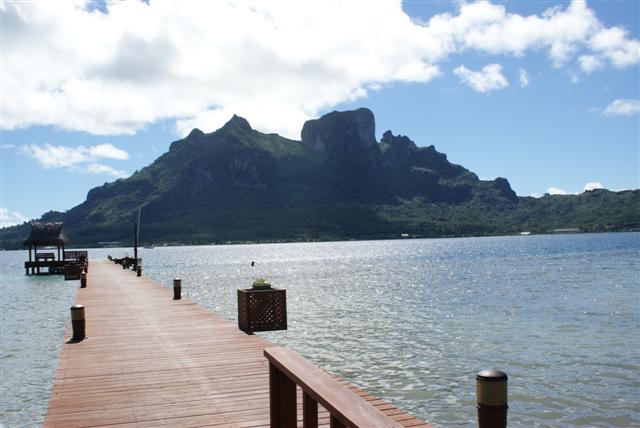
The lagoon of Bora Bora
The weather was not kind to us during our stay in Bora Bora, there were several rainy days then it closed in on us, predicting high winds and steep seas for our 2 week passage to Fiji. Although the main rally were well ahead of us now, three other rally boats who were also behind caught us up and, together with three Australian boats, we formed the ‘Tail End Charlie’s’ rally. During our 10 day stay we celebrated two birthdays and a 40th Wedding Anniversary at the yacht club within our little group. On the day of the Anniversary we had planned a barbeque at the Yacht club but rain threatened again. It was suggested that we call it off but with true British grit we continued to barbeque in the rain, I think the Aussies thought we were mad! The usual round of conversations about the weather took place every day until finally on 22nd June a window opened up and we could get away.

Coral reef off of Bora Bora
Our time in French Polynesia was really enjoyable but it was over all too quickly. The lagoons were bluer than we imagined but the weather wasn’t as good as we had hoped for. The people were very friendly and welcoming; we have a lot of good memories.
Tahiti and Moorea
This is the story of our stopover in Tahiti and Moorea, the windward isles of the Society Islands.
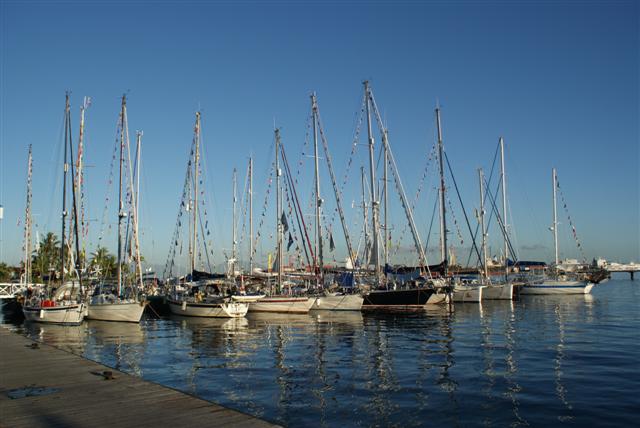
- BWR boats in Papeete harbour
17º32.4 south
149º34.2 west
Tahiti is French Polynesia’s largest island and Papeete, it’s capital, was where the BWR made its base. We were moored next to the main boulevard alongside cruise liners and inter-island ferry boats.
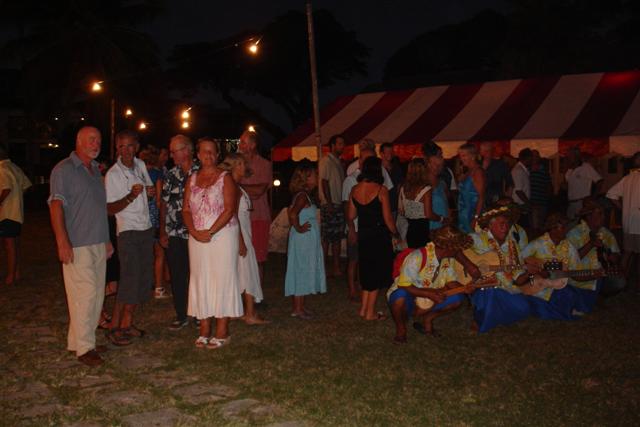
Welcome reception
We arrived in Papeete in the dark at 1am on Monday 10th May. We managed to moor up ok with the help of other rally boats. The city beyond the waterfront is a jumble of colonial buildings, churches, small stores and modern shopping complexes with a backdrop of jagged volcanic slopes soaring into the clouds. Our first job, as always, was to sort out our customs and immigration entry, which took all morning. We then went for a nice lunch followed by the usual trail around chandleries to fix anything that’s dropped off on the journey. As we were alongside a pontoon for a change it was nice to be able to get the boat sorted out.

Polynesian dancers
The following day we were entertained very well by the local tourist board with the presentation of leis in the afternoon followed by a delightful reception in the evening. We were ‘summoned’ to attend by some Polynesian musicians and everyone followed ‘Pied Piper’ style through the town to the charming French colonial style city hall for a delicious buffet. We were then treated to a wonderful display of Polynesian dancers performing some traditional dancing. Beautiful men and women performed dances that have been handed down through the generations.
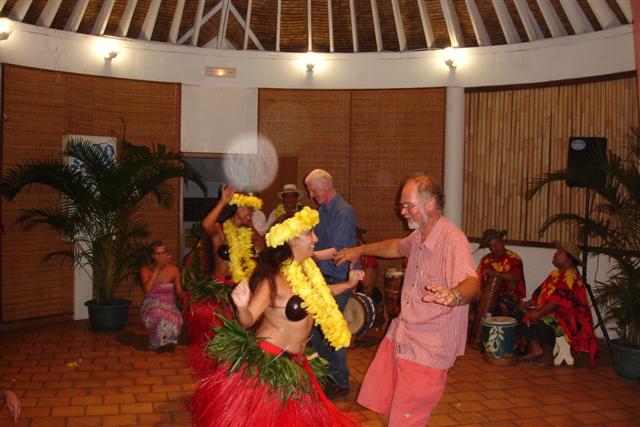
Ian enjoying the dancing
After their performance we were invited to join in. Some people really enjoyed themselves. This is our friend Ian from Lucy Alice showing off his dancing skills! The evening was rounded off with the presentation of beautiful engraved oyster shells to each of the boats.

Point Venus
The next day was spent in a coach touring the island but as it was raining most of the time we didn’t see the island at it’s best. Our first stop was at Point Venus the location where Captain Cook set up an observatory to study the transit of Venus in 1769. The lighthouse later built on the sight in 1867 marks the northern most point of the island. It overlooks a beautiful black sand beach where it is thought the first missionaries landed at the end of the 18th century but as we were admiring it the rain started coming down
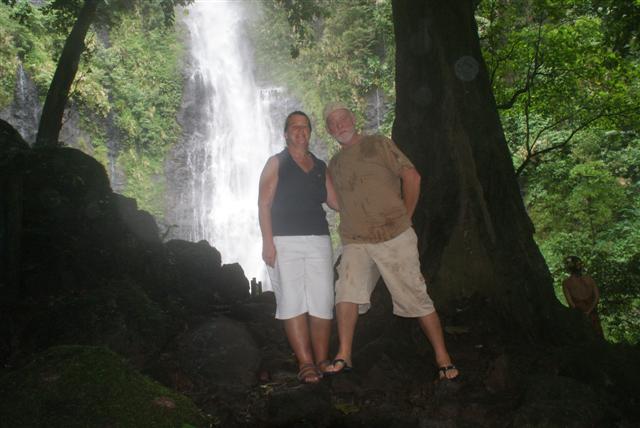
Faarumai Waterfall
We continued around the island to the Faarumai waterfall. It was only a five-minute walk from the road and a very impressive sight. The rain continued but at least liquid sunshine was warm!
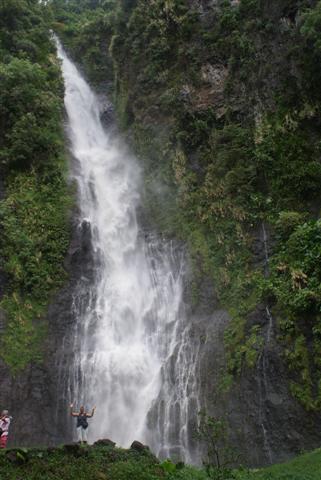
Sue at base of waterfall
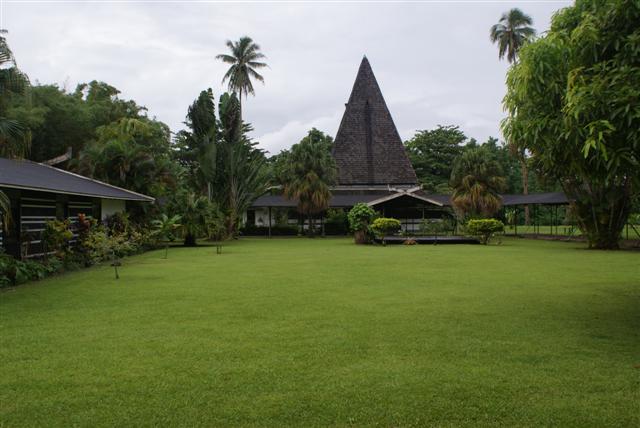
Gauguin museum
We continued around the island to the Gauguin museum restaurant on the south side for lunch and then onto the museum. It features Paul Gauguin’s original work; paintings, sculptures and engravings, as well as documents, photographs and household items belonging to the famous artist. The gardens overlook the picturesque lagoon and the smaller island of Tahiti Iti in the distance. On the return journey the coach stopped at various places but the rain really started to hammer down. Our final stop was at the Marae Arahurahu, the most significant, and beautiful, ancient stone temple of the island. Unexceptional in its day, it was one of dozens of pre-christian shines. In modern times it was chosen for reconstruction to keep the memory of old Tahiti alive. It remains a magical setting, peaceful in the shadow of the mountains but sadly unexciting in the rain.
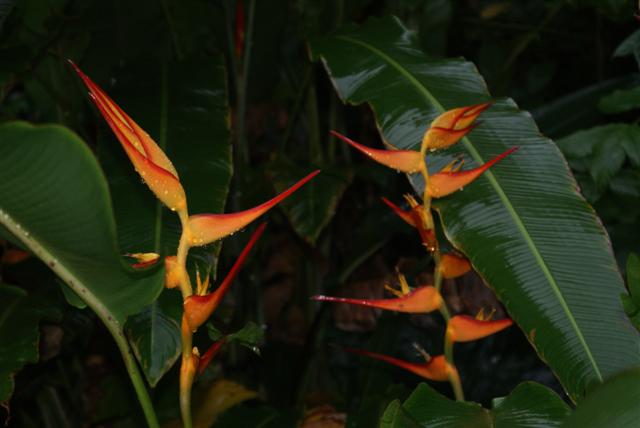
Beautiful flowersHeliconia
We spent the next couple of days continuing the usual round of washing, shopping and boat maintenance. This included a visit to the colourful market in the centre of the town; a quintessential South Seas covered market, vivid with colour and commerce. Here they sell everything from straw bags to sticky desserts, from live pigs to bananas to fresh fish from the days catch and beautiful Heliconias.
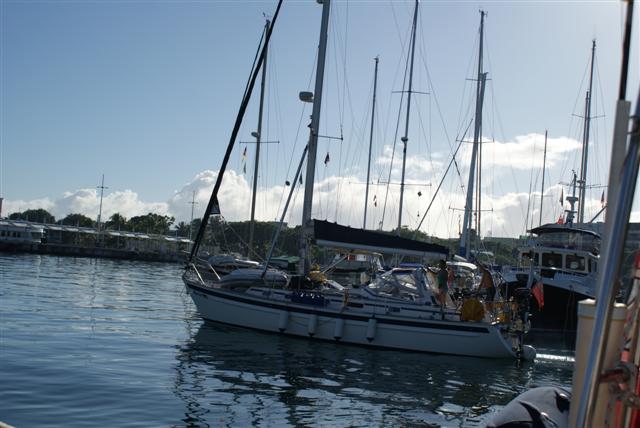
Norsa leaving
All the boats were tied to one jetty so on the last evening, which was a Friday, we had an impromptu pontoon party where we all brought a plate of food and we followed it with a heat of the Blue Water Master Millionaire challenge aka ‘Friday night is quiz night’. It was great fun, I organised the crews into teams, they had to think of an inventive name and each team was asked 10 questions. Although it was ‘just for fun’ some people took it seriously and some even dressed up, the vision of Stuart (Gaultine III) and Paul (Jackamy) dressed in sarongs and blue wigs will stay with us for a long time!! We had a really fun time and it ended with a tie between the ‘Tippyies’ and ‘Balibou’ (Bali Blue and Natibou). The following morning we all waved goodbye to Norsa as Norman and Sara were leaving the rally.

Going through the Tahiti reef
After our 5 day stay in Tahiti we checked out ready for our trip to Tahiti’s sister island of Moorea on Sunday morning. Although it’s only 12 miles from Papeete, we had a bit of a choppy crossing with some uncomfortable cross swells coming from the southeast and the north. We arrived in Cooks bay, Moorea just in time for Sunday lunchtime drinks, what perfect timing!

Mt Rotui
17º30.1 south
149º49.0 west
Cooks Bay, Moorea
Moorea is an island of volcanic origin and was populated by navigators who arrived in large double outrigger canoes from south east Asia 1000 years ago. The first Europeans arrived during the 18th century, one of whom was Captain Cook in 1777, followers by the missionaries. The French Protectorate was established in 1842. Moorea benefits from a beautiful turquoise lagoon that completely surrounds the island. Cook’s bay framed by lush green jagged mountains, which is dominated by Mt Rotui, the sacred mountain of the Ancient Polynesians, was our base for the next 5 days.
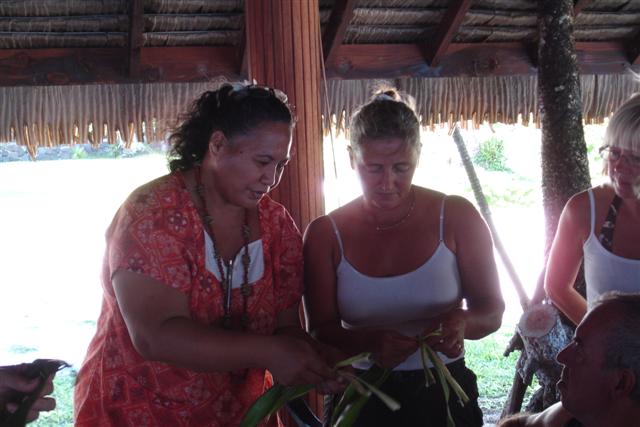
Mama teaching Susan how to make a flower crown
We anchored next to the Club Bali Hai, a lovely resort that allowed us to use their pool and facilities. The next morning the ladies were invited over to the resort for a demonstration of how to make the beautiful Polynesian flower crowns, here is ‘Mama’ showing my friend Susan how it’s done.
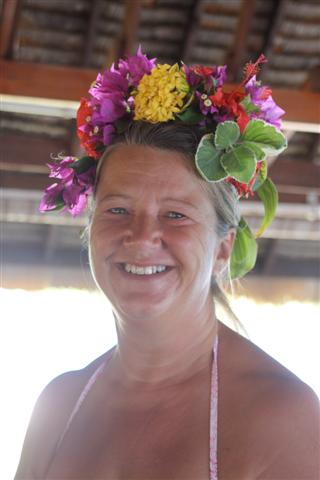
‘I made it all myself’
She also taught us how to tie a pareo properly. The pareo is the basic article of clothing for all Polynesians. It’s simply a large rectangle of printed cotton fabric. Both men and women wear it and it seems there are a thousand and one ways to tie it, even elegantly for the evening. ‘Mama’ taught us lots of different ways. It was a very interesting morning. As it was Susan’s birthday that day I made her a cake. Later Bill and I were invited on board Enchantress for a delicious meal.

The girls in their crowns and pareos, I'm 4th from the left.
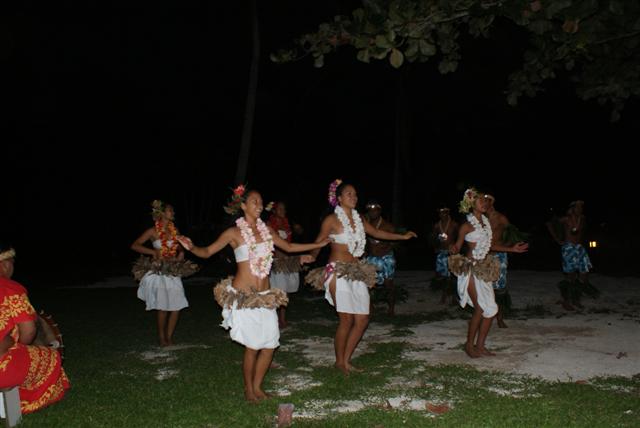
Local dancing girls
The next day we were going to hire mopeds but it was raining so we stayed on the boat and did jobs instead. The following day we had a breakfast briefing for the next leg in the morning and then in the evening the hotel organised a delicious bbq followed by a spectacular dance show. We were able to show off our pareo tying skills again. After the show we all had our photos taken with the dancers.
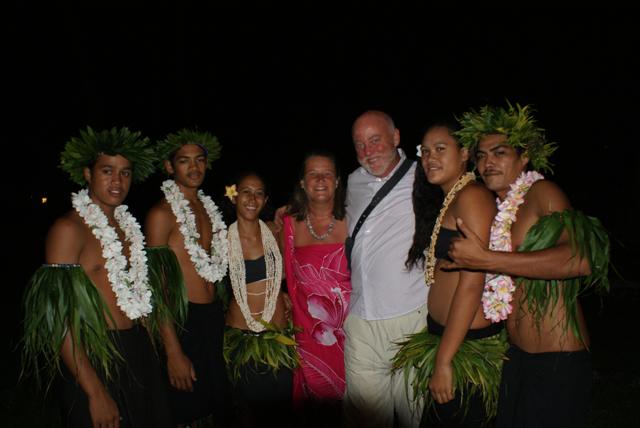
Bill and I after the show
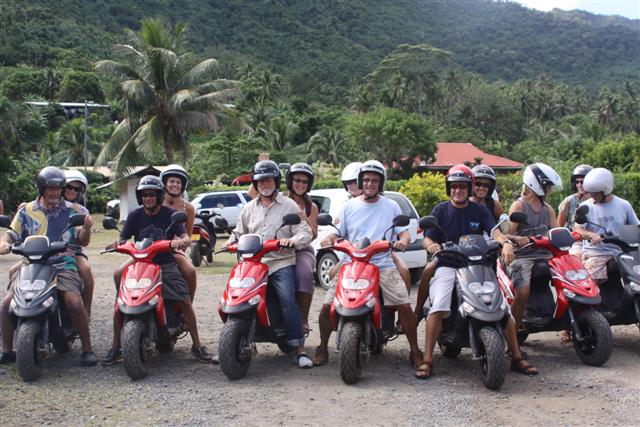
Blue Water Angels, we are 3rd from the left
On the Thursday, despite the fact that it was forecast to rain again, a group of us decided to hire mopeds for the day. Bill and I haven’t been on anything like that for about 30 years but it was good fun. It took a while to get us all kitted out but finally we were ready to go. We called ourselves the Blue Water Angels. The circular road around the outside of the island is 62km so we could easily do it in a day.
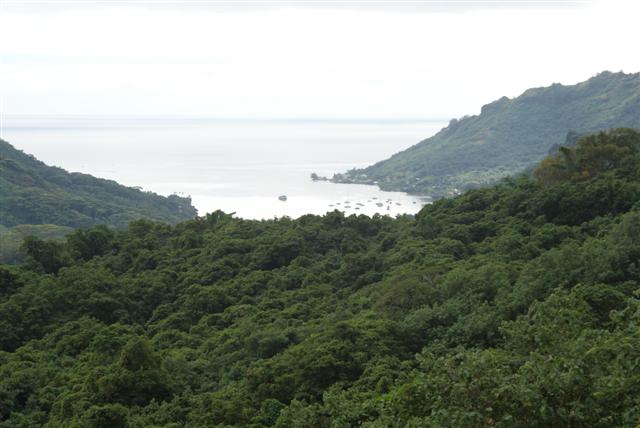
The view from the Belvadere
We set off around the edge of Cooks bay and then up to Belvedere view point which gives a spectacular panoramic view point over the two bays separated by Mt Rotui. We stopped at several archaeological sites (marae) on the way down – just as it started raining. We continued around Opunohu bay with its thatched huts extending down to and beyond the water’s edge. Most of Moorea’s 11,000 inhabitants live near the coast fishing or farming. There are no real towns only loosely knit settlements with a post office, a school, a church or two, and a general store trailing off into the next hamlet.

Learning how to dance
We continued around anti clockwise until we came to the Tiki Village Theatre on the western side. Polynesians love to dance, sing and play music but most of all enjoy performing on stage. We decided to stop for some lunch, which meant we were entitled to watch the afternoon performance. They put on a great show including more ideas for tying the pareo. Afterwards we were invited to join in, we all had a great time. We had a look around the village in the afternoon before continuing on our way. We had been told about a beautiful waterfall on the south side of the island. We found the track leading to it and the men decided to ride the mopeds up them. By this time the rain was coming down heavily and the track was very muddy. We left the bikes and walked some of the way but abandoned the idea after realising it was still a mile or two away.
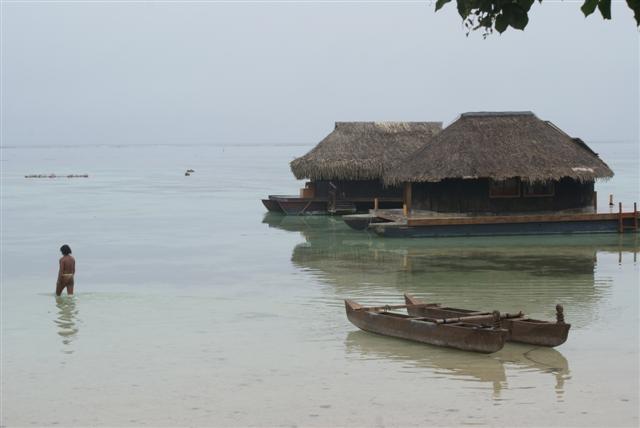
Tahitian hut
We had planned to stop at a beach for a swim but we just decided we wanted to go home because we were getting wetter and wetter. Although it was warm rain it was quite painful as it beat into our faces. We got back to the boats absolutely soaked.
We stayed one more day to join in the 60th birthday party of Peter on Peregrina and then on the Saturday we lifted the anchor and motored around to Opunohu bay, the next bay along. The water was much clearer and we enjoyed some wonderful snorkelling over the reef.
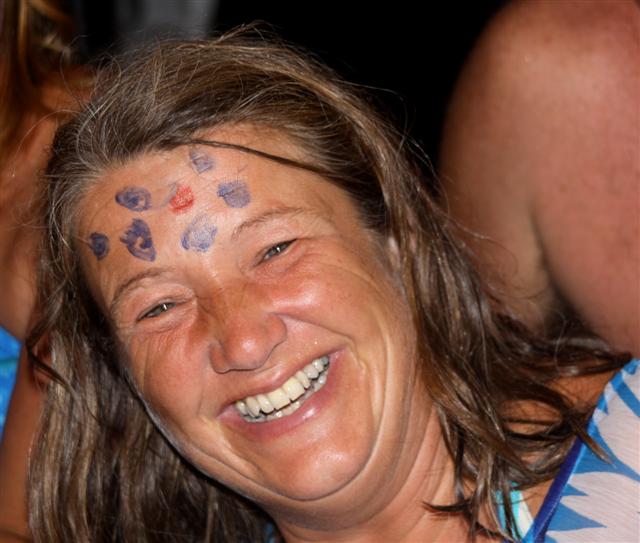
Someone had too many sherbets
After our snorkel we joined the crews of Blue Magic, Miss Tippy, Jackamy and Bali Blue on board Chsalonina with our friends David and Susan and Fai Tira’s Pete. Paul on Jackamy is a very bad influence and suggested we play a drinking game called Cardinal Puff. This entailed you individually performing a sequence of hand movements while finishing your drink but if you got the sequence wrong your glass was topped up and you had to start again. I decided it looked easy and I was going to have a go! A half hour later having consumed a whole litre of wine I gave up but not before I was completely legless!!

David's turn with the infamous Paul behind him
David decided he was going to have a go too and also failed. The dots on my face were from another game I don’t even remember playing but I obviously got it wrong!! Neither David or I could sit up and Bill had to take us back to the boats in our dinghy while towing Susan in theirs. I don’t remember a lot but There were a lot of sore heads in the morning!!
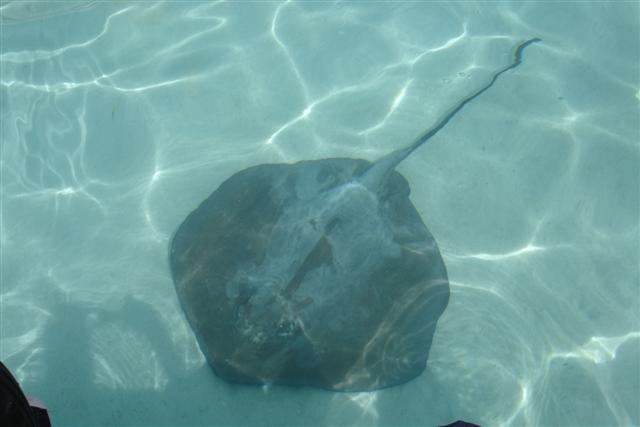
Stingrays by our feet
The next day we dinghyed over to the other side of the bay because we had been told it’s possible to swim with rays and sharks. It was an amazing sight. We got out of the dinghies and stood in the water up to our chest while several rays were swimming around our feet. There were also black tipped reef sharks too. It was possible to snorkel over a deeper area to see all the wildlife waiting to be fed. We had the place to ourselves for about an hour until the tourist boats arrived with the shark food … and the fish bait!!

Feeding the sharks
Pearl collection and birthday celebrations in the Tuamotus

With Susan and Glenda at the Pearl Lodge resort
14º27.9 south
146º02.3 west
Tuamotu islands

An atoll in paradise viewed from inside the lagoon
We’ve found paradise! The atolls of French Polynesia are beautiful. The Tuamotu archipelago consists of 76 islands and atolls spread over more than 20,000 square kms. Born from coral, emerging just enough to create the most mythical lagoons in the world. They offer a Robinson Crusoe lifestyle that dreams are made of. Manihi is an elliptic atoll containing a stunning lagoon sprinkled with pearl farms. We arrived off the entrance to the Turipaoa passé after a 3-day sail from Nuka Hiva at 10am. The tide was still ebbing quite strongly but as that slowed us down it ensured we could enter at a controllable rate without bumping into anything. Once inside the view was breath taking. The water was an amazing azure blue which matched the sky perfectly. There were already 2 BWR boats there and another 5 followed us in so it was a bit crowded.
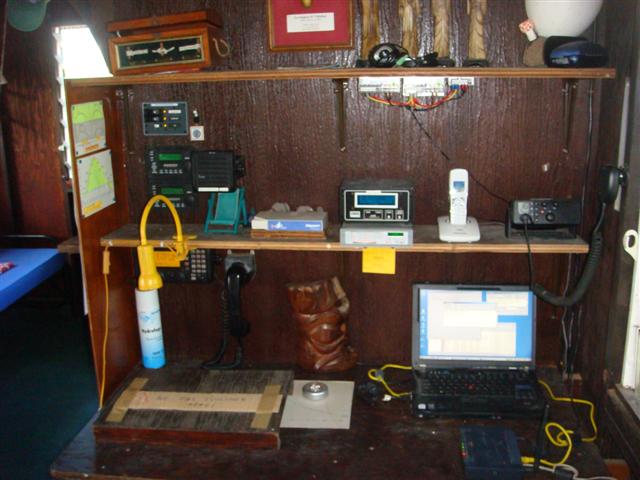
Sailmail station
Our sailmail email server is run by sailmail who have radio broadcasting stations throughout the world that enable emails to get from the internet to our boat using our SSB radio. One of those stations is based on Manihi and Xavier who runs it welcomes visitors. Ian from Lucy Alice and David from Enchantress and Bill were very keen to see it. Glenda, Susan and I wanted to see the house he’s building on one of the atolls. We jumped in the dinghies and motored for about 30 minutes to his atoll.
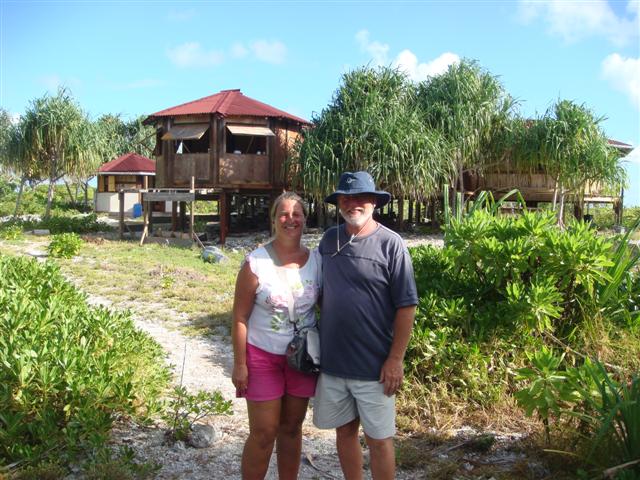
Xavier’s island paradise
Xavier and his wife bought one of the atolls (didn’t like to ask for how much) and they are building a home on it in true Robinson Crusoe style. The building behind us houses the kitchen with the bathroom off to the left. It’s built on stilts in modules; the bathroom was wonderful with its outside shower.
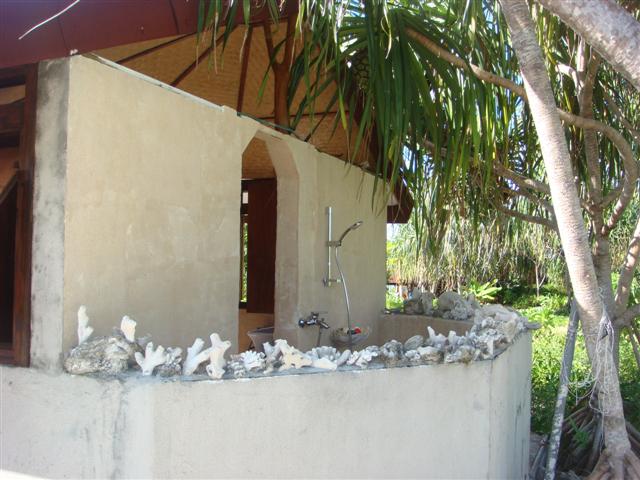
The outside shower
The island has it’s own borehole for water and is self sufficient for power. There are 3 forms of power, a wind generator, a massive bank of solar panels that tilts towards the sun as it moves and a mini water turbine powered by the water flooding over the reef. These all feed a huge bank of batteries giving him 1000’s of amp hours. The men were fascinated. Xavier was a wonderful host and gave an interesting guided tour accompanied by Fletcher Christian, his beautiful cocker spaniel. That evening all the crews joined together on the beach for a bbq followed by a Camomile quiz. The teams were English men, International men and Women. The women won.

Bill collecting my oyster shells
The next day Fernando, the local pearl farmer cum baker cum Mormon preacher cum Chinese delivery man, picked Ian, Glenda, David, Susan, Bill and me up from our boats to take us to his pearl farm in the middle of the lagoon. We were enjoying the ride in his fast boat when he suddenly stopped and tied it to a buoy. When we asked where the pearls were he pointed down below. So Bill, Susan and Glenda got in the water, Ian, David and I can’t swim under water. Bill went down first and found a string of oyster shells 4m below the surface. After several attempts he brought a string to the surface.
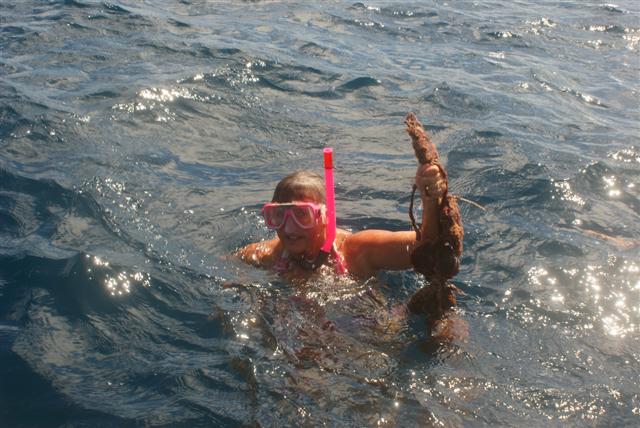
Susan collecting her pearls
Susan was next and, with Fernando’s help, also produced a string. Glenda was next and bravely tried but Fernando did it for her. Everyone got back in the boat and then we headed back to his pearl farm on stilts on the edge of the lagoon. The deal is you pay per person for the trip and keep the oysters that are produced from your shells. The next step was to cut them out. Glenda cut open 2 of hers first but sadly they were quite small.

Fernanado helping me open the oyster shell
Next it was my turn. It was very hard because the shells have been in the water for a year or more and have lots of barnacles growing on them. Fernando helped me and hey presto the most beautiful black pearl emerged followed by an equally beautiful one in my next shell. We continued in turn until Glenda, Susan and I each had 6 or 7 beautiful pearls of varying quality.

Two little beauties
Later we went back to his house where he had 1000’s more in bnoxes to purchase at cost price. I choose another 10 to go with mine in varying colours and size and I’ve sent them to Claire to make into a necklace and ear-rings.
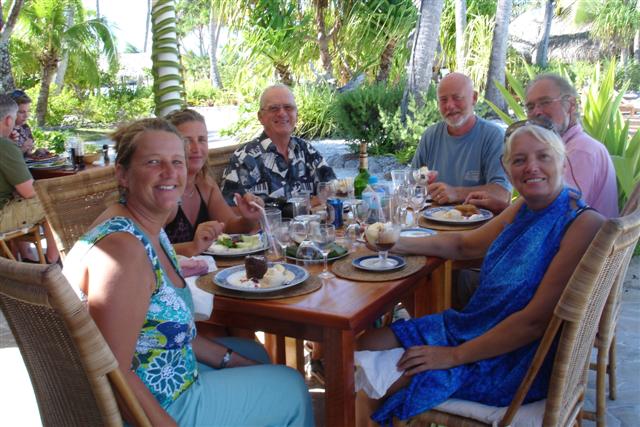
Birthday lunch with Susan, David, Bill, Ian and Glenda
The next day was my birthday and our best friends David and Susan, Ian and Glenda joined us at the Pearl Lodge resort across the lagoon for a sumptuous birthday lunch. It was wonderful and I was so lucky to spend my birthday in such a beautiful place with such good friends.
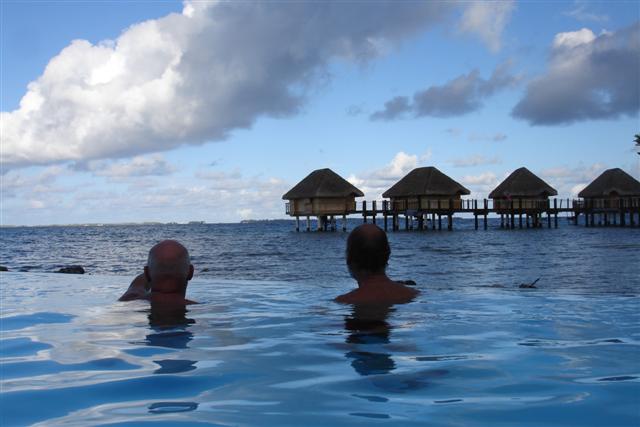
Two wise old owls
After lunch we got changed and relaxed in their infinity pool for the afternoon. We went back to the boats where we were joined by quite a few of the other crews making 13 in total, Glenda produced a lovely chocolate birthday cake, Peter from Bali Blue brought some rum, others brought more alcohol and, from what I can remember, we all had a great time … I think!

Camomile on her way to the Blue Lagoon
The next day Enchantress, Lucy Alice and Camomile motored inside the atoll to the other end, which was known as the Blue Lagoon. We had difficulty finding it expecting the water to be bluer but I think we were in the right place, the water was still very blue and it’s had some large coral heads which we all explored with our snorkels. We watched a black tipped reef shark doing a circuit and the colours of the coral create a superb underwater landscape. We had the place to ourselves and enjoyed a lovely walk along the beach and across one of the gaps to the edge of the reef on the other side. The breakers could be seen crashing onto the outer edge of the reef.
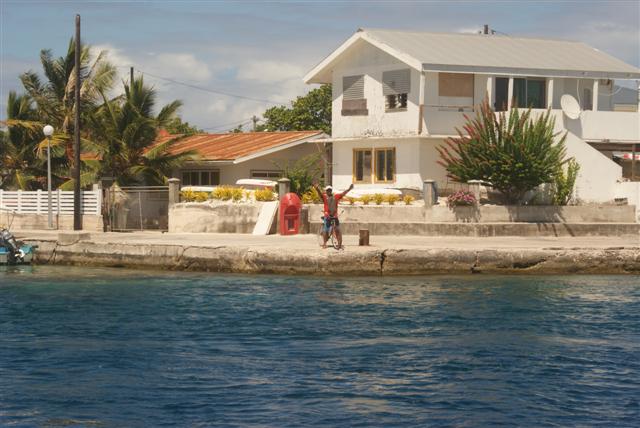
Fernando waving goodbye as we leave through the passé
We stayed for 2 days but then decided to move on to see another atoll. We left together and motor-sailed back down the lagoon to the passé. Enchantress went through first followed by Lucy Alice and then it was our turn. The ebb tide pulled us out with hundreds of fish beneath us. Fernando waved us off from the quayside as we sped by.
We put the twizzle up and enjoyed a wonderful overnight sail to Tikehau. We arrived at 4pm the next day along with the other two boats and we were joined by Norsa.

The entrance to Tikehau
Tikehau is about 15 miles across the middle. It’s full of coral heads but there’s a buoyed channel around the edge. We came in through the pass with about 2kts of tide against us. Unfortunately the wind picked up and was creating quite a swell within the atoll. We were anchored in the southwest corner and the wind was coming from the northeast so it was creating quite a fetch across the lagoon. We were next to the Pearl Beach resort with it’s over water bungalows looking across the atoll. The residents paid £100s if not £1000s for this view and we have it for free. As it was Friday and ‘Friday night is quiz night’ the others came over to Camomile for a trivial pursuit evening. We mixed up the teams but it was too clever for us and it went on long into the evening. I’m afraid to say alcohol was involved again!!!
We stayed for 2 nights but decided to leave and make our passage to Tahiti.
The Marquesas – our first French Polynesian Islands
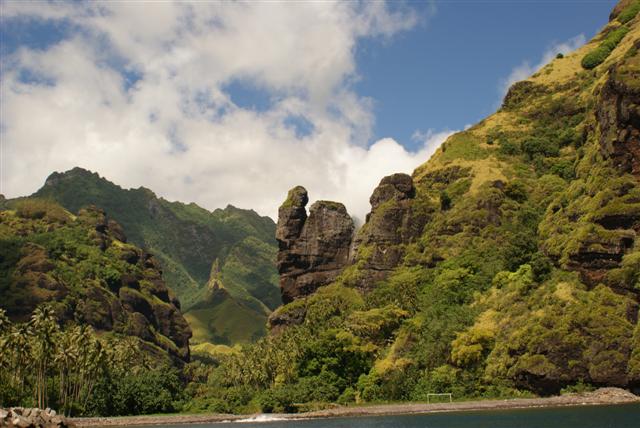
The Bay of Virgins
10°27.8 South 138°40.1 West
After our long Pacific crossing we were looking forward to starting our travels through French Polynesia.
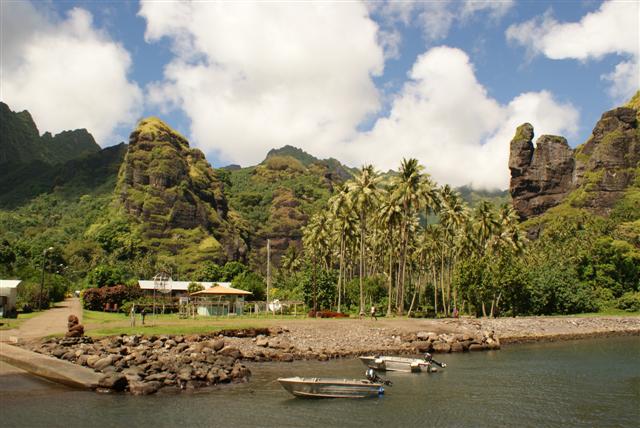
The little harbour at Fatu Hiva
So the everlasting journey was over and we made landfall at the Bay of Virgins on the island of Fatu Hiva, which has the most beautiful anchorage with superb rock formations at the entrance. Fatu Hiva is an authentic island where life is very simple. It’s the most southern, wettest, lushest and the most untouched of the Marquesas. It’s made of two volcanoes joined together with extreme geology. There are only two villages on the island and the Bay of Virgins surrounds Hanavave on the western side.
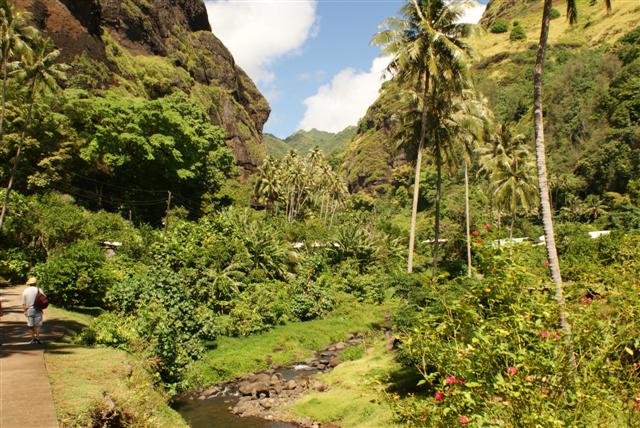
Walking to the waterfall
We spent the first afternoon on Bali Blue which started off as ‘come over and have a beer’ but quickly became the welcome boat with more BWR yachts arriving with champagne to share. It was wonderful to celebrate the achievement of crossing the great Pacific ocean. The next day we went ashore with Peter and Carol from Bali Blue and David and Susan from Enchantress to find the famous waterfall. We walked through the village with lots of smiling happy faces looking at us, shadowed by the impressive over hanging rock formations.
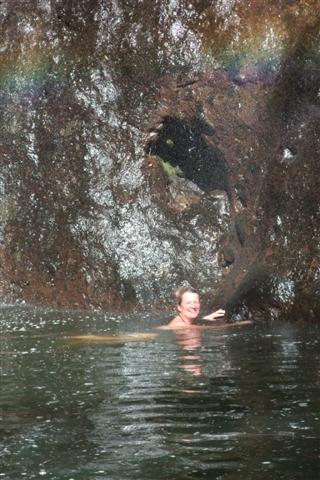
Enjoying a swim in the waterfall pool
The walk was only about 3 or 4 miles but it was through jungle terrain and the last half-mile would have been more suitable for a mountain goat, but eventually we found it and couldn’t wait to strip off our sweaty clothes (costumes underneath) and jump in the cool mountain water. We sat around on the rocks for a while to dry off and then started the trek back down the hill. We were invited to join a local family for a meal that evening along with the crews of Chsalonina, Norsa and a lovely swiss couple in the anchorage. The locals don’t deal in money but are pleased to accept ropes, fishing tackle, toiletries and alcohol, which we were happy to supply.
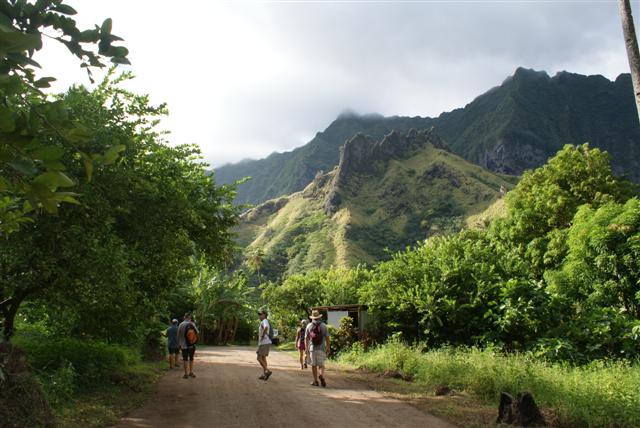
The walk back
I took some little necklaces and hair slides for the little girls in the family. They made us feel really welcome and we enjoyed fish in coconut milk, chicken, and an assortment of vegetables, some of which we had never seen.
Technically we were there illegally because there isn’t a check-in post in Fatu Hiva so the next day we left to go north to join the rest of the BWR fleet that had gone straight to Nuka Hiva. We stopped at the island of Tahuata over night on the way and got to Taiohae bay, Nuka Hiva the following evening so we were able to take part in the official welcome that was starting the next day.

Welcome dance
Fionn from BWR was there to welcome us as well as the local mayor, we were supposed to be presented with the Polynesian leis but apparently the rain had spoiled all the flowers. The mayor officially welcomed us while the locals performed a welcome dance and had laid out a fruit platter for us to enjoy.

Welcome fruit platter
Nuka Hiva is the largest of the Marquesas at 345 square kms and the most populous with over 2000 inhabitants. The Marquesans are among the most creative in the Pacific. The traditional arts of tattooing, carving and tapa cloth are all evident in Taiohae. The bay is a flooded volcanic crater with jagged walls that plunge into the ocean below. It doesn’t have a fringing reef or many beaches. The few beaches they have got are black sand and they are full of no-no flies, which leave a nasty bite so we’ll stay away from them.
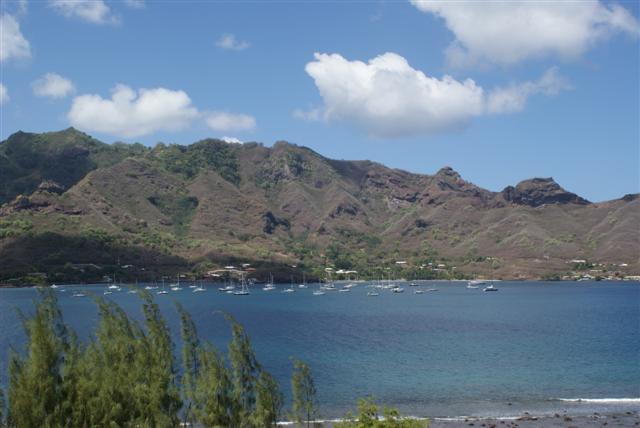
BWR yachts at anchor in Taiohae bay
We walked up to the big hotel for Sunday lunch, which was a nice treat after 3 weeks at sea. It had a veranda overlooking the bay giving stunning views of the yachts at anchor in the bay. In the evening we were invited to a ‘lovo’ supper at Rose Corser’s restaurant just below the hotel. This consists of a whole pig cooked in the ground, covered in banana leaves and hot stones. It had a strange taste but we all enjoyed it. Afterwards there was more dancing from the locals by both the men and the women and then our men were invited to join in.

The men joined in
Bill decided to have a go. I managed to get some photos in between rolling on the ground laughing; they looked more like apes than Polynesian dancers!
Monday morning Bill went to customs to check-in while I went to find a supermarket. We still had a lot of our Panama goods but it was nice to pick up some fresh fruit and veg although we found French Polynesia very expensive.

BWR boats in Daniels bay
In the afternoon we sailed to Daniels bay a couple of miles along the coast. There wasn’t much room but we all managed to squeeze in. We went ashore in the evening for a bbq and a sing-song but we all looked like german dancers as we kept lifting our feet to slap the flies off our legs. In the morning a lot of the crews went ashore to walk to a waterfall but after seeing the stunning one in Fatu Hiva we decided not to join them and Bill set about his jobs list instead. We sailed back to Taiohae bay in the afternoon.
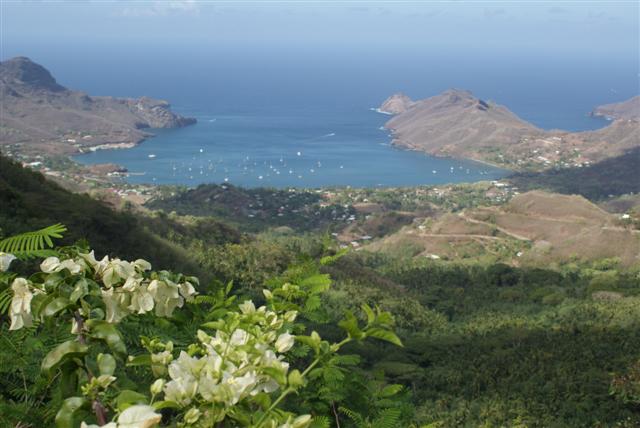
Looking south over Taiohae
The best way to see Nuka Hiva is by 4×4 vehicle so on the Wednesday the crews of Enchantress, Fai Tira and Aspen (USA) joined us as we got into 2 vehicles and set off with our guide Richard to see the sights. We started off by driving up the Muake at 864 meters high for a sweeping view across the bay. We continued on to Houmi past the vanilla plants that grow wild across the valley to stop to look at a magical church on the banks of Controller bay. We zig-zaged back up the winding road to Taipivai, whose ancient warriors were cannibals, for a magnificent view out to sea with the island of Ua Pou in the distance.
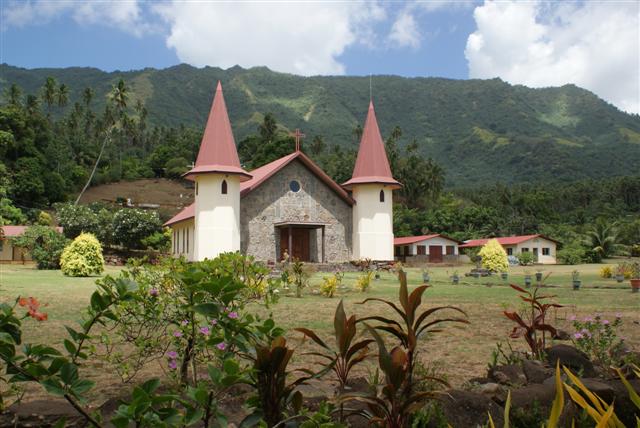
Beautiful Hatiheu church
We continued across the mountainous terrain to Hatiheu on the north coast with its black sand beach for a delicious lunch at Chez Yvonnes. The Hatiheu church stands majestically overlooking the village.
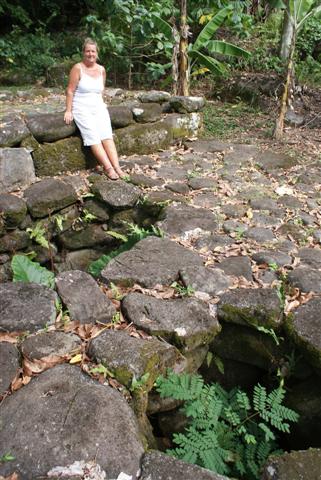
Sue by ‘bones’ hole
We drove up into the jungle to the restored archaeological site of Hikoku’a Tohua home to many ‘paepae’ or stone platforms and a huge ‘tohu’a’, an ancient gathering place decorated with many petroglyphs. The me’ae or ancient cult worship site consisted of several terraces of large blocks of stone next to a sacred Banyan tree, where in ancient times the Marquesians would have held dances and banquets. Many human sacrifices were made to the goddess Te Vana’uau’a. The victims were kept in a ‘bone’ hole until it was their turn to be consumed at the cannibal feast.
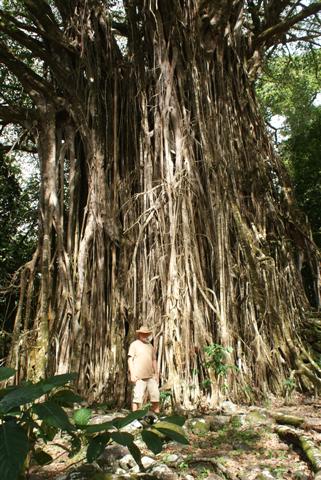
Bill by giant Banyan tree
The Banyan tree in the photo is a famous one that’s featured in many books because when it was discovered by the first missionaries it was full of skulls. We continued through the jungle to find many more me’ae sites some with ancient hiamoe or sleeping platforms watched over by sculptured stone tikis or phallic fertility statues that keep the secrets of the ancient rites once practised there. The site is among the largest and most intriguing in the Marquesas and as with all archaeology I found them fascinating. Richard was very informative but intrigued at my interest in everything. We drove back across the island to the boats.

Ua Pou from a distance
We spent the next few days sorting out the boats ready for the next leg of the journey and doing boring stuff like laundry, wifi, etc. We left early Saturday morning for Ua Pou, the third largest island in the Marquesas, which lies about 25 miles south of Nuka Hiva. The weather wasn’t very good and the anchorage looked very rolly so we decided to continue on our journey to the Tuamotus. Sadly we turned south away from the beautiful Marquesan islands, our visit had been far too short.
Pacific Crossing
Farewell Ayora
Having had a memorable stopover in Galapagos “the enchanted isles” Camomile was ready to go again, “top line” with food, water, fuel, with her rigging repairs done and maintenance complete.
The Pacific crossing to the Marquises is the longest passage in our circumnavigation route so we were suitably apprehensive as we hauled up our two bowers and a kedge. Camomile had been anchored all on her own in the harbour for several days while we had enjoyed a cruise on the local pleasure boat Daphne. Although this might sound a bit like a busman’s holiday it was really nice after all the sea miles so far to let someone else take the strain of sailing, navigating, cooking and anchoring in some really fantastic spots not to mention the air conditioned cabin, a toilet that flushed without you pumping it and as many refreshing showers as we wanted!
Just what we needed to galvanise us for the trip ahead.
While we were letting Daphne take the strain, crew members from other Blue Water Rally boats had been keeping an eye on Camomile and going aboard to run the engine for battery charging and so on but, even so, I had been taking no chances with not having enough ground tackle down if a blow came through while we were away having too much fun on someone else’s boat.
So it was that, suitably refreshed and recharged, we motored slowly out of Puerto Ayora passing the huge 3 masted schooner which had gone aground on nearby rocks during the previous week, a reminder, if one

On the rocks
were needed, that sometimes even local knowledge is not enough!
We left a couple of days ahead of the bigger faster rally boats so that we would have as much of the fleet around us for as long as possible and, as it turned out, the first days were spent motor sailing while we made our way south to pick up the southeast trade winds which were expected to blow at about 20 knots for a good deal of the voyage. Camomile has a main fuel tank of about 200 litres, a small auxiliary tank of 60 litres and for this trip 300litres in steel jerry cans below deck and plastic ones above. Although this gave us a possible 10 days of motoring with a range of up to 1200 miles and we had been briefed that we would need to burn fuel early on this passage, it was still a little worrying seeing all that diesel being consumed with so many of the 3000 sea miles still ahead of us.
Big…
When God made the Pacific he was thinking big. Really big. There is just sea and more sea, too much to capture with a puny camera. It was

Big
perhaps a little rougher than its name suggested and it was a distinctly different blue to the Caribbean though showed much less life on the surface after we left the area of converging currents around Galapagos. Having sited pods of dolphins and even a large ray jumping clear of the surface early on it then seemed to us that the dolphins, sharks, whales etc. had all said “here comes Camomile, quick hide!” On reflection though, we were not all that sorry about not seeing the whales or sharks on the basis that they can go bump in the night and/or bite you.
Once we arrived below 3 degrees south it was with some relief then that we greeted the beginnings of the trade winds at last. We gave the engine a rest, let the sounds of a downwind rig settle comfortably around us and really started sailing.
At first we went through squally weather which, after a couple of days, gave way to finer sunny days. The squalls were wet but did not have the
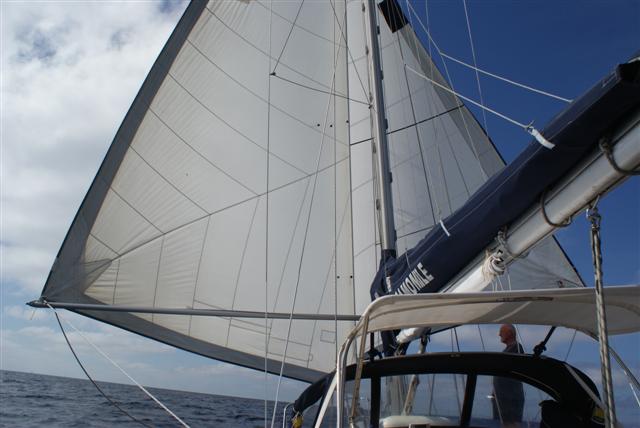
Let's twizzle again
vicious wind in them that we had experienced in the Atlantic so we found, once the twizzle rig (twin 135% heavy Dacron genoas flown from the forestay foil on poles) and the Hydrovane wind pilot were set we had very little daily sail adjustment to do. We have been really pleased with the twizzle rig and it made us smile whenever we listened in to the little group of boats in our area on the HF radio net comparing notes and hints on sail plans. They were trying this sail plan or that, flying spinnakers, rigging cruising chutes from the back of the boom, poling out this way or that and when it came our turn we had to confess; yes that we still had the twizzle up and hadn’t so much as touched the sheets for the last 24 hours!
Even so the rolling motion from a following sea was there but at least it was missing most of that sharp flicking motion of the Atlantic and we just moved on with a warm wind of between F3 and F5 over our stern day after day making slightly more northing that we needed to stay on the rhumb line. We paused the twizzle rig only twice on the voyage, broad reaching with the cruising chute to bring us back on track.
Home comforts
Life on board goes on and after 2 or 3 days we found ourselves again falling into a good routine with some of the tiredness that dogs us at the

Killer brownies
beginning of a two up passage and its 24 hour watches dropping away. We have long since learned that sleep is one of the most precious commodities on board and are careful to protect it for each other.
Sue had stocked the boat thoroughly in both Panama and Galapagos so we ate well including fresh bread, bacon & eggs, flapjacks and her killer chocolate brownies. At 10:00 and 18:00 each day there was a radio net on the SSB which, in the morning, entailed a controller of the day calling a 2 minute silence for urgent calls then taking the position of each rally boat in turn together with their local weather conditions. This usually took about 40 minutes after which the net was opened for chat and boats would call each other to natter about how things were going. One of the boats would come on the air each day and do a joke of the day, which was usually appalling but no matter.
Camomile’s aging but powerful SSB radio earned her the nickname “Radio Camomile” and her most popular broadcast was without question Sue’s “Friday Night is Quiz Night”. This was an institution she had started across the Atlantic based on a rather tacky and very British pub
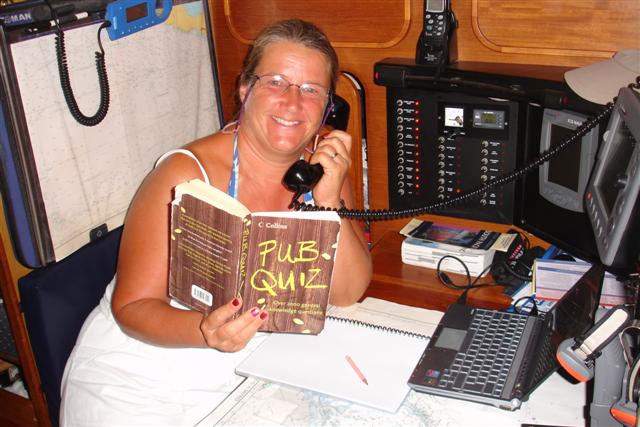
Radio Camomile's Pub Quiz
quiz book where, every Friday after the net, boat by boat, she tormented victim after willing victim with her questions. Goodness only knows what the Swedes, Spanish, Americans, Canadians et al thought when they were asked questions ranging from the likes of unknown Coronation Street scenes through to the reign of obscure British Monarchs but to their enduring credit they came back for more and often scored better than British boats who might have been expected to know some of the answers! It was great to hear friendly voices from people who we felt, by now, we knew well and this together with email via Pactor modem helped keep our morale high. We might not be able to see the rest of the fleet and we might be a long way from everything but company was there and sometimes, using the radio net position plots, we found some of it was only just over the horizon.
Where is everybody?
Having sighted no other boats nearly since we had set out, after five days the faster boats finally started coming past us, it was a brief interruption to an otherwise empty horizon and, with the exception of one container ship, was the only time we saw another boat until the fleet started to converge just before we came to the end of the passage.
Strangely, although I had kind of hoped for it, there was no cathartic

Big ocean dawn
moment for me though the place was humbling beyond words and, in those wee small hours beneath the galaxy of stars set in the blackest of skies watching the satellites spin across the firmament chased by scudding meteorites, you could feel a peace as deep and broad as the ocean.
Early on I contemplated stopping the boat and taking a swim, just as we had in one of the deepest points of the Atlantic, however, after hearing that another rally boat skipper, who had had to go over the side to clear a line from his propeller, spotted sharks nearby I decided that caution was the better part of valour and stayed dry. It seems that, as the nutrient rich waters of the Galapagos give way to open ocean, there is less food around which encourages sharks among other fish to follow yachts for the scraps that go over the side and to prey on smaller fish that rise towards the boat attracted by the disturbance caused by the wake.
Big Ocean – big milestone
On our tenth day at sea we passed another milestone, 10,000 nautical miles since we sailed off from the UK. Nearly as far as we had ever sailed
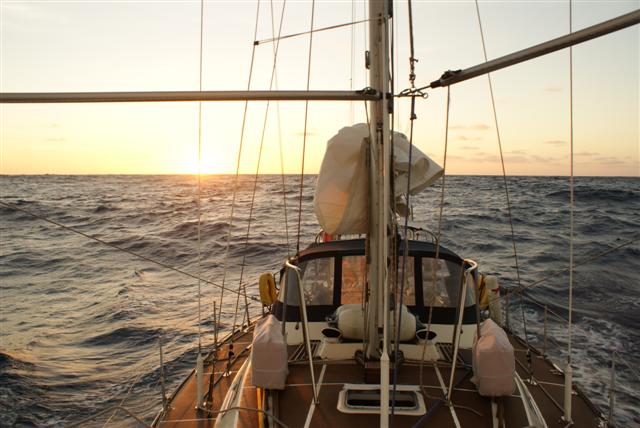
10,000 miles
in Camomile before we left. Even though we spent so many years planning to sail “further afield” it really does not seem possible that we have put so many cruising miles under our keel and we still feel like beginners; newcomers to passage making.
I have never been so far from everything. This passage from the unique Galapagos across the awesome Pacific to the enigmatic Marquises impressed with the sheer scale of the place we were in and our insignificance in it. “A long way from help” tended to play on the mind while Camomile ploughed on mile after mile because, out there, even the smallest thing, like a minor injury or illness, could rapidly become a crisis.
A fellow rally boat broke a shroud just beyond the half way mark and fortunately managed to make a repair so that they could continue to sail however it did bring home that you can’t just motor to the nearest port if something breaks.
Watermaker problem
Camomile has a small watermaker which produces fresh drinking water by compressing seawater through a membrane. Some fifteen days into the passage we found that we were having difficulty with it as it had started to draw in air somehow. It seemed as though the lift pump was not working so a replacement or a very flat sea were the only fix. Neither was available but, as the tanks had been regularly topped up along the way, we still had at least 300 litres on board with backup systems to prevent any accidental loss. Camomile was built with two water tanks totalling around 450 litres which can be isolated from each other and I had added an entirely separate dedicated drinking water tank of 90 litres. This arrangement means that we can judge quite accurately how much we have on board and can take on water from local sources without the worry of compromising our drinking water supply. The daytime temperature was by now peaking well above 35 degrees and drinking less was not an option in the tropical heat so, with our drinking water tank luckily nearly full, we decided to cut down our consumption by washing in seawater. Thus it was that our daily ablutions transferred to the transom boarding platform where, with careful precautions against the soap or anything else falling overboard, we would take it in turns to shower by pouring buckets of sea water over each other and then having a final small rinse in fresh water. It sounds basic and cold however with the water temperature at more than 27 degrees it was just mildly refreshing after the heat of the day.
Are we nearly there yet?
As we came to the last few days of this leg, little by little a sense of achievement started to grow inside us… yes really we had crossed a 3000 mile ocean, little Westerly us, who would have thought it!
Winds were decreasing by now and progress had faltered so our estimates of landfall were frustratingly going further and further out. Strange how an extra few days or even hours at this end of the trip are so much more difficult to accept than more time taken at the beginning.
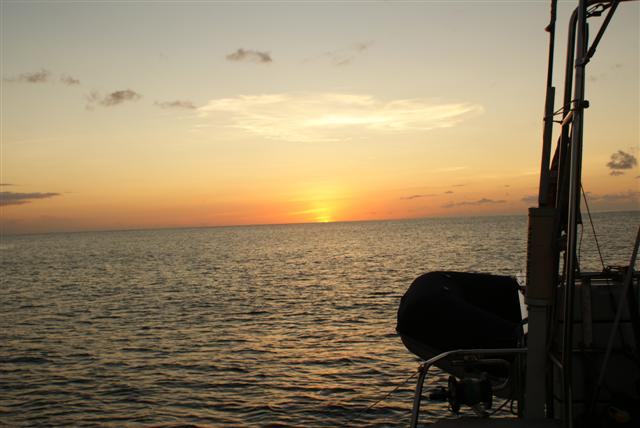
No wind
Approaching the end of the leg the faithful trade wind finally expired and the log read “no wind, never going to get there”. We set out carrying enough fuel to motor around 240 hours and had used 134 mostly at the beginning of the trip going south in search of the trade winds and then thereafter for periodic battery charging. We checked the forecast and realised that it could be some days before the south easterlies re-established themselves so we decided not to languish in the long Pacific swell and fired up the engine for the final day and night of the passage.

Fatu Hiva
At long last we sighted land, the island of Fatu Hiva in the Marquises. Its bulk rose out of the pre dawn gloom with soaring and ragged volcanic peaks covered in lush green vegetation fed by the rich volcanic soil and watered by the heavily humid wind releasing its rain as it was forced up hundreds and hundreds of feet for the first time in thousands and thousands of miles.
As we rounded the leeward side of the island, after so long breathing deep draughts of almost sterile sea air the smell of the land assaulted our nostrils with an almost tactile heavy earthy moistness delicately perfumed by exotic species of tropical plants.
We made for the Bay of Virgins and, as we approached, were just astounded by the almost unearthly beauty of the bay with its natural spires and lush valley with the small village nestling down by the harbour almost totally overwhelmed by the surrounding spectacle.
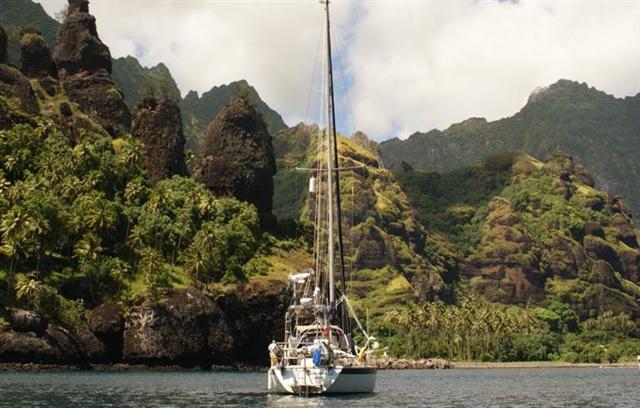
Landfall
For some bizarre reason the appearance of the landscape brought Herges cartoons of the Tin Tin adventures to mind. Well, here we were in our own, totally non fictional, adventure and to add to the elation of the achievement we were greeted by three fellow rally boats that had arrived a little before us. Somehow their welcome radio calls were all the more poignant for knowing that they had shared the same experience. Needless to say the celebrations that followed were happy and very thorough. What a landfall. 21 days and 3113 nautical miles, what a passage!
The Stunning Galapagos Islands

What a beautiful boy
00° 44.8 South 090°18.4 West The Galalpagos Islands otherwise known as The Enchanted Isles because they certainly were. We took a 5-day holiday aboard Daphne with air-conditioning while someone else did the driving.
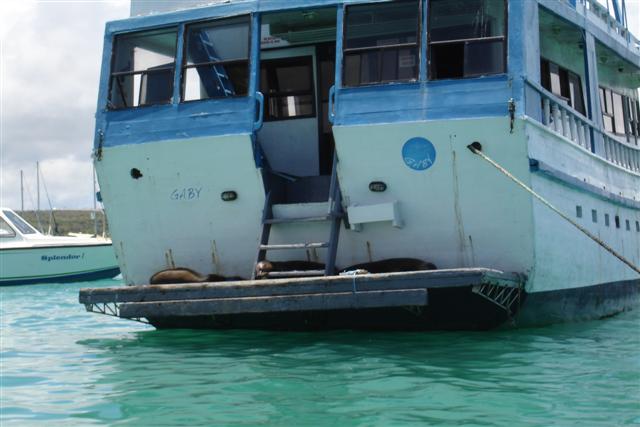
Sea-lions asleep on a local boat
We arrived Wednesday 10thMarch at 10am – what a relief. We found a space to anchor and Tony from BWR came on board to complete our check-in process. Bill wanted to put the temporary fix on the shroud straight away. I again found myself holding on to the mast but in the anchorage I felt more in control. Bill had to spend quite a bit of time filing the bottle screw so we made the right decision not to attempt it at sea. That evening Enchantress and Lucy Alice joined us for champagne to celebrate our safe arrival and then we all went ashore to The rock for happy hour; a big cheer went up when Bill walked in. We ate out in the kiosks, a row of ramshackle restaurants with tables and chairs in the street; it was good value and nice food. We slept well that night.
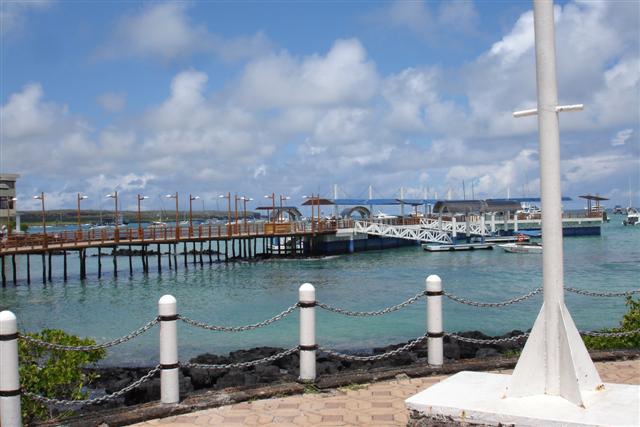
Water taxi rank with BWR boats in background
Puerto Ayora on the island of Santa Cruz was established in the early 1970’s and is full of multi-ethic contrasts between the Ecuadorians and immigrants of European decent. It thrives well on the passing yacht trade and visitors flying in to join the many island cruises available. It has a very good water taxi system so it wasn’t necessary to put the dinghy down.
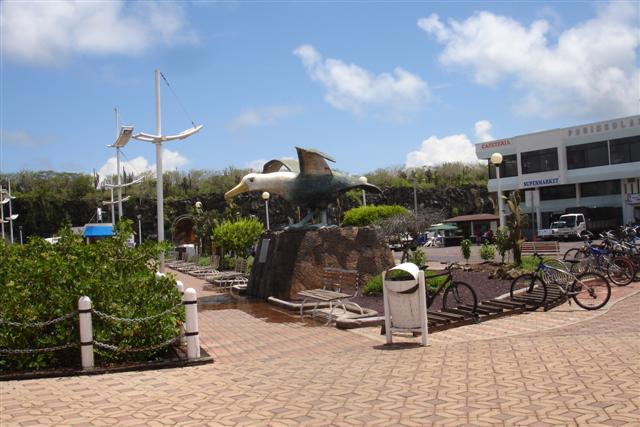
The supermarket next to the dock
There was a good supermarket by the dock and a good market further up in the town. I spent the next few days back and forth from the internet café trying to log on to a very slow connection to download our mail and various other tasks. The cost of living seemed cheap in the Galapagos so we enjoyed several meals out for a change.
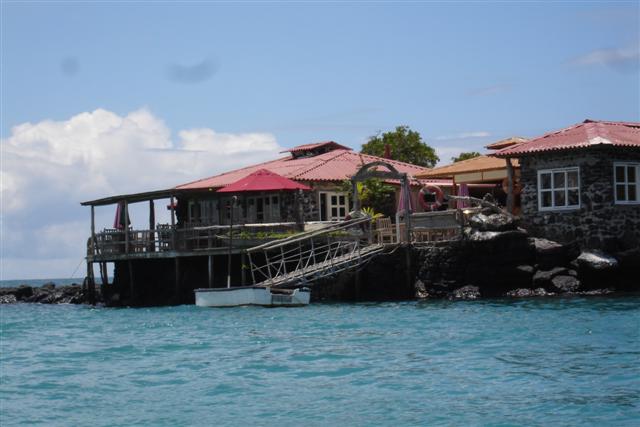
The restaurant at Angermeyer
On the Sunday Tony from BWR had arranged for us all to have Sunday lunch in a lovely restaurant at Angermeyer point just across the bay. Luckily it was on the water taxi route so we didn’t have to take our dinghies, which was probably just as well because it had a very small landing stage. It was a lovely day but very hot as usual. We all had a delicious barbeque meal with some wonderful salads. Afterwards we walked to the beach but as it was Sunday the beach was a bit crowded so we went back to the boat.
We had an ‘out and about’ day on the Monday. It started with a taxi ride to the Darwin centre. There is a very good breeding programme involving giant tortoises to try to prevent them from becoming extinct.

Lonesome George
We were able to walk around the raised walkway overlooking their pens. We found Lonesome George in one of them with his girlfriends but sadly he wasn’t showing any interest. There’s a possibly that once he dies that particular breed of Tortoise will become extinct. We spent a couple of hours wandering around there. We walked back into town and, after spending a bit of time in the internet café, we joined the rest of the BWR crews for a coach trip to a nearby farm for a briefing for the next leg. The farm was also a resort hotel with a pool so after the briefing some of us got changed and enjoyed a refreshing dip in the water. The bar was opened and ‘all was happiness’ to quote Tony from BWR.
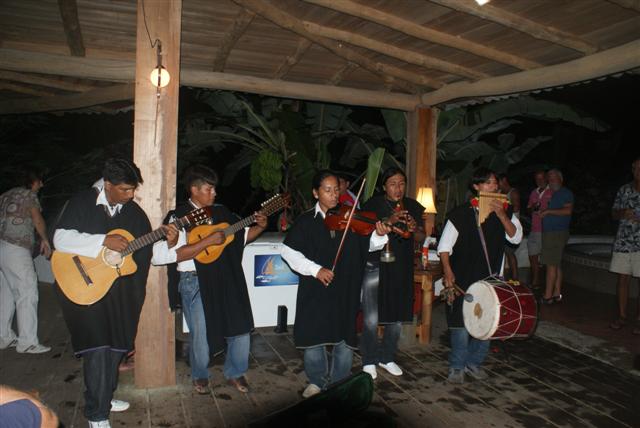
A local band entertained us
A local band came to entertain us and played some traditional pipe music. We all enjoyed a delicious barbeque before returning to the boats by coach.
On Tuesday our new rigging parts arrived in the afternoon and Bill was anxious to fit them before we left Camomile at anchor while we were on Daphne. Ian and David came over to help. I spent the afternoon packing our bags for our mini holiday.

Daphne
Wednesday morning we locked the boat, got in a water taxi and went ashore. We were met by Charlie our guide and naturalist and left in a coach at 11.00 with the crews of Enchantress, Lucy Alice, Mercury Rising, Fai Tira, 2 of Roundabouts crew and 3 Canadians. We were off on our holiday and guess what – it was raining. We drove for an hour to the other side of the island where Daphne was waiting for us. She was a really nice boat and had just had a refit. We were shown to our cabins, ours was really nice on the upper deck. It had a double bed, a nice shower room but best of all, air-conditioning. We sat down to a nice lunch while the crew gently motored us round to the next bay.
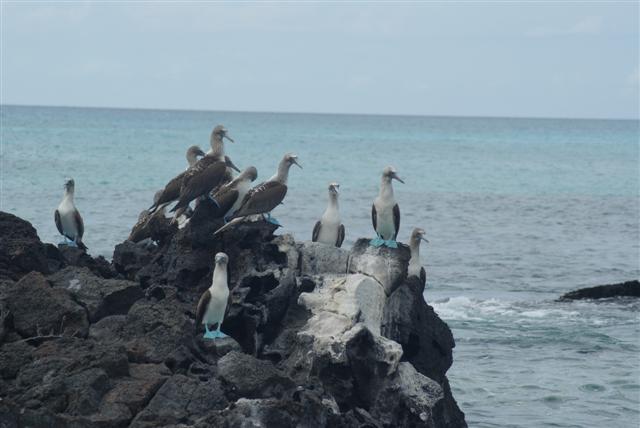
Blue-footed boobies
We all got into the large dinghy and were taken ashore. We went for a walk along the beach and saw lots of blue-footed boobies. We snorkelled off the beach where there were lots of fish. We returned to the boat to relax for a few hours and have a long shower.
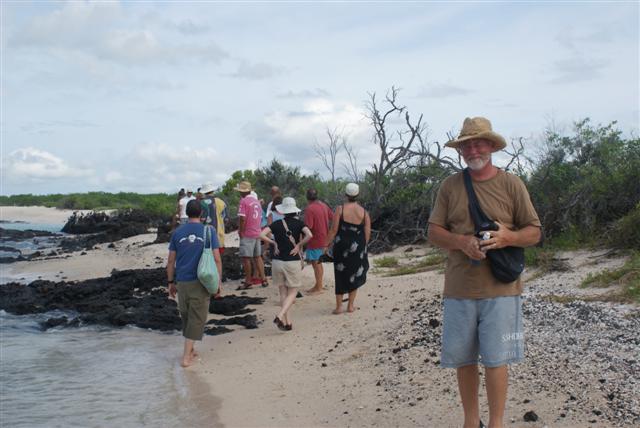
Our group walking along the beach
We got changed and joined everyone in the little lounge, which was beautifully finished in wood with new seating. We were offered a welcome cocktail and introduced to the crew. There were seven, all men, including the captain plus Charlie who spoke perfect English. We introduced ourselves while Charlie translated for us. We sat down to a delicious dinner in the little dining room/bar before retiring to our air-conditioned cabin. Heaven!
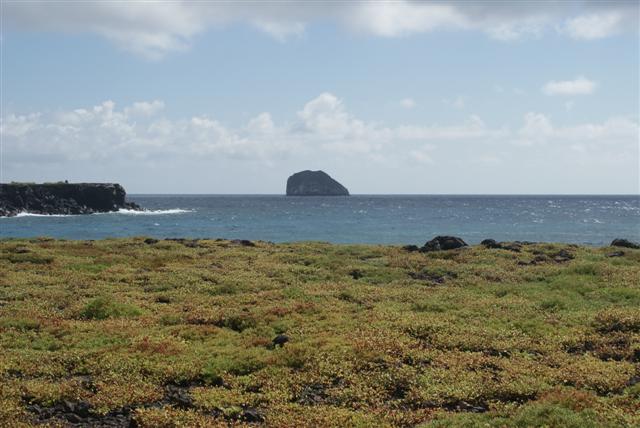
The carpets of red sesuvium
We awoke to a beautiful day. During the night we had motored to the small island South Plaza. Located on the east of Santa Cruz, the main characteristics are the Opuntia cacti and the carpets of red sesuvium, a succulent plant that turns green in the rainy season. The cactus is the main food of land iguanas. We landed on a jetty and went for a nice walk to see the land iguanas sunbathing under the cacti.

A land Iguana
The more you looked the more you saw, there were so many and they weren’t bothered by us walking past at all. As they approached each other they would nod their heads up and down which is their sign to say ‘this is my bit of land’. We had a beautiful walk up over the hills. We saw swallow-tailed gulls and red-billed tropicbirds nesting, and boobies roosting on the south cliff of the island.
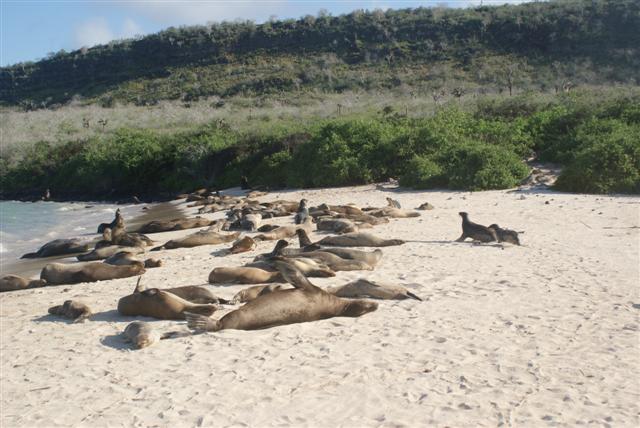
Sea lions lying in the sun
As we walked back to the jetty we saw lots of sea lions playing in the water below and sunbathing on the rocks around us. We were taken back to Daphne where the bar man had fruit juice and cookies waiting for us. I could get used to this.
We weighed anchor and motored 2 hours to Santa Fe, which has one of the most beautiful coves in the archipelago.

A beautiful cove with pelicans on the beach
A turquoise lagoon with two small white sand beaches which are protected by a peninsula where sea lions lie in the sun. After lunch we swam near the boat and saw lots of fish. We were taken outside the cove in the dinghy and snorkelled back. We saw a sea lion in the water and swam with 2 big turtles. At the entrance to the cove there was a fish ball below us. I’ve never seen so many fish together; there were literally millions of them. Later in the afternoon we landed on the beach.
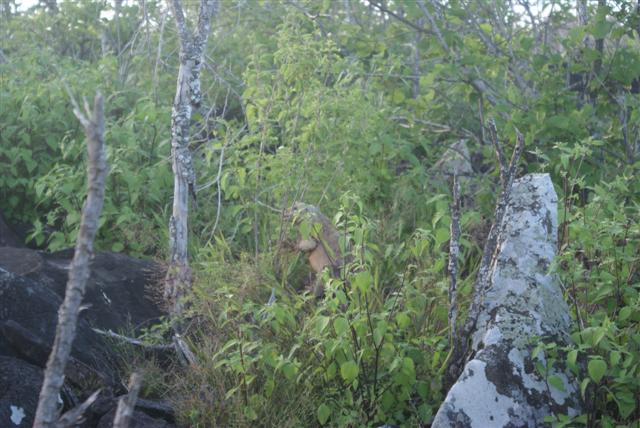
A land Iguana hiding
The island contains one of the largest sea lion colonies. A trail runs alongside the coast and then crosses through an Opuntia Forest. The Santa Fe species of land iguanas are larger and of a paler yellow than on the other island but we only saw one. On our way back we walked passed the sea lions lying on the beach with out a care in the world and they weren’t the slightest bit bothered by us wandering amongst them.
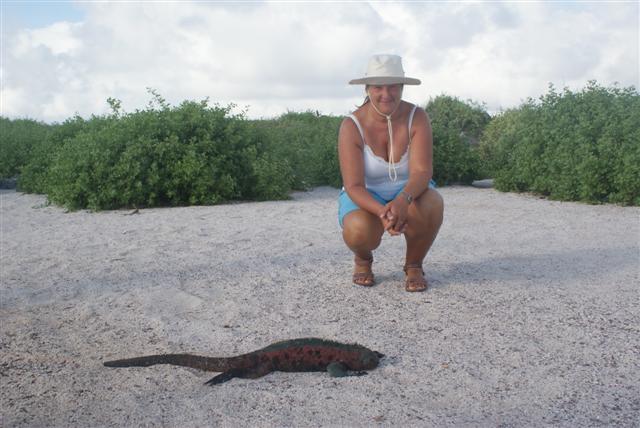
A marine Iguana on the beach
On Friday morning we found ourselves anchored off the island of Española that, as one of the smallest islands, is flat with no visible volcanic crater or vent. We landed on the beach for our daily walk. There were lots of brilliantly coloured marine iguanas lying in the sun on the rocks and walking across the beach, again oblivious to our existence. We continued to the seaward side of the island and saw lots of nesting birds including Nasca boobies, Mockingbirds, Galapagos doves and Galapagos hawks.

A Nasca boobie with her baby
It was amazing to be so close to birds with their young. This photo of a Nasca boobie with her baby was taken right next to them and not with the zoom lens, they were sitting in the cliff just above our heads. We stopped on top of the cliffs for a photo opportunity. With the heavy swell running below it was creating a spectacular blowhole with thundering spray shooting 30 metres into the air.
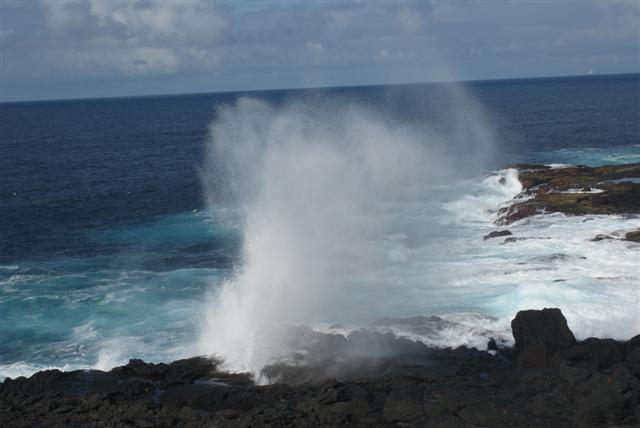
Spectacular blow hole
The spray was forming beautiful rainbows as it fell back onto the rocks. It was a spectacular sight. We returned to Daphne for lunch and motored round to Gardner bay on the eastern side of the island with its magnificent beach again full of sea-lions. In the afternoon we went for our usual snorkel. We were dropped off about 1km away and drift snorkelled back. We swan into a cave where lots of fish were collecting in the entrance. The captain and some of the crew were in the water with us and spotted a shark and several turtles for us. We returned to Daphne to relax on the sun deck before dinner. We motored to the island of Floreana over night.
Saturday was our last full day on Daphne and they seemed to have saved the best for last. We were anchored off Floreana, perceived as one of the most exotic islands of the archipelago.

Posting cards in the whalers post barrel
We were in Post Office bay, home to the legendary post barrel that whalers used to send their mail. There were letters and postcards in the barrel. Traditionally if you put an item in to be posted then you take one out to post. We all choose some postcards to be sent on from our next destination. I took one for New Zealand, which I’m going to hand deliver, one each for Sweden, US and Ireland, which I’ll send from the Marquesas. We continued on to the lava tube. We had to climb down a ladder to enter and it was very dark inside. We paddled in the pool but Susan and Glenda very bravely waded deeper and swam in it. I’ve seen too many creepy films to venture further forward in the dark.

A Galapagos penguin
We came back to the surface and walked back to the beach. Just as we were leaving in the dinghies we caught sight of some rare Galapagos penguins swimming close to the boat.
The crew moved Daphne nearer to an eroded volcanic vent called the devils crown.
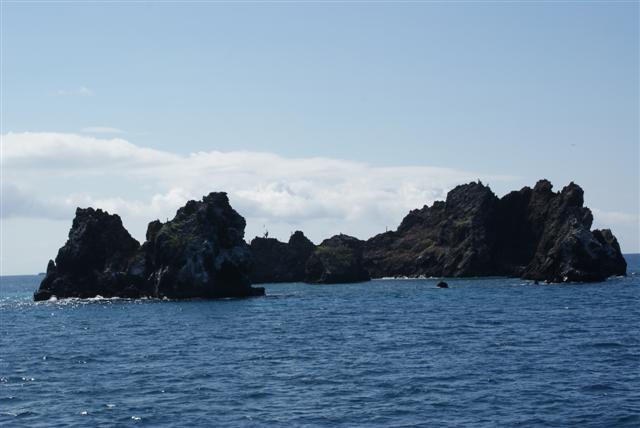
The devil’s crown
We were all loaded into the dinghies for a snorkel. It was probably the best snorkel we have ever had. There was a fantastic array of wildlife, white tipped and black tipped sharks, manta ray, octopus, starfish, turtles and hundreds of different kinds of fish. We were dropped off at one end and drifted with the current over the top of all the wildlife. It was like looking down into an aquarium, just out of this world.
Not believing they could top the devil’s crown, after lunch we were taken on our last walk.

Flamingos in the pink lagoon
We walked past a lagoon, which seemed to have a pink hue to it. It had lots of elegant flamingos standing on their slender legs; we stopped for a while to watch these graceful birds wading through the water picking at the tasty morsels beneath them. We continued along the trail to a beautiful white sand beach made from ground coral so fine it looked like flour. This is the nesting sight of the green sea turtle.
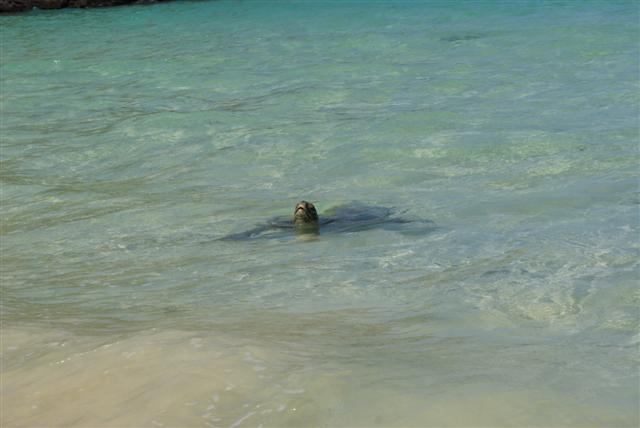
A turtle waiting to come in to lay her eggs
Tracks were evident across the beach where the turtles had dragged themselves above the waterline to lay their precious eggs. Sadly we watched a Frigate bird repeatedly dive into the sand dunes trying to grab the baby turtles as they were emerging from their nest. The Galapagos policy is not to interfere with nature and we weren’t allowed to chase the birds away. We turned our attentions back towards the water and saw several turtles waiting to land on the beach, which they would do after dark.
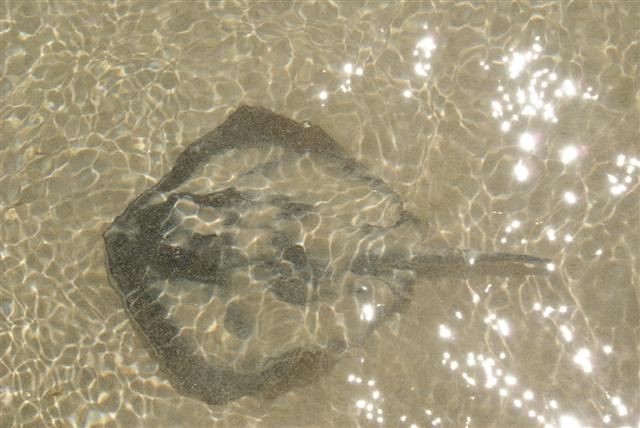
A ray swimming around our feet
We also had rays swimming around our feet, there were so many we had to be careful where we stepped. The fine sand was lying on their backs.
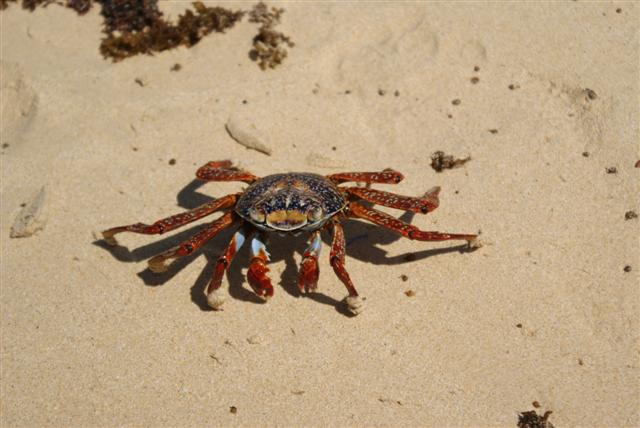
A Sally light foot crab
We wandered over to the rocks around the edge and saw many Sally Light foot crabs with their beautiful red and white spotted legs attached to their blue spotted bodies running sideways across the beach.
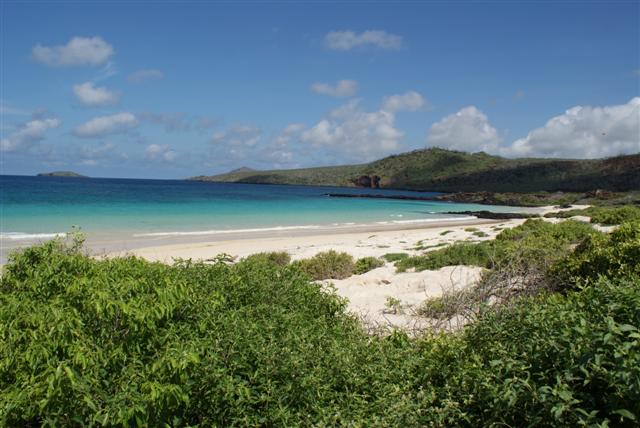
A last view of the cove
It was probably the beautiful beach we had been on, it certainly had the most wildlife. We reluctantly left the beach and walked back across the island looking over our shoulders many times to get one last view of the stunning blue water.
We returned to Daphne ready for the journey back to Santa Cruz. Bill wanted to have a look at the bridge and was welcomed in. Pictures were taken with the Captain and we asked him if they ever see Dolphins.
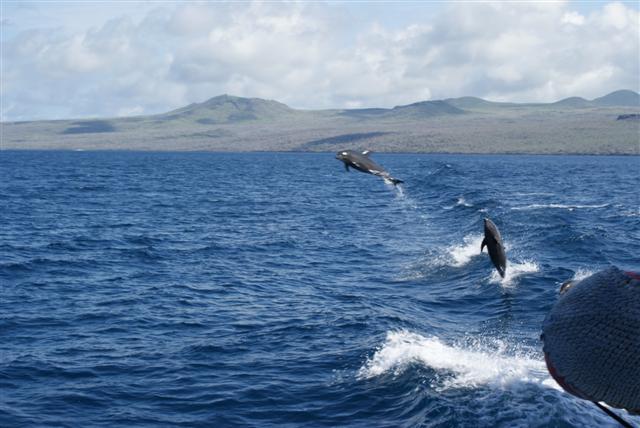
Dolphins leaping out of our wake
As if on cue the call of “Dolphins” was called out and everyone rushed to the bow of the boat to watch them. We’ve had Dolphins many times swimming in our bow wave but Daphne was travelling at 15kts which is twice as fast as Camomile and the Dolphins were still managing to keep up. The extra speed seemed to excite them more because they were also leaping right out of the water in our wake. It was going to take quite a while to get back so we watched a BBC Galapagos documentary, which was very interesting. We arrived back to a cloudy evening.
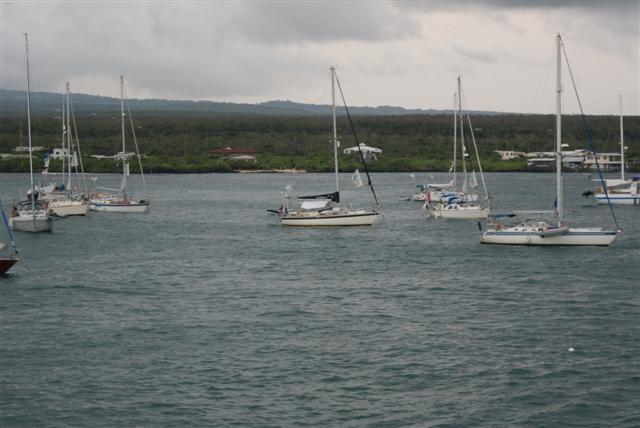
Camomile was still where we had left her
Camomile was still where we had left her. The crew kindly took all the men round to check on their boats and they managed to bring back various bottles of alcohol. Most of the crew went off duty leaving us all to have a party on board. The next morning we reluctantly packed our bags and enjoyed one last breakfast together. Sue and David, crew from Roundabout had finished their time with the BWR and headed to the airport. The rest of us went on our final excursion to the Highlands to visit a Tortoise Sanctuary.
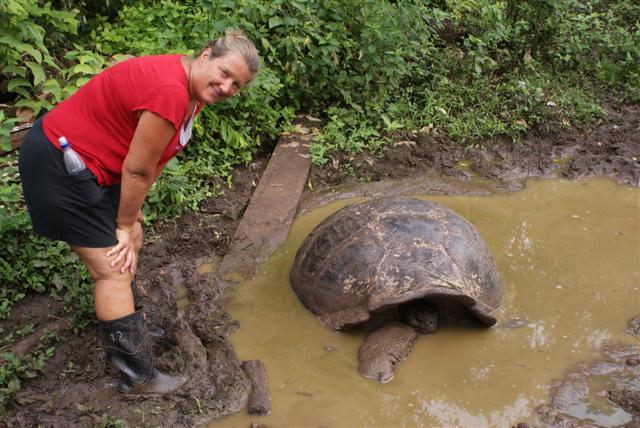
Wallowing in mud
We donned Wellie boots and went to find the tortoises, who were wallowing in the mud. We went back to the dock for our luggage and were taken back to our boats. What a fabulous time we’d all had. We spent the next few days getting ready for our longest passage …… across the Pacific Ocean.
Crossing the Equator
There’s one final part to this story. To reach the Galapagos we had to cross the equator. The ‘Crossing the line’ ceremony is an initiation rite which commemorates a sailor’s first crossing.

Bill dressed ready for the shellback ceremony nursing the broken shroud
We were all Pollywogs and needed to become Shellbacks or sons of Neptune. After crossing the line Pollywogs receive a summons to appear before King Neptune. This is preceded by a beauty contest of men dressed as woman and then Pollywogs have to go through a number of disgusting ordeals. So we decided to organise our own ceremony on each of our boats. The men would dress as woman, the woman would wear their clothes inside out and back to front and we would perform our own ceremony on the front of our boats for the entertainment of the others.
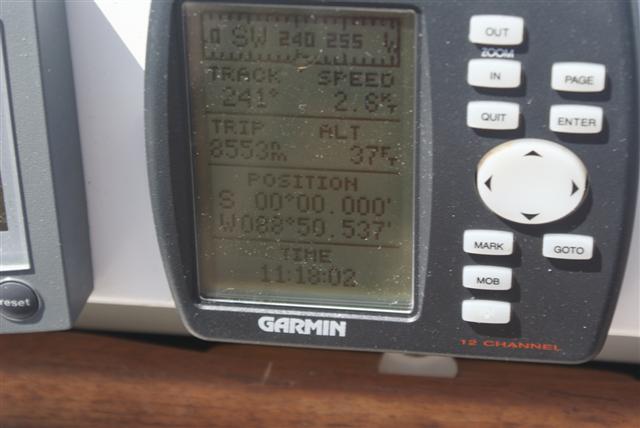
Crossing the equator as the GPS reads 00.00 south
We had a 4th boat join us called Briet and the skipper Duco was already a shellback so he was Neptune. Bill, David and Ian dressed in our clothes and we all crossed the line together with Duco, as King Neptune, counting down the degrees. Then the fun could begin. Bill squirted water at me from the super soaker.
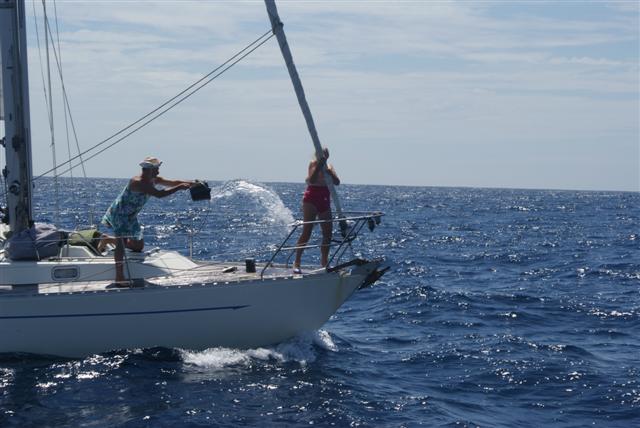
Ian and Glenda performing shellback ceremony
Ian threw several buckets of water over Glenda and she threw several back but David and Susan carried out the works. David doesn’t like Couscous so he threw that at Susan then she squirted cream on his feet and had to kiss it,
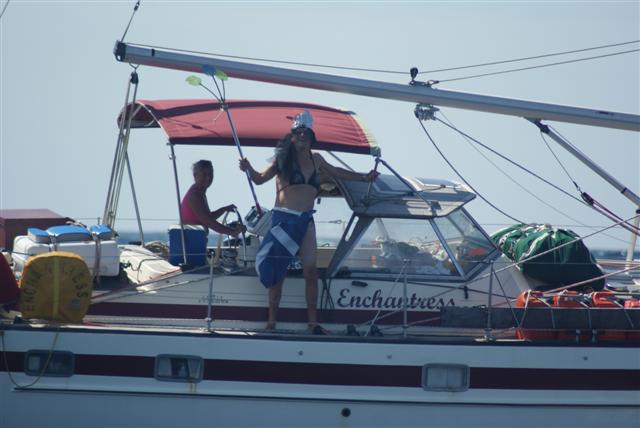
David and Susan ready for their ceremony
then came the buckets of water and then finally they opened cans of beer and tipped some over the bow of their boat and drank the rest. It was all a lot of fun. The funniest part of the afternoon was when Ian turned round to go back on deck and the wind got up lifting his dress to reveal nothing underneath. His excuse was that, as he couldn’t fit into any of Glenda’s kickers he thought he wasn’t allowed to wear any! After the fun we continued on our journey because we still had another 100 miles to go. Lucy Alice, Enchantress and Briet were able to sail and they adjusted their speed to match ours, their support was invaluable. We arrived the following day having motored 491 miles in 104 hrs. We had used all our jerry cans of fuel but we still had our mast.
On to Galapagos…
Bang! It was 01:30am, very dark, blowing F4-5 in a choppy sea and, although I had never heard that sound before, I knew instantly what it was. Still slightly groggy at the start of my night watch I spent the next second travelling towards denial, no the rig is not that old and then back to reality “I really have lost a shroud, what now”?
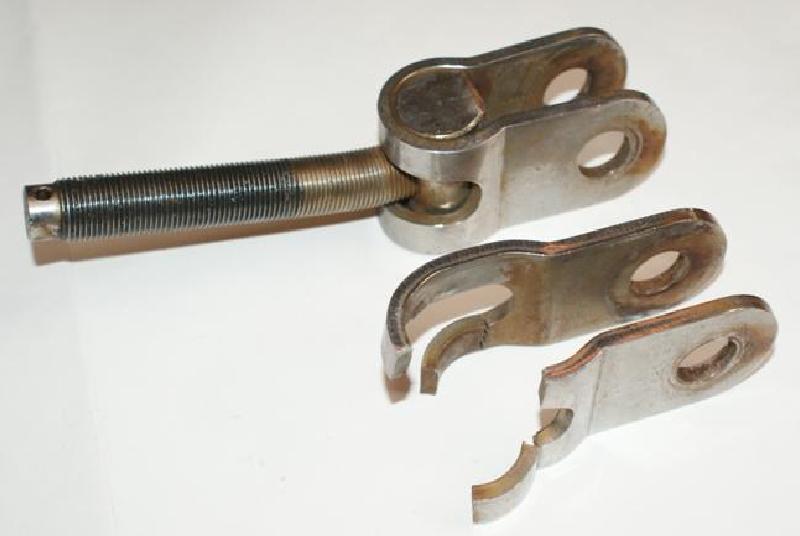
The bent and the broken
Camomile was 447nm into a 937nm passage between Las Perlas and Galapagos on the 2009/10 Blue Water Rally. The wind had recently started to blow from behind so we were sailing under our twin headsails poled out with a twizzle rig.
Deck lights on! It was the port lower shroud and it had parted low down around the turnbuckle. It was now snaking its way through the air like a whip with each rolling movement of the boat.
Engine on! I fought to turn the starboard bow to the wind and waves to reduce the boat’s rolling movement. Then I noticed that the mast was bending to port alarmingly in the middle with each roll of the boat, snapping back with a rattle as the remaining starboard lower took up the slack. I knew I did not have much time before this became a dismasting!
Broken shroud, what now?
I put the auto pilot on and went out on deck as Sue came up the companion way. Grasping the loose end of the shroud which I noticed still held the turnbuckle I heaved it towards the cockpit where I handed it to Sue telling her “don’t let go of this”. Just at that moment the autopilot decided it was not going to hold its bearing into the wind and the bow sheared away from the weather increasing the roll instantly. Again I struggled for control, adding more engine revs to regain our heading. After what seemed like an age she responded and the movement lessened.
We had to stabilise the rig and fast. I grabbed the turnbuckle from Sue who had, with gritted teeth, heroically stopped it from thrashing around the deck and unscrewed the lower bolt which left me the body. I planned to pass a line through this so I could tie it directly to the chain-plate leaving the removal of the broken toggle, which was still attached, until later. Grabbing 12mm braided line Sue and I went out on a pitching deck where she held onto the shroud while I passed six turns through and around heaving it down as I went. The shroud flapped but seemed to hold and the mast was still moving, but not nearly so badly. I started to think that we were getting to grips with it but I was about to get my second surprise of the night.
Loose again
A large lurch and….Bang! The lashing snapped like cotton. I was shocked at the forces involved and realised that only steel was going to hold in these conditions. Sue went to the cockpit locker where I keep a selection of stainless shackles while I hung onto the shroud feeling for myself as I did the relentless pull at every roll of the boat. I took the shackles and Sue hung onto the shroud again while I linked a short chain of them together passing one through the lower opening in the rigging screw barrel. I planned to pass the lower shackle in the short chain through the chain plate loop as Sue held on to the shroud to stop it whipping away into the darkness. This turned out to be very difficult as the shroud was continually being pulled away as I attempted to put the shackle pin through.
By now it was about 02:15, we were getting exhausted and we were also both very frightened, each trying not to show it to the other. Sue shouted at me “you can do it! Keep trying!” Again and again I came tantalisingly close to pinning the final shackle and time and again the shroud snatched it away. Sue told me later that this was the moment that she felt we should be cutting the rig loose altogether as the 50’ mast flexed like rubber away from it’s loose shroud. I was thinking “we will not let this beat us”. A momentary lull, perhaps a double wave, I don’t know. What I do know is that the pin went home and I got 3 turns on it before it snatched again, this time fast against the chain-plate.
The rig was more stable now but it still had no shroud tension so the middle of the mast was still loose against the lowers. Sue grabbed four sturdy braid lines from the cockpit locker and I passed 2 bowlines around each shroud leading the bitter end to our 4 forward winches. I

A cats cradle in the cockpit
took more 14mm line and passed turn after turn after turn up and through the chain plate and rigging screw body not so much to reinforce the shackles but in an attempt to dampen the shock loads going into them. This done I tightened the 20mm lines winch by winch bending the shrouds into tension back and across the boat. The result was a cat’s cradle of creaking lines but it held and the mast finally now stood straight and fast.
Stable but what now?
The time was 03:00 and we were shaking with exertion but elated at having got the situation back under control.
However although we had the rig upright, we could not use it to hoist sails. It was nowhere near well enough supported and I had no idea what damage might have been done higher up the mast while we were trying to get it under control.
The choice was to return 447nm upwind to Las Perlas or down weather to Galapagos. Without the sails we only had the engine however we did have enough fuel in jerry cans to motor more that 600nm. Given that down weather would stress the rig less, we would have the Bluewater Rally fleet around us and that returning could also prevent us visiting the “enchanted isles” altogether it made sense to continue on the further 490nm run to Galapagos.
A call for help
Having reached a decision we put out SSB calls to the rest of the fleet and reset our original course. We sent an email to Blue Water Rallies

Shout
explaining what had occurred and letting them know that we would be in need of spare parts when we got there and could Tony bring them when he flew out to support the Rally stopover.
We made voice contact with S/Y Briet at 06:00 and the Skipper Duco kindly agreed to call Tony via Iridium to alert him of our situation.
In the meantime I had carried out a deck level damage assessment and was shocked to find that the starboard shroud toggle had snagged sideways on the chain-plate while slack and looked as if it could have been close to shearing off. This would have left us with no lowers and a certain dismasting. Far far too close for comfort.
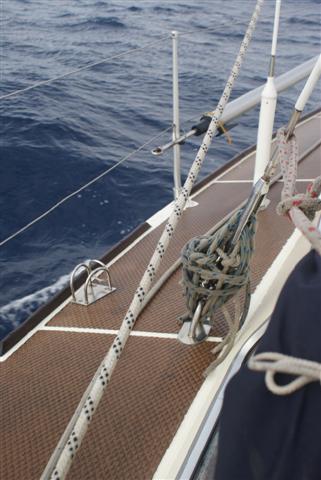
Mummified shroud base
We motored through the rest of the following day, finding that around 4 to 5 knots kept the boat fairly stable which in turn kept the stress off the cobbled shroud fixing.
Support from the Rally
Blue Water Rally control had been busy too. They put out an SSB email to all the boats close to our position. Lucy Alice, an Oyster 406, steamed towards us and was the first to arrive at our position. It was a huge relief and comfort to see them appear over the horizon of an ocean which had, until then been empty and very lonely. We both knew that there was little they could do at that time but her skipper Ian offered calm advice and gave us such confidence saying “don’t worry we’ll get you there whatever it takes”. It was a turning point for our morale; at last
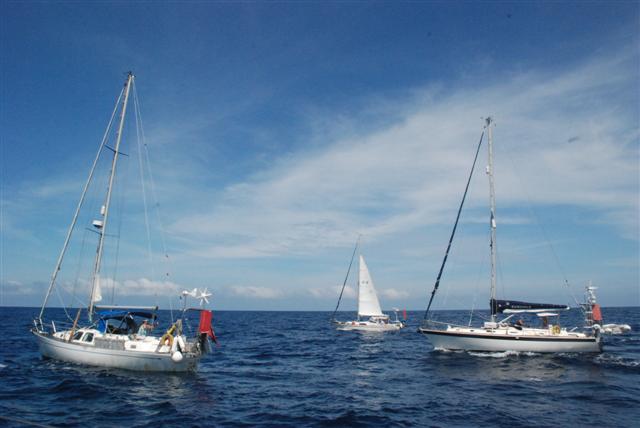
Camomile's escort
we started to believe we could still do it. We were joined a little later by Enchantress, an Aphrodite 44, and escorted by both boats, one to port and one to starboard as we motored on into the Pacific Ocean together.
Richard Bolt from BWR had in the meantime been in frantic conversation with XW Rigging owned by Ian Cochrane (an ex Westerly rigger, hence his company’s name and a past owner of a Sealord too). He reacted quickly, he knew the parts I needed and would provide 7 of them so that I could replace all the toggles throughout the rig. Thanks Ian, fantastic! Would I please check though that they were all left handed threads and that the diameter of the thread was all the same throughout to ensure that the right parts were sent.
This resulted in yet another memorable moment as, because of the time difference and the urgency of getting them sent, I had to carry out this check in the dark. So it was that I found myself crawling around on all fours with my harness and a head torch on gripping a micrometer in my mouth going from shroud base to shroud base trying to see which way the rigging screw thread ran and measuring the diameter of each. Bizarrely enough it was only at this point that I questioned my sanity, who would have thought it!
By this time we had had offers of help and support from across the fleet including emails to Richard informing him of who was flying out to Galapagos to join which yacht and when. In the end the parts went with some friends of Jackamy, whose owners Paul and Derry laid on a special delivery to their business address in the UK and bent over backwards to make sure it got off the ground and headed towards us as quickly as humanly possible.
Back on Camomile spirits were high as we were joined by yet another rally boat Briet, skippered by Duco and we all started to look forward to crossing the Equator and becoming Neptune’s latest shellbacks, but that is another story.
More trouble?
During this time I was carrying out regular checks on the state of the jury rig but my observations were leading me to believe that it was weakening. I could see through the “mummification” of line that one of the shackle pins had started to bend. I knew that this is a favourite pre-failure mode for shackles so I had to do something about it. I did not have a spare toggle assembly so I dug deep into my tools and bits locker and found just the thing I needed, a piece of 5mm thick flat bar. As I carry a heavy engineer’s vice and a club hammer on board (subtly had no place here) I soon fashioned this into a “make do” toggle at least as strong as the original one if not quite as pretty. Fitting this would stop
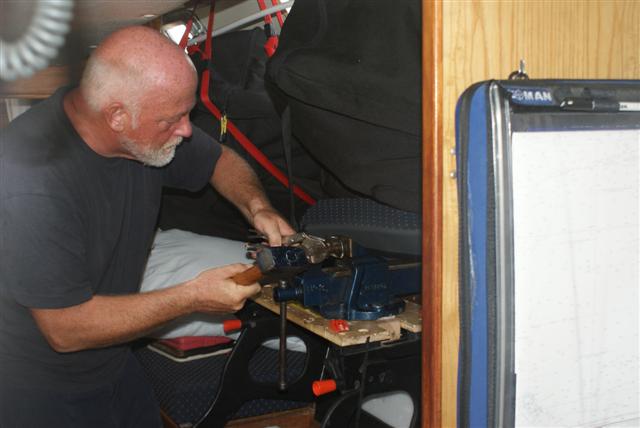
Hit it don't tickle it
the rot and possibly even allow us to put some sail up if the upper rig was sound.
The next challenge would be to replace it in a seaway as the cobbled shroud linkage would have to be disconnected completely. This would bring back all the problems of the first time except that we could now do it at a time of our own choosing. Two things were against us though. Firstly the sea would not settle and secondly the rigging screw body end looked as if it might have become burred by the shackle that was now fastening it and, if so, would have to be removed from the lower shroud to be re-worked with no way of securing the shroud while this took place.
3rd time lucky?
With trepidation I called the yachts escorting us to brief them that I was planning to make a manoeuvre to find a “sweet” direction to steam in causing the least stress to the shroud which was currently on the windward side of the boat. I would then strip the fixing away and replace it unless the burr on the turnbuckle prevented it.
Some little while later with all the tools in place I turned Camomile for the first time since she had lost her shroud. I found a good direction although it was still far bumpier than I would have liked and started to remove the outer lashings of my joint.
As the chain of shackles was revealed my heart sank. Not only was the rigging screw body seriously burred but several of the shackle pins were showing signs of fatigue. I had to abort fitting the new part immediately as to do otherwise would have put the mast back at risk but I could not leave the chain as it was with over 300Nm still to go.
I set about building a second line of shackles to back up the first taking the tension out of the rigging by slacking off on the winches for just long enough to get the last pin in so that when tightened it would share the load. I then re-bound the joint with line putting tension into it as I went. I was not sure, in the end, whether this binding would have done anything if the worst happened and shackle chains failed but it might give me a few minutes of reaction time so I thought it worthwhile.
Onwards to Galapagos
Once the last binding was on we turned the boat around and set our course for Galapagos again hopeful that this time the fixing would fare better.
We motored across the Equator listening to the tensioning lines creak at the crest of each wave and checking every few hours that the shackles were not distorting. Finally, after 490 of the longest nautical miles we
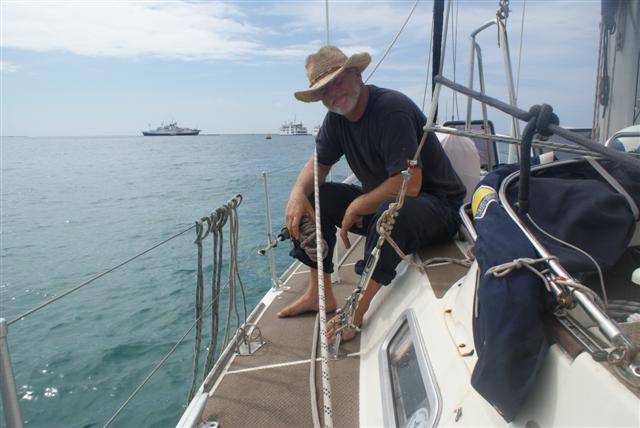
Safely at anchor
have ever travelled we nudged our way into the anchorage at Puerto Ayora on Santa Cruz in the Galapagos.
The modified fix had lasted all the rest of the way without incident and with no further signs of fatigue. When we walked into the adopted rally pub that afternoon to see the rest of the crews again we were met with a raucous cheer and a round of applause. We knew that we had arrived!
Safely at anchor now I stripped the joint down to replace it with the made up toggle and made ready to go up the mast to inspect for any damage. I checked all the lower and cap terminals and fixings which amazingly and to my huge relief were without any obvious signs of damage. All I had to do now was enjoy the Galapagos while I waited for the new parts to arrive from the UK and thank all the kind people who had supported us so well through this difficult time.
To read a response to breaking a shroud follow – https://yachtcamomile.wordpress.com/job-list/response-to-shroud-breakage/
A short stop in the beautiful Perlas Islands for some boat maintenance

Panama city looking across the causeway from where the boats were.
Panama city was much bigger than we expected and it had several big shopping malls with huge supermarkets. We stocked up the boat because this was the last time we would see food in such quantity until we get to NZ. The prices were good so we made several shopping trips filling the boat with essentials. Bill spent time visiting the chandlers to try and buy a new muffler but without luck, BWR will bring one out to Galapagos for us it should last until then.

Carnival comes to town
Carnival came to Panama city and a group of us went into town to watch the parade. We arrived early and found bags of ‘hole punch droppings’ being sold and everyone was throwing them at each other and us. We soon bought some bags and joined in, the little pieces stuck to our hot skin and we kept finding them in the boat for days afterwards. We walked the length of the main road looking at all the sights. The parade started at 4pm and was very noisy and colourful. There were lots of people there enjoying the atmosphere.
BWR put on a social programme and we spent 10 days at anchor.
Monday 22nd February we left Panama city, it was 8am and already hot and sunny. We were off to find a nice anchorage where we could jump in the water and have a swim. The water at Panama had been very dirty. We were heading for the Archipelago of Las Perlas. There wasn’t any wind so we motored for 6 hours to charge the batteries and make some water.

The beach at Contradora
We arrived at an island called Contradora where there were already 4 other BWR yachts. The crews of Briet and Norsa joined us for a drink that evening.
The next morning we had our swim off the back of the boat, it was wonderful. We dropped the dinghy into the water and landed on the beach to go and explore the island. It’s the most developed island in the archipelago with a small runway for light planes and paved roads although there were plenty of potholes.

Sadly this boat had seen better days
Sadly a lot of the buildings had fallen into disrepair and this boat on the beach had been abandoned, it was like a ghost town, maybe a sign of the times.
The next day we moved to the anchorage between Chapera and Mogo Mogo, these 2 islands had been the setting for the TV series ‘Survivor’. We were looking for a beach to put Camomile up on her legs to dry out and scrap her bottom before the Pacific crossing. Mogo Mogo looked like a possibility.
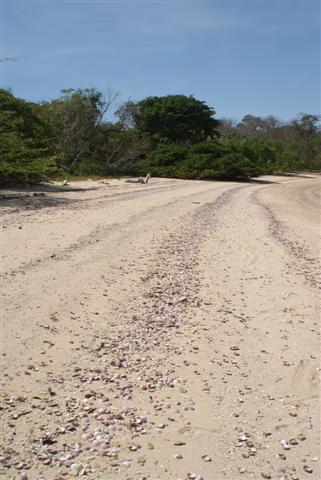
The beautiful beach on Mogo Mogo covered in pink shells
The island is surrounded by shoals and isn’t suitable as a normal anchorage because it’s too shallow. We took the dinghy over at low tide and it looked ideal. We surveyed the depth and found a channel deep enough to enter. We set up our own transits on the beach and went back to Camomile to wait for the tide to come in.
There was a group of rocks sticking out of the water that marked the end of a reef, at low water it looked like it could take a bite out of a yacht. This was opposite a peninsular at the end of the island. The channel in between was deep enough for us at high tide. We already had the ‘legs’ attached to the side of the boat so we motored very slowly towards the beach.
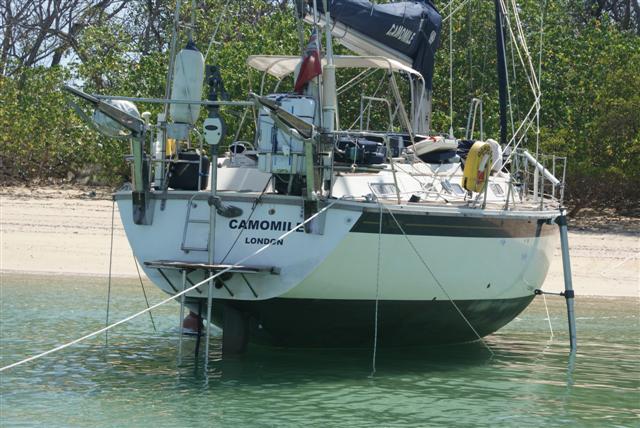
Camomile sitting firmly on the beach
We just touched the bottom and stopped. Bill quickly wound the legs down in place and attached a line fore and aft from each leg. We put the dinghy down and Bill took a kedge anchor and dropped it in the water behind us then we tied one of our long Panama warps to a tree on the beach and tied it to the bow … and waited.
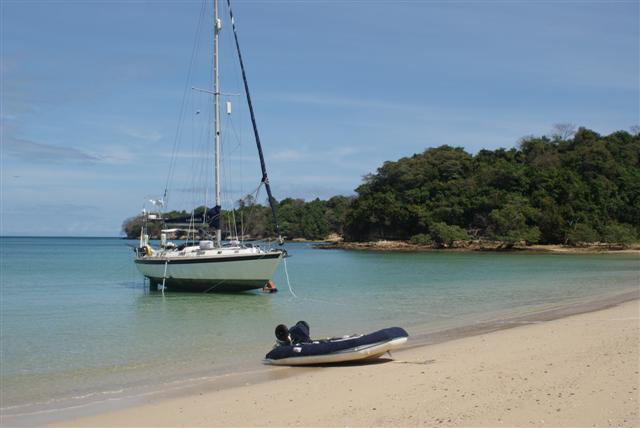
Camomile on the beach waiting for the tide to go out
The water slowly dropped exposing the hull. The copper coat that we had put on before we left had worked very well but there were lots of barnacles attached which needing scraping off.

I helped too
I set about that while Bill gave the hull a scrub, he also changed the anode and scrapped and polished the propeller. It didn’t feel like hard work because it was such a beautiful setting. The island was completely uninhabited and I walked the beach collecting beautiful pink shells and watching the Iguana’s running around while wearing only a hat!
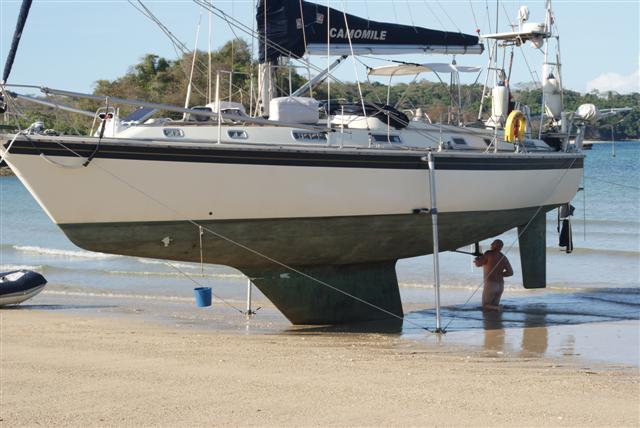
A lovely pair of bottoms!!
It’s impossible to describe what it was like, the sounds and smells and quietness are difficult to convey with just a photo. That evening we sat on the bathing platform, glass of wine in our hand, watching the tide coming back in. A ray glided past to see what was going on. The tide didn’t come in until after dark but all was well. We lifted for 3 or 4 hours and then sat back down again and stayed in the same position.

On the beach
The next day we decided to stay longer because it was such a beautiful place. We went exploring and found an equally beautiful beach on the other side of the island. There were lots of Iguana’s sitting in the sun and birds nesting in the trees. It felt like the garden of Eden. We had been talking to other BWR boats on the VHF who were anchoring between the islands where we had originally been, they said it looked as through Camomile was floating in the air.
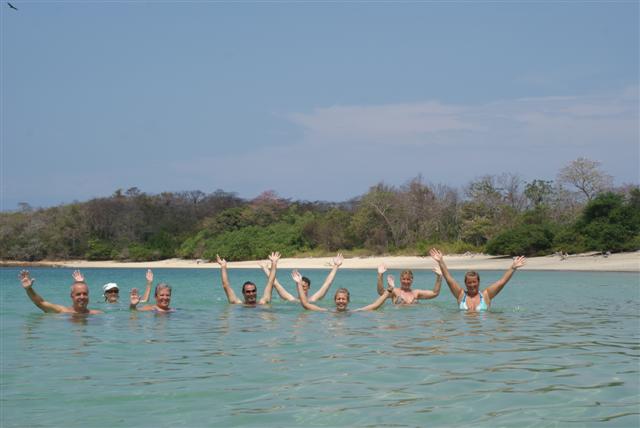
BWR crews enjoying the water
On the third day we were invaded, they all came over in dinghies to see us. That afternoon when we lifted we gradually slipped off the beach and motored back over to join the others for Mark on Blue Magic’s birthday beach party and back to reality. Too much reality because the next morning someone logged on early to check their emails and discovered a tsunami warning from Rally control. Word went round the anchorage and we all weighed anchor and headed out for deep water. Fortunately nothing came and we went back to anchorage.
We decided to go and see what some of the other islands were like and sailed down the east side of the Isla del Rey and anchored off the village of Esmeralda.
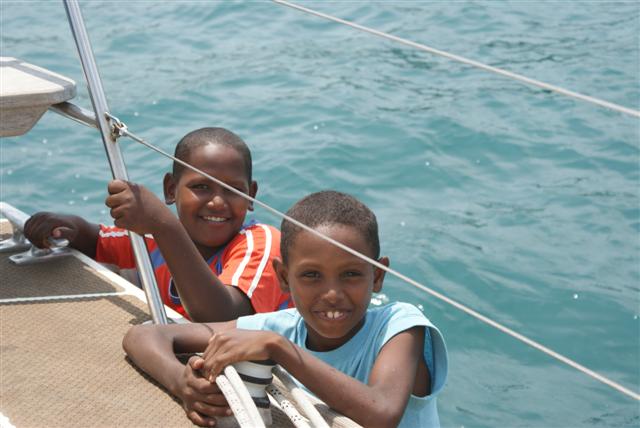
These two little chaps appeared selling bananas
Within minutes two little faces appeared over the aft quarter offering us bananas and papayas, they looked so cute. We ended up paying US$3 for a big hand of bananas and 2 big papaya and they took our rubbish away. We’d obviously paid over the odds because they went away smiling. We got in the dinghy and went ashore. I took a bag of trinkets and chocolate to give out. A young man who wanted to show us around the village met us as we approached. They weren’t as organised as the Kuna’s but they had a nice community. We were shown around the village.
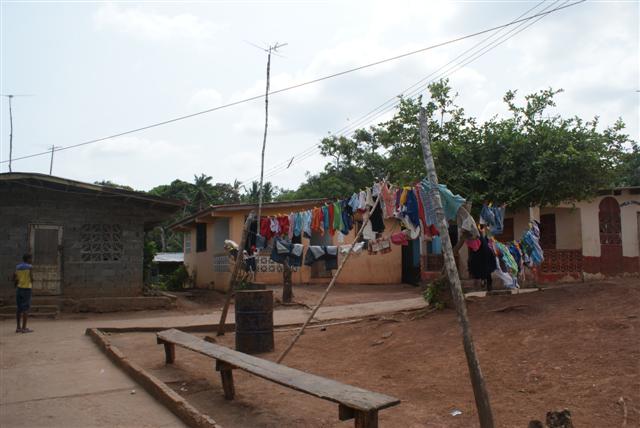
Washing hanging out
Their homes were made of concrete with cast iron roofs and everywhere you looked there was washing hanging out. There was a school, a clinic, a cantina, a military post and a small shop selling very basic food. As we walked around the village we were treated like celebrities, children surrounded us wanting their photo taken and then wanting to see themselves on the screen on the camera, they were fascinated. There were children of all ages following us and some were fighting who was going to hold my hand, they were so sweet.
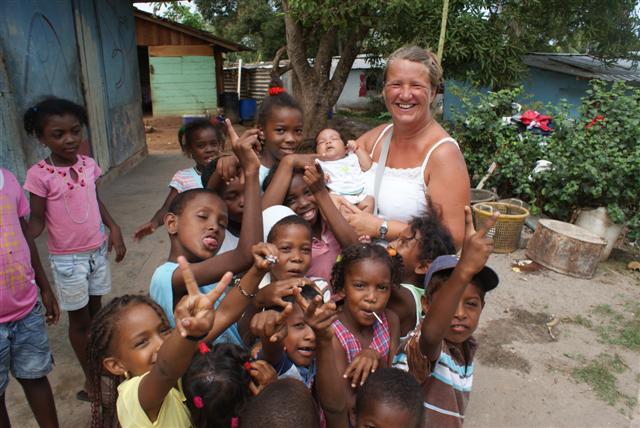
I was surrounded by children
Mothers were bringing their babies out to show me so I had to have a cuddle although one was very wheezy; I’m not sure what the infant mortality rate is. After staying for an hour and bartering for some pearls we got back in the dinghy and went back to the boat with all the children waving us off.
We continued a little further along the coast to Rio Cacique where we intended anchoring for the night. We found a dozen or so BWR boats already there. Rio Cacique, a scenic river full of wildlife, can be explored by dinghy on the flood tide. At about 4pm, an hour before high tide, we motored to the entrance.
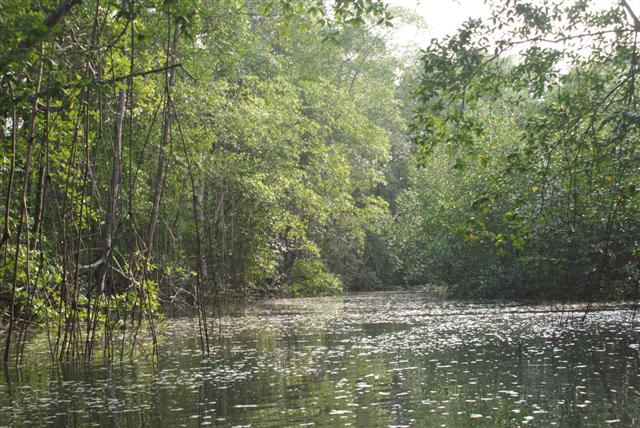
Creepers dangling in the water
We followed the river for a while then Bill turned the engine off and rowed, we let the tide take us as we glided through tall, partly submerged mangroves and rainforest in silence. We saw several different kinds of birds sitting in the trees and creepers hanging down from the branches like fingers dangling in the water. There were lots of noises coming out of the rain forest and we saw lots of crabs climbing around the mangrove roots. Towards the top it was difficult to tell where the river was but we continued rowing among the mangroves and eventually found it again.
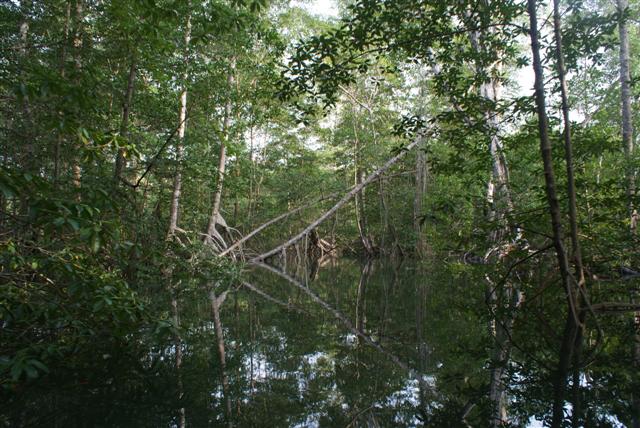
Beautiful reflections in Rio Cacique
As the tide turned we rowed back marvelling at the wonderful reflections the mangroves made in the calm still water as it gently ebbed away in the fading light.
But time was pressing on and we needed to start heading out into the Pacific for the Galapagos Islands.
Panama canal transit
The next morning we were off again. It would have been nice to have a look around the old town but sadly, as is often the nature of the rally; we had to move on to keep to schedule. We needed to reach Shelter bay in reasonable time because Bill was booked to be a line handler for one of the other boats that afternoon.
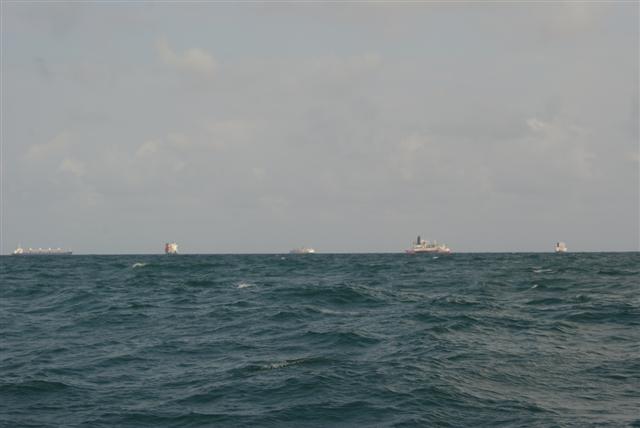
Ships on the skyline
There wasn’t any wind so we motored the 20 miles to the entrance to the harbour. As we approached, the ships started appearing on the skyline, waiting for their turn to go through the canal. I counted 27.
Shelter bay marina was great. It had showers, a launderette, nice restaurant and bar and best of all a swimming pool and spa pool. We had a proper pontoon berth with wifi for the first time since Lanzarote. Bill went off to be a line-handler that afternoon but didn’t have a very good time.
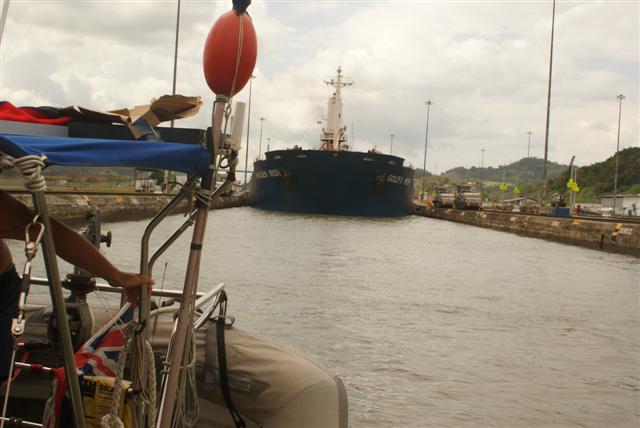
A Panamax coming in behind Moonshiner
The boat they put him on had only just joined the rally so we didn’t know them plus it had engine problems. It ended up breaking down in front of a panamax ship and had to be quickly towed out of the way by a pilot boat. Luckily Bill managed to fix it for them.
We spent 3 days at Shelter bay. I did lots of washing and shopping and, once he returned, Bill had lots of jobs to do on the boat. There was a free bus to a safe supermarket in Colon, a crime black spot in the world.

Camomile off for her turn in the canal
On Wednesday 10th February we left Shelter bay for the canal. The canal rules state you need 4 line-handlers plus the skipper plus a transit advisor, you also need 4 x 125ft warps (seen in the photo laid out on the deck). We had Margi from Peregrina and Susan from Enchantress plus Fionn from BWR to line handle for us.
In 1903, following Panama’s declaration of independence from Columbia, Panama and the US signed a treaty by which the US undertook the construction of the canal across the Isthmus. It took 10 years, the labour of 75,000 men and women, and almost US$400 million to complete the task. Many died from malaria and yellow fever before it was brought under control. The canal opened for traffic 15th August 1914. Since then there have been more than 850,000 transits through the waterway and now it was our turn.

Coming alongside Natibou
We assembled on the flats with Natibou, a catamaran, and Chsalonina as we were all to be rafted together. There was also Blue Magic, Gaultine III and Miss Tippy who were to form a 2nd raft. Our transit advisor arrived and we motored the 6 miles towards the first locks, it was so exciting. As we approached Gatun locks we joined together with Natibou and Chsalonina. We all had our engines on but Hans on Natibou was the controlling boat. As none of us had bow thrusters Bill and Jeremy were given instructions by the transit advisors as to when to speed up or slow down to keep all 3 boats level.
Camomile in Gatun locks
As we continued into the lock there were 2 line handlers standing up on the wall each side for each raft. They throw monkey fists down to you, which are extremely hard (we had covered the solar panel with a blanket), we then had to tie one of our warps to it and they haul it back up. As we motored into the lock they walked alongside us on the wall. Fortunately we were in the lock with just the other raft and no other ships. The lock gates closed and the lock started filling. Fionn and Margi hauled in on the forward line and Susan and I winched the aft line.

Susan and I manned the aft lines
Steadily we made our way to the top, the gates opened we motored into the next lock and repeated the process. There are 3 locks in all raising the boats a total of 84 feet. Each chamber is 110 feet wide and 1000 feet long. Once through we were led to two huge buoys in the lake and told to raft up to them overnight. Our pilot was taken off and we were left alone. It was possible to walk across these buoys to the other boats …. PARTY!!!
Camomile in Gatun lake
The next morning we awoke to find we were in a huge lake, that we hadn’t been able to see in the dark the night before. Some people had sore heads but we were all up ready for a new set of transit advisors to board us at 6am and off we went. Unfortunately the transit advisor for Gaultine III didn’t turn up and they were left behind. We asked our advisor if we could wait but he wouldn’t hear of it, the canal runs a tight schedule and they would have to lock in later. Gatun lake is man-made and extends across the isthmus; it covers an area of 117 square nautical miles. It was formed by erecting the Gatun dam across the Charges river.
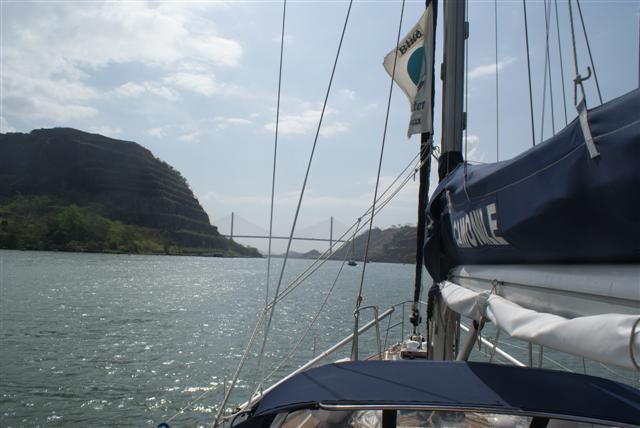
Gold hill in the Gaillard cut
We had to motor 20 miles across the lake to enter Gaillard cut where the Chagres river flows into the channel. Gaillard cut is 7.4 nautical miles long and is where the bulk of the canal excavation took place. It still undergoes a constant programme of widening to accommodate increasingly larger ships. We passed Gold hill in the cut where, during the excavations, it was rumoured to contain gold deep down in order to make the workers dig harder. On the Pacific side the three locks are separated.

Joining up with Natibou again for the Pedro Miguel lock
As we approached the first one, Pedro Miguel lock, we joined together in our raft again. We had heard on the radio that Gaultine III was catching us up but we weren’t allowed to wait for them. Miss Tippy and Blue Magic rafted together and we entered the lock. We were lowered 30feet to the Miraflores lake, a small artificial body of water that separates the two sets of locks. We motored across together in our rafts to the Miraflores locks. We waited 40 minutes in the lock for Gaultine III to catch up which enabled us to wave at the webcams but I don’t know whether any one saw us. There wasn’t time for Gaultine to join their raft so they had to tie alongside a small pleasure vessel that joined us in the locks. We were lowered to sea level in the last two locks.
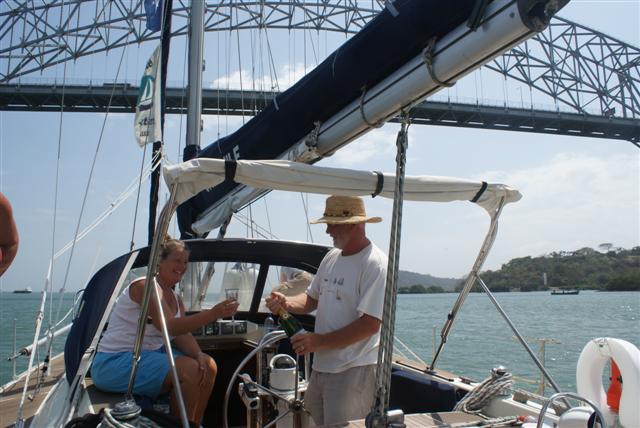
Champagne under the Bridge of the Americas
It was an emotional moment as the lock gates opened and we got our first view of the Pacific. It was 13.06 and the next part of our adventure was beginning. As we motored under the bridge of the Americas the champagne corks were flying.
 Camomile