Category Archives: Coastal cruising
Into the Bay of Plenty and onto Tuhua (aka Mayor Island)
The radio was handing out strong wind warnings and telling us to keep a sharp look out for containers spilt from the wreck of Rena which struck a well charted reef some 45 odd miles further into the bay doing 17 knots on what turned out to be the captain’s birthday.

Wreck of Rena
Hmmm should be interesting to see what the board of enquiry makes of that one.
Our Position on 27th January
37˚ 18.3 south
176˚ 15.4 east
Meantime the sky was grumpy as we set off from Tairua and the wind was whipping over our decks at 20 knots plus which made for a great downwind romp toMayor Island. I put the full cockpit cover up despite it making sail handling difficult because I really didn’t fancy a soaking in one of the squally downpours which were sporadically marching black and angry across our path. Bless the New Zealand summer.
Like most places hereaboutsMayorIslandis the proud owner of several names. The Mayor name was donated by Captain Cook when he sited it around Lord Mayors Day but it is also named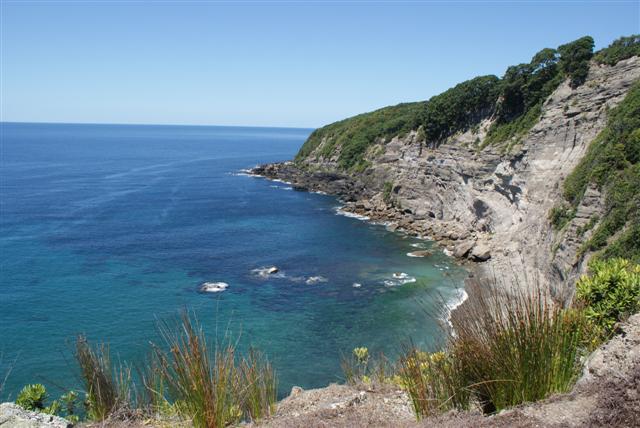 Opuahau on the chart of the area and yet when you arrive there the local warden knows it only as Tuhua. Frankly I think it’s all a cunning scheme to confuse Pommy yachtsmen. It certainly works on me.
Whatever it is called it had an imposing presence as we approached it in the half light of a torrential downpour. The island is quite steep along its coast and rises to 355 metres above sea level. It is believed to have risen from the sea about 7000 years ago but the most recent lava flows have been dated at between 500 and 1,000 years old which, slightly disturbingly, makes it merely dormant rather than extinct.

South East Bay
We turned into South East bay, the only permitted landing point on this protected private island and found that the there were only two other boats there. These looked like commercial fishermen taking a rest while their nearby recently placed crayfish pots filled. Good, we might get the place to ourselves. This turned out to be completely wrong as we did not consider that some misguided Kiwi politician had decided to make a public holiday out of the founding of nearbyAuckland. Yes we had arrived on Friday preceding a Monday bank holiday and yes we had company with up to 29 other boats cramming themselves into this tiny bay for the coming three days. I have to say that it was just likeBrittanyin August except that the Kiwi’s seem to know how to anchor in a tight spot without swinging annoyingly close. But then the sun came out so we didn’t care, we just enjoyed the crystal clear water of the sandy bay dappled by sunlight shining through trees hanging from the surrounding cliffs.
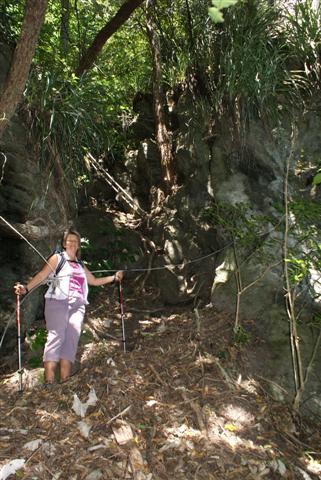
Ready to walk
There are walking tracks all over the island and the Maori warden was really helpful in advising us what level to go for once we had been through quarantine. Yes quarantine, they take pests seriously here as they have gone to a lot of trouble to clear out all the rats, cats, pigs etc. and really don’t want to do it again. You did get the feeling though that the rite of entering the quarantine room and having the door closed behind you also implied that this was a border control into Maori territory. It is highly likely that this was not designed exclusively to wind up white Kiwis (Pākehā as they are known to Maori) but some of them certainly don’t think much of it or the $5 landing charge. They were what is best described as vocal about their opinion. Once the warden had satisfied himself that I did not have any pigs or itinerant rodents in my backpack we decided to walk up to the rim and then down into the crater where there are two small lakes imaginatively called GreenLake and BlackLake.
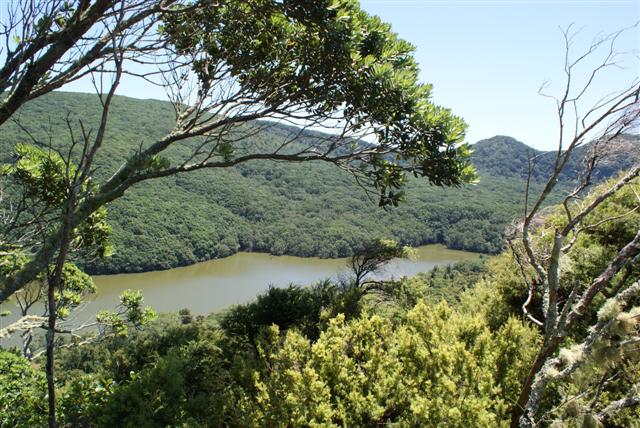
Coluld this be Green Lake?
This is because one is green and one is black. Do you think if they were not so busy giving three names to everything else they could have found something more interesting to call those lakes?The walking track was well marked but is what they call a “bush standard” inNew Zealand. This does not translate into Pom because our health and safety culture would not allow it to exist and even if it did no one would admit ownership of it in case some genius decided to sue them for straining a hair follicle while walking it. I find there is something really refreshing about walking tracks with steep gradients, tree roots sticking out everywhere, wasp’s nests on the path and cliff tracks you have to nearly abseil down using knotted rope lines. I suppose it is because you have to put real effort in and focus on what you are doing rather than shuffling along with a bovine gait in a semi coma induced by the lack of any interest because someone of infinite wisdom has removed from the path every conceivable obstacle or danger. Apart from dying of boredom that is.
The foliage on the slopes is dense so although it was a hot day the overhead cover provided a cool and pleasant environment for our trek even when the going got tough descending into the crater. There were trees all the way down to the lakes at

Cheers to DOC for the ladder
the bottom which were lined with all manner of vegetation but we were completely mystified by a noise sounding something like a herd of agitated cattle. We knew that this was impossible because we had both narrowly escaped breaking limbs getting down here therefore there was no chance of livestock making it. The mystery was solved by a botanist who happened to be walking the path when she explained that the lakes were full of frogs calling their mates.
The climb back out of the crater was easy until we got to the “Devils Staircase”. This was a steep assent along a very narrow ridge with a few chains and lengths of wire to steady you from the hundreds of feet sheer drop on both sides. In fairness though, they had planted a nice ladder on the really impassible bit.
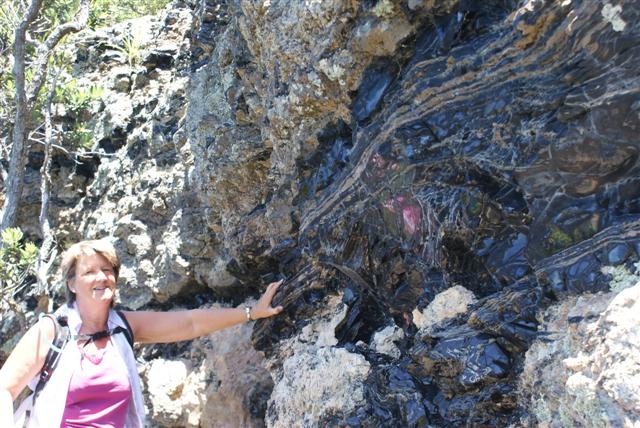
Volcanic black glass
Near this same part of the route we came across a huge vein of shiny black rock. This brittle substance is a volcanic glass called obsidian and is created by the rapid cooling of silica-rich lava. In ancient times it was highly prized by Maori as a cutting tool and called Tuhua from where the island gets one of its names. The spot we had come across was an ancient Maori quarry though there were many places along the track where we had seen this interesting material just lying on the ground or protruding from eroded rock faces.

Top of the Devils Staircase
Sue and I were really pleased with ourselves when we emerged at the top of the “Devils Staircase”, it was not so long ago when neither of us would have been fit enough to do it and by the time we got back to the beach we had been walking for four and a half hours which is also pretty good by our standards.
Sunday evening was spent in the pleasant company of Shelly and Wolfgang, from the visiting Botanic Society group. They have an idea that they might like to take up the cruising life one day and wanted to quiz us on our experiences so far and take a closer look at Camomile. It’s always a pleasure to have interested people on board and to have the opportunity to give potential cruisers the best advice we know. Stop making excuses, get on and do it now!
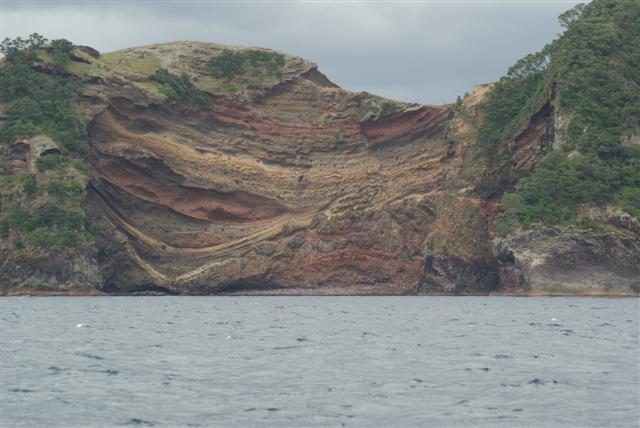
North coast
Camomile departed the island via the north to admire its spectacularly diverse coastal cliffs plunging from the rim of the caldera. The rich strata, veins of obsidian, lava flows, tubes, caves and arches are the island’s geological history written large for all to see. This place is a real jewel and to think that, for a time, it was only valued for its local game fishing.
Great Mercury

Camomile anchored in Coralie Bay with Motutaupiri headland behind
We found another piece of Kiwi Paradise as we entered Coralie Bay in the Mercury Islands, it was the best anchorage we have found in NZ so far. We had sailed from beautiful Little Bay first thing on the 24th January and our position was

and the view from the top
36º 36.3 south
175º 47.5 east
These islands are so named because Captain Cook was nearby when he observed the transit of Mercury which located New Zealands position accurately for the first time.
We went ashore and walked up the Motutaupiri headland that we passed on our way in, it gave astounding views of Camomile in the middle of the anchorage.
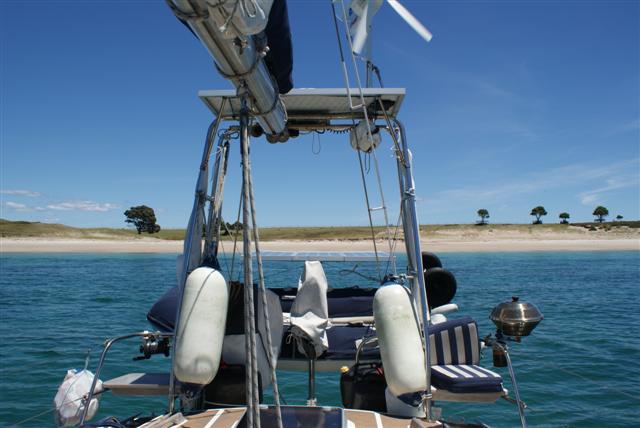
View of the beach from the cockpit
The next day we walked around to the headland on the other side.
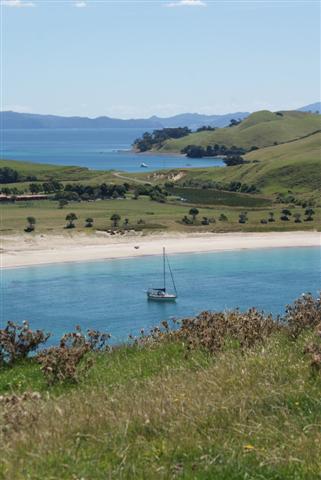
View to the other side of the island
As this was higher we were also able to get a superb view across to the other side of the island, the middle is very narrow.
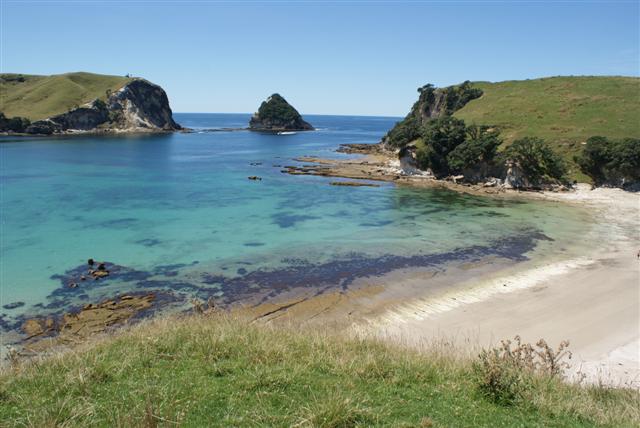
View across to the entrance

Beautiful rocks outside the entrance
Te Koru bay, the next bay along, had some wonderful rock pools to explore. The beach was deserted….

Te Koru bay
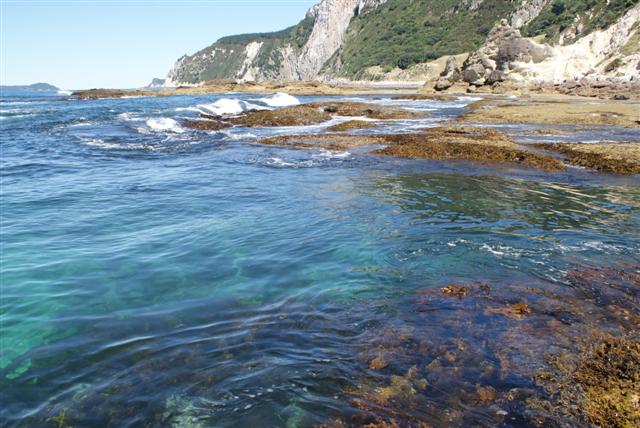
Beautiful clear water in Te Koru bay
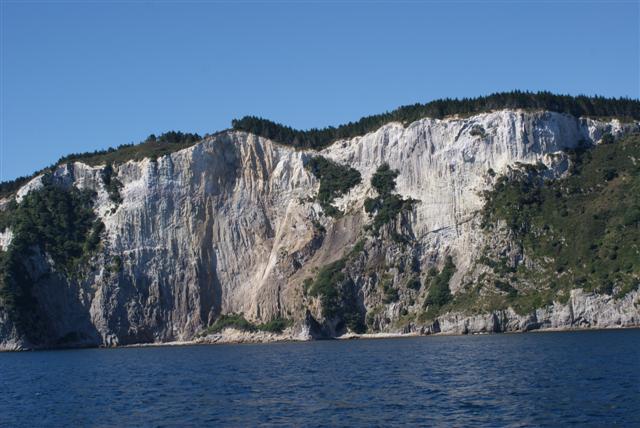
The White Cliffs of Mercury
The White cliffs outside of the bay were higher and whiter than the White cliffs of Dover.
We needed to keep travelling south while the wind was coming from the north so we left the next day.
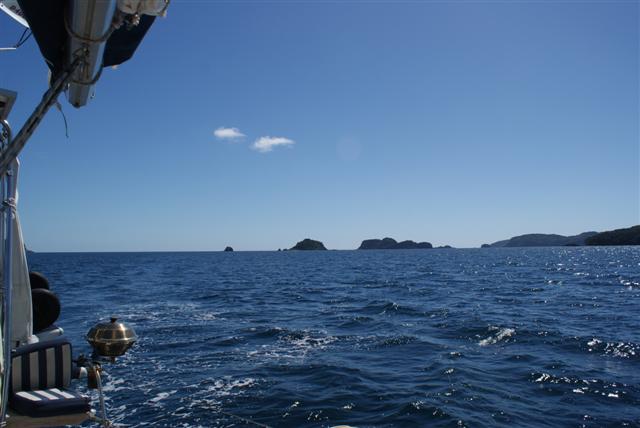
Sailing through the Mercury Islands
Sailing through the islands on a clear sunny day was amazing. We had an overnight stop in Tairua to stock up on provisions before continuing on to Tuhua (Mayor) island the next day. Bill will take up the story from here.
Of fridges and Auckland views from a volcanic rim
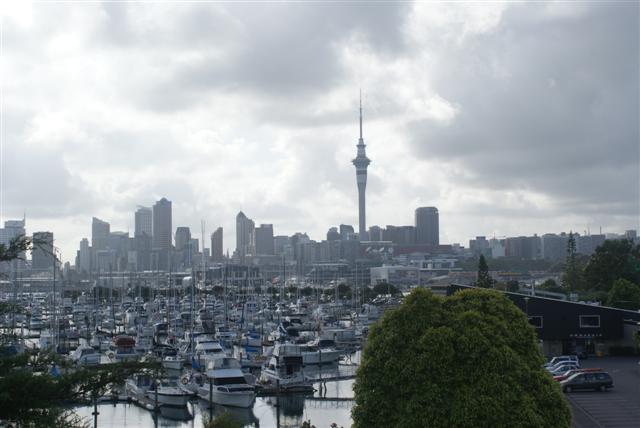
Camomile is somewhere among this sea of yachts in Westhaven marina
Our position on 4th January 2012
36˚50.1 south
174˚47.0 east
It had been great fun though a little crowed living 6 up on Camomile for 2 weeks while Kate, Barry, Will & Daisy stayed with us over Christmas but the time came for them to fly back home to Christchurch with what I sensed was some ambivalence. They looked forward to sleeping in a proper bed that you could get into from both sides and didn’t have to pack up in the morning, a shower which wasn’t preceded by a trek to find it and a toilet that flushed without blocking. On the other hand it had been a welcome break from the continuing earthquake aftershocks which now count 10,000.

Camomile dried out
So it was that, after bidding them all a fond farewell atAuckland’s Westhaven Marina, life returned to reality and it was time to re stock the boat after the visit of the gannets and start on the boat job list for a few days. This time it was the ancientWesterlyfridge which had been merrily sucking the batteries dry ever since we first entered the tropics. I had decided to water cool it but this involved drilling an epic size hole in the bottom of the hull and doing some fancy plumbing work. We (Norman from Norsa and I) put her up on her yacht legs and, as soon as the tide was out far enough, cut the hole and gummed a new seacock in place. It was then just a question of waiting for the tide to come in and hoping that nothing leaked.

The remodeled fridge
The wait was long and tense but all was well until Sue pointed out that with a new super efficient compressor I could now afford to remove some of the dummy insulation I had used to reduce the fridge box’s volume. This was an irritatingly accurate insight and is one that can only come from someone who has lived with an engineer for over 30 years as it is done in a fashion which overlooks that the stripping out and reforming the inside of a fiberglass lined fridge is a very unpleasant experience both for the engineer who itches fiberglass for days afterwards but also for anyone within earshot who is assaulted by the necessity of this sort of tasks requirement to be cursed into submission.
Job list slightly slimmed we now had to turn to slim ourselves because somehow we needed to pay for all the lbs the clotted cream and booze had distributed around our waists over our Christmas and New Year with our Christchurch tribe on board with us.
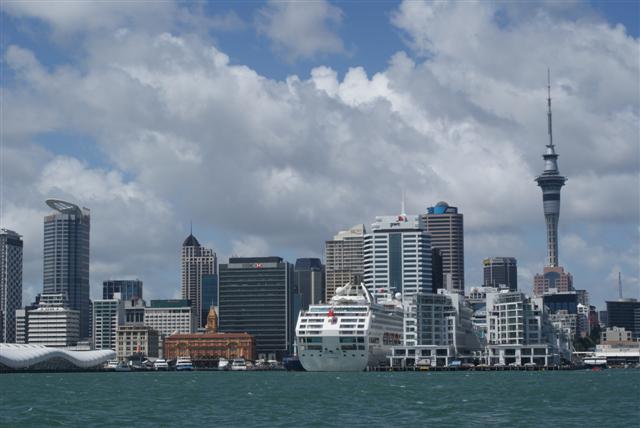
Our last view of Auckland waterfront
Some walking seemed in order so we set off on the short sail across the bay towards the broad, squat profile of Rangitoto and rounded into Islington bay on the Eastern side of the island, a popular sheltered anchorage with good holding, dropping the hook for an overnight stay.
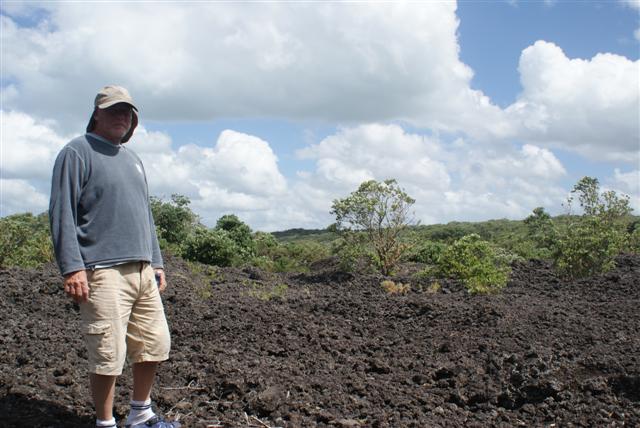
Walking across the lava fields
The following morning we set off on the 4 hour return walk up the 850ft summit and back. From the sea the island had the look of any other island hereabouts, green and verdant albeit that this one has that distinctive cone shape across its 5.5 km girth. As we trudged along the track it soon revealed it’s true nature as the scrubby, low brush and trees could be seen to be clinging to widening areas of unforgiving bare jagged black clinker lava flows. Rangitoto is Maori for ‘Bloody Sky’ and that this is named by the local Iwi (tribe) is a reminder that the ground was hot and moving a mere 600 years ago. And it is big. The 2.3 cubic kilometers of material which erupted from the volcano was about equal to the combined mass produced by all the previous eruptions in the Auckland Volcanic Field, which were spread over more than 250,000 years. Happily this volcano is not expected to become active again, although future eruptions are likely within the volcanic field is a source of some understandable preoccupation by Aucklanders.
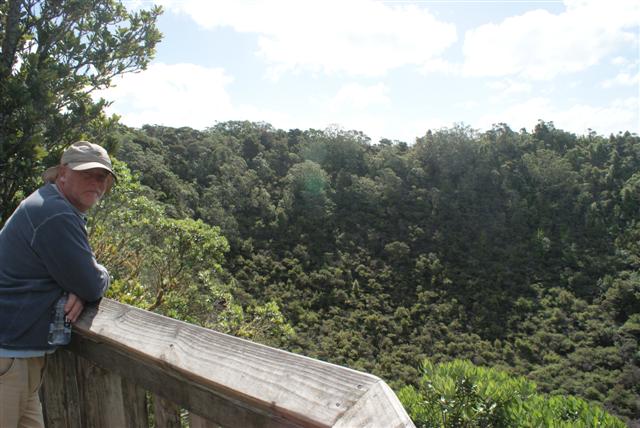
View of the crater
As we approached the summit the flows disappeared to be replaced with ash soil, loose and piled up on such an angle as to make the climb difficult and dangerous. The Department of Conservation has built a wooden walkway cum staircase however which makes the final assent feasible and pleasant as it winds around the base of the summit revealing tantalizing glimpses of the surrounding islands and sea.
Arriving at the rim there is a viewing point where you can observe the crater which, due to lingering volcanic gasses only became covered in foliage in the last 100 years as they finally dispersed.

Relaxing
At last the summit gave up it’s superb 360 degree views of the area with Auckland in the distance and the added interest that it formed a defense battery spotting and command centre during WWII (though it happily saw no action). Well worth the climb! Subsidence back down the throat during the cooling process has left a classic rim around the crater summit where a path has been formed allowing us to circumnavigate it as we began our decent back to the anchorage. Feeling as if we might have burned a couple of calories we arrived back at the small wharf in the gathering dusk and met a lady who was on holiday in a friend’s bache (a small holiday house). She told us how some of these were built around the island’s edge in the 1920s and 1930s but were later banned as the island become a scenic reserve though apparently some 30 of the original 140 baches remain and are preserved to show how the island used to be. People really find paradise in the most improbable places don’t they?

View from the top
 Camomile