Category Archives: Port posts
The Great Barrier (Aotea)
We could not resist a quick circuit of what Sue christened “Millionaires Row” as we picked up the hook from our last overnight stop in Great Mercury Island. For us, these few isolated waterfront mansions in their sheltered bay had to be some of the most desirable on the planet. No doubt their price tags reflected our sentiment.
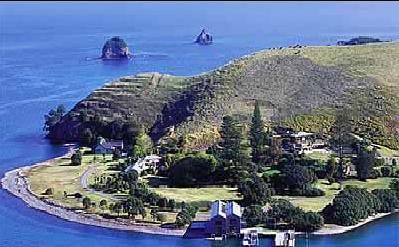
Millionaires Row
Our position on 7th February 2012
36º 18.7 south
175º 35.9 east
Sailing north with 20 knots of wind over our transom we were reminded of our Pacific crossing ( https://yachtcamomile.wordpress.com/2010/04/14/pacific-crossing/ ) by the heavy rolling movement of the boat. In these seas the most innocent everyday items placed on a horizontal surface instantly transform themselves into vicious ballistic missiles bruising crew and denting woodwork on their flight towards the cabin sole where they skitter around wildly until restrained.
We weren’t the only sailing boat on our way to GreatBarrierIslandand they all looked to be having about the same ride. Aotea is New Zealand’s 6th largest island and is only 62 miles north east of Aucklandmaking it extremely popular during the Christmas break hence Camomile arriving in February. The remote island was initially exploited by Europeans for its minerals and kauri trees, saw only limited agriculture and is now inhabited by a small population of around 1000 people. The island’s European name, allegedly donated by that man Cook again, stems from its location on the outskirts of the Hauraki Gulf. With its length (north-south) of some 27 miles it and the Coromandel Peninsula protect the gulf from the storms of the Pacific Ocean to the east.
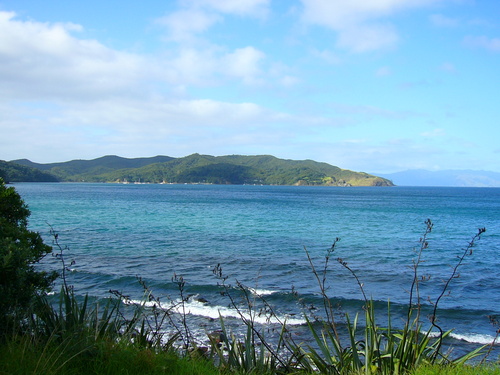
Tryphena Bay
The western coast, sheltered and calm, is home to hundreds of tiny, secluded bays which offer some of the best diving and boating in the country.
We headed for Tryphena as we had arranged to rendezvous there with Norsa (our Blue Water Rally friends) who had been on a road trip inSouth Island. Anchoring up near one of the nicest beached we have yet visited I noticed that one of the yachts following us was having some difficulty getting its sails down. As I looked on I guessed that they had engine trouble so dropped the dinghy and headed out to where they were trying to anchor in an unsheltered part of the bay. The skipper of Manuwai confirmed that his gearbox had failed so I offered to push him to shelter so he could anchor up and sort it out. Kiwi’s are famous for saying what they mean and the three men in this boat were no exception as they commented skeptically on my outboard and their 12 tonnes.
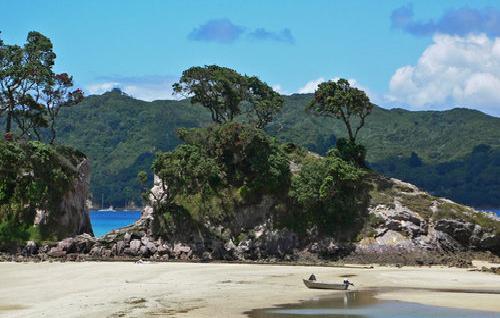
Tryphena Beach
I told them that if my tender could push a 20 metre Spanish Amel (Bionic Un) I could probably help them so our dinghy was soon strapped to their side with my 8hp outboard opened right up. To everybody’s surprise this pushed them through the chop at 2-3 knots and they were soon anchored up and ready to get oily in their engine bay. Some time later they passed by in their small inflatable and explained their hydraulics had leaked but had found that they could still select gears manually at the box, they chatted for a while and then departed having very thoughtfully donated a nice bottle of wine.

Tryphena sunset
The following day Norsa arrived, we had some time on the shore and a lovely evening on board hearing of theirSouth Islandexploits. As the sun set over the beautiful lagoons on the sandy beach we were looking forward to exploring this island with them. I also reflected on converting outboard fuel into wine, not a bad bit of alchemy I thought.
Whitianga, Arches and Hot Beaches
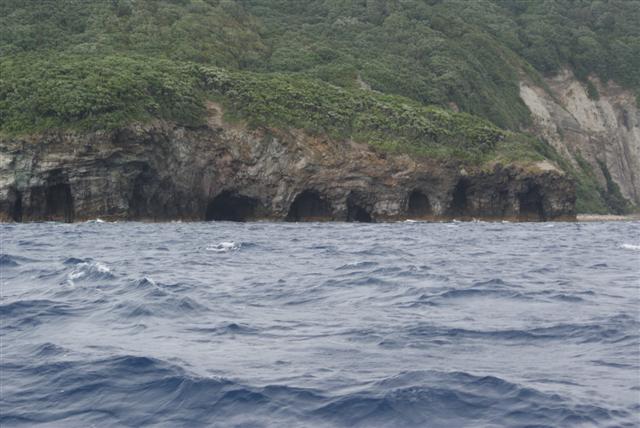
Lava tubes north of Mayor Island
Mayor Island in the Bay of Plenty was as far south as we intended to go this year, indeed it’s as far south as we will ever go at 37º 18 south. Sydneyis 34º south and South Africa is about 36º south, if we end up going that way. We are now making our way inexorably further north towards home. The east wind was giving us a pleasant sail north with a great view of Crater bay just below the devil’s staircase that we had viewed from the top the day before. The Lava tubes around the north of the island were also interesting. It was a cloudy day with a lumpy sea but the island was soon left behind. We arrived at Matapaua bay outside Whitianga just after 4pm. The next day we motored into Whitianga for a couple of days in the marina.
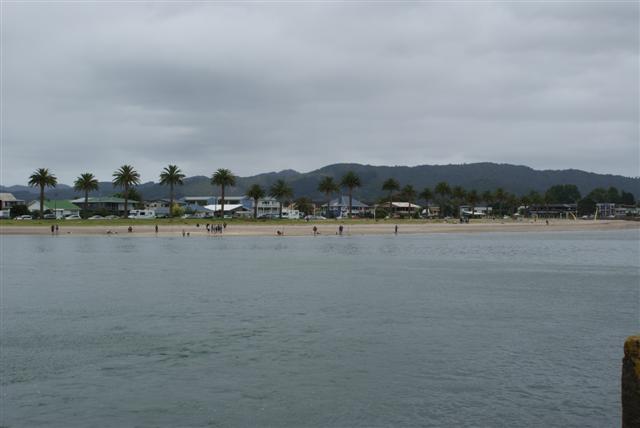
Whitianga Seafront
Our position on 31st January 2012
36º 50.1 south
175º 42.4 east
The usual domestic chores were catching up with me such as piles of washing, and the marina is very conveniently within walking distance of a nice big New World(NZ Sainsbury’s). I like to stock the boat up at the beginning of the month with enough food to last the month, which meant a couple of trips. I also had a much needed hair cut.
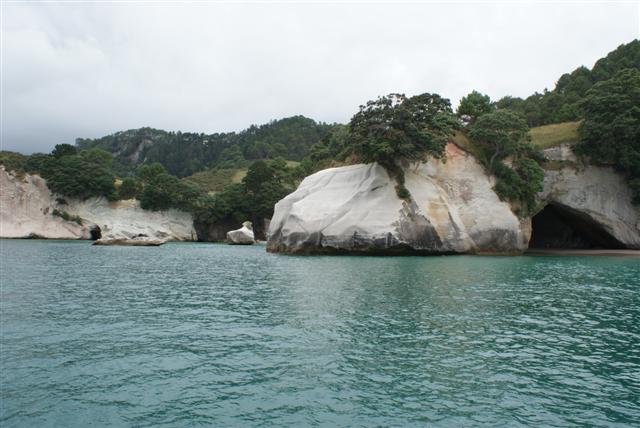
Cathedral Cove
Before leaving the marina I met up with a very nice lady I had met in Seoul on my way home to the UK in June. Rae had given me her address and suggested we meet up when I reached Whitianga. We met in a local coffee shop and caught up with our news. I invited her back to the boat to have a look around and she offered to take us out in the car so we agreed to meet on Saturday.
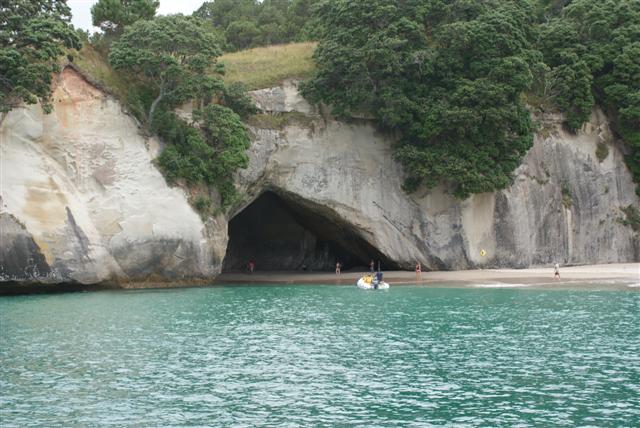
The Arch that gives Cathedral Cove its name.
We left the marina, having topped up the water and diesel tanks, for the short trip around to Cathedral Cove. Unfortunately the weather had turned against us again and our lovely sunshine had changed into cloudy skies with an easterly breeze making life on the East coast very difficult. We had the anchorage to ourselves, which wasn’t surprising because there was quite a swell running. Even without the sun it was still a spectacular spot. We launched the dinghy and landed on the beach.

Velvety beach in Cathedral Cove
The sand was very velvety under our feet and the rock formations around the bay were amazing.

Camomile through the Arch
We walked through the arch to another picturesque beach on the other side with steps up the cliffs leading to a breathtaking cliff top walk with views over Gemstone bay and Stingray bay. Some of the scenes from the film Prince Caspian of the Narnia stories were shot on this coastline. We didn’t want to leave Camomile alone for very long because the swell was quite bad so returned quickly.
We moved to the more sheltered Cooks beach. On the 9th November 1769 Cook was reminded by Charles Green the astronomer that it would be possible to observe the transit of the planet Mercury as it passed over the face of the sun and Cook would be able to accurately fix the longitude of New Zealand. The day dawned fine and calm. Cook went ashore with Green and their astronomical instruments and successfully carried out the observation on the beach, now named Cooks beach, which is in Mercury bay. Unfortunately the swell was curling around the headland and gave us a very unsettled night so the next morning we motored back into Whitianga and anchored out in the harbour.
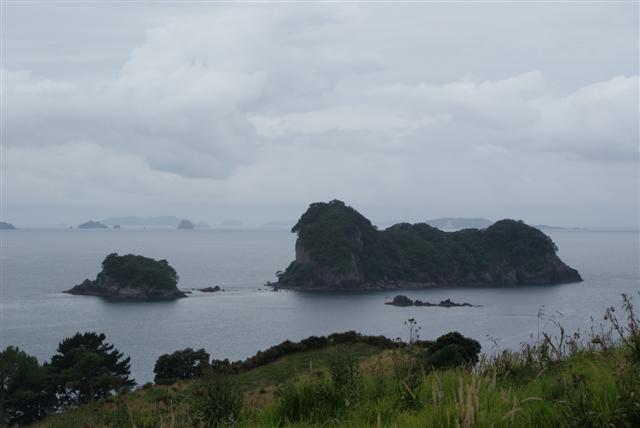
Maherangi Island from the Cliff top
On the Saturday morning we took the dinghy ashore to meet Rae at 9am.
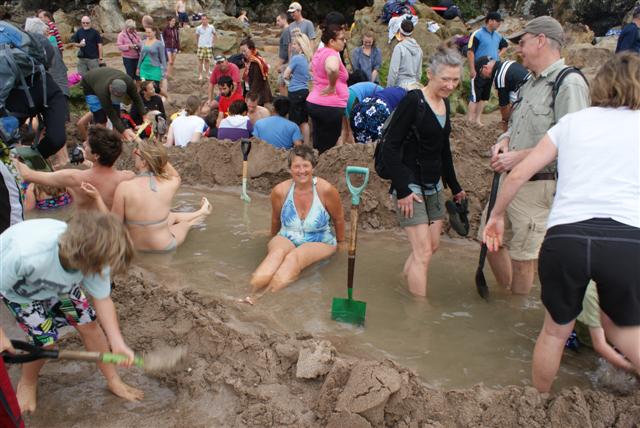
My 'Spa' on Hot Water beach
We had agreed to go to Hot Water beach where it’s possible to dig into the sand, tap into thehot springsand create your own thermal pool an hour either side of low tide. The low tide was at midday and as it was about a half hour drive we needed to get going. Although it was a cloudy day the beach was packed. There’s only a very small area of beach that has the warm sand and everyone was trying to get their little patch. Rae had brought her garden spade and Bill started to dig my ‘spa’. In some areas the sand was really hot under the surface and the water was warming up nicely but the easterly swell was causing waves to crash over the top of my sand hollow bringing in the cold sea. It was great fun but we wanted to get on so after a quick change left the beach.

This is where Camomile had been anchored
Rae drove us to the Hahei beach area; it had a viewpoint over Cathedral cove where Camomile had been anchored the day before, and along Cooks beach. We stopped for a lovely lunch before driving back to Whitianga. It always feels strange being driven in a car after travelling at 6mph everywhere.
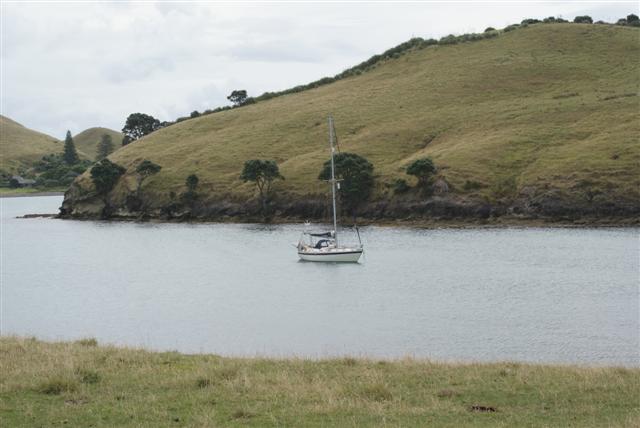
Camomile anchored in Parapara bay, Mercury Islands
We couldn’t get out of Whitianga until the Monday when the swell had dropped. Once out of Mercury bay we turned north to go back to the western side of the Mercury islands for an overnight stay.
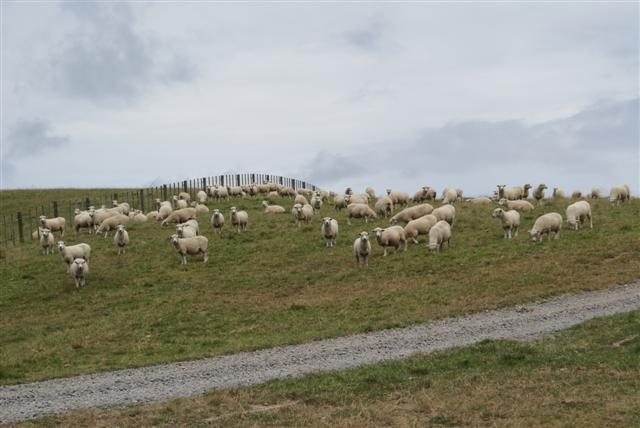
There are a lot of sheep on Mercury Island
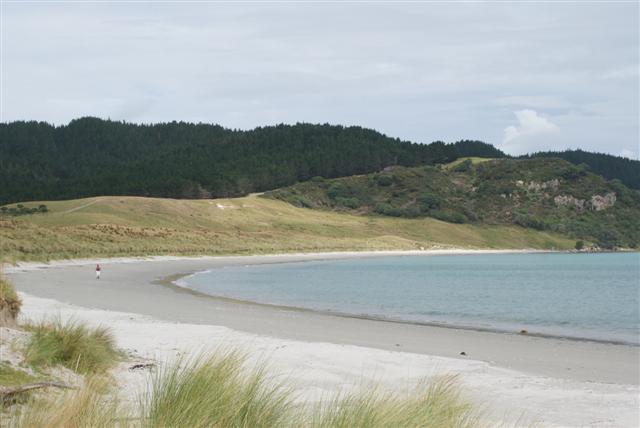
I was the only one on the beach
Into the Bay of Plenty and onto Tuhua (aka Mayor Island)
The radio was handing out strong wind warnings and telling us to keep a sharp look out for containers spilt from the wreck of Rena which struck a well charted reef some 45 odd miles further into the bay doing 17 knots on what turned out to be the captain’s birthday.

Wreck of Rena
Hmmm should be interesting to see what the board of enquiry makes of that one.
Our Position on 27th January
37˚ 18.3 south
176˚ 15.4 east
Meantime the sky was grumpy as we set off from Tairua and the wind was whipping over our decks at 20 knots plus which made for a great downwind romp toMayor Island. I put the full cockpit cover up despite it making sail handling difficult because I really didn’t fancy a soaking in one of the squally downpours which were sporadically marching black and angry across our path. Bless the New Zealand summer.
Like most places hereaboutsMayorIslandis the proud owner of several names. The Mayor name was donated by Captain Cook when he sited it around Lord Mayors Day but it is also named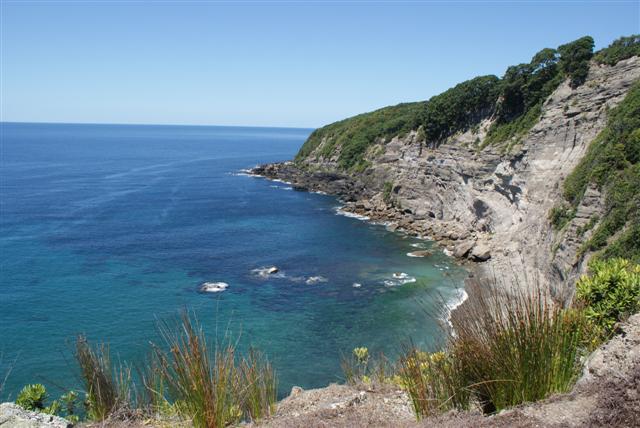 Opuahau on the chart of the area and yet when you arrive there the local warden knows it only as Tuhua. Frankly I think it’s all a cunning scheme to confuse Pommy yachtsmen. It certainly works on me.
Whatever it is called it had an imposing presence as we approached it in the half light of a torrential downpour. The island is quite steep along its coast and rises to 355 metres above sea level. It is believed to have risen from the sea about 7000 years ago but the most recent lava flows have been dated at between 500 and 1,000 years old which, slightly disturbingly, makes it merely dormant rather than extinct.

South East Bay
We turned into South East bay, the only permitted landing point on this protected private island and found that the there were only two other boats there. These looked like commercial fishermen taking a rest while their nearby recently placed crayfish pots filled. Good, we might get the place to ourselves. This turned out to be completely wrong as we did not consider that some misguided Kiwi politician had decided to make a public holiday out of the founding of nearbyAuckland. Yes we had arrived on Friday preceding a Monday bank holiday and yes we had company with up to 29 other boats cramming themselves into this tiny bay for the coming three days. I have to say that it was just likeBrittanyin August except that the Kiwi’s seem to know how to anchor in a tight spot without swinging annoyingly close. But then the sun came out so we didn’t care, we just enjoyed the crystal clear water of the sandy bay dappled by sunlight shining through trees hanging from the surrounding cliffs.
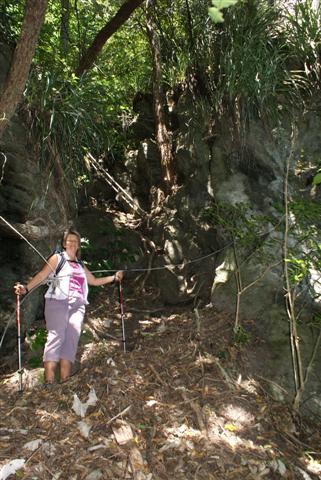
Ready to walk
There are walking tracks all over the island and the Maori warden was really helpful in advising us what level to go for once we had been through quarantine. Yes quarantine, they take pests seriously here as they have gone to a lot of trouble to clear out all the rats, cats, pigs etc. and really don’t want to do it again. You did get the feeling though that the rite of entering the quarantine room and having the door closed behind you also implied that this was a border control into Maori territory. It is highly likely that this was not designed exclusively to wind up white Kiwis (Pākehā as they are known to Maori) but some of them certainly don’t think much of it or the $5 landing charge. They were what is best described as vocal about their opinion. Once the warden had satisfied himself that I did not have any pigs or itinerant rodents in my backpack we decided to walk up to the rim and then down into the crater where there are two small lakes imaginatively called GreenLake and BlackLake.
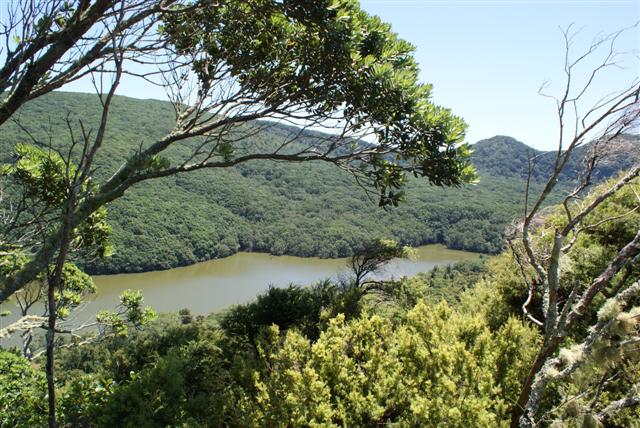
Coluld this be Green Lake?
This is because one is green and one is black. Do you think if they were not so busy giving three names to everything else they could have found something more interesting to call those lakes?The walking track was well marked but is what they call a “bush standard” inNew Zealand. This does not translate into Pom because our health and safety culture would not allow it to exist and even if it did no one would admit ownership of it in case some genius decided to sue them for straining a hair follicle while walking it. I find there is something really refreshing about walking tracks with steep gradients, tree roots sticking out everywhere, wasp’s nests on the path and cliff tracks you have to nearly abseil down using knotted rope lines. I suppose it is because you have to put real effort in and focus on what you are doing rather than shuffling along with a bovine gait in a semi coma induced by the lack of any interest because someone of infinite wisdom has removed from the path every conceivable obstacle or danger. Apart from dying of boredom that is.
The foliage on the slopes is dense so although it was a hot day the overhead cover provided a cool and pleasant environment for our trek even when the going got tough descending into the crater. There were trees all the way down to the lakes at

Cheers to DOC for the ladder
the bottom which were lined with all manner of vegetation but we were completely mystified by a noise sounding something like a herd of agitated cattle. We knew that this was impossible because we had both narrowly escaped breaking limbs getting down here therefore there was no chance of livestock making it. The mystery was solved by a botanist who happened to be walking the path when she explained that the lakes were full of frogs calling their mates.
The climb back out of the crater was easy until we got to the “Devils Staircase”. This was a steep assent along a very narrow ridge with a few chains and lengths of wire to steady you from the hundreds of feet sheer drop on both sides. In fairness though, they had planted a nice ladder on the really impassible bit.
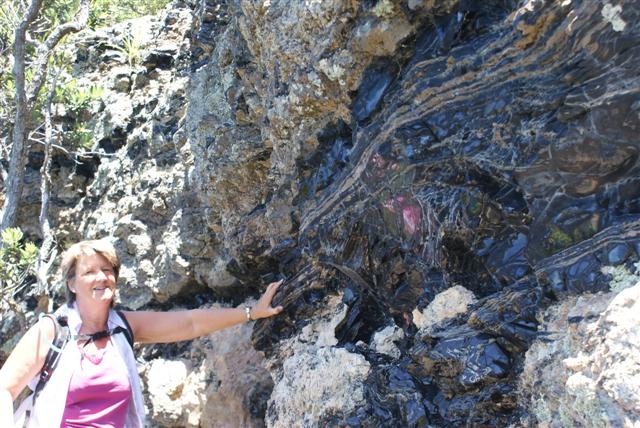
Volcanic black glass
Near this same part of the route we came across a huge vein of shiny black rock. This brittle substance is a volcanic glass called obsidian and is created by the rapid cooling of silica-rich lava. In ancient times it was highly prized by Maori as a cutting tool and called Tuhua from where the island gets one of its names. The spot we had come across was an ancient Maori quarry though there were many places along the track where we had seen this interesting material just lying on the ground or protruding from eroded rock faces.

Top of the Devils Staircase
Sue and I were really pleased with ourselves when we emerged at the top of the “Devils Staircase”, it was not so long ago when neither of us would have been fit enough to do it and by the time we got back to the beach we had been walking for four and a half hours which is also pretty good by our standards.
Sunday evening was spent in the pleasant company of Shelly and Wolfgang, from the visiting Botanic Society group. They have an idea that they might like to take up the cruising life one day and wanted to quiz us on our experiences so far and take a closer look at Camomile. It’s always a pleasure to have interested people on board and to have the opportunity to give potential cruisers the best advice we know. Stop making excuses, get on and do it now!
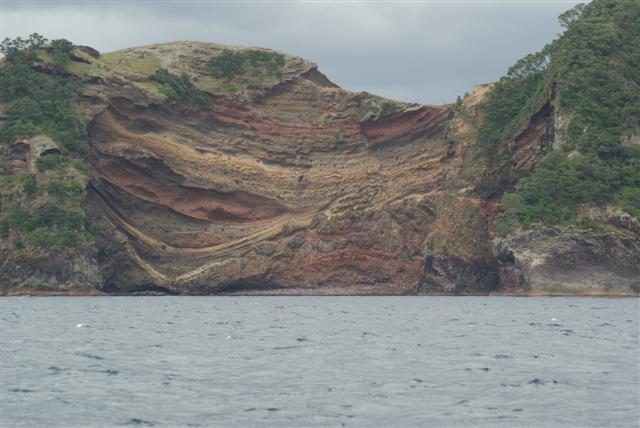
North coast
Camomile departed the island via the north to admire its spectacularly diverse coastal cliffs plunging from the rim of the caldera. The rich strata, veins of obsidian, lava flows, tubes, caves and arches are the island’s geological history written large for all to see. This place is a real jewel and to think that, for a time, it was only valued for its local game fishing.
Great Mercury

Camomile anchored in Coralie Bay with Motutaupiri headland behind
We found another piece of Kiwi Paradise as we entered Coralie Bay in the Mercury Islands, it was the best anchorage we have found in NZ so far. We had sailed from beautiful Little Bay first thing on the 24th January and our position was

and the view from the top
36º 36.3 south
175º 47.5 east
These islands are so named because Captain Cook was nearby when he observed the transit of Mercury which located New Zealands position accurately for the first time.
We went ashore and walked up the Motutaupiri headland that we passed on our way in, it gave astounding views of Camomile in the middle of the anchorage.
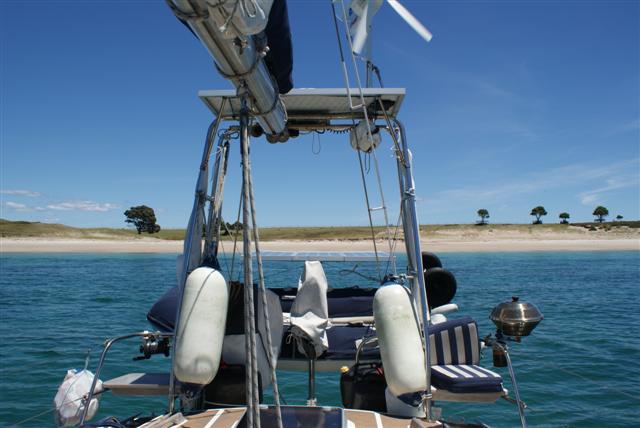
View of the beach from the cockpit
The next day we walked around to the headland on the other side.
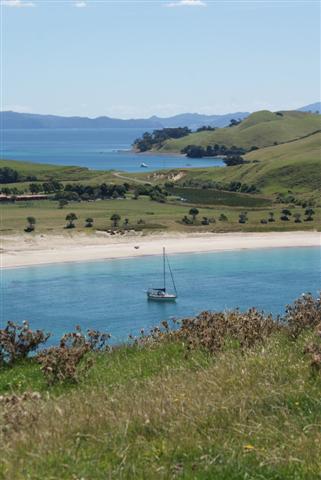
View to the other side of the island
As this was higher we were also able to get a superb view across to the other side of the island, the middle is very narrow.
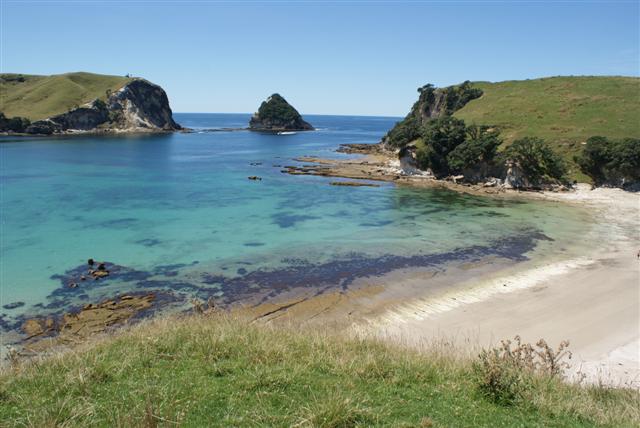
View across to the entrance

Beautiful rocks outside the entrance
Te Koru bay, the next bay along, had some wonderful rock pools to explore. The beach was deserted….

Te Koru bay
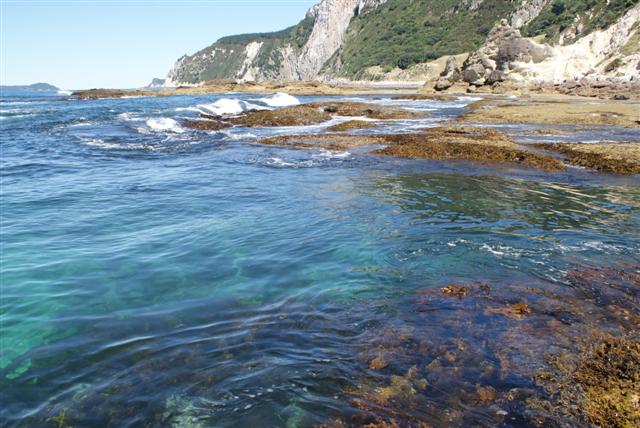
Beautiful clear water in Te Koru bay
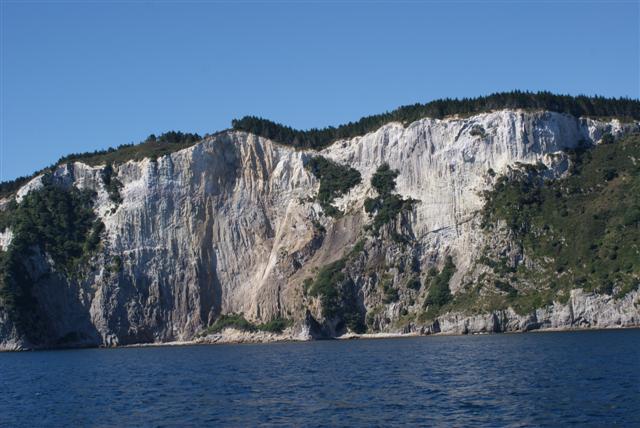
The White Cliffs of Mercury
The White cliffs outside of the bay were higher and whiter than the White cliffs of Dover.
We needed to keep travelling south while the wind was coming from the north so we left the next day.
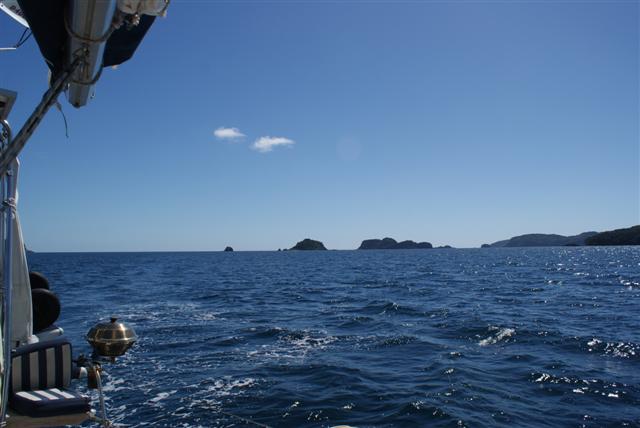
Sailing through the Mercury Islands
Sailing through the islands on a clear sunny day was amazing. We had an overnight stop in Tairua to stock up on provisions before continuing on to Tuhua (Mayor) island the next day. Bill will take up the story from here.
Around the Coromandel Peninsular
As we left Rangitoto island turning Camomile south, we passed Motuihe island where we had enjoyed our Christmas celebrations then continued East through the Tamaki strait south of Waiheke Island. A lovely sail in a brisk northerly across the southeast Hauraki gulf took us into Te Kouma harbour.
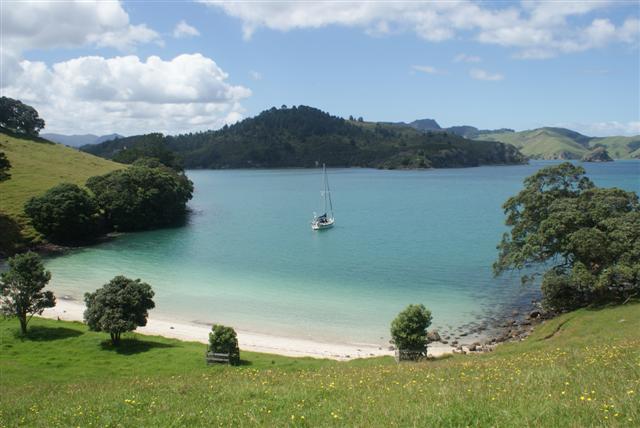
West bay in Te Kouma harbour
Our position on 15th January
36º 49.32 south
175º 25.56 east
We picked West bay to anchor because it would shelter us from the north winds and luckily there was no one else there. Te Kouma is arguably the most picturesque harbour on the Western Coromandel and the white sandy beach of West bay was stunning. Bill dropped the dinghy and we went ashore to explore.

The cow and calf islands
The bay was surrounded by hills, which we climbed to gain amazing views of Camomile and the little islands we had just passed including the Cow and the smaller Calf islands.
We also had a brilliant view up the neighbouring Coromandel harbour.
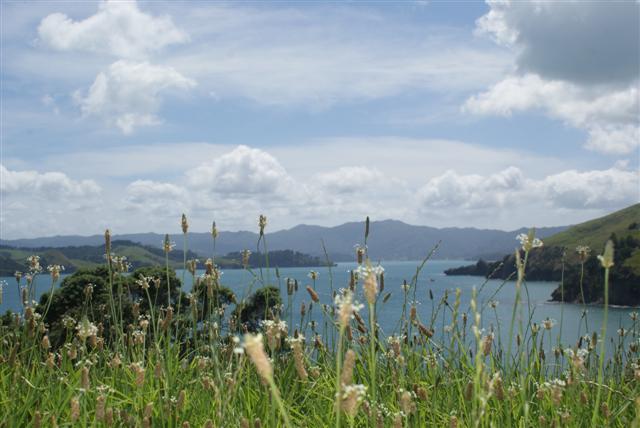
View up Coromandel harbour
Up to this point I hadn’t swam in the sea in NZ. Bill has snorkelled over the anchor a few times but I’ve managed to avoid it because the sea hasn’t been warm enough for me. The next morning as the sea temperature has now risen to 22C and the sun was out I decided to give it a try. It felt cold when I first got in but I managed to swim to the beach then swam back again. Bill and I swam to the beach together and sunbathed for a while before swimming back. The summer hasn’t been very good in NZ this year so hopefully this is the start of the good weather everyone has been waiting for.
Our position on 17th January
36º 45.9 south
175º 28.2 east
We motored the 6 miles around to Coromandel harbour with the main town of the peninsular, also called Coromandel, a short dinghy ride up the river at high tide. A lot of the townships in NZ are one street towns with a small selection of shops and cafes, Coromandel wasn’t an exception. We walked up one side and down the other as we selected somewhere nice to have lunch. I wanted a salad and Bill wanted a burger, fortunately we found one of the cafes serving just that.
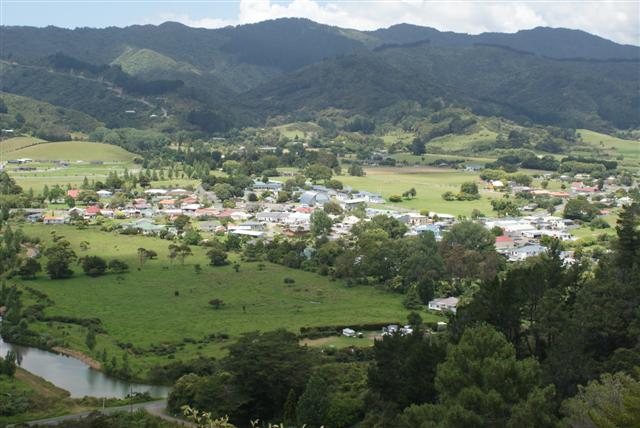
A view over Coromandel town
After lunch we walked the Harrey track. The area was regenerating bush with planted Kauri trees. Part of the area has been dedicated to Christchurch with a plague with names of the poor people who had perished in the recent earthquakes, a touching sight. A sidetrack led to a Maori ‘Pa’ site with spectacular views over the town and the anchorage. The track continued inland up hill and down dale, including lots of steps up and down inbetween, for a couple of hours finishing at the top of the town after which we walked back down through the town to the dinghy and back to the boat for a well earned cup of tea. Our friends Stefan and Silva on Meditteraneo from the ICA rally came into the anchorage, it was nice to see a familiar face. They came over for drinks that evening and we had a great time catching up. We left Coromandel harbour on Friday but the wind had dropped so we anchored overnight off Waimate island for favourable winds promised the next day.
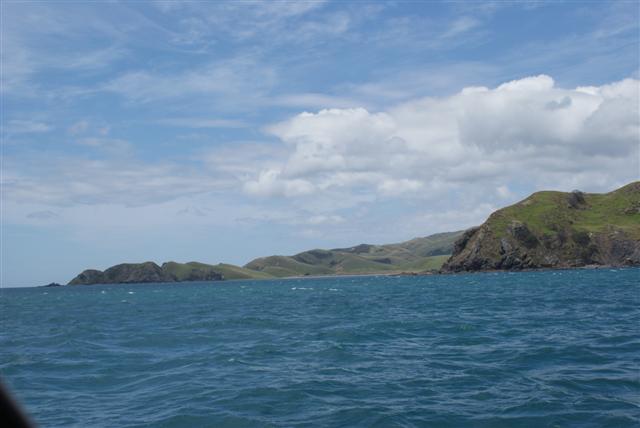
Sailing up the western Coromandel
On Saturday although the wind was light it was coming from our aft quarter, which would give us a nice broad reach. We left the anchorage just after 9.00. The main sail was raised straight away while Bill busied himself getting the cruising chute out, commonly called ‘The Green Thing’. After deploying it and turning the engine off the speed dropped to 3kts but it was a beautiful day and we weren’t in a hurry. We gently sailed north towards Cape Colville, a bit of a notorious corner but as the wind was light we assumed it would be ok. Second rule of boating never assume a passage is going to be easy (first rule of boating – pointy end forward!).
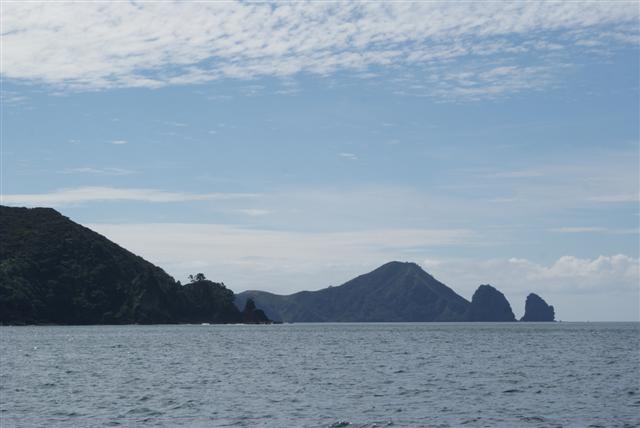
Cape Colville
As we approached the cape we put the ‘green thing’ away since the wind picked up. The chart shows over falls around the headland that usually means confused seas. The wind was still coming from behind but the tide turned against us resulting in wind against tide and caused the sea to become choppy. We motored for a half hour or so to get through it, thankful that the wind wasn’t very strong. I wouldn’t like to make the journey in strong headwinds or higher seas. Once on the other side the sea calmed down and all was wonderful again. We anchored in Port Charles just after 17.00
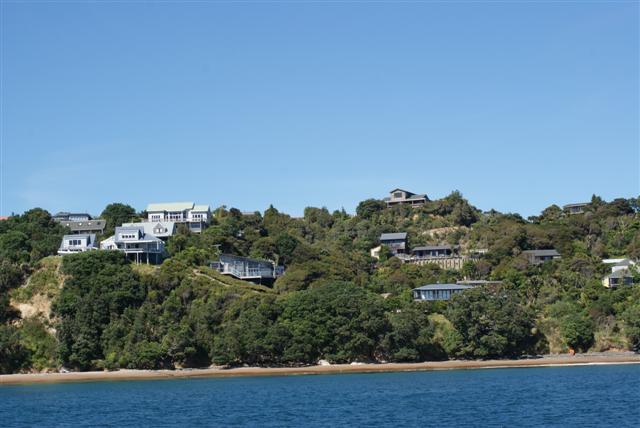
Baches in Little Bay
Our position 21st January
36º 31.4 south
175º 27.6 east
Port Charles looked like it might be interesting but there was a swell coming into the bay. The next day we decided not to attempt to land the dinghy but moved on to the next bay called Waikawau bay. We dropped our anchor in the little bay next door called, appropriately, Little Bay. Unfortunately the swell followed us, along with some rain, so we stayed on board for the third day running. Monday morning dawned with blue skies and sun but also, more importantly, the swell had dropped. The dinghy was lowered and we went ashore to explore. The hills surrounding the bay were covered in bachs (NZ holiday homes).
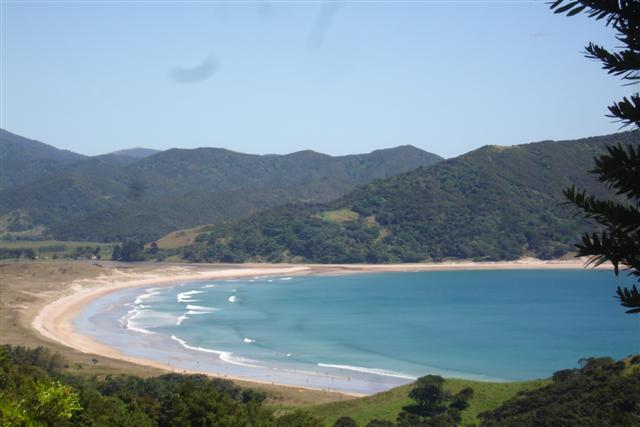
Waikawau bay
We walked up in between them and followed the road out into the country. There were amazing views of the neighbouring bay from the top. When we returned it was such a beautiful day that we sunbathed on the beach. Any one would think we were on holiday!!
Of fridges and Auckland views from a volcanic rim
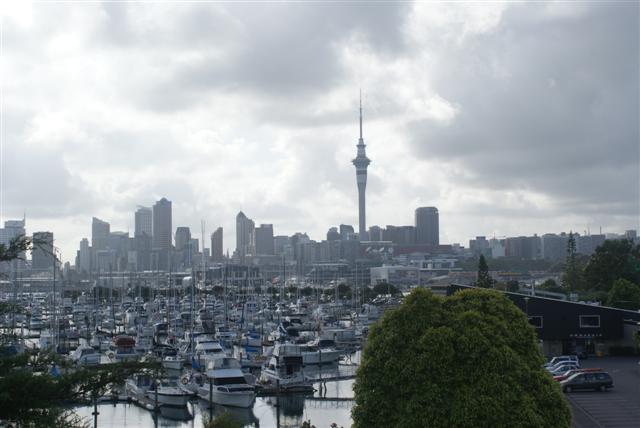
Camomile is somewhere among this sea of yachts in Westhaven marina
Our position on 4th January 2012
36˚50.1 south
174˚47.0 east
It had been great fun though a little crowed living 6 up on Camomile for 2 weeks while Kate, Barry, Will & Daisy stayed with us over Christmas but the time came for them to fly back home to Christchurch with what I sensed was some ambivalence. They looked forward to sleeping in a proper bed that you could get into from both sides and didn’t have to pack up in the morning, a shower which wasn’t preceded by a trek to find it and a toilet that flushed without blocking. On the other hand it had been a welcome break from the continuing earthquake aftershocks which now count 10,000.

Camomile dried out
So it was that, after bidding them all a fond farewell atAuckland’s Westhaven Marina, life returned to reality and it was time to re stock the boat after the visit of the gannets and start on the boat job list for a few days. This time it was the ancientWesterlyfridge which had been merrily sucking the batteries dry ever since we first entered the tropics. I had decided to water cool it but this involved drilling an epic size hole in the bottom of the hull and doing some fancy plumbing work. We (Norman from Norsa and I) put her up on her yacht legs and, as soon as the tide was out far enough, cut the hole and gummed a new seacock in place. It was then just a question of waiting for the tide to come in and hoping that nothing leaked.

The remodeled fridge
The wait was long and tense but all was well until Sue pointed out that with a new super efficient compressor I could now afford to remove some of the dummy insulation I had used to reduce the fridge box’s volume. This was an irritatingly accurate insight and is one that can only come from someone who has lived with an engineer for over 30 years as it is done in a fashion which overlooks that the stripping out and reforming the inside of a fiberglass lined fridge is a very unpleasant experience both for the engineer who itches fiberglass for days afterwards but also for anyone within earshot who is assaulted by the necessity of this sort of tasks requirement to be cursed into submission.
Job list slightly slimmed we now had to turn to slim ourselves because somehow we needed to pay for all the lbs the clotted cream and booze had distributed around our waists over our Christmas and New Year with our Christchurch tribe on board with us.
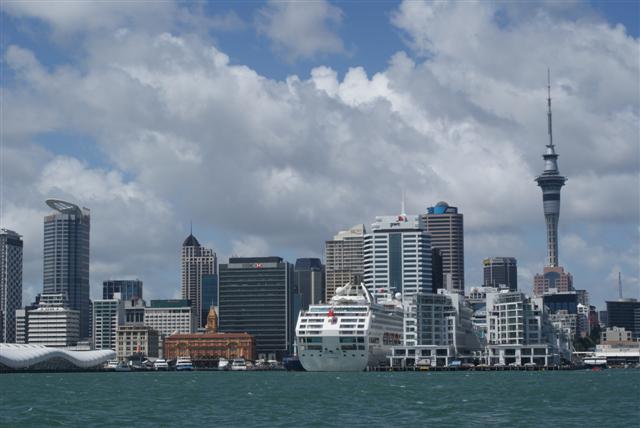
Our last view of Auckland waterfront
Some walking seemed in order so we set off on the short sail across the bay towards the broad, squat profile of Rangitoto and rounded into Islington bay on the Eastern side of the island, a popular sheltered anchorage with good holding, dropping the hook for an overnight stay.
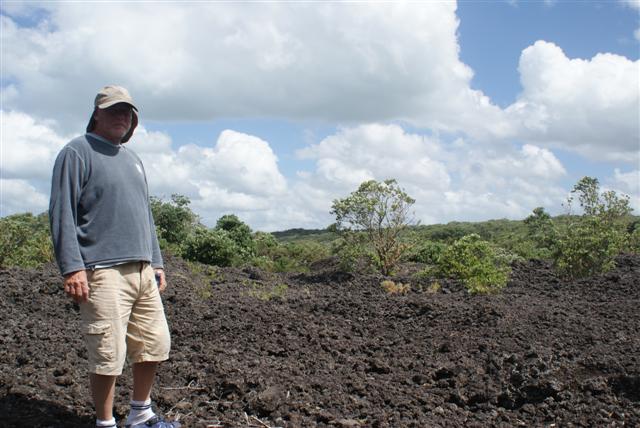
Walking across the lava fields
The following morning we set off on the 4 hour return walk up the 850ft summit and back. From the sea the island had the look of any other island hereabouts, green and verdant albeit that this one has that distinctive cone shape across its 5.5 km girth. As we trudged along the track it soon revealed it’s true nature as the scrubby, low brush and trees could be seen to be clinging to widening areas of unforgiving bare jagged black clinker lava flows. Rangitoto is Maori for ‘Bloody Sky’ and that this is named by the local Iwi (tribe) is a reminder that the ground was hot and moving a mere 600 years ago. And it is big. The 2.3 cubic kilometers of material which erupted from the volcano was about equal to the combined mass produced by all the previous eruptions in the Auckland Volcanic Field, which were spread over more than 250,000 years. Happily this volcano is not expected to become active again, although future eruptions are likely within the volcanic field is a source of some understandable preoccupation by Aucklanders.
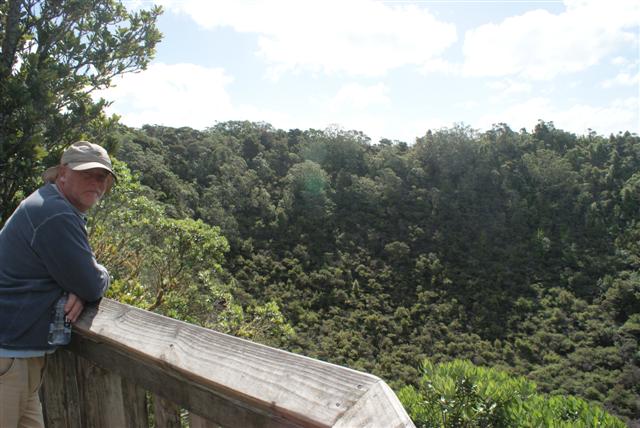
View of the crater
As we approached the summit the flows disappeared to be replaced with ash soil, loose and piled up on such an angle as to make the climb difficult and dangerous. The Department of Conservation has built a wooden walkway cum staircase however which makes the final assent feasible and pleasant as it winds around the base of the summit revealing tantalizing glimpses of the surrounding islands and sea.
Arriving at the rim there is a viewing point where you can observe the crater which, due to lingering volcanic gasses only became covered in foliage in the last 100 years as they finally dispersed.

Relaxing
At last the summit gave up it’s superb 360 degree views of the area with Auckland in the distance and the added interest that it formed a defense battery spotting and command centre during WWII (though it happily saw no action). Well worth the climb! Subsidence back down the throat during the cooling process has left a classic rim around the crater summit where a path has been formed allowing us to circumnavigate it as we began our decent back to the anchorage. Feeling as if we might have burned a couple of calories we arrived back at the small wharf in the gathering dusk and met a lady who was on holiday in a friend’s bache (a small holiday house). She told us how some of these were built around the island’s edge in the 1920s and 1930s but were later banned as the island become a scenic reserve though apparently some 30 of the original 140 baches remain and are preserved to show how the island used to be. People really find paradise in the most improbable places don’t they?

View from the top
Tomkinsons holiday & NYE aboard Camomile
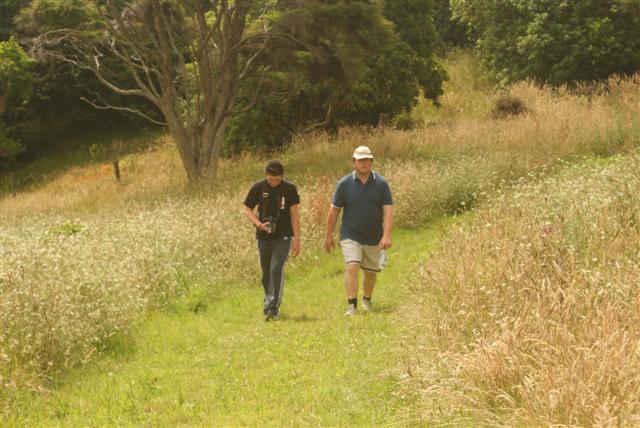
Will and Barry having a manly chat
Boxing day was a sobering day so I rounded up ‘the troops’ for a brisk walk around Motuihe island – walking is great for hang overs. After a bit of persuasion we managed a full house. Motuihe is owned by the Department of Conservation and there are several well kept paths around the island. We had a great time with different views of the surrounding islands around each corner. Part of the walk went across a beach so it gave everyone a chance for some beachcombing.

Beachcombing

What a Motley crew
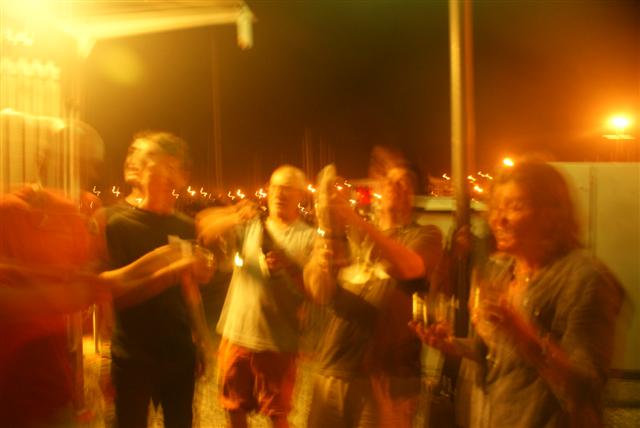
Not a very ggod photo but you can just about make out Barry opening the fizz
We continued on to the next island of Waiheke and anchored off of Blackpool beach! Everyone was landed on the beach and we all walked over the hill to the village of Oneroa. Unfortunately the weather wasn’t very kind to us so we made our way back to Westhaven marina for New Years Eve. All day we kept watching the Sky tower going in and out of the clouds. After dinner we joined Norman and Sara on Norsa for fizz and fireworks but sadly it wasn’t to be.

Just a lot of coloured clouds
We had our bubblely ready but at midnight all we saw were coloured clouds. The photos aren’t very good but maybe someone was a bit p***ed by the time it came to take them!
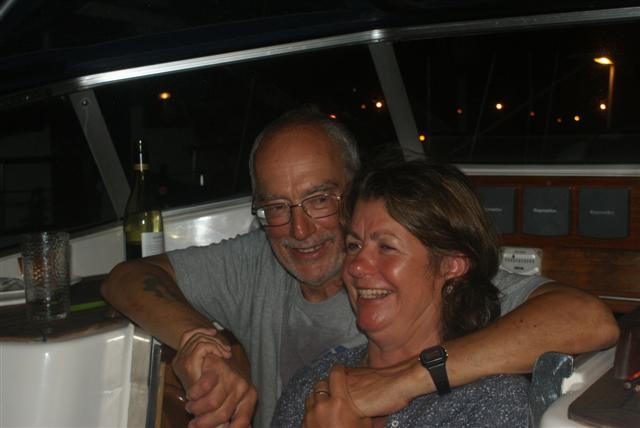
Norman and Sara
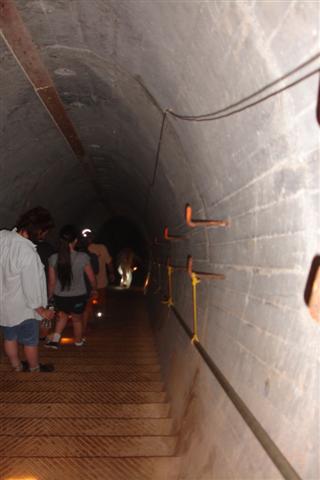
Steps down into Stony Batter
The weather improved and we went back out to Waiheke Island but went to Man of War bay on the other side of the island. We all set off for another walk (route march) this time to Stony Batter the site of the WWII gun sites. It took us about an hour to walk the 6kms to the entrance. We were given some torches and a guide leaflet and set off into the darkness. The tunnels seemed to go on for miles and there were lots of steps. It was fascinating to read about how they planned to defend Auckland from the Japenese, fortunately the guns weren’t used in anger. The site is derelict now but there’s a conservation programme under way to try and restore it.

Norman, Barry and Kate looking at the old gun site
After the tunnels we climbed out onto one of three gun enplacements although the guns were long gone.
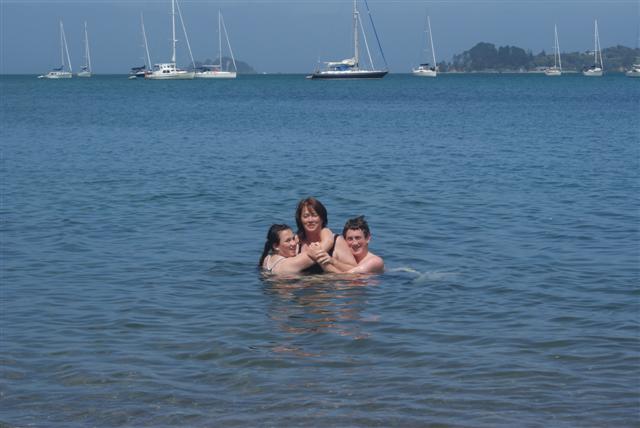
Kate on the beach with Will and Daisy
Christmas on Camomile
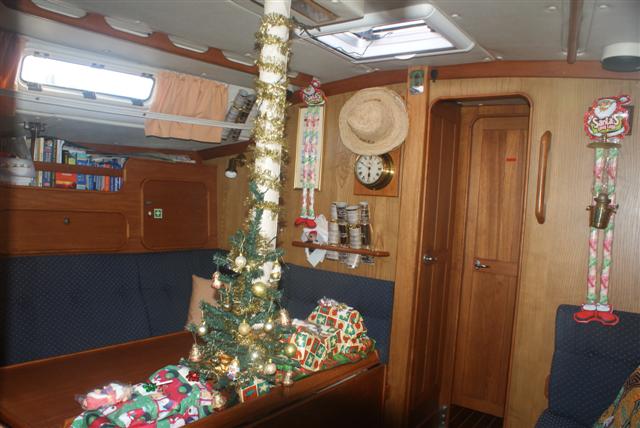
Camomile's Christmas tree with presents
We arrived in Auckland 22nd December and I got busy cleaning the boat, washing bedding, making beds, filling the cupbaords and fridges with food and putting up a Christmas tree complete with lights and presents under it.
Kate, Barry, Will and Daisy arrived safely on the 24th despite Christchurch having another rumble the day before and the present pile grew bigger.
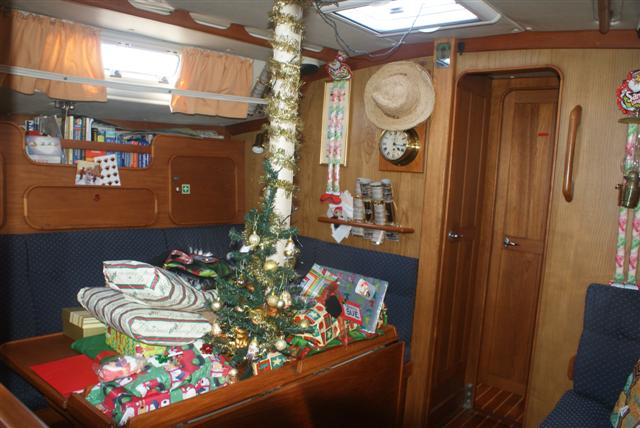
A big pile of presents
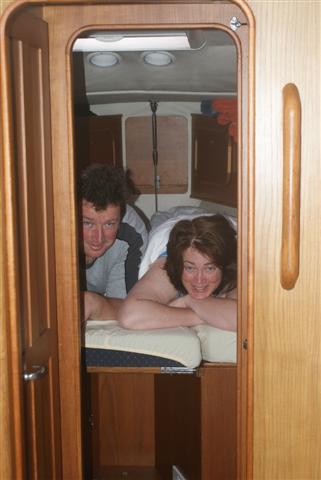
Kate and Barry on Christmas morning
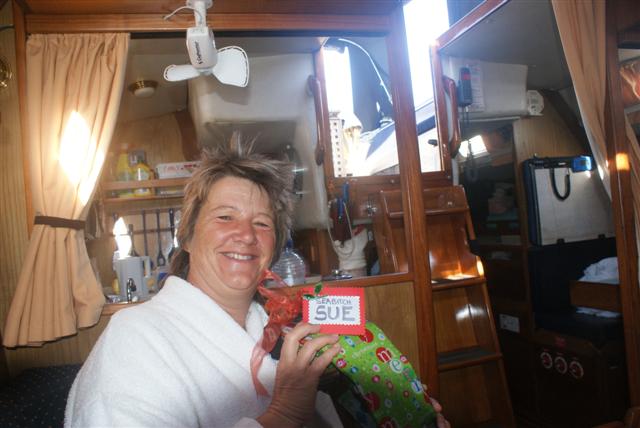
A stocking for Seabitch Sue
Christmas morning saw everyone opening presents
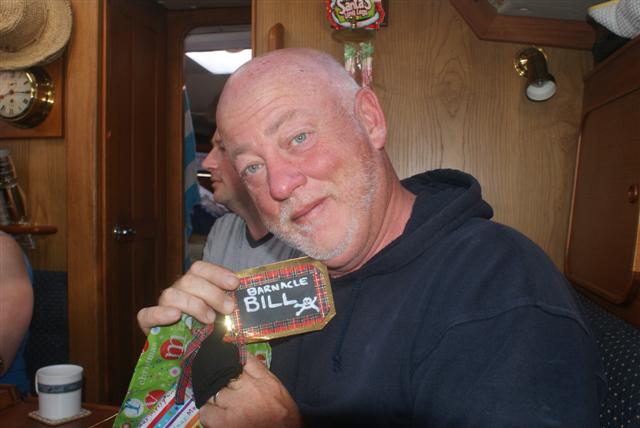
and one for Barnacle Bill
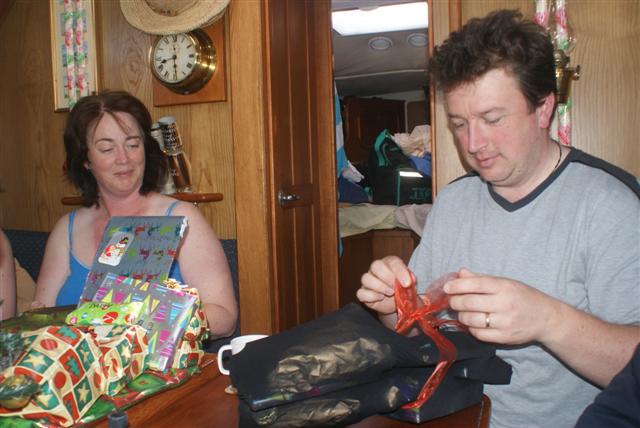
Barry had a stocking - or was it a pair of tights!
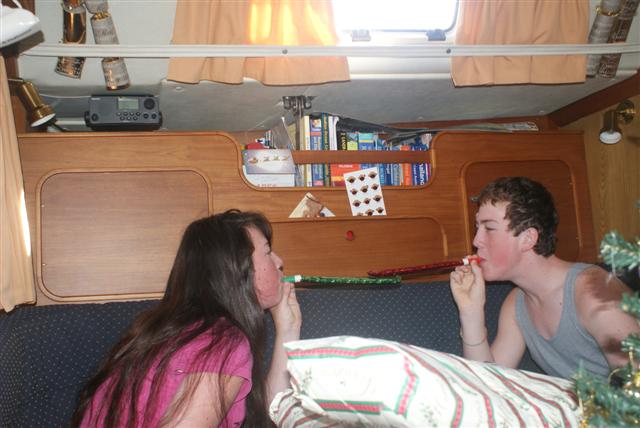
Daisy and Will had blowers in their stockings
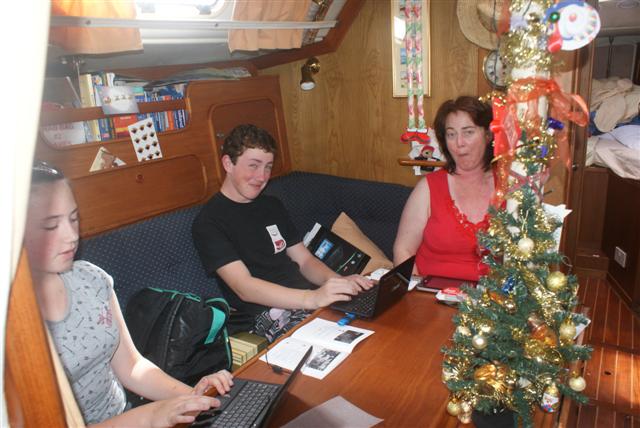
Will and Daisy play with their new notebooks
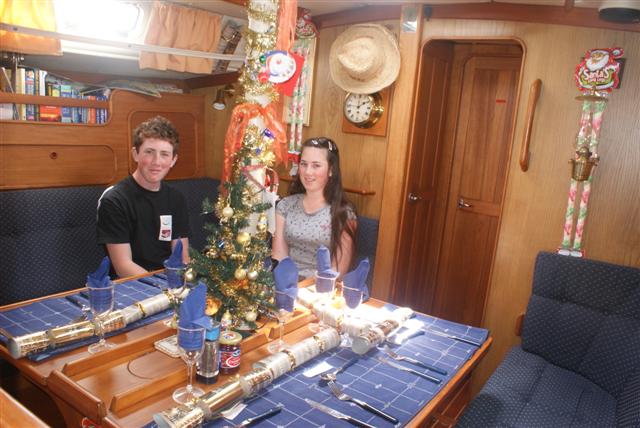
The table ready for Christmas dinner
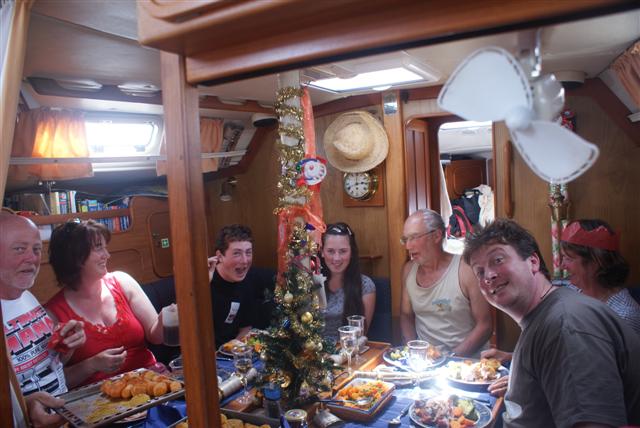
8 for Christmas dinner

Norsa and Camomile tied together
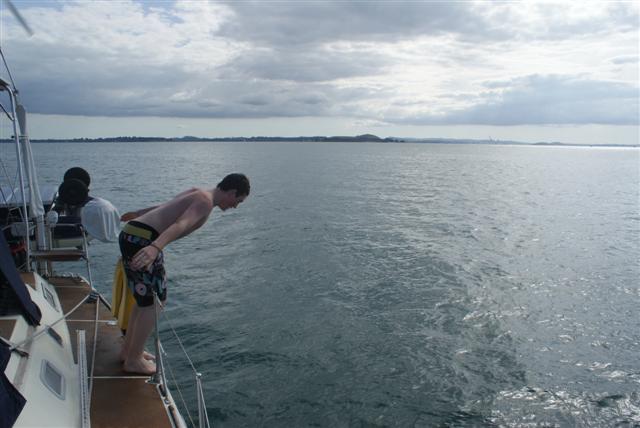
ready steady
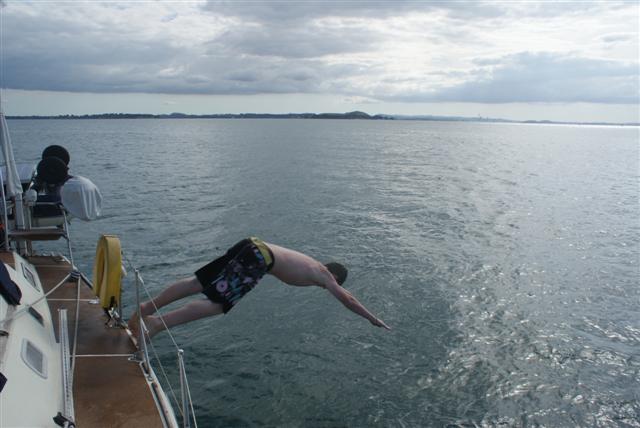
go for it Will

gone

Kate and Daisy joined him
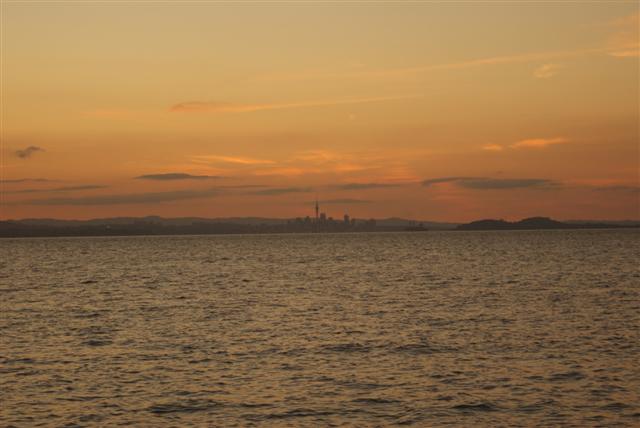
We watched the sun set over Auckland as we drunk our sundowners
Bus trip to Cape Reinga in the Far Far North
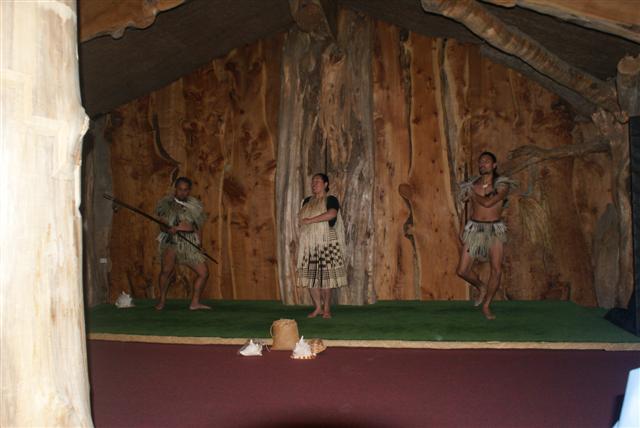
Morning Powhiri
On Monday 28thNovember we joined Norman and Sara on a bus trip to Cape Reinga. Having reached Mangonui we decided not to take Camomile further north because there isn’t anywhere further north that’s possible to leave the boat safely. We choose the coach company Sand Safaris because Sarah, the lady who runs the company agreed to drive to Mangonui to pick the four of us up. The tour normally leaves from Kaitaia, a 20-minute drive away, which we obviously couldn’t get to. Sand Safaris also offered a very good tour. The tour started with a welcome onto a Marae for a morning Powhiri, which was the beginning of our spiritual journey to Cape Reinga.
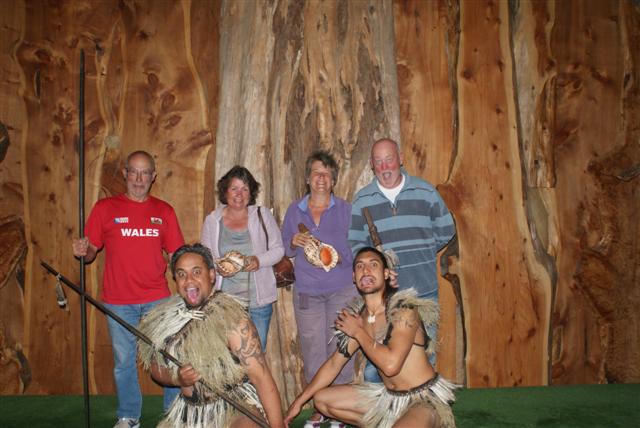
Norman, Sara, Sue and Bill with the Maori's
We experienced a traditional Maori cultural performance, which told the story of The Far North. The performance only lasted about 15 minutes but was a nice start to the day. The performers were happy to pose for photos after. The men were encouraged to take up the similar stance. We got back in the bus for the 72 mile journey north. The bus driver was very amusing and told us lots of stories about the area, he pointed out a side road named Cemetery road, underneath it was another sign – no exit. The driver thought this was very amusing.

Rarawa beach
Our first stop was half way along the road where we stopped at Rarawa beach to marvel at the white silica sands of the beautiful bay. The pure quartz sand was dazzling. As we approached the little town of Waitiki the driver was busy telling us of the famous ice cream shop there but he apologised that we couldn’t stop because only the Wednesday tour stopped there. We were all instructed to wave nicely as we drove past because he didn’t want the shopkeeper upset, as we weren’t stopping today. Like idiots we did as he said whilst wishing we were stopping. Of course he pulled into the car park with a hearty laugh saying he couldn’t do that to us…. we all enjoyed our ice creams.

Ancient Kahika tree
At the very end of the road lies Cape Reinga, legendary departing place of Maori spirits. A place of intense cultural and spiritual significance to Maori. We alighted from the bus and began to descend the path to the lighthouse. The rocky point jutting out to sea is Te Reinga, the place where the spirits enter the underworld. Clinging to the rock is the ancient Kahika tree named Te Aroha. It is said the spirits descend to the water on steps formed by the tree’s roots. They then continue on their journey to Hawaiki, their spiritual resting place. I hope you can spot the tree in the photo.

The meeting point
“The meeting point of Te Rerenga Wairua (cape Reinga) marks the separation of the Tasman sea from the Pacific ocean. For Maori these turbulent waters are where the male sea, Te Moana Tapokopoko a Tawhaki, meets the female sea, Te Tai O Whitirela. The whirlpools where the currents clash are like those that dance in the wake of a waka (canoe). They represent the coming together of male and female – and the creation of life.” As it was such a clear day it was possible to see the two seas coming together as they were slightly different colours.

Cape Reinga lighthouse
We were so lucky to have such a beautiful day the views were stunning. We walked the windy path right down to the lighthouse.
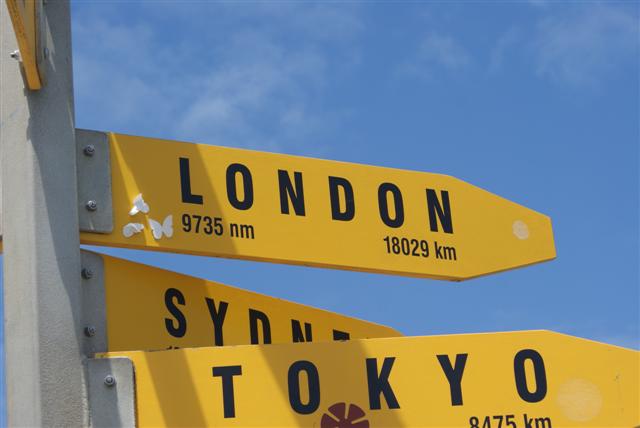
We’re a long way from home
This sign next to the lighthouse shows we are a long way from home.
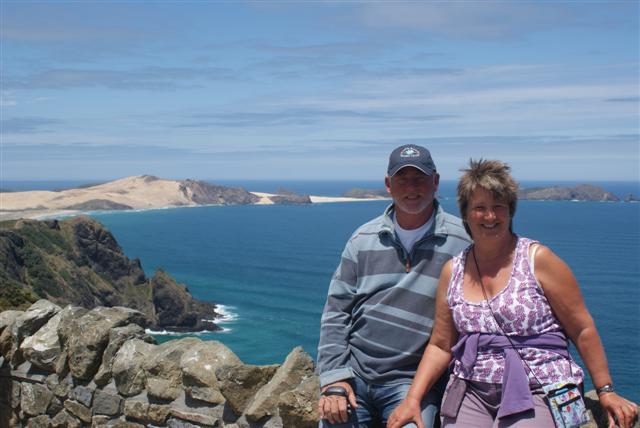
Bill and Sue with Cape Maria von Dieman behind them

Cape Maria von Dieman
Cape Maria van Diemen was named by Abel Tasman in honour of the Goverernor of Batavia’s wife and was the site of New Zealand’s first lighthouse. In 1941 the lighthouse was moved to Cape Reinga. The beautiful white sand beach looked magnificent.
We had an hour to explore the area then made our way back to the bus for the short journey to the picnic site at Tapotupotu Bay where the bus driver laid out our lunch. Sandwiches, biscuits and drinks were included in the price. There was time to explore the beach, which had lovely rock pools at one end, before getting back on the bus.
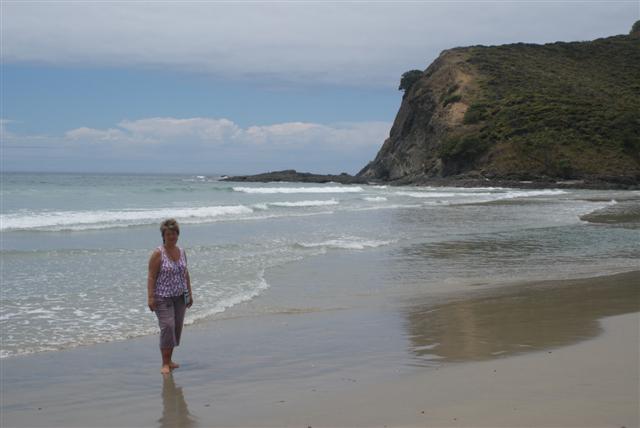
Sue on the beach at Tapotupotu
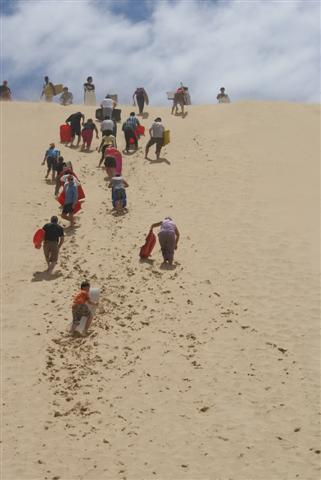
Climbing the sand dunes
We travelled back down on the same road for about 10 miles before turning off towards the Te Paki sand dunes. We were met with an incredible sight of 60ft high sand dunes. The driver issued us with toboggans and, after a short instruction of use, said, “Follow me.” Climbing the sand dunes was like wading through treacle; you needed to take a dozen paces forward to get one pace up. It was one of the hardest things either Bill or I had attempted. We congratulated ourselves that we were the only ‘older’ members of the bus to try it, except for Norman but he’s very fit so doesn’t count! Eventually I made it to the top, the driver sat me down and told me to hold on and keep my feet up and gave me a good push.
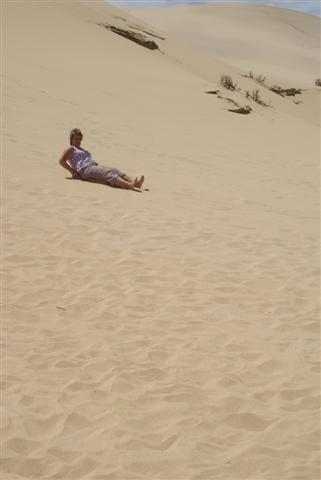
and tobogganing back down again
I came hurterling down at an alarming pace. I was almost at the bottom when I was worried I wasn’t going to stop so put my foot down …… I was absolutely showered in sand, it was every where – hair, ears, bra, knickers, mouth, I decided not to attempt the climb a second time! Bill managed to get up a bit quicker than me but also found it very difficult, he also made the same mistake as me and put his feet down. We didn’t want to end up in the stream at the bottom. When every one had had their fun the driver performed his party piece. He ran and jumped onto a boogie board face down and hurtled down the sand dune, across the stream, right down to the door of the bus amid cheers from his audience.

One of the coaches being pulled out of the quicksand
The Te Paki stream flows past the sand dunes through to 90 mile beach providing a path for the buses to drive through. Throughout the day the driver had been warning us that the stream is drying up and quicksand patches are forming that the buses were getting struck in. He assured us this wouldn’t be a problem because there were several big guys on the bus that day and he had little spades for the rest of us! After the tobogganing we all got back on the bus to drive through the stream that the driver said needed to be driven fast. We came around the corner and did indeed find one of the buses stuck. The driver went to see what was happening then got back on the bus and told us to hang on tight. We thought he was joking again but he meant it. He turned the bus round and drove back a few hundred yards then turned again, he picked up speed and must have been doing 40-50mph when he hit the quicksand area. The bus slowed right down but he kept going and we got through. There were about 5 other buses that all did the same thing. They then tied all their towropes together to pull the bus that was stuck out of the quicksand.
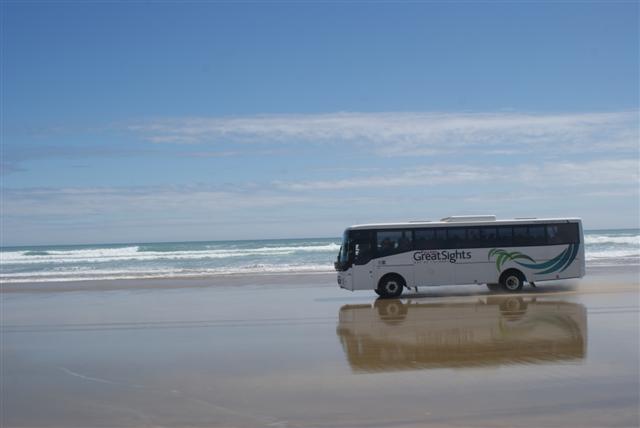
Driving along 90 mile beach (one of the other coaches)
Once all the buses were through we drove onto 90 mile beach. It’s actually only 56 miles or 90kms long and we drove along about 40 miles of it. It was an amazing journey. The sand was as flat as a motorway but a lot wider. The driver drove fairly fast slowing only for the few shallow fresh water streams that crossed the beach.

Walking on 90 mile beach
We stopped briefly to walk on the beach and dip our feet in the Tasman sea. Eventually the bus drove up a ramp back onto the road. We stopped at a service station that had a very clever bus wash to wash underneath the coaches to clear away the seawater.
Sarah was waiting there to give us a lift back to Mangonui. We had had a fantastic day in the far far North. The next day we left the harbour and headed south to Auckland for Christmas.
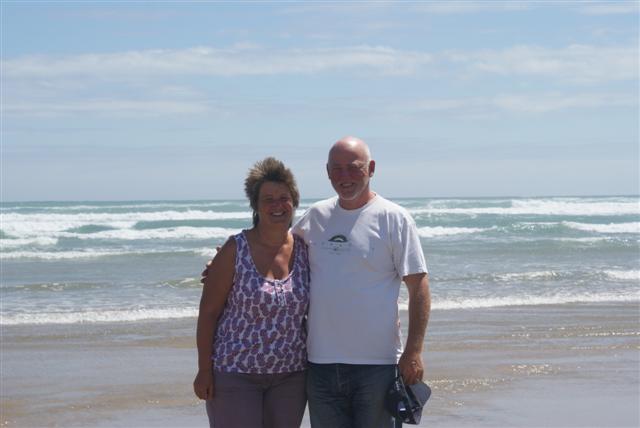
Bill and Sue on 90 mile beach
Heading North to Mangonui Harbour
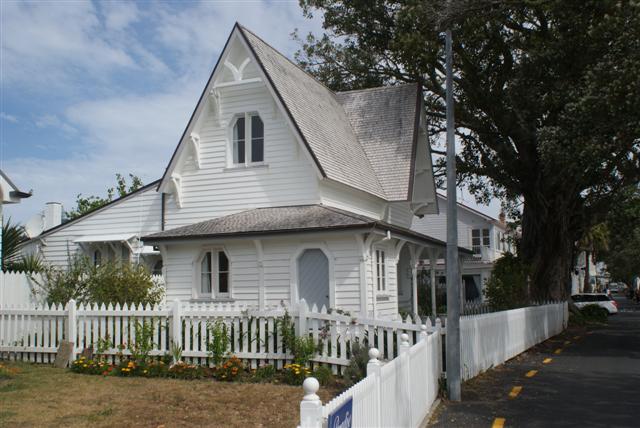
Colonial buildings line the waterfront at Russell
On 22ndNovember we finally left Opua. Our friends Norman and Sara on Norsa arrived at the weekend and joined us on our journey north. We didn’t go very far – only 3 miles up the harbour in fact. We stopped at the delightful little town of Russell, New Zealand’s first European development. It was once known as ‘the hell hole of the Pacific’ in the days when lawless whalers came into violent contact with local Maori but it’s now a quiet hamlet full of historic buildings and fascinating stories.
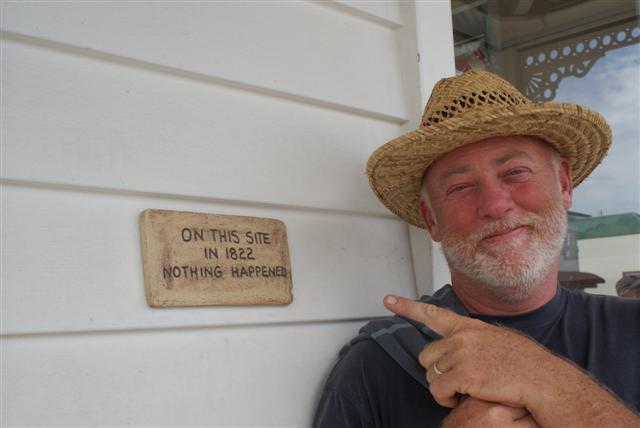
Strange sign
We walked around the pretty village in the sunshine and bought a delicious ice cream. This strange sign was attached to one of the buildings.

Camomile anchored in Waiwhapuku bay
The next day we sailed around to Moturua Island and anchored in Waiwhapuku bay (these Maori names are so difficult to pronounce). We went ashore to walk around the island. There are many well-marked walks in NZ maintained by the Department of Conservation (D.O.C.). We walked up and down the paths, each bend giving another stunning view of the Bay of Islands and the views from the top were spectacular.
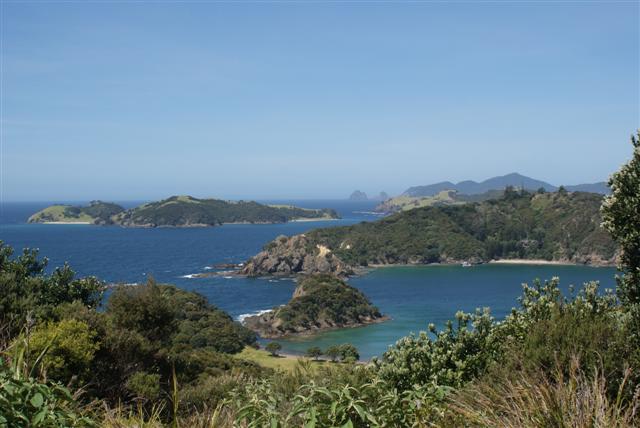
Fabulous views across the Bay of Islands
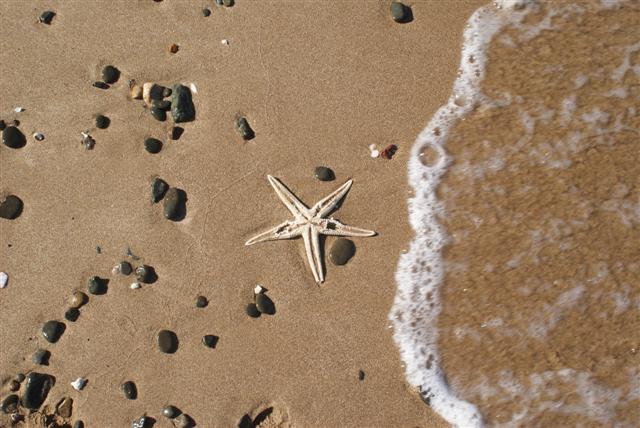
A starfish on the beach
Part of the walk was across a beach which had beautiful shells and a few starfish strewn around.
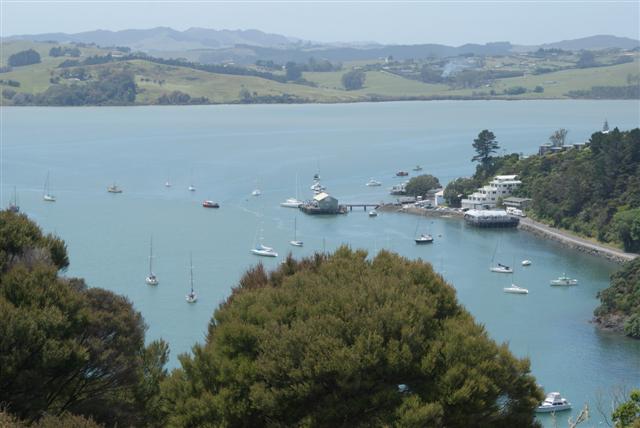
Camomile and Norsa anchored at Mangonui harbourin the crook of the tree
We spent the next few days making our way north to Mangonui harbour. We anchored with Norsa beside the local boats. Mangonui is famous for its fish and chip shop, advertised as ‘The Best Fish and Chip shop in NZ’. We went ashore to sample its cuisine. It was indeed very nice fish and chips but I’m not sure if it was the best in NZ but I suppose the advert worked because it encouraged us to try it.
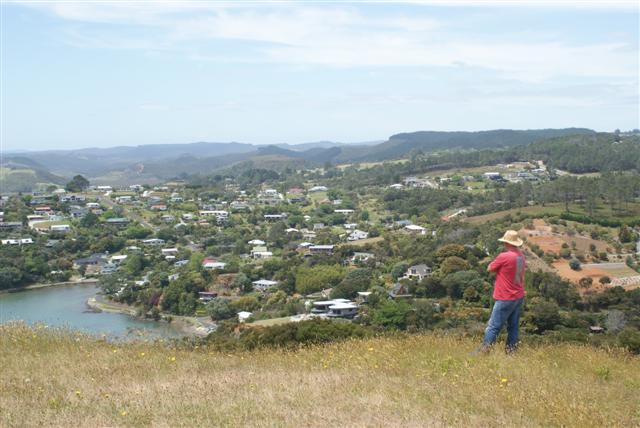
Bill looking across the valley
On the Sunday morning I thought it would be a good idea to walk up to the Rangikapiti Pa, an ancient Maori fortified village. We found the path and walked up to the top of the hill. On reaching the top we were rewarded with a fabulous view of the harbour and surrounding village.

View across the water towards the Rangikapiti Pa
Our position on 27th November
34º59.23 south
173º31.90 east
 Camomile