Category Archives: Port posts
South Africa to the Caribbean – day 46
Our position at 10.00 (12.00 GMT) Tuesday 7th March was
00 19 NORTH
037 39W
on a course of 325T with sunny blue skies.
Our 24 hour run from 10.00 yesterday to 10.00 today was 126 miles. Average 5.2kts we motor slower than we sail. We have 1512 miles to go to Barbados
WHOOP WHOOP WHOOP WE HAVE CROSSED THE EQUATOR FOR THE FINAL TIME.
The first time we crossed the equator was with our wonderful friends on the Blue Water rally on the vessels Enchantress, Lucy Alice and Briet they had come to support us after a shroud fitting had broken and we had nearly lost the mast. With the mast strapped down we were unable to sail and they all escorted us to the Galapagos islands sailing alongside us while we motored 900 miles. We all had a wonderful equator crossing party on our own boats while watching each other throw various concoctions over each other as we crossed the line. It’s on the website somewhere I think around March 2010.
The second time was in 2013 after Sail Indonesia as we motored up towards Singapore on our way home after Mum had died.
The third was in 2014 after Sail Malaysia East in the Makassat strait between Sulawesi and Borneo in Indonesia on our way to meet Thomas and Sonal in Lombok. The forth was on our way back up to Singapore again later in 2014.
The fifth was last year 2016 on our way south through the Maldives (it was hot then too)
The sixth and definitely last time was at 3.30am this morning – we are back in the northern hemisphere to stay.

Camomile crossing the equator
The last few days have been stiflingly hot on board with no wind plus having the engine on made it really hot below deck. We kept having to close the hatches because of the rain showers; I hope to never be this hot on board again. Yesterday, in all that heat, we took the twizzle down as we hadn’t had any rain for several hours and the sails were dry. We didn’t want to take it down while there was a chance of more SE winds but the forecast was for NE winds tomorrow. We dropped the downhaul and Bill took the poles off the sails first taking off the ‘twizzle links’ and re-stowing the poles on the guard rails. We can have both the headsails up at the same time and pull them both to one side or the other but with the possibility of stronger north easters coming Bill decided it would be best to drop the sails and take it off. With no wind they came down easily, lines were swapped, shackles undone and the single headsail reattached, hoisted and furled away. The second sail had come down nicely and Bill and I managed to flake it the best we could on deck and roll it up. It’s now sitting under the table until we can take it ashore in Barbados and fold it properly. All this was done in the midday sun! We didn’t realise until the job was finished how hot we were. I have to have a sleep early afternoon so I can do the first night watch but I just couldn’t sleep because I was bathed in perspiration, I couldn’t cool down.
The black clouds are behind us now and we feel so fortunate to have had such a benign crossing; not a single flash of lightening. Up to the day before yesterday we had only ran the engine for a total of 11 hours just to charge the batteries. It has now been running for 42 hours as we’ve motored through the ITCZ and finally went off at 9.30 this morning as the wind started to fill in from the East. The mainsail went up for the first time since leaving Capetown and the wind is strengthening. We aren’t making our course yet but as the wind gradually backs to the NE we’ll get back on course.
We saw our first ship yesterday, in fact we saw two. There have been several on the AIS recently but they were the first ones we’ve had a visual on. Will need to keep a better look out.
I made a stir fry last night. I sliced up half an onion, half a red pepper, half a green pepper and ‘matchsticked’ a carrot. Stirfry with a chicken breast sliced. I then added a jar of basil, garlic and chilli stir fry sauce from Thailand and some noodles. All cooked in about 10 minutes. YUM.
Bill ate his last apple last night in celebration of our equator crossing, I had some grapes – or they were until they were made into wine. Haha.
Finally a very Happy Birthday to my little sister Amanda. Enjoy your last year of being forty something! See in May, lots of love. XX
All well on board. 🙂
The blog goes through to facebook but we can’t see facebook or your comments. I’ll catch up with them all in the Caribbean. If you wish to email us please use mdqf6 @ sailmail.com (take out the gaps) Stay safe everyone.
South Africa to the Caribbean week 3 – Exploring St Helena

The beautiful cliffs on the approach to the mooring field.
Discovered by the Portuguese in 1502 St Helena became a Dutch and then a British possession first under the East India company then the crown. Situated in the South Atlantic ocean it was a strategically important port of call during the British Empire until the opening of the Suez canal. It is now a British Overseas territory forming a dependency with Ascension island and Tristan da Cunha. The island’s remote location meant it was used as a place of exile for key prisoners including some 6000 Boers, Chief Dinizulu, Bahraini princes and of course Napoleon.

The cliffs behind us.
This is the view of the volcanic cliffs behind us.
A volcanic outcrop the island is a 47 sq mile and has sheer barren cliffs that are intersected with deep valleys, which slope steeply from the central ridges.
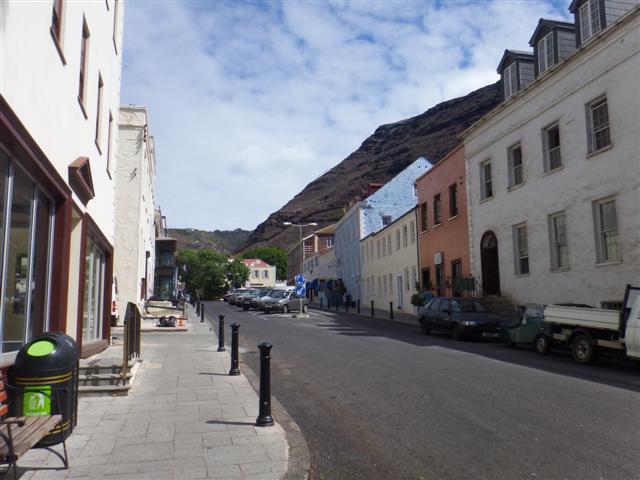
The main street in Jamestown
Jamestown, the capital of St Helena, was founded in 1659 when the English East India company built a fort and established a garrison at the site of James bay naming it after James II. The quintessential Georgian seaport consists of little more than a single street stretching for a mile inland nestling in a deep-sided volcanic valley. It retains a remarkable heritage with the likes of the Duke of Wellington, Captain Bligh, Charles Darwin, Captain Cook, as well as Napoleon, having walked its streets. Main Street has some of the best examples of Georgian architecture in the world. There are also a significant number of fortifications, remains, and historic buildings around the island.

One of the old quayside buildings
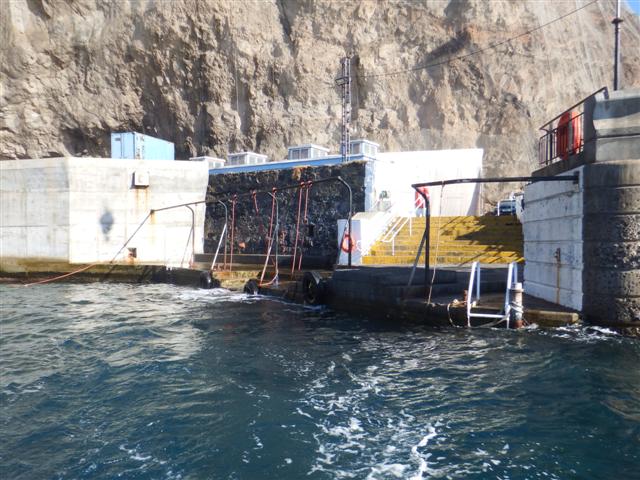
The approach to the jetty
Having arrived safely early on Thursday 2nd February we were keen to go ashore and explore. Once the customs had left us we packed up our bag to go ashore to see immigration. There is a very useful ferry service here to save you taking your dinghy ashore. It’s only £2 return each. As we approached the jetty this is what we were faced with. There’s a lot of swell here and it would be impossible to land our own dinghy but the ferry boat is also quite difficult so to the yachties behind us be ready for this.
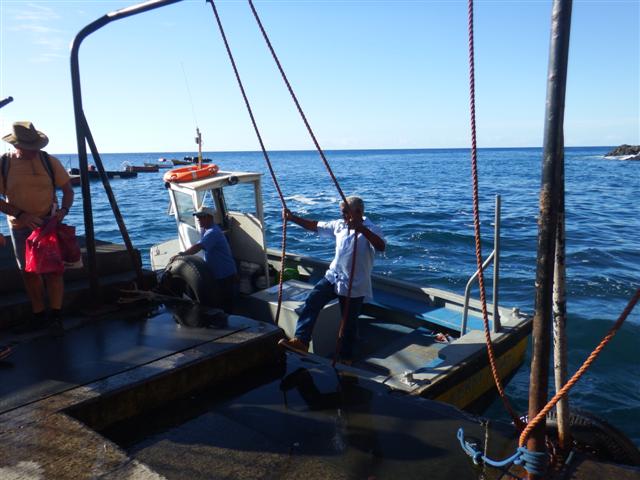
The little ferry boat

The customs building
As you walk along the sea front you pass this beautifully restored customs building.

The entrance gates looking out
We continued towards the entrance to the town over the dry moat and through the arch doorway built in 1832.
The first building in front of you is the beautiful St James church the oldest Anglican church in the southern hemisphere dating from 1774. The steeple was added in 1843 but it looks very new so I think it’s recently been replaced again.

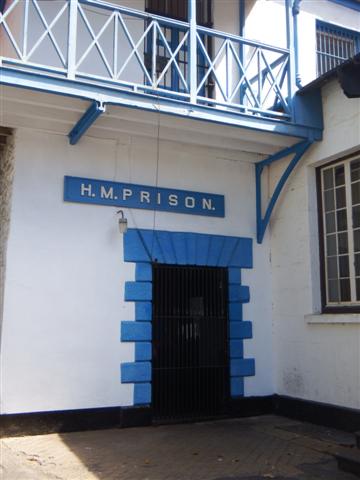
The little prison
Next door is the prison, which apparently has some dozen or so prisoners. Then there’s the immigration centre where we had to produce our passports for our St Helena stamp and check in.

The entrance to Jacobs ladder
We had a glimpse of Jacobs ladder through the alley in between the immigration centre and the little museum – but that’s for another day.
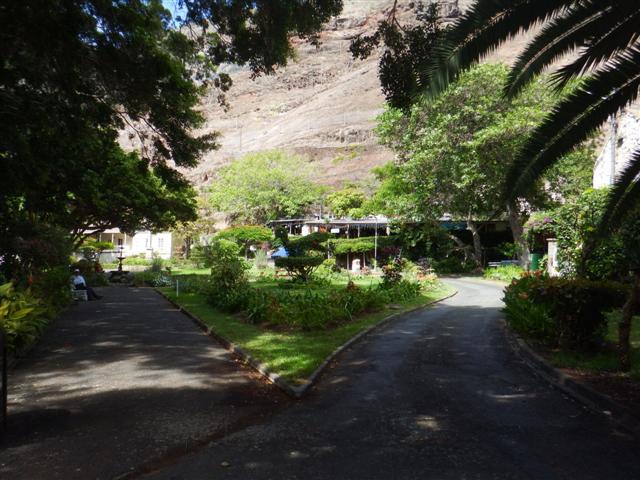
The castle gardens with Anne’s place at the back
Opposite the church are the castle gardens where you will find Anne’s place, a local eatery popular with the locals as well as yachties. It’s one of the three places where it’s possible to get onto the Internet although it isn’t free. £3.30 for half an hour is probably the most expensive Internet we’ve used on our travels and it’s the same price throughout the town. We decided to have burger and chips as it isn’t the sort of food we usually eat on passage.
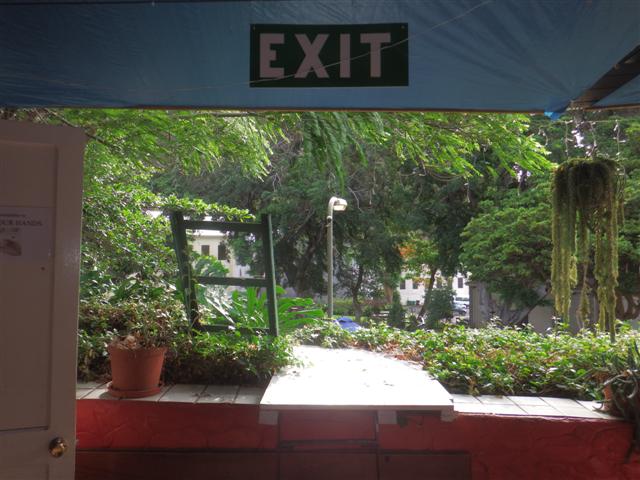
The fire escape
The fire escape was very quirky; there was a ladder leading back into the gardens on the outside.
Friday we stayed on board sorting out the boat. Bill had some small jobs to do and I wanted to clean through after all the rolling around on passage. We had a heavy shower of rain, which washed all the salt off and saved me washing it.
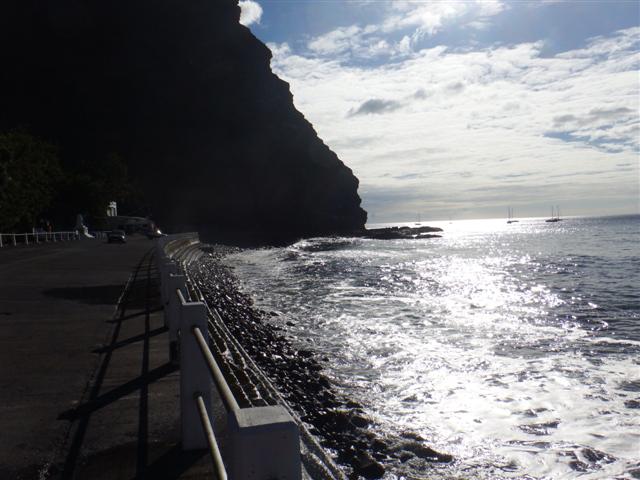
Looking out to the anchorage in the evening
Saturday we went ashore on the 4pm ferry to have a delicious pig roast at Anne’s place, which at £12 a head with all you can eat plus a doggy bag to take home was good value. It’s only once a month but to our friends behind us this is a great evening. We booked a late ferryboat at 8pm to take us back to the boat.
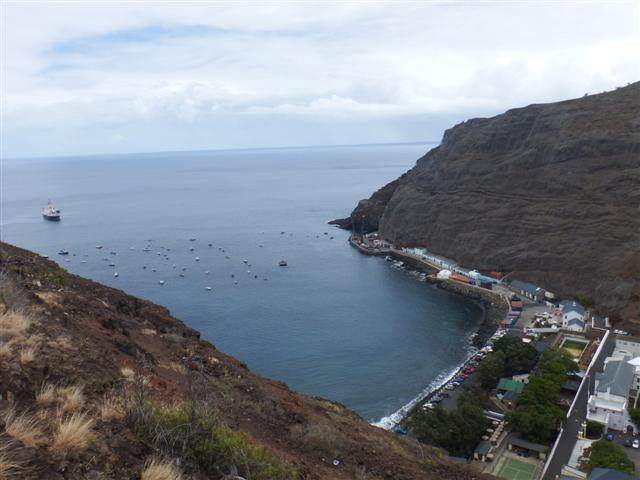
A good view of the town from Jacobs ladder
Sunday morning we decided to go to church, as it was the first C of E church we had seen in a long while. The vicar and the parishioners welcomed us. We had coffee afterwards while looking up at Jacobs ladder. As we didn’t have anything to rush back for we thought we’d attempt it in our Sunday best.
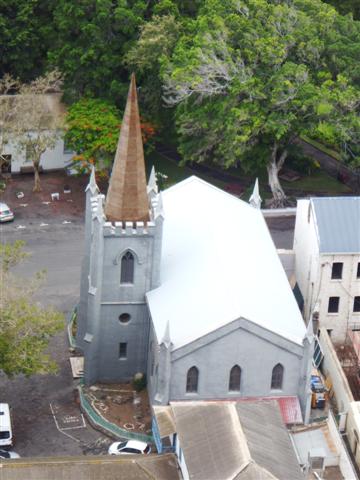
Wonderful view of St James church
We didn’t race up and did 50 steps then stopped to look at the view, another 50 steps and took a photo, another 50 steps and had a drink and so on until we made it to the top.
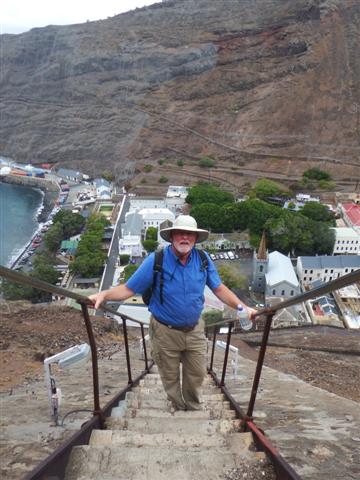
Bill half way up

I’m not very good at taking selfies
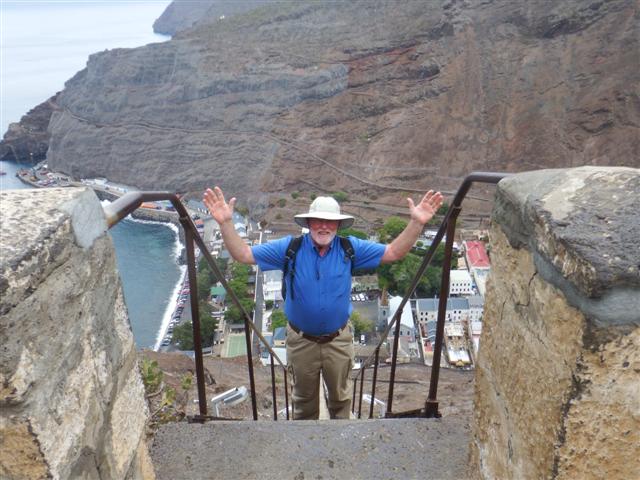
We made it to the top

Panoramic shot from the top
The view was magnificent. We had a good view of the supply ship RMS St Helena that had arrived with passengers, containers and supplies.

Remains of the old fort
At the top were the remains of a Napoleonic fort built in 1873.
The old barracks were now derelict but some of the out buildings were being used by the local fire brigade to store their vehicles.

Fire brigade vehicles.
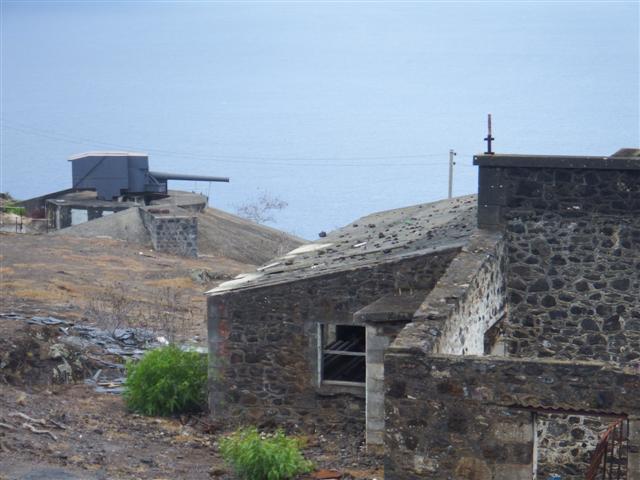
Old gun enplacements
We walked further along and noticed some gun inplacements that were from either WW I or II.
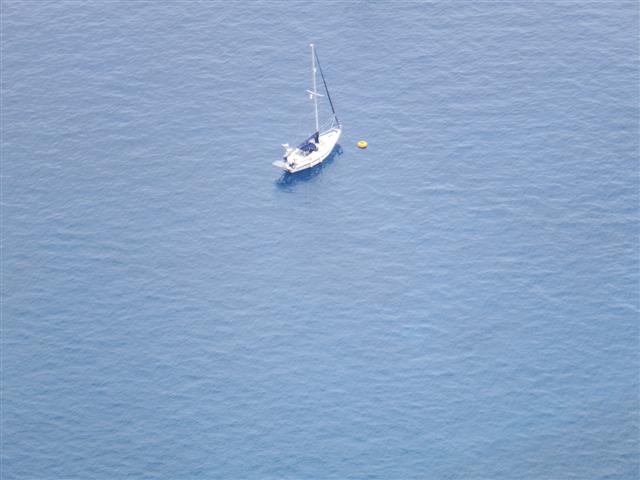
Camomile on her buoy
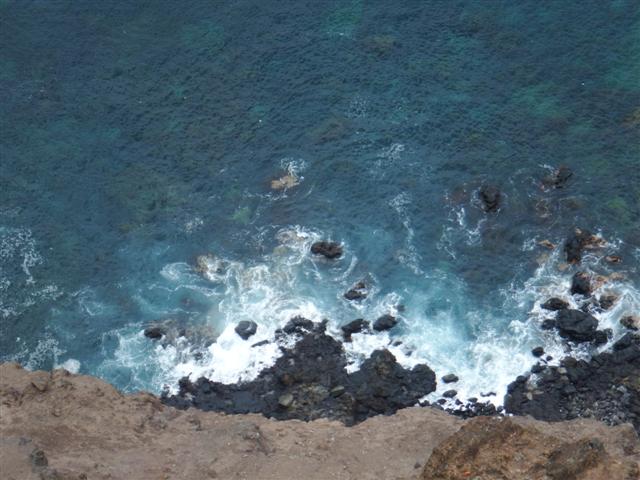
The bottom of the cliffs below
Looking out over the edge gave us a superb view of Camomile in the mooring field. The rocks below us at the bottom of the cliffs didn’t look very friendly. There aren’t any beaches around St Helena.

The beautiful Georgian Main street
We walked back to the look out by the steps and the town below looked like a model village but from that height it was possible to see the main street in all its Georgian glory.

The view down from the top
Coming back down was harder than walking up because of the pounding your knees get. I was lowering myself down as carefully as I could.
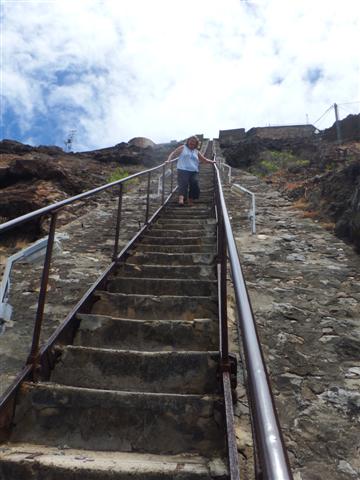
Half way down
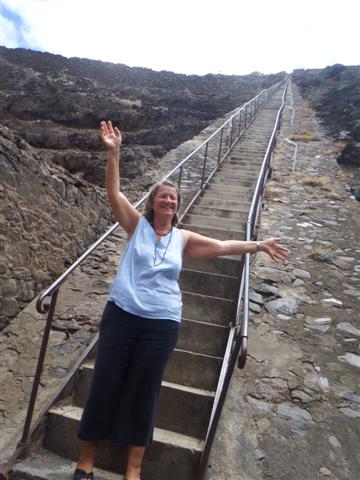
I made it!
It was a relief to get to the bottom of the 699 steps.
We walked back along the quay to the water ferry. The whole area was a hive of activity with the unloading of the RMS St Helena taking place. Everything but everything on the island arrives on the ship including vehicles. The RMS has her own cranes and can lift her cargo onto a flotilla of flat bed barges, which may their way back and forth to the quay where a local crane is used to unload them.
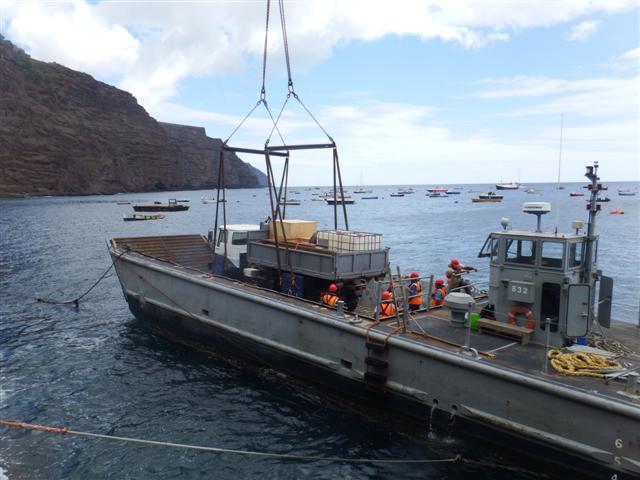
Ready to lift
We watched as a lorry was being unloaded. These set of photos make it look easy but there’s always a metre or two of swell running and the timing is critical.
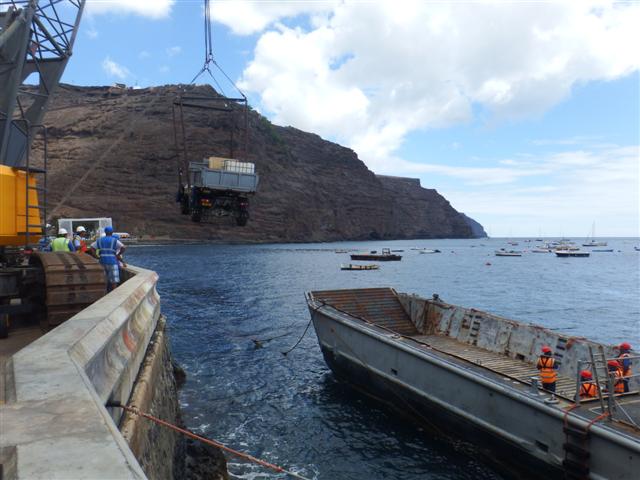
Up it goes

Lowering the lorry onto the quay
As the barge dips down with the swell the crane started taking up the slack then as the barge came up the crane lifted the vehicle clear of the barge and kept going up over the sea wall and onto the quay. Very clever.
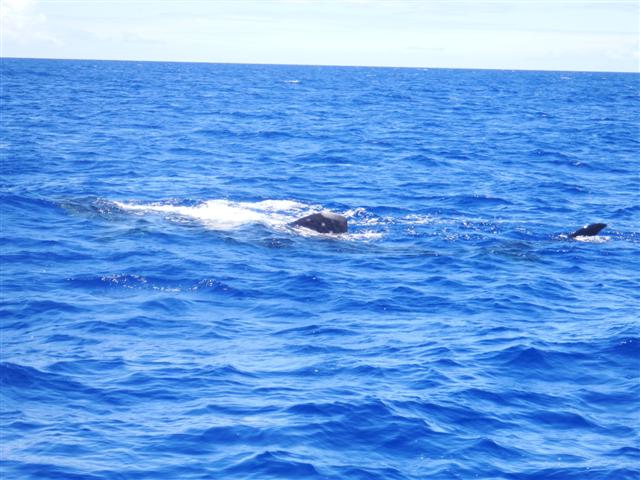
First sight of the whale sharks
The highlight of our week was swimming with Whale sharks. We had arranged for Johnny who runs the ferry service to take us out on his big boat. We went with Martin and Elizabeth on Caduceus and a guide and that was it – so lucky. The ferry boat came alongside Camomile picked us up and transferred us to the bigger boat waiting just offshore for us and off we went. Within an hour the call went up there were whale sharks ahead. Two of them were basking on the surface. We had gone in our wetsuits all ready to get in the water.
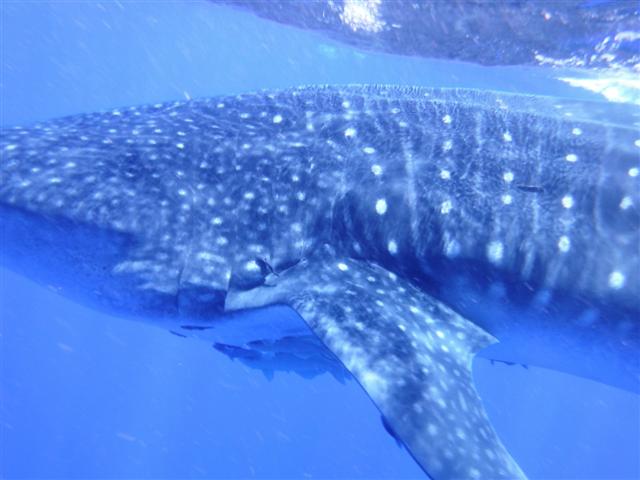
So close
As soon as we were alongside them we jumped in. The first thing that strikes you is their size, they are enormous at about 12 meters long – bigger than Camomile! Bill and I saw a third whale shark on its own so swam over to get a closer look.
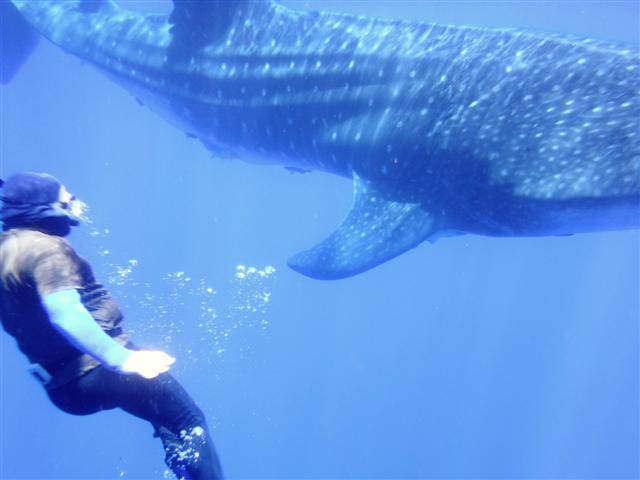
Bill was so close
I got an amazing video of Bill swimming underneath it but unfortunately I can’t upload in St Helena maybe in the Caribbean. We watched it for a while then it twisted and dived out of sight. We swam back to the boat to find a forth whale shark swimming nearby at an even bigger 14 metres. Karl the guide got a wonderful clear shot of Bill swimming above it. After about three quarters of an hour we got back on the boat, exhausted with amazement at what we had just seen, totally awesome!
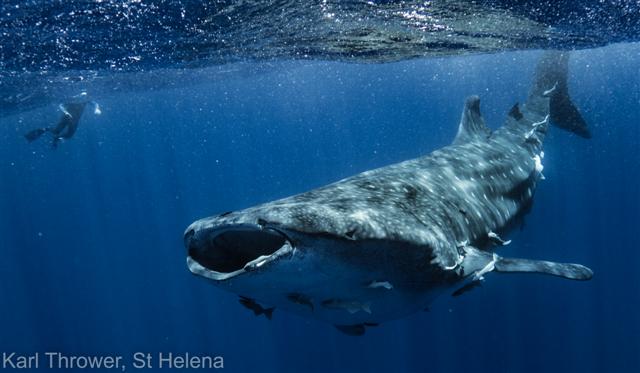
Karl’s photo of Bill
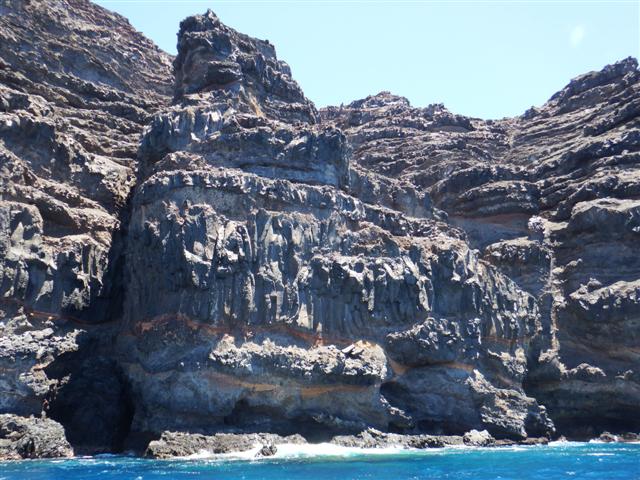
Amazing landscape
Johnny drove back along the coastline for us to get a good view of the construction of the island. It was possible to see the layers and layers of volcanic activity that took millions of years to form.

An old Napoleonic fort
There were different colours in some areas. There are also parts of a Napoleonic fort built into the cliffs and we could see a walkway had been carved out of the hill to take the soldiers back to Jamestown all those years ago.
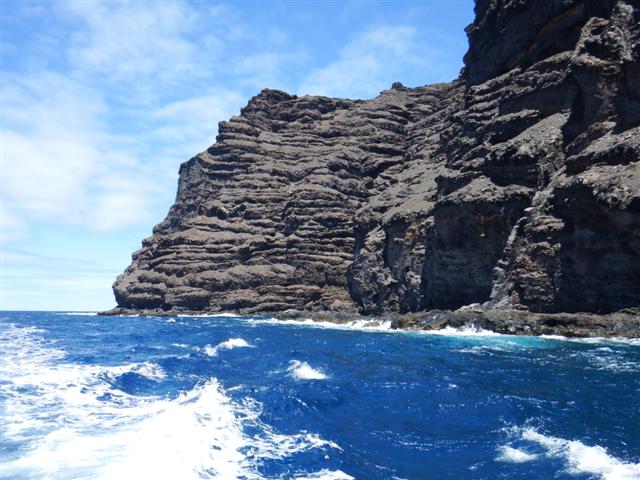
An amazing day.
South Africa to the Caribbean – day 12
Our position at 10.00 (09.00 GMT)Tuesday 31st January
18 36S
002 47W
We have 230 miles to go to St Helena and our 24 hour run from 10.00 yesterday to 10.00 this morning was 125 miles, a bit better.
The wind finally died completely yesterday and the engine went on at 1.00pm and was on for the rest of the day and all night. The air temperature is a lot warmer now and the sea temperature is back up to 25.8C which we need for when we get to St Helena because friends ahead of us have reported whale sharks are swimming around the mooring field. I might get to swim with a whale shark hopefully. They are harmless by the way and only eat sea morsels. We saw one in the Maldives but it was quite a way away and there were so many tourists you couldn’t get near it
I was out of bread yesterday and the bakers was closed so I made bread. I also made some flapjacks so they will last us until we arrive. Last night I made bangers, mash and beans with an egg on top. Now you may be thinking that doesn’t sound very special but we are talking really nice pork sausages (haven’t been able to get pork for a while) and proper Heinz baked beans not own brand rubbish. I found 4 tins in a supermarket, they are coveted by cruisers.
A tiny moon came out last night after the most amazing sunset. The sunrise this morning was beautiful too. Must be getting near land.

Amazing sunrise
So the journey continues. These blogs go through to our facebook page but remember we can’t see facebook or your kind comments but thank you for them, I look forward to reading them when we arrive. If you wish to contact us on passage please use mdqf6 @ sailmail.com (but take the gaps out) I love to hear from you. xx
South Africa to Caribbean – day 2 & 3
Day 2
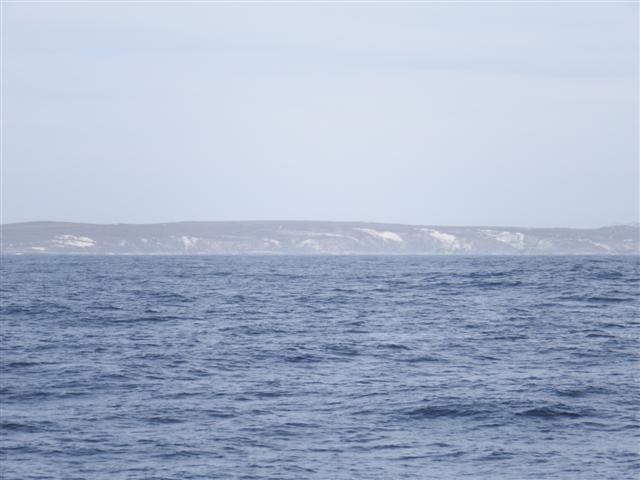
The sand dunes of the west African coast
Having gone to bed surrounded by fishing boats, the next morning they had all gone. By 8.15 we left the anchorage. There wasn’t any wind so we had to motor. There are quite a few lobster pots on this coast so to the cruisers behind us, be careful. The fishermen were moving between them.
The feature of the day was wildlife. We saw lots of seals and birds, several pods of dolphins but the real treat was whales and a lot of them. Sometimes it was just a water spout but we had several breach right by the boat, which I wasn’t happy about, with the full tail display. Whales are something we haven’t seen a lot of so it was a real treat. Of course as soon as I got the camera out they disappeared.
This was our second day sail and the anchorage in St Helena bay around from cape Columbine was our goal. As we were rounding the cape the wind piped up and we managed an hour of sailing. Unfortunately the wind kept building and by the time we got to the anchorage we had 30kts over the decks. There’s a fishing harbour in the bay and we anchored on the north side of the break water for shelter. The waypoint was 32 44.37S
018 01.06E
There was quite a good signal so I was able to have a nice chat with Thomas and pick up our messages. Once we leave the anchorage there will be no more facebook or internet for a while. The wind continued to blow most of the night and the forecast for continuing north wasn’t good. We had traveled 57 miles.
Day 3
By the morning the wind had gone but the forecast wasn’t good for our 3 day passage to Nimibia. We listened to cape town radio. Firstly they were giving fog warnings for the area we would be traveling through plus Bill had noted that by the end of our journey there would be strong winds blowing off the Nimibia coast. We spent several hours trying to decide what to do. Eventually we decided that we would miss Nimibia and go straight to St Helena. It was a shame but we didn’t want to continue north that day and we didn’t have the time to sit and wait in the anchorage for the weather to improve. The forecast might change again, they often do, but the decision was made and we motored back out around the cape towards St Helena. Once I put our waypoint in it gave us a distance of 1645 miles to go. ARRRGGGG.
Within an hour the sails were up and we were making speeds of 7 and 8kts over the ground with a beam reach in a F4 SSW wind. By 4pm the wind was up to F5 and Bill decided to put a reef in the main and pull in some of the genny but we were still cracking along at 8 to 8 1/2kts, at least a knot or so of this was current in our favour but the sea was very lumpy. For the cruisers behind us the area between the 200m and 300m contour lines had Indian ocean style ‘washing machine’ waves and our beautiful clean and salt free decks were soon bathed in sea water coming right across the decks. All hatches were closed, even the little cockpit one that we leave open for ventilation. As the sea was still only 15.2C, it was making the wind cold.
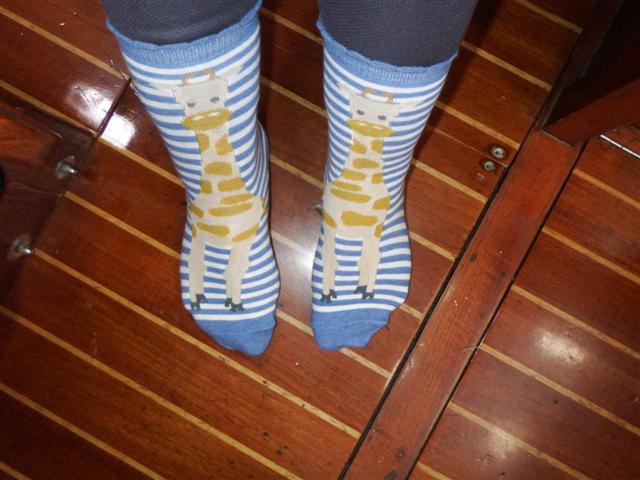
My lovely Giraffe socks – thank you Hailey
That evening to do my night watch I had on 3 top layers and 2 bottom layers plus my UGG boots, hat and mittens! The wind picked up to F6 by 9pm so neither of us got much sleep with the boat being throw around by the wind, sea and our speed. We choose not to put another reef in because the forcast showed the wind was going to die down in the early hours so we decided to stick it out. By 2am the wind started to drop and by 6am it was back to F4 and we both took it in turns to get a bit of sleep.
At 10.00 this morning our position was 31 20.6S 014 58.9E with 1459 miles to go to St Helena. In 24 hours we had traveled 186 miles, an average of 7.75 an hour, this is a new record for us beating our top speed in the Pacific ocean in 2010.
So the journey continues. I hope these blogs are going through to our facebook page but remember we can’t see facebook or your kind comments. If you wish to contact us please use mdqf6 @ sailmail.com (but take the gaps out) I love to hear from you. xx
South Africa to Caribbean – Day 1
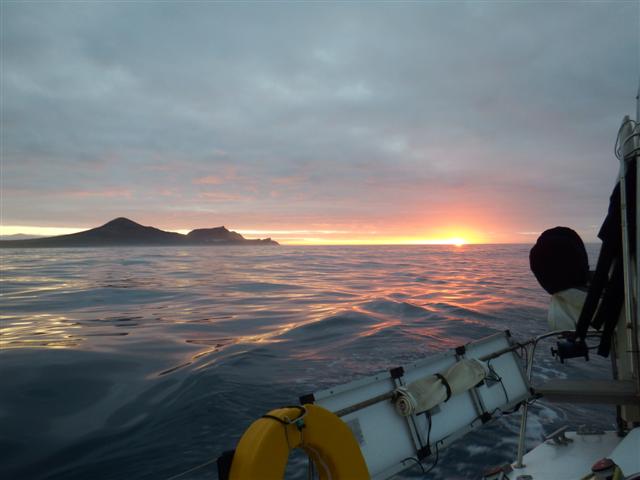
Cape of Good Hope at dawn
After leaving Simonstown on Sunday 15th January at 2.30am we successfully motored around to the V&A marina in Cape town. The reconditioned fuel pump worked well and the new solar panels regulator was also performing but more importantly not interfering with the replaced VHF radio. All was good for leaving South Africa as our visa’s were running out on 23rd January.
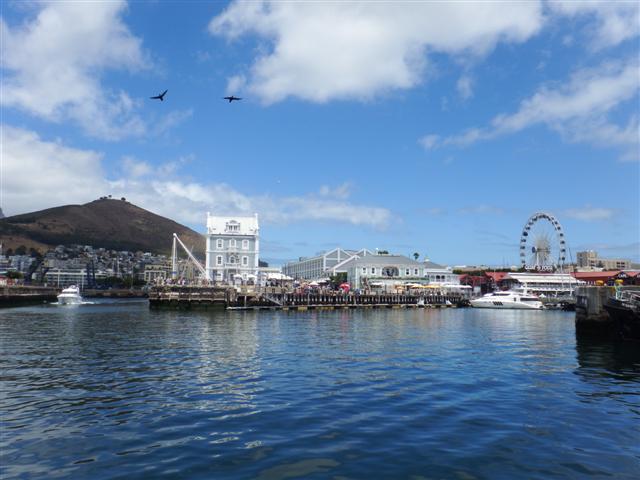
Arriving at V&A marina
My first job was to clear the backlog of washing in their washing machine which had a hot water fill, every one knows I love a hot water washing machine. As it was ‘too windy’ to go to the RCYC to check out Josh of the V&A persuaded them to let us check out from the V&A but first we had to wait for the letter. Finally arriving via Josh at 4pm it was too late to check out that day. The next morning we obtained a letter from the V&A to confirm all monies had been paid and set off for the control tower in the port to obtain the third letter we needed to take to customs to check out. The control tower is only open for letters from 12 to 3.30pm and after our second visit we got it. (Our 3 letters had different dates but customs didn’t seem to mind) we walked back into the port to, first immigration, where numerous forms were filled in and our passports stamped, then finally customs. That took 5 hours altogether and I can honestly say apart from Indonesia South Africa has been the worse for paperwork.
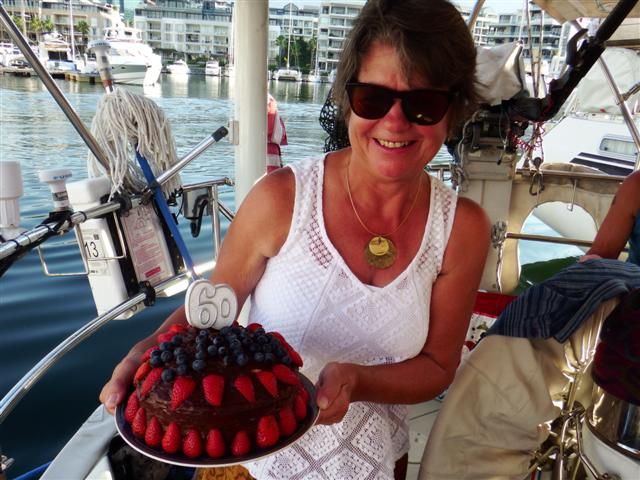
Sara on Norsa had a big birthday
Tuesday was also Sara of Norsa’s birthday and I made her a cake. We spent a wonderful evening celebrating with Solstice and Gaia too.

Table mountain and the 12 Apostles
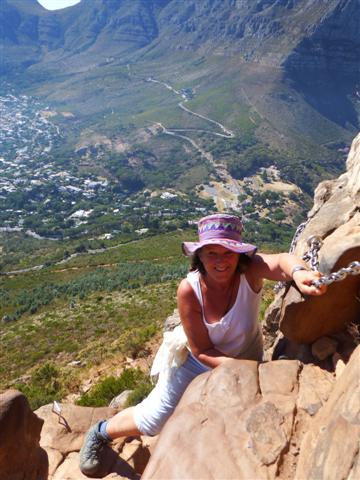
Climbing the Lion Head
Wednesday morning we climbed the Lion’s head next to table mountain, chains and all. The last 200ft was quite difficult but what a fantastic view! We’d started early and got back down at 10.30 3 1/2 hours round trip. I was in need of a coffee!
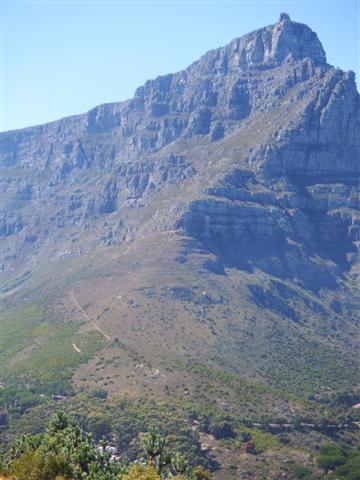
Table mountain
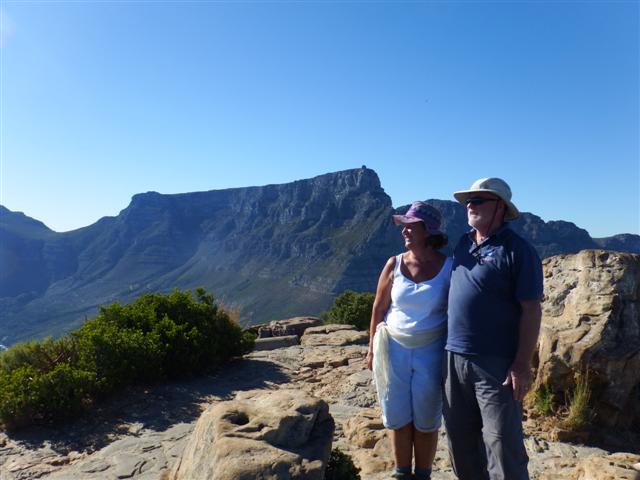
Standing on top of the Lion’s head with Table mountain in the background.
The rest of the afternoon was spent shopping for last minute provisions, fruit and veg and a bit more wine. It was early to bed because we both felt absolutely exhausted after our walk.
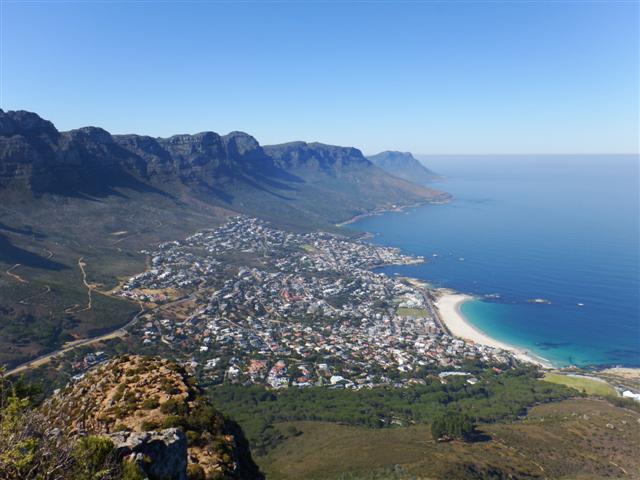
A view down the beach side of the 12 Apostles
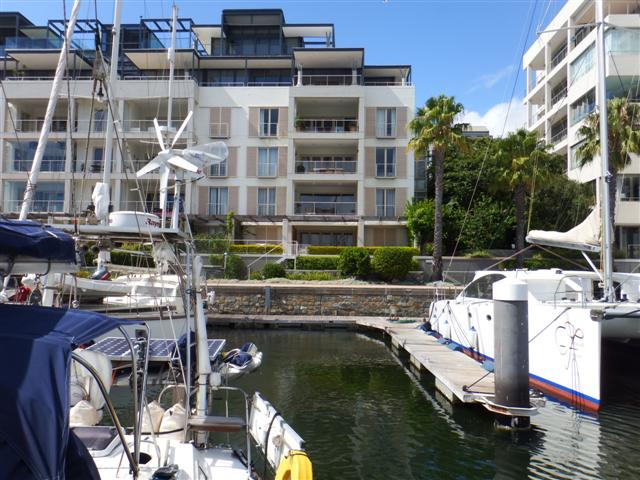
Leaving our berth at V&A marina
Thursday morning we were ready to go, our 48 hours after our check out was up and we couldn’t delay any more. It was with mixed feelings we left at 10.15. We want to get going but we’ve enjoyed south Africa and haven’t done everything we would have liked to do so hopefully we’ll come back one day – but on a plane.
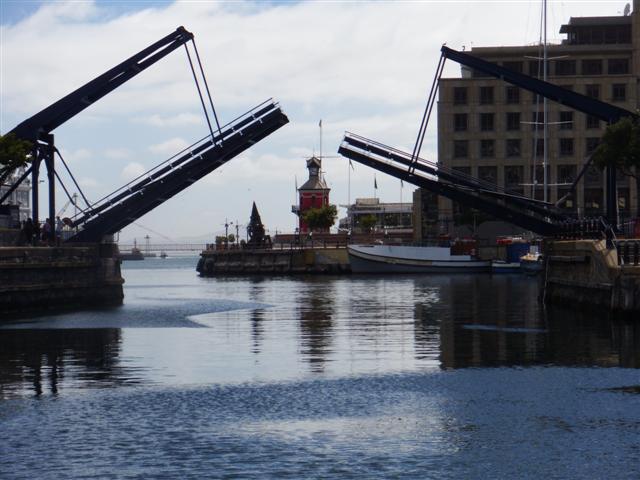
The bridge lifted to let us out.
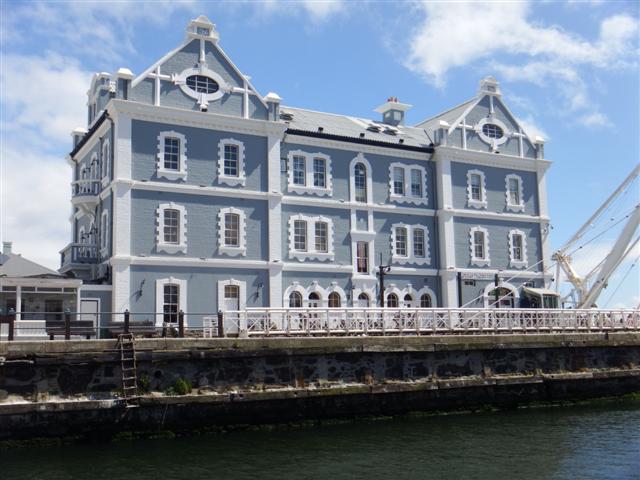
The old customs house on the waterfront
Within an hour the sails were up and we were enjoying a great sail. The main thing we noticed was that it was cold. The water temperature was only 15 degrees and despite it being their summer and the sun being out the wind had a chill to it.

Our last view of Table mountain but it had it’s ‘tablecloth’ on.
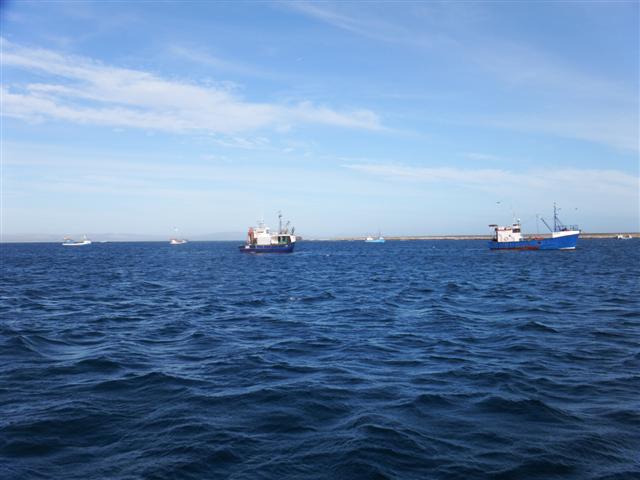
Fishing boats at Dassen island
It had been decided we would do a couple of day sails to start with to get used to the motion of being at sea again after spending weeks in marinas along this coast and motoring between them when the wind dropped to save being beaten up by the weather. Our first stop was Dassen island and we anchored at 33 24.78S
018 04.70E
along with a dozen fishing boats and millions of birds. The island was a bird reserve and fairly flat but with the anchorage on the north side it was very protected from the southerly winds. We had travelled 41 miles, a good start to our journey.

Fishing boat joining us
November Update
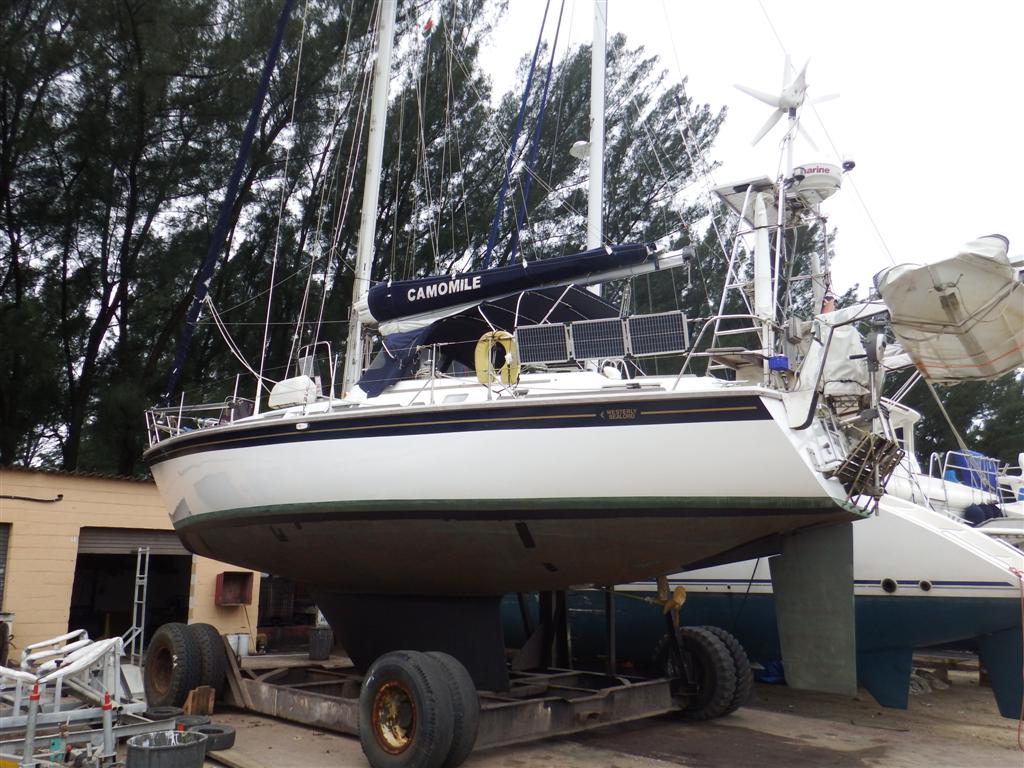
Camomile ready to go back into the water
The website has fallen behind again so I’m going to try to bring it up to date before we leave South Africa.
When we first arrived in South Africa and checked into Richards bay we had quite a few jobs to do on Camomile. We were able to arrange to come out of the water for a few days to repair the copper coat, anti-foul the keel, replace a bulging sea-cock, clean the prop, replace anodes, and polish the hull. Camomile looked very smart when she went back into the water on 31st October.

Next to Norsa again

The outboard going to the doctors
We went back to our berth in the marina next to Norsa, who had arrived while we were out of the water. The jobs continued with our outboard going to a local engineer for a much needed service and to sort out why it’s difficult to start sometimes.
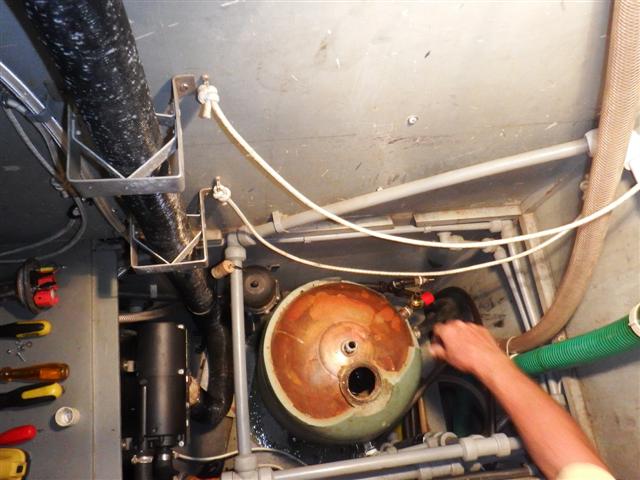
Disconnecting the old tank
Our new hot water tank arrived for Bill to fit which entailed emptying the deck locker of most of it’s contents and storing them in the forward cabin, disconnecting the seven inlets and outlets on the old tank and removing it, reconnecting the same and testing.
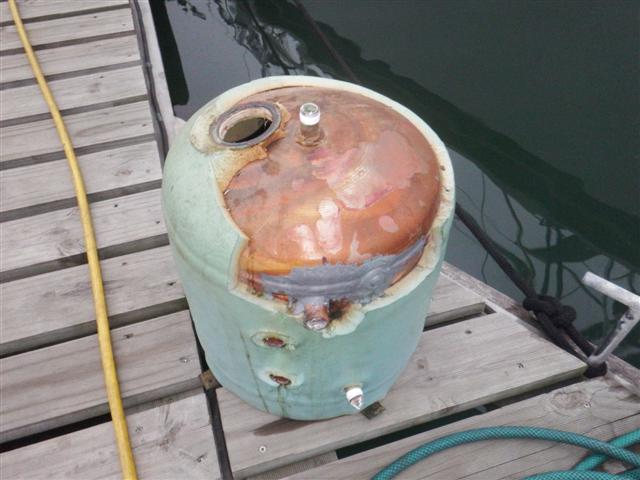
The old tank out with the failed repairs showing.
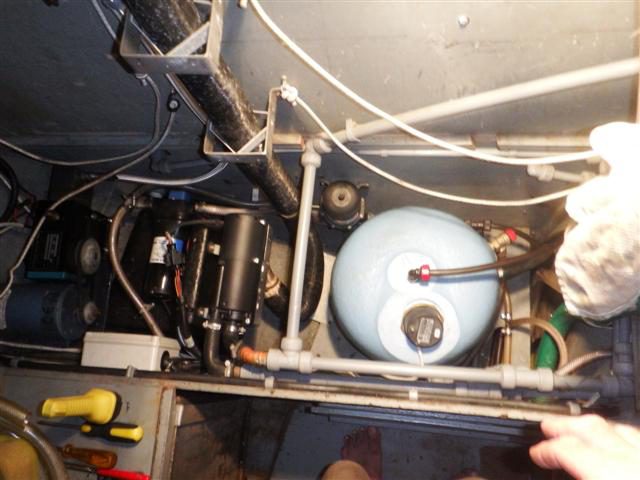
Hot water at last
Fortunately it worked first time without any leaks. Hot water at last. I don’t mind having cold showers in the tropics but it’s cold in south Africa! Then we had to refill the deck locker. All this took several days. Meanwhile normal jobs like washing, shopping, cooking, having my haircut, refueling, boat maintenance continued.
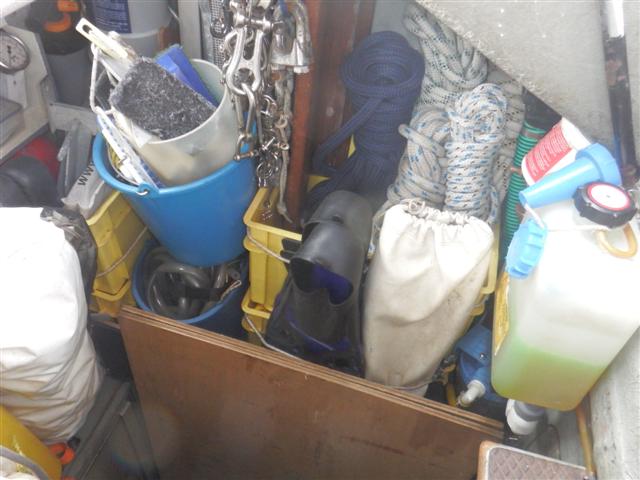
Deck locker refilled
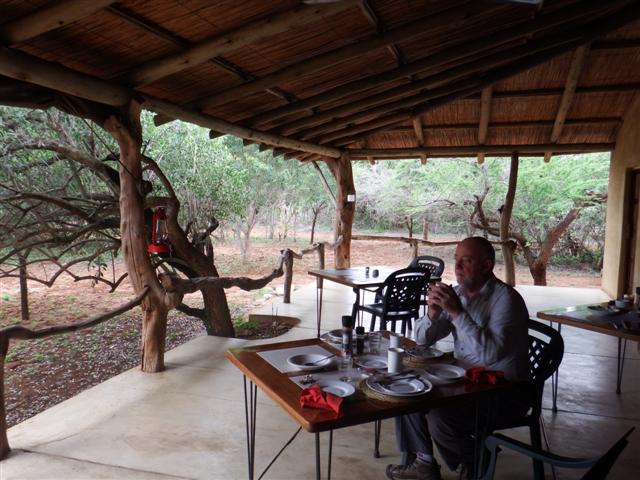
Eating breakfast……
I have already written about the hippos at the iSimangaliso wetland and our jeep safari in the iMfolozi safari park but we had a third day away where we explored the Hluhluwe park in our own car. If you’re short of time I would recommend going on a jeep safari because you see so much but if you have time it’s nice to drive yourself because you have more time to stop and look at the scenery. We spent two nights at the Leopard walk lodge about 20kms from the northern gate of the Hluhluwe section of the park. The breakfast ‘room’ was an open staging overlooking a private game reserve.
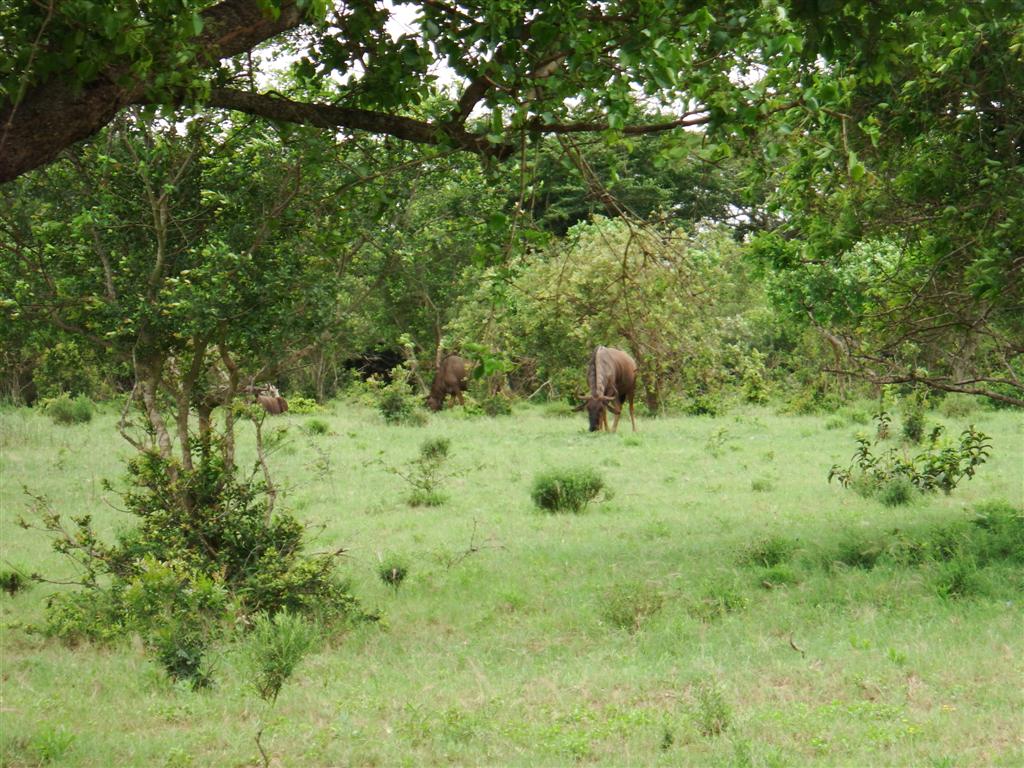
….. watching Wildebeest
While eating our breakfast some wildebeest walked by. They also had impala, zebra and a giraffe although we didn’t see him. If you get up early enough and go with a guide you might see a leopard (we were told) .
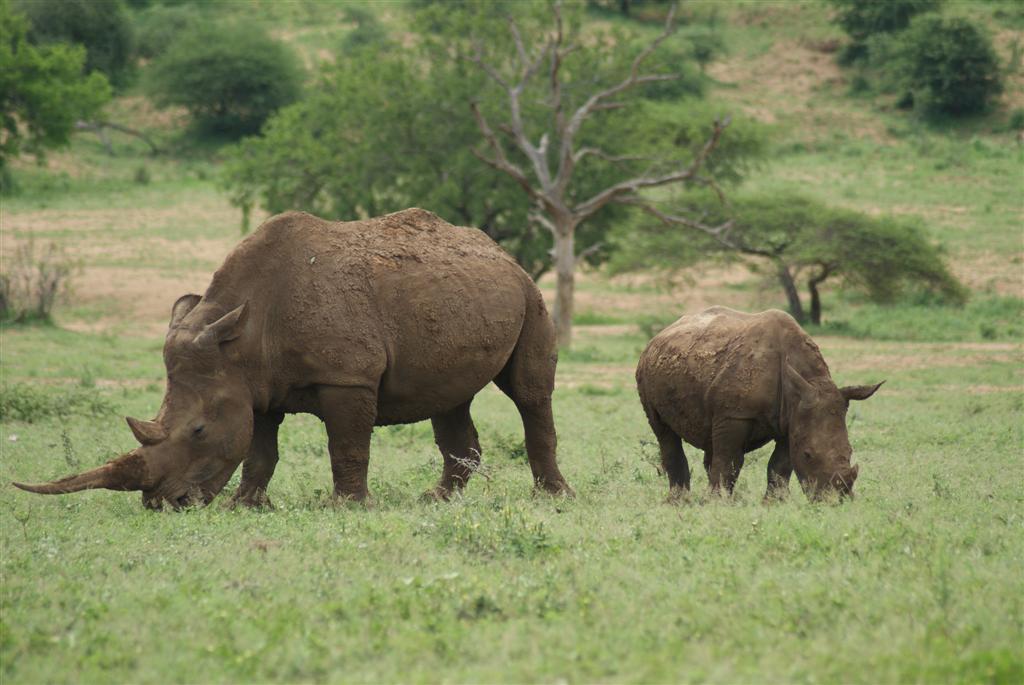
Mother and baby rhino
We entered the Hluhluwe park through the northern gate and straight away saw a mother and baby Rhino grazing by the side of the road. They were both covered in mud so must have been wallowing some where. The mother was sporting a huge horn, hope the poachers don’t see her.
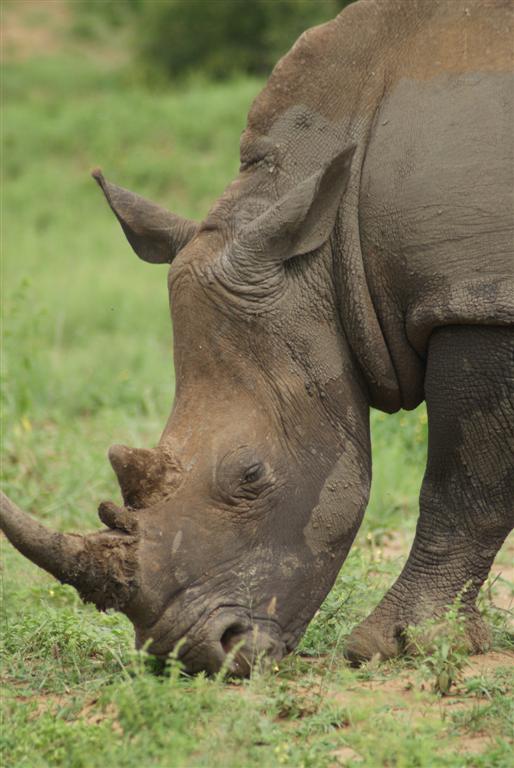
A female white rhino
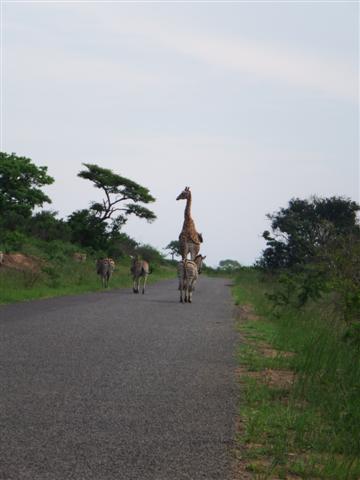
This is Africa!
I love this photo. Right in front of us was a beautiful giraffe with some zebra just walking up the road. How cool is that!
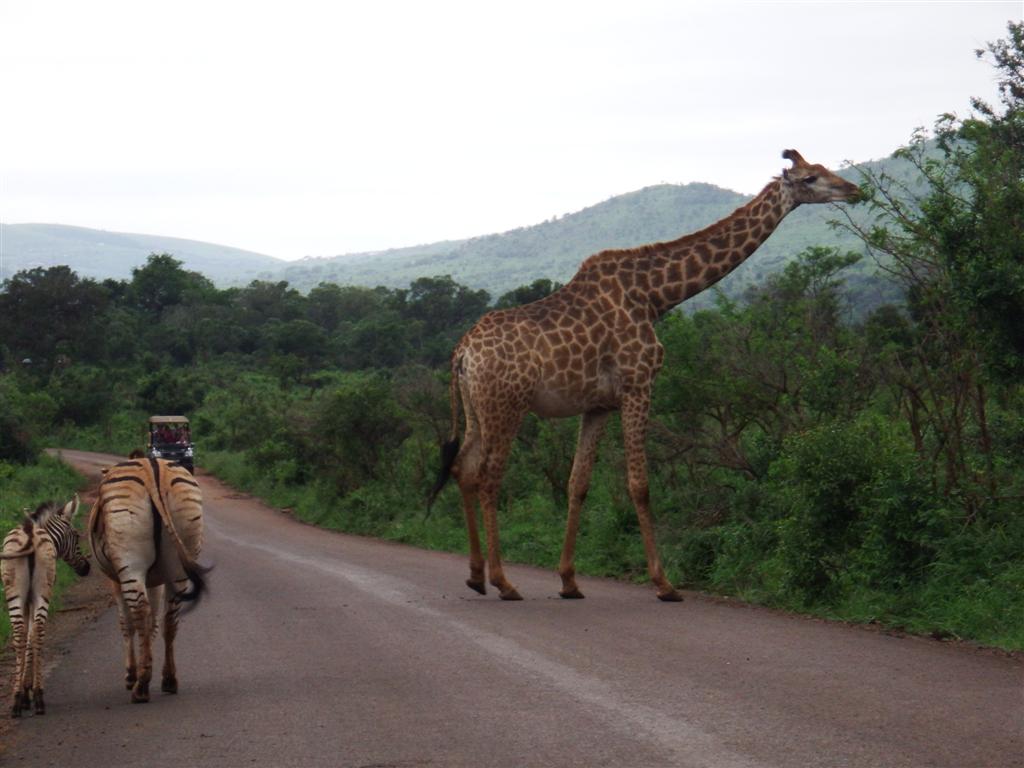
A beautiful giraffe
We continued to drive around the park until we came to the Hilltop camp which is a resort within the park where it’s possible to stay. This would have been a nice thing to do but a bit beyond our budget but they did nice coffee. The view from the veranda was breathtaking.

Stunning views from the Hilltop camp

The baby elephant is underneath the left hand elephant.
We continued on our journey and came across a small herd of elephants with a very young elephant with them but the adults were shielding it from our cameras.
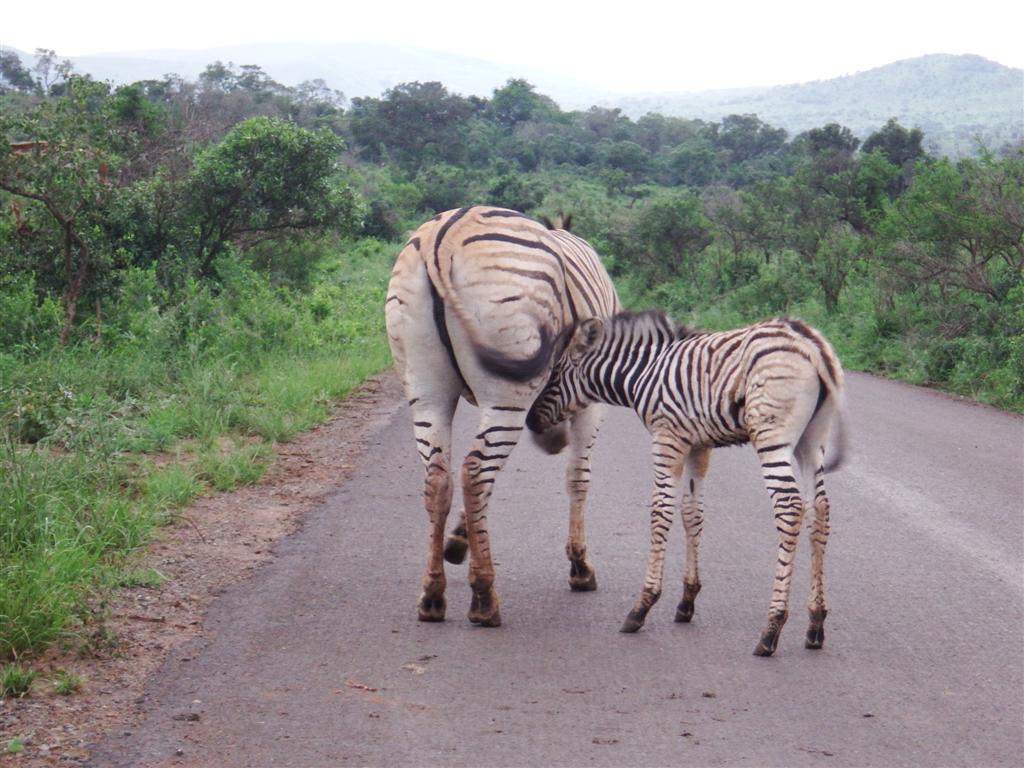
Mother zebra with a baby feeding
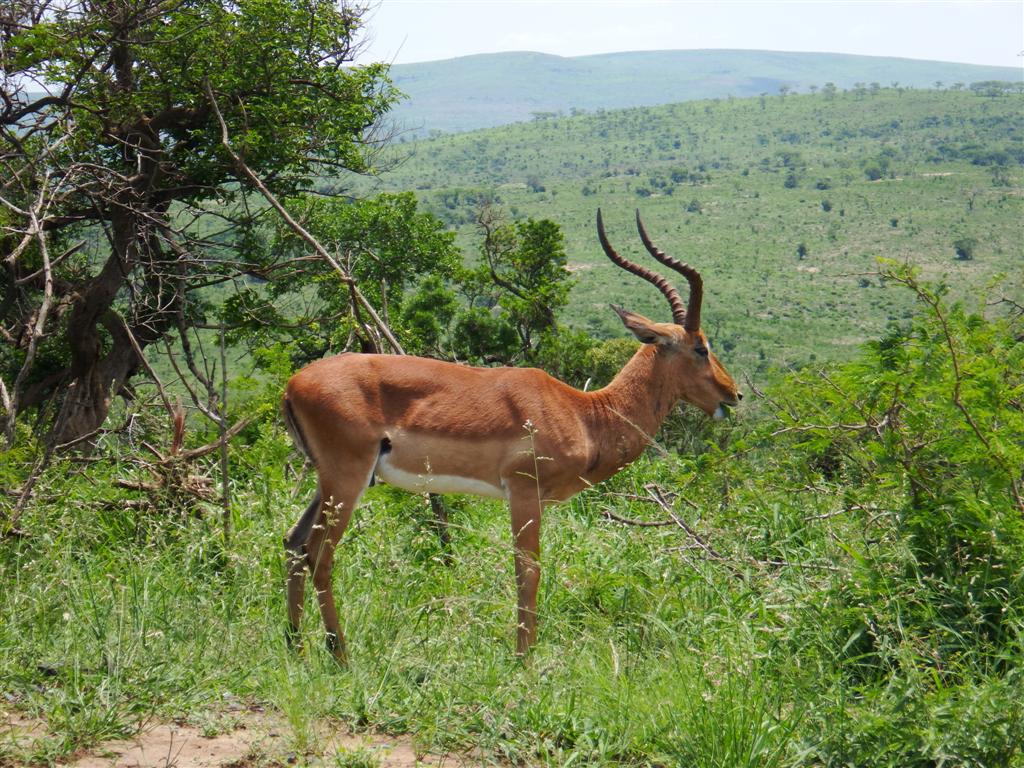
Male impala
We saw more rhinos, lots of impalas including this chap with a pair of wonderful horns, luckily the Chinese don’t like them, some warthogs (pumba), some zebra with more babies and finally another pair of giraffes came to say goodbye as we left the park.

A pair of giraffe come to say goodbye

Baby cheetah. I was standing about 3ft away from him.
Once we left the Hluhluwe park we drove back towards the town on the main road to the Emdoneni rehabilitation center for Cheetahs and other game cats. Firstly the animals ARE NOT drugged in any way, this was not a Thailand tourist attraction. Secondly it’s not a zoo. Many of the animals have been taken there because they’ve been injured or orphaned. Of the animals they have or have breed, half of them will go back into the wild and don’t have any contact with humans at all. The other half can’t go back for one reason or another and enter the breeding programme and are kept in the area open to the public. Without the part of the center open to the public they wouldn’t be able to fund the part not open to the public which is having huge success in breeding, rearing and releasing cheetahs in the wild, which are in danger of becoming extinct because their numbers are declining.

African wild cat
The first animals we were shown were African wild cats, I know, I know they look like your average moggy but up close they are lighter than a normal house cat. As you can imagine there’s a lot of inter-breeding with house cats and the center has a breeding programme to try and keep the breed pure.
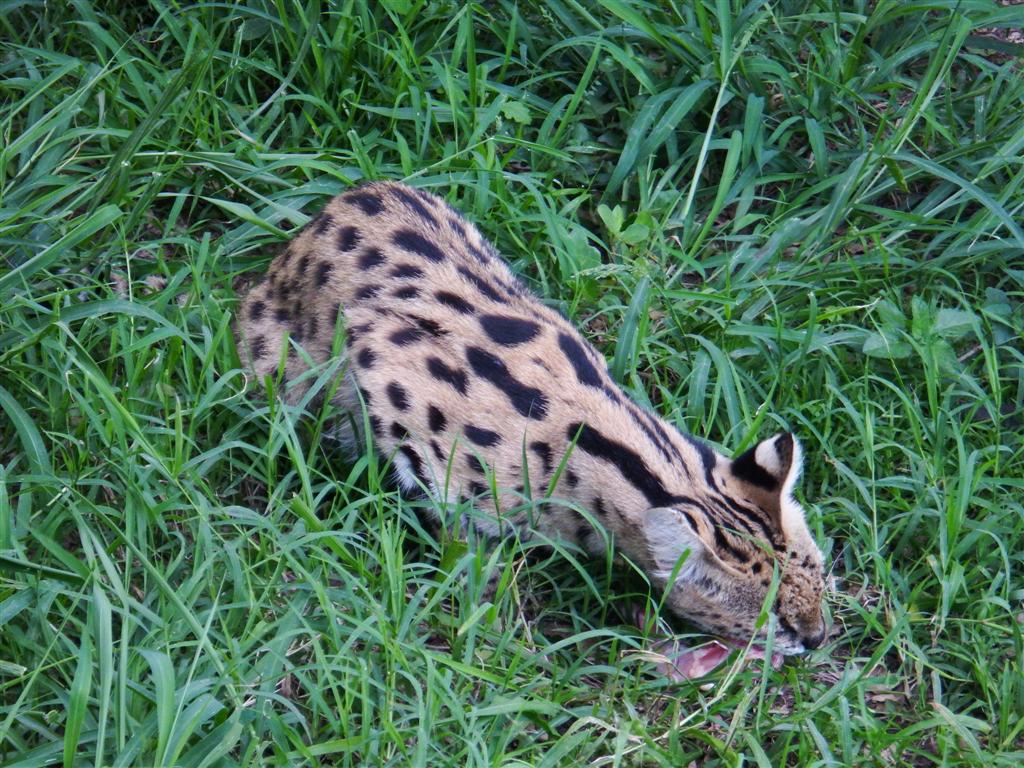
The stunning Serval
Next was the Serval, an absolutely beautiful creature, fabulous markings. The guided tour is also feeding time so they were all content to have their photo taken. This one was behind wire but his pen was huge. We also saw a Caracal but he wouldn’t stand still to have his photo taken.

“Who’s this coming into my space”
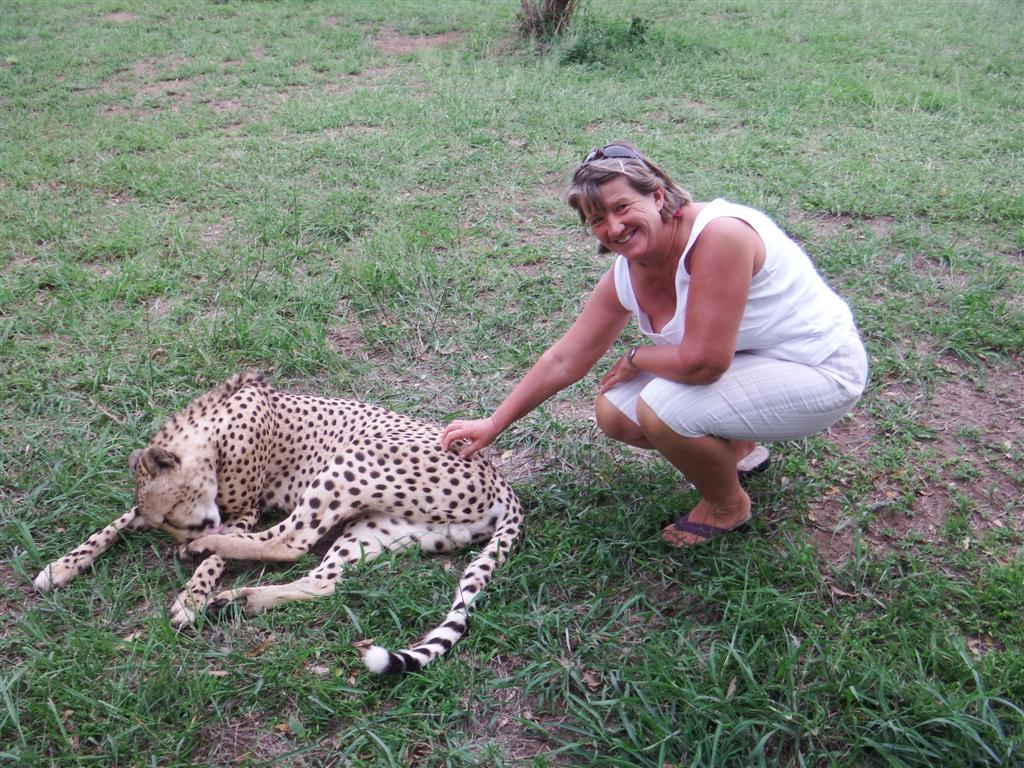
I got to stroke the cheetah
Then we were taken into the cheetah enclosure. The center has two pairs of brothers who have been hand reared so can never go back in the wild because they wouldn’t be able to fend for themselves. The beauty of the Emdoneni centre is you are able to stroke this handsome chap, another tick in the box for me! The center is very strict and we were all given implicit instructions before we entered the enclosure for the two bigger boys. We had to walk in single file and keep together with a ranger at the front and one behind. Once they were sure he was settled we were given the opportunity to come forward one by one. Guess who volunteered first?

Beautiful creature
In the second enclosure are two much younger cheetahs who will stand more than one person touching them so we both had a turn. The rangers stroke them like pets and the purring was like a steam engine, so loud.
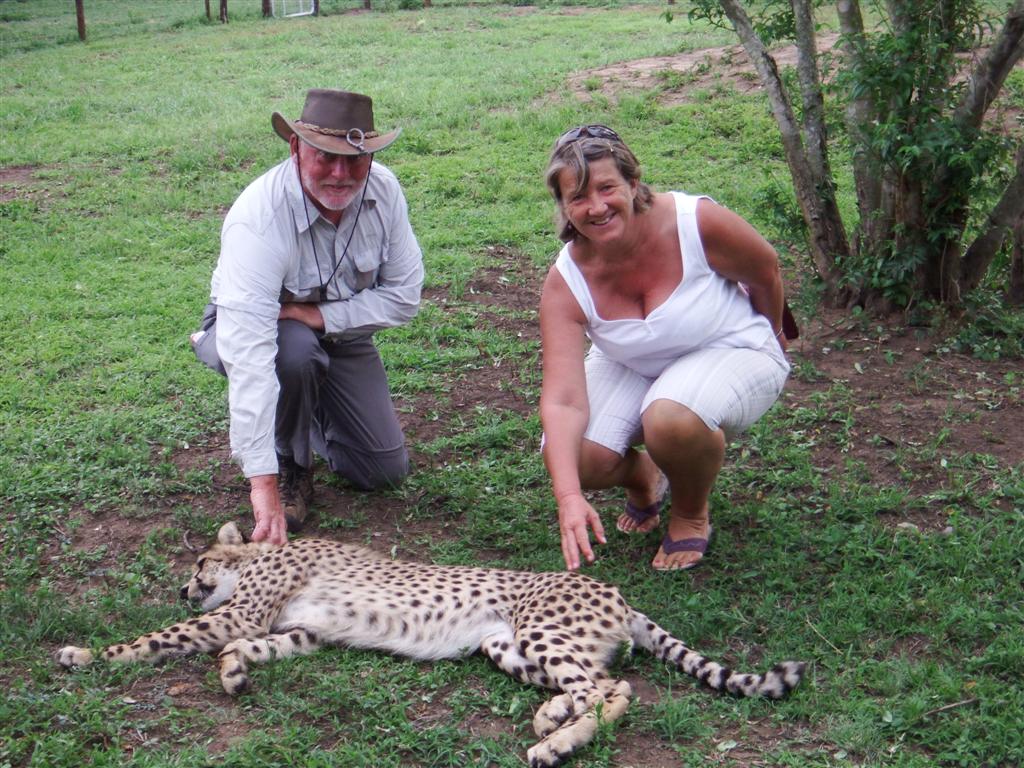
This one was much younger. I could have sat with him all afternoon.

Goodbye Zululand YC and Richards bay. We enjoyed our stay.
After our second night at the Leopard walk lodge we drove back to Richards bay to do some shopping and refuelling, picked up the serviced outboard and checked out of Richards bay before taking the car back at the end of the day. Friday 11th after a nice lunch with Divanty and Gaia we left at 4pm with Divanty for an overnight sail to Durban.

Arriving at Durban
It was a good sail and we arrived at 7am. We anchored outside the marina at first because the marina was full but later we were allowed to go in and raft up next to Norsa, who had sailed there while we were on safari.
Not a lot can be said for Durban really. It was quite chilly while we were there and rained quite a bit. The problem with the rain was that it was full of coal dust that had come off the numerous piles of coal from the local mines waiting to be shipped out of the port and during the 2½ weeks we were there the boat became absolutely filthy. Quite a few boat jobs were completed including replacing the bearings in our wind generator and Bill and Norman replacing the bearings of Dons wind generator on Solstice.
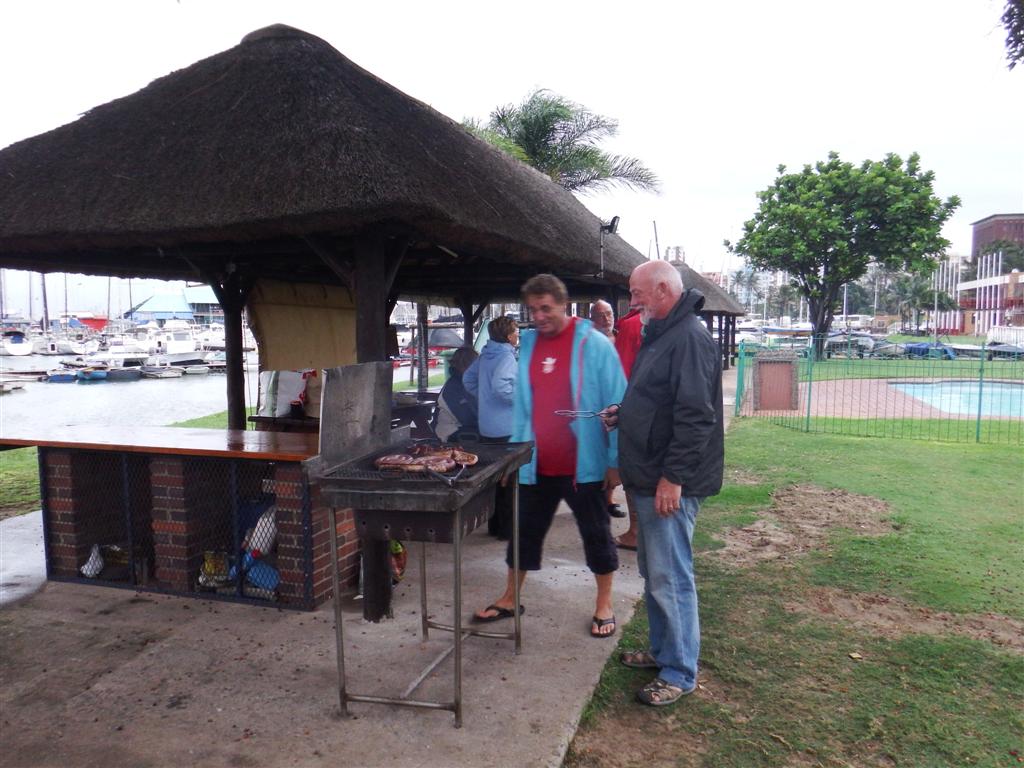
Bill and Kevin manning the braai
The 16th we planned to have a braai (BBQ) one evening and almost called it off because it was raining again but we are British and a bit of rain didn’t stop us all!
On 17th I got my sewing machine out to adjust our new cockpit cover which hadn’t been right since it was supplied after our refit in May 2015. I also sewed the zip on that had been left off so we could put our aft cockpit cover on, normally for the winter!
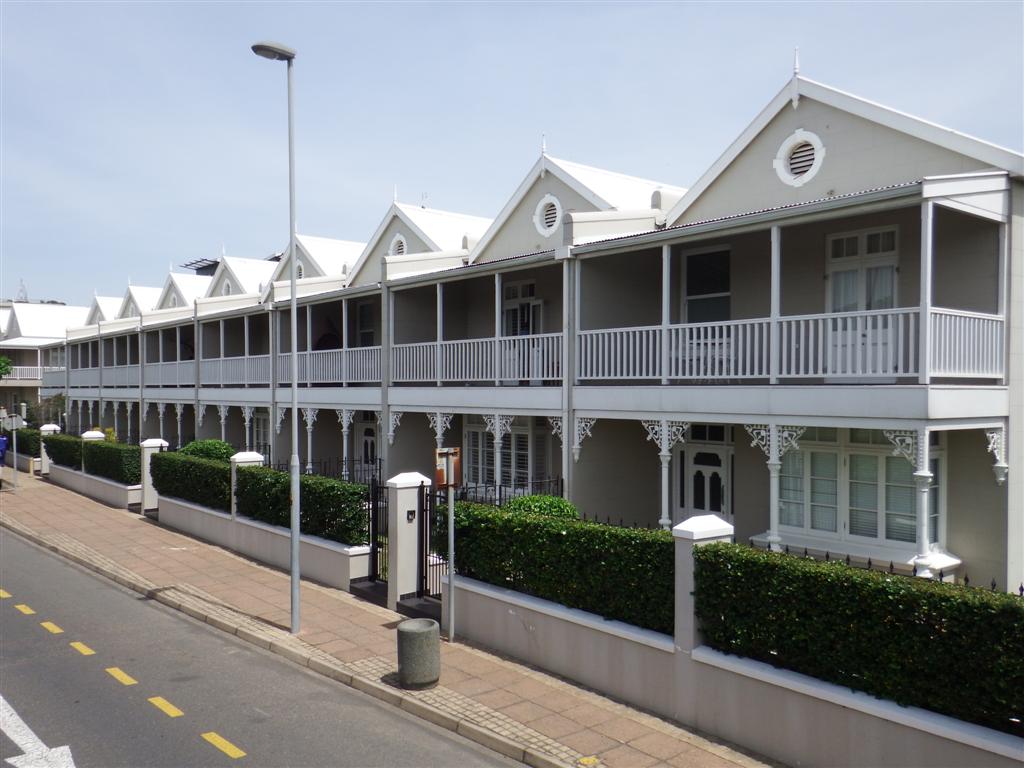
An interesting row of houses
Monday 21st Davina on Divanty suggested we all go for a ride on the big red hop on, hop off bus. The only difference for the Durban bus is you don’t hop off because it’s too dangerous but stay on until they stop in a safe area! The ‘good’ bits of Durban are few and far between and Delboy would have given this company a run for their money but it was nice to get off the boats for a day. I managed to take a couple of photos of some interesting places.
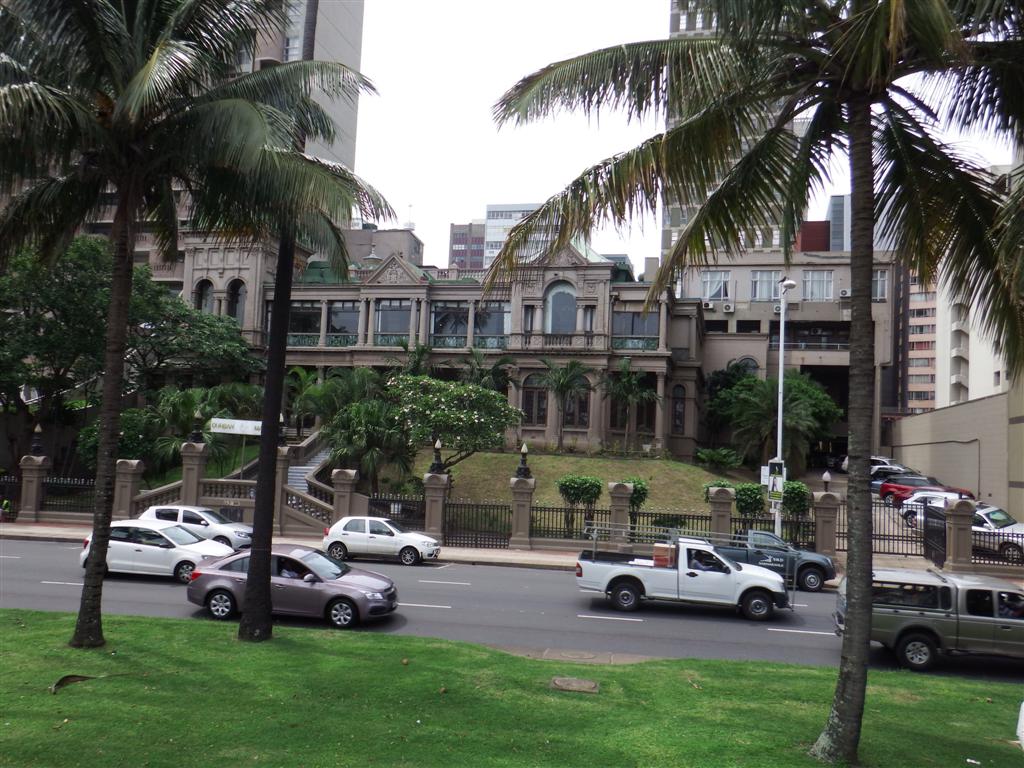
Nice building

city hall
I think this was the town hall but not certain.

The fork lift training school
As we went past the forklift school all the men wanted to get off and have a go.

A typical street

A market stall
Most of the city looked like this, just streets full of modern buildings. The market areas looked interesting but we had already been warned not to go into those areas on our own without a local guide. A couple of cruisers had had little run ins with the locals trying to steal jewelery or other items. There was a lot of poverty in between the wealth.

An unfinished road
This was interesting. The motorway hadn’t been finished and the road just came to an abrupt end. The locals had set up some stalls on it and a temporary bridge had been built to link it to a working area.
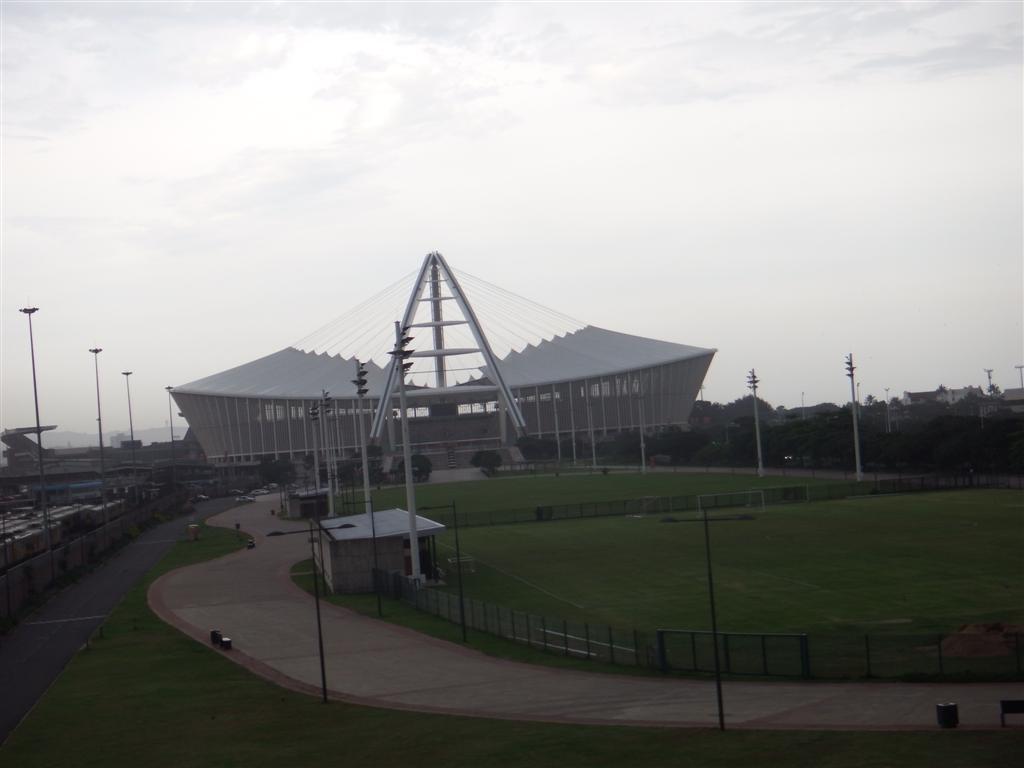
The Moses Mabhida stadium
Once back on the waterfront we were driven past the stadium that was built for the 2010 world cup, looking like a giant picnic basket with seating for 56,000 people, it was very well used. The ‘handle’ has steps up one side or its possible to use the Skycar. Once on the top it’s possible to plunge off on the Big Swing. All around the outside were various sports areas. The seafront itself has a walkway along the waters edge several miles long. The problem was the area between the seafront and the marina isn’t safe so you need to take a Uber taxi to get there.
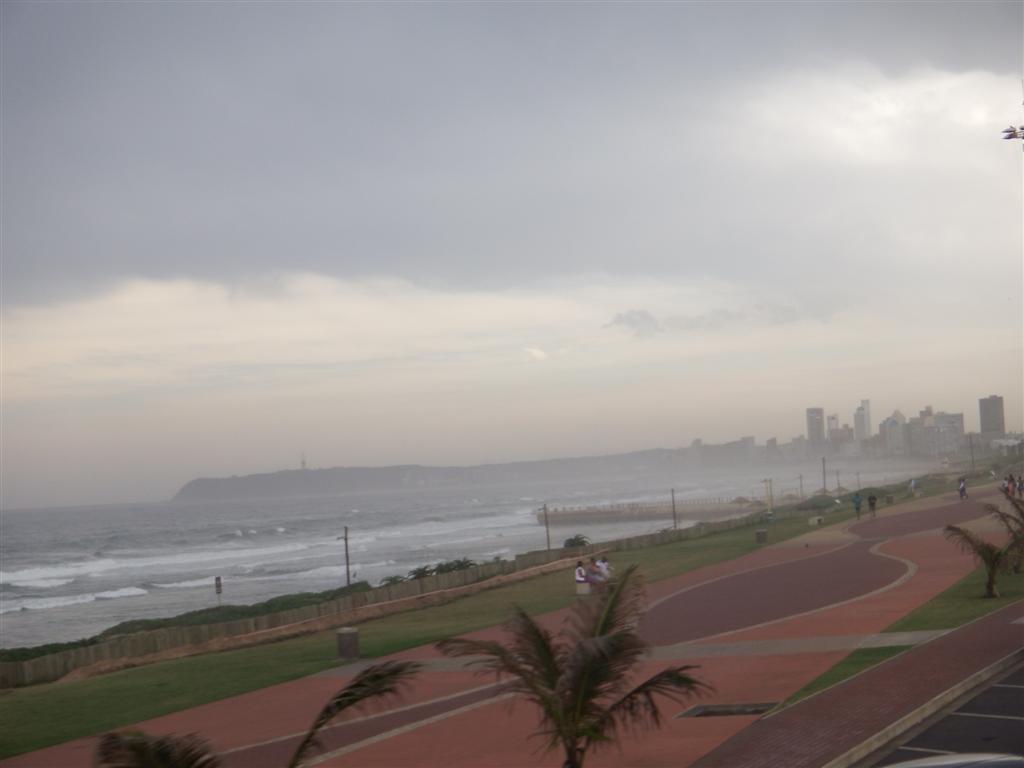
It looks like rain.
After our bus ride we made our way back to the marina before more rain.
Life continued until 29th when 7 boats had a meeting about the weather and sea conditions to Cape town. Later that day we all left on passage for the journey many of us had been dreading since arriving in south Africa – Cape Agulhas.
More in the December update.

Sailing south
Safari in the Hluhluwe-iMfolozi park
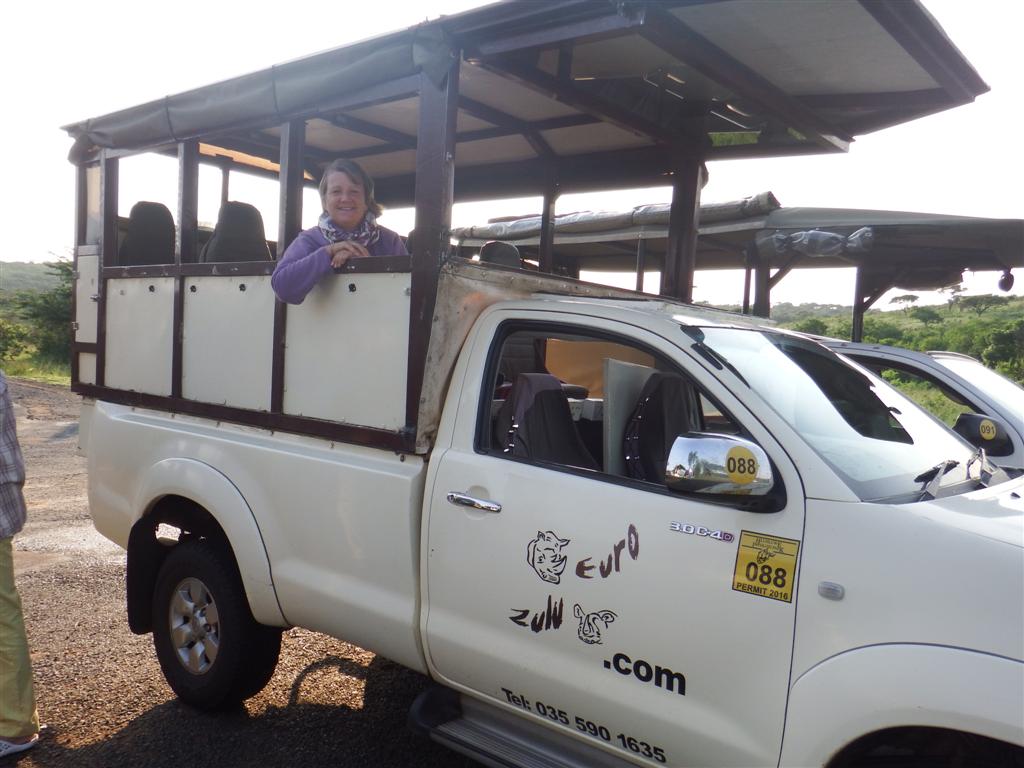
Sue in the jeep
After our rainy boat trip to see the hippos we awoke the next morning to a better day – although at 4am it was still dark! We packed up the car and waited for the safari jeep to arrive. We didn’t want to stay in St Lucia for a second night and had booked a place near the northern gate of Hluhluwe. The plan was to follow the jeep to the eastern gate, leave the car inside, rejoin the jeep for our safari after which we could drive ourselves through the park to the northern gate. Our jeep arrived with Steve our guide. We had booked an elite safari with Euro Zulu safaris. This meant there were only 6 in our jeep and the middle seats weren’t filled. We had our friends Davina and Antony with us and a couple called Andy and Emma also joined us. At 6.15 the sun was out and we were ready to see some animals. I’ve been wanting to do this since I was a little girl.

Our first head of Impala
Hluhluwe-iMofolozi (pronounced shloo-shloo-wee-im-for-lozi) park covers 960 sq km (3 times the size of the Isle of Wight) a lot of which is mountainous landscape so unlike ‘safari parks’ (read zoos) back home it’s quite difficult to spot the animals. Its possible to drive yourself but you’re much higher in the jeep. The first animals we came across were impala, pretty little things, as common a sight as sheep in our countryside, but Steve said their tails form a letter M on their bottoms which he said stands for MacDonalds, yes these dear little creatures are the fast food of the game park. All of the big cats eat them.

A male impala
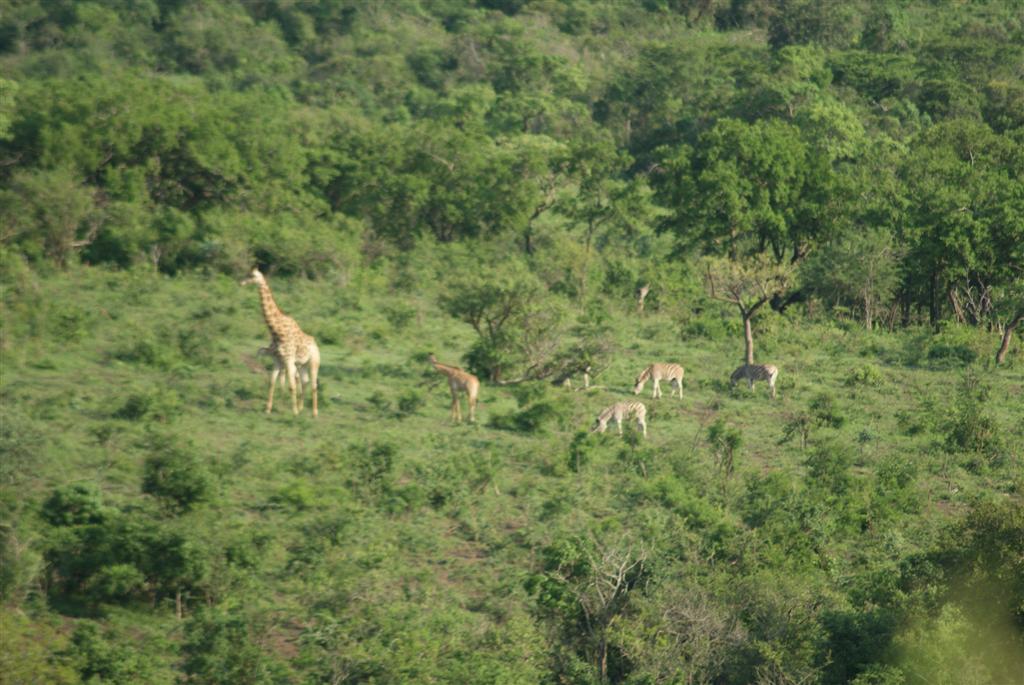
A giraffe in the distance
I had already told Steve my favourite animal was the giraffe and I really wanted to see one so as we continued along the road several were spotted in the distance grazing with some zebra. Their long graceful necks were very distinctive. There was a 4×4 track heading off towards them which Steve took. It was a bit rough but the jeeps are built to take it, a hire car wouldn’t have been able to use the track.
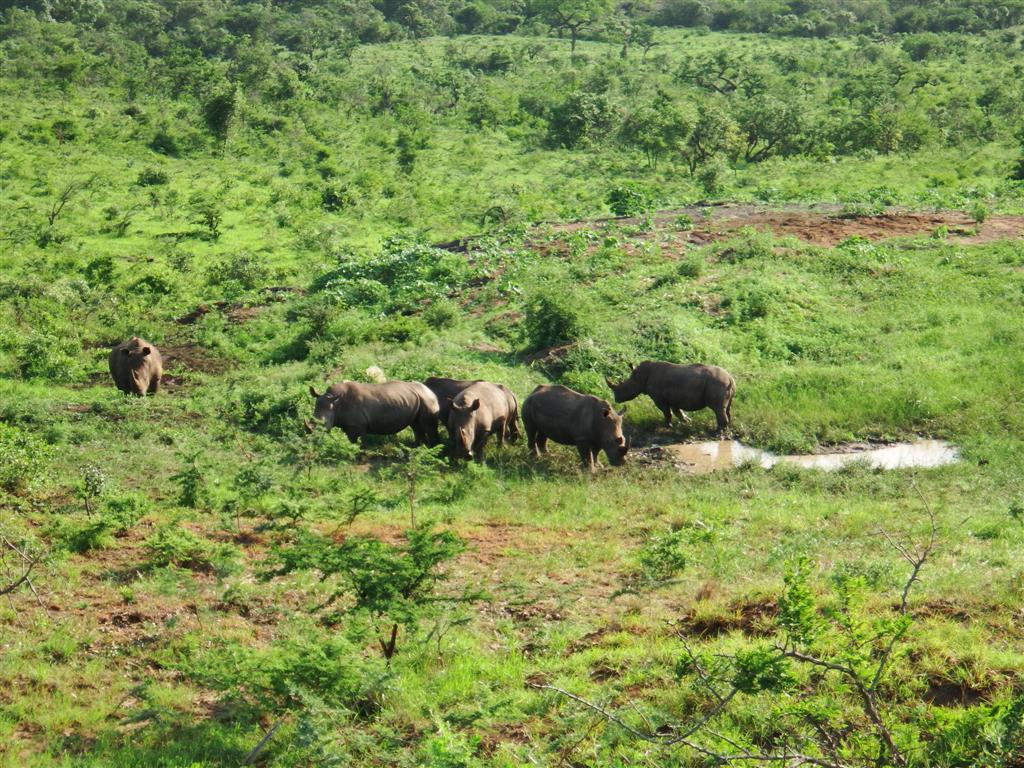
A crash of rhinos
As luck would have it as we were driving along the track a crash of rhinos were spotted (sounds like a Camomile quiz question to me!) the collective name for a group of rhinos. They were white rhinos, black rhinos are smaller and very hard to spot, sadly we didn’t see any of those. Despite the parks best efforts these creatures are still hunted for their horns. As we watched the rhinos helicopters were circling in the distance watching out for poachers from Mozambique. Steve said there is zero tolerance towards poachers and they are shot on sight. No beating about the bush in South Africa These were our first sighting of one of the big 5.

The first of the Big 5
The Big 5 are Lion, Leopard, Elephant, Rhino and Buffalo. I asked why those particular animals and its because they are the ones most difficult and dangerous to hunt, in other words they are the ones that bite back! This group were all female with one male rhino standing on his own close by. One of the ladies was particularly attractive to him and he wanted his way with her but her sisters were having none of it and wouldn’t let him near her despite several charges. We sat and watched them for about a quarter of an hour before they ambled away with the big fella following them.
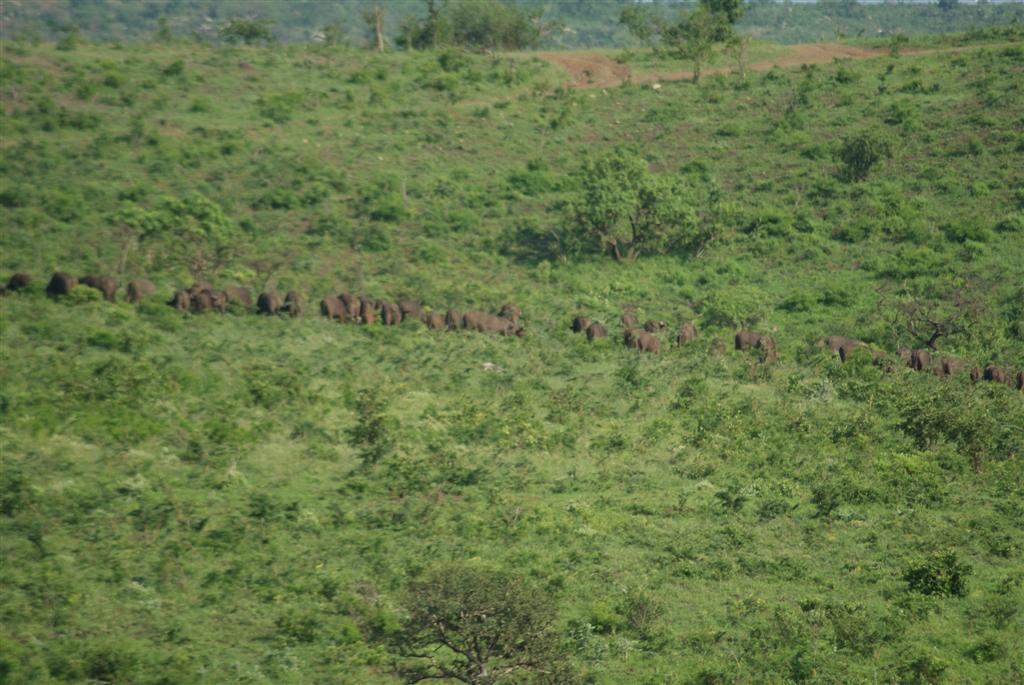
A herd of buffalo
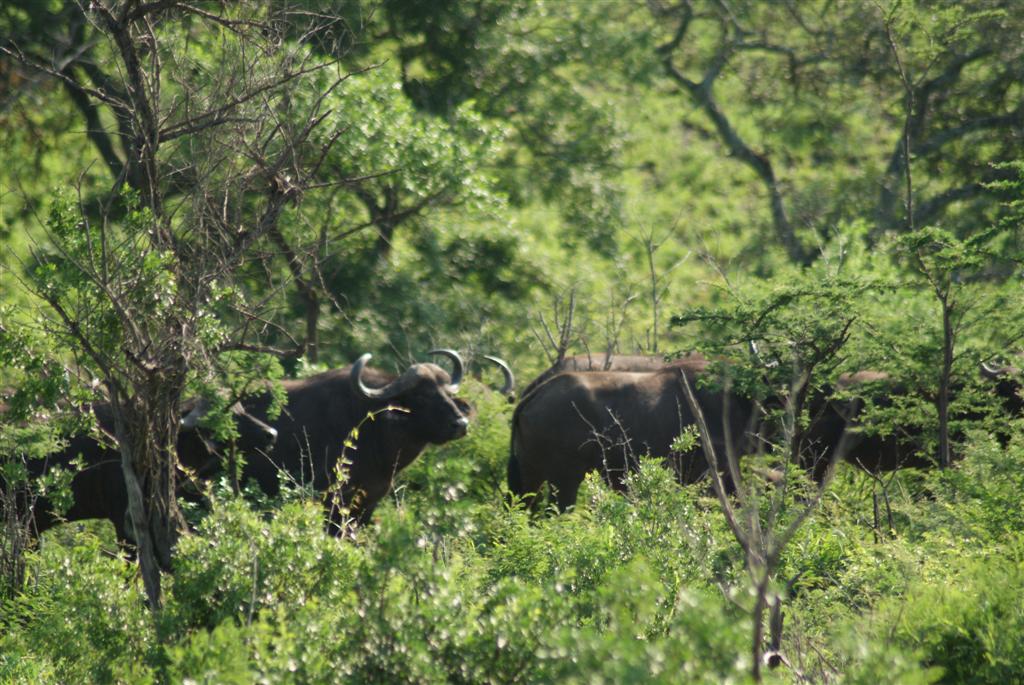
A closer shot of the buffalo
In the distance Steve spotted a herd of buffalo – our second of the Big 5, and he drove closer to them. Even though there are quite a few roads around the park there aren’t a lot and it’s difficult to get close to some of the animals. Remember none of these animals are fed in any way, it’s not a ‘safari park’ but part of the wilds of south Africa. The outer fence (which we didn’t get any where near) is to protect them and keep poachers out.
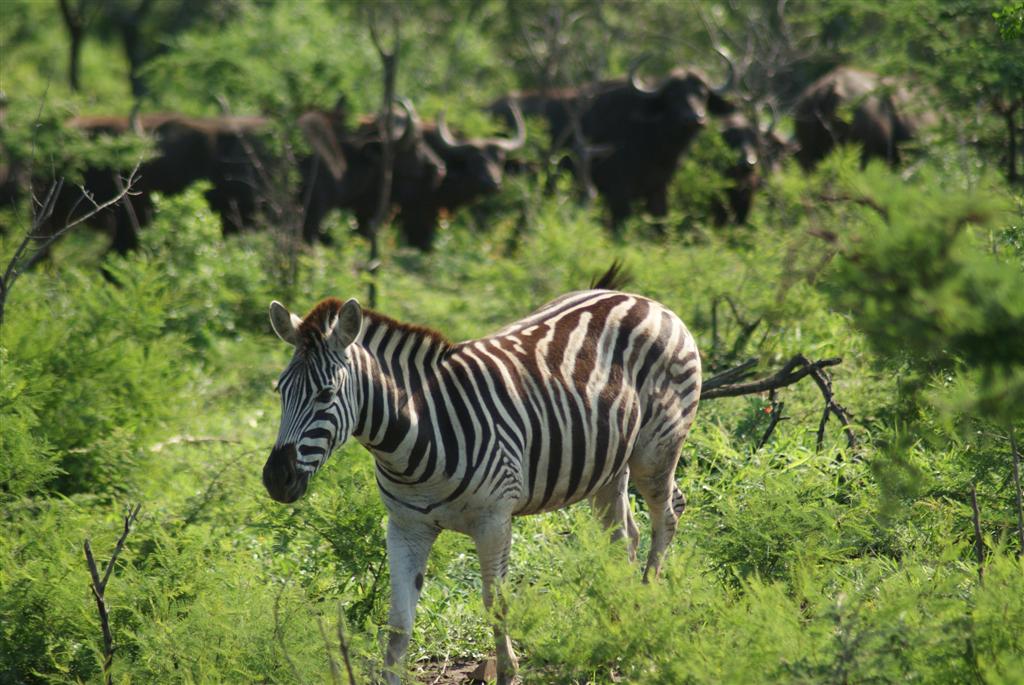
They’re behind you!

A dazzle of Zebra
As we got closer a dazzle of zebra (hope my sailing buddies are taking notes) appeared. They didn’t seem to be worried about the buffalo behind them. Zebra really are the most striking animals. Their makings are unique to each animal. Many of the females were pregnant. These ungulates (hoofed animals) weigh between 230 – 380kgs and their length is 260 – 300cms but they are not ruminants (haha, look it up)

Handsome boy
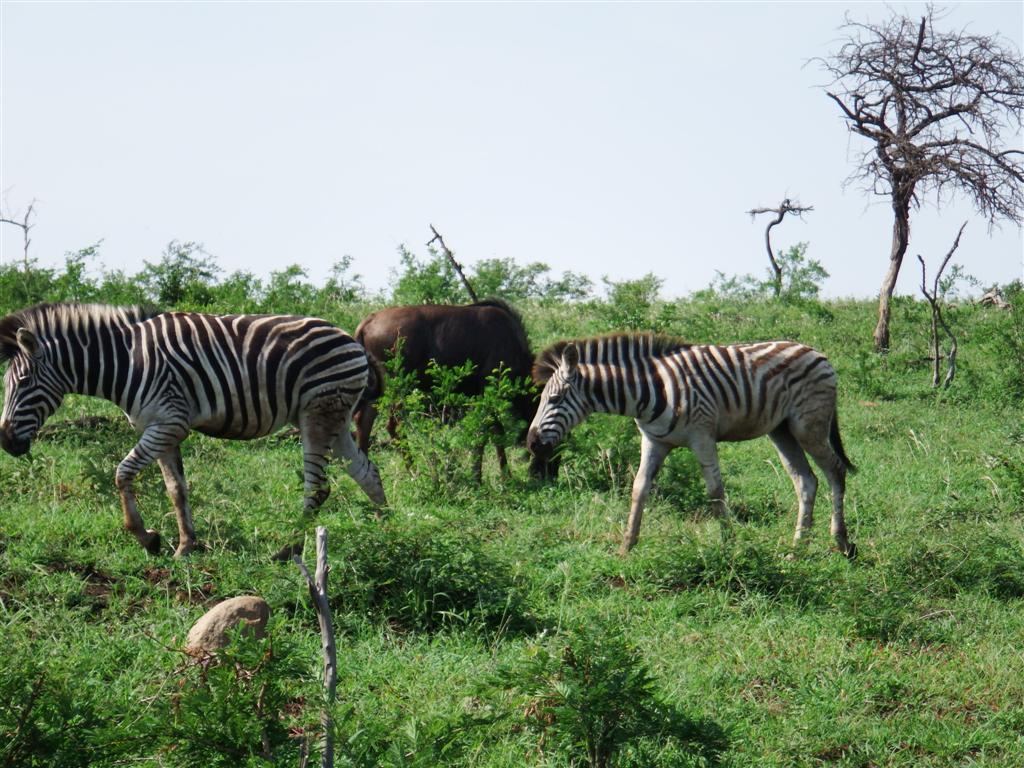
Zebra and wildebeest
In amongst the zebra were some wildebeest. Another ungulate and these ruminate, and as they have horns they are bovine. Wildebeest also find themselves on dinner menus of the big cats.

Wildebeest
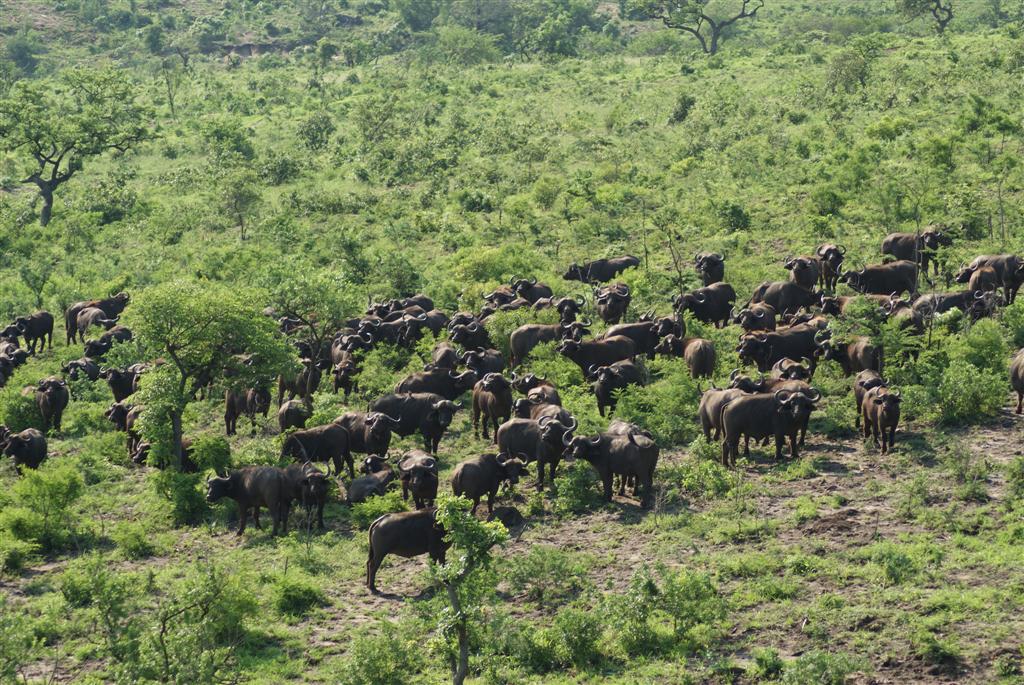
A herd of buffalo
We were doing really well for animal sightings and we hadn’t even had breakfast yet. Steve drove to the top of the track where we were all allowed to get out and stretch our legs while he laid out a breakfast for us on the little drop down shelf on the back of the jeep. We had yogurt and cereal, fruit, muffins, rusks and tea or coffee while we were busy looking out on the surrounding area. The buffalo heard were getting closer. My camera was in the jeep but suddenly we turned round and we were being stared at by several hundred buffalo no more than 50 meters away from us. Steve wanted us to quietly and slowly get back in the jeep, just in case, but fortunately they crossed the path and went down the other side of the hill and melted into the undergrowth.
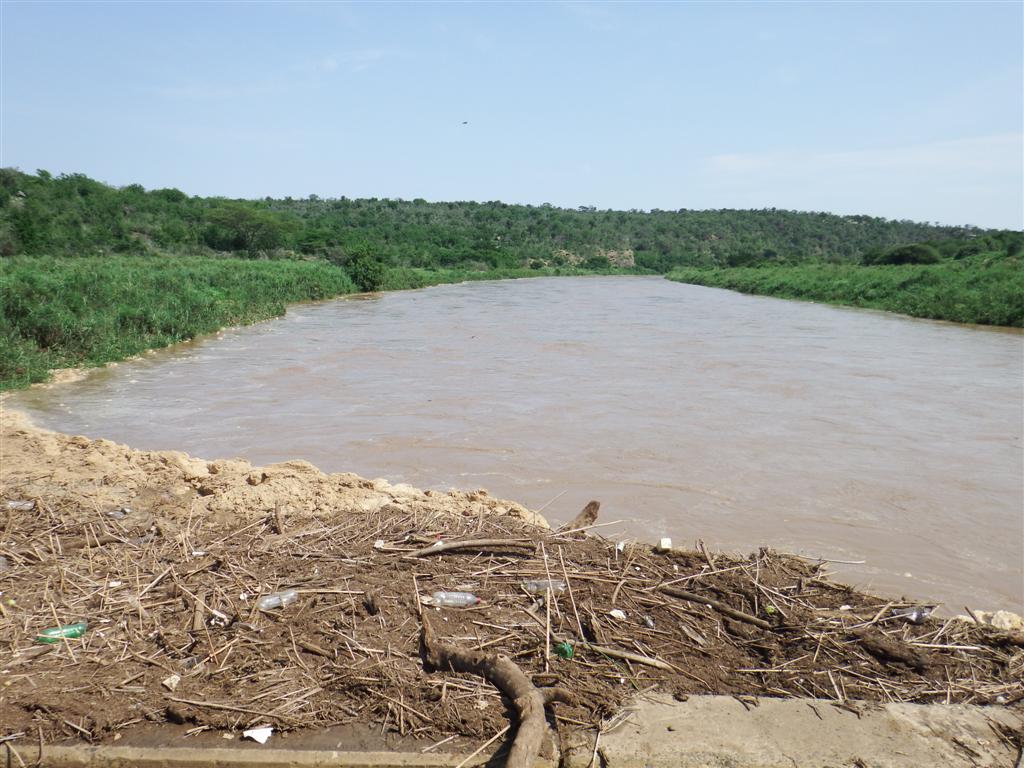
The Black Umfolozi river, see the debris in the foreground
Steve packed up the picnic and we continued on our journey. After returning to the main road our journey took us over the Black Umfolozi river which was very swollen after the rains of the previous couple of days. A lot of debris had floated down the river and was caught up by the bridge. The water was only a few inches below the bridge. Once on the other side the scenery flattened out a bit and many of the smaller trees had been bent over and snapped as though a storm had gone through.
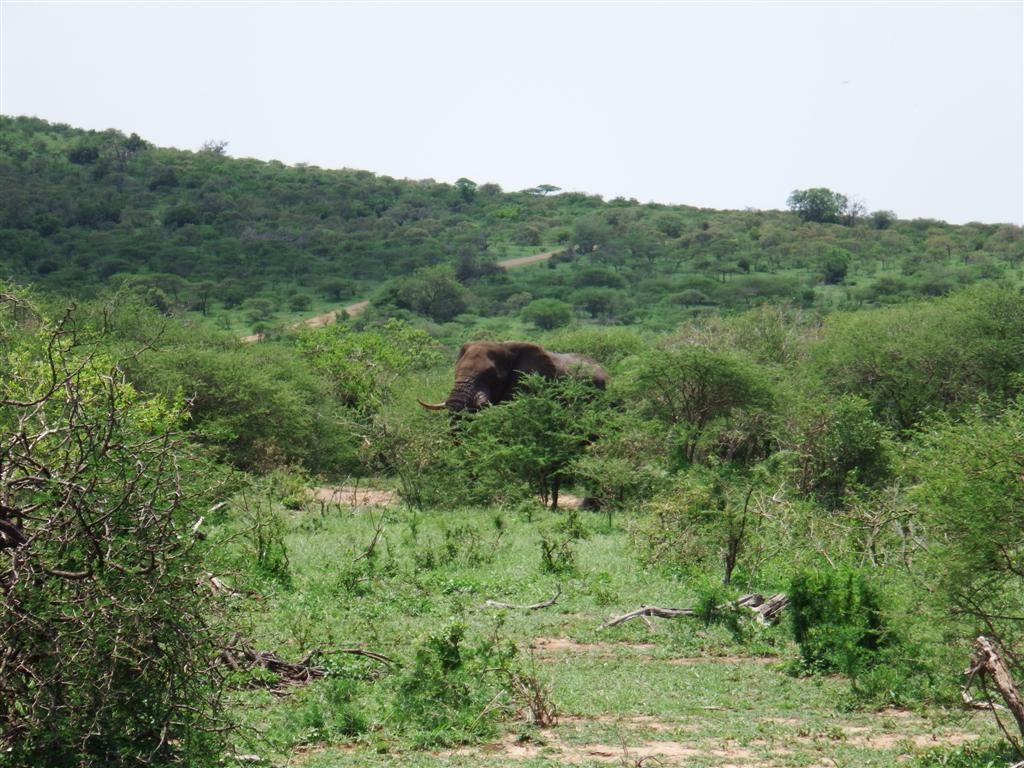
‘I’m hiding’
Steve explained it was the elephants, the males were ‘in must’ and wanted to mate. As some of the lady elephants have other ideas the males get frustrated and go stamping around the bush. Steve was certain there were some males close by. You think it would be difficult to hide elephants but we spotted this big boy hiding.
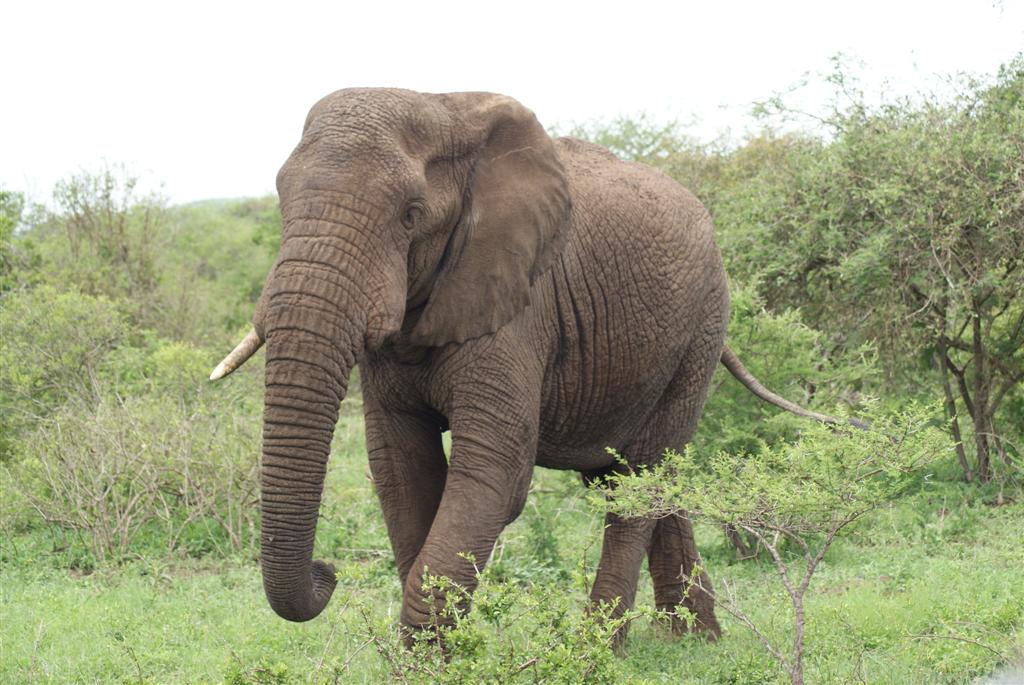
Stunning sight
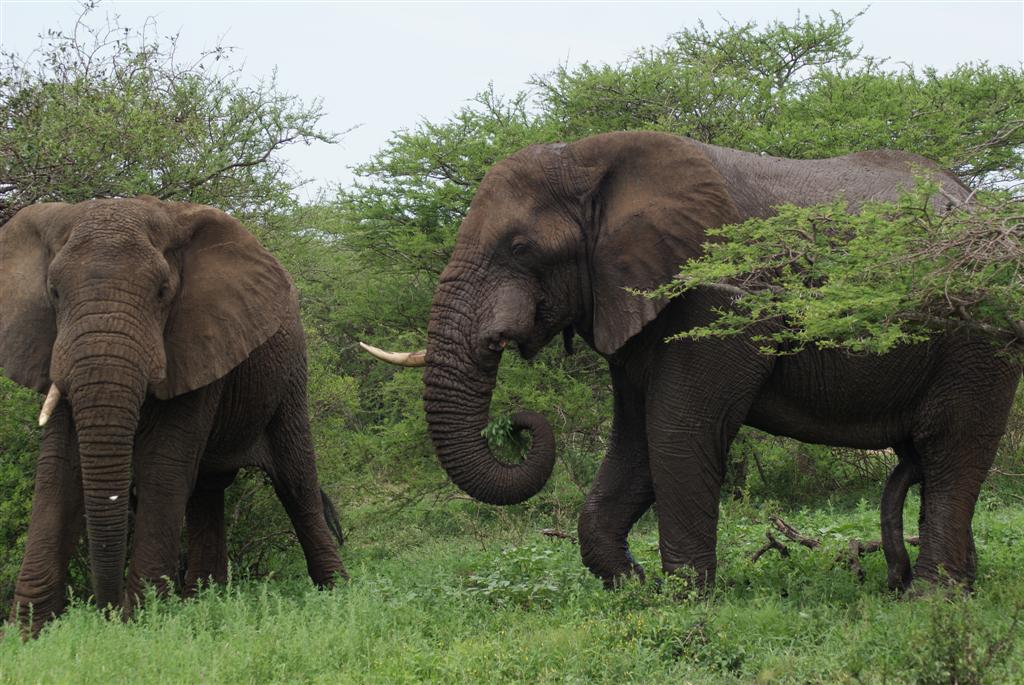
A second one appeared
A second elephant appeared and they both started moving closer to us, so lucky. The third of the big 5. You can see the elephant on the right was definitely looking to mate but these two were both males. Oddly enough they both had a tusk missing. We sat and watched them for ages while they were tearing us grasses and pulling leaves off trees. They looked so much bigger than the ones we had seen in Sri Lanka. Male African elephants can weigh between 4000-6300kg and are 3-4m in height. Often referred to as King of the Beasts but it’s actually the elder females that rule in elephant society – can’t argue with that.
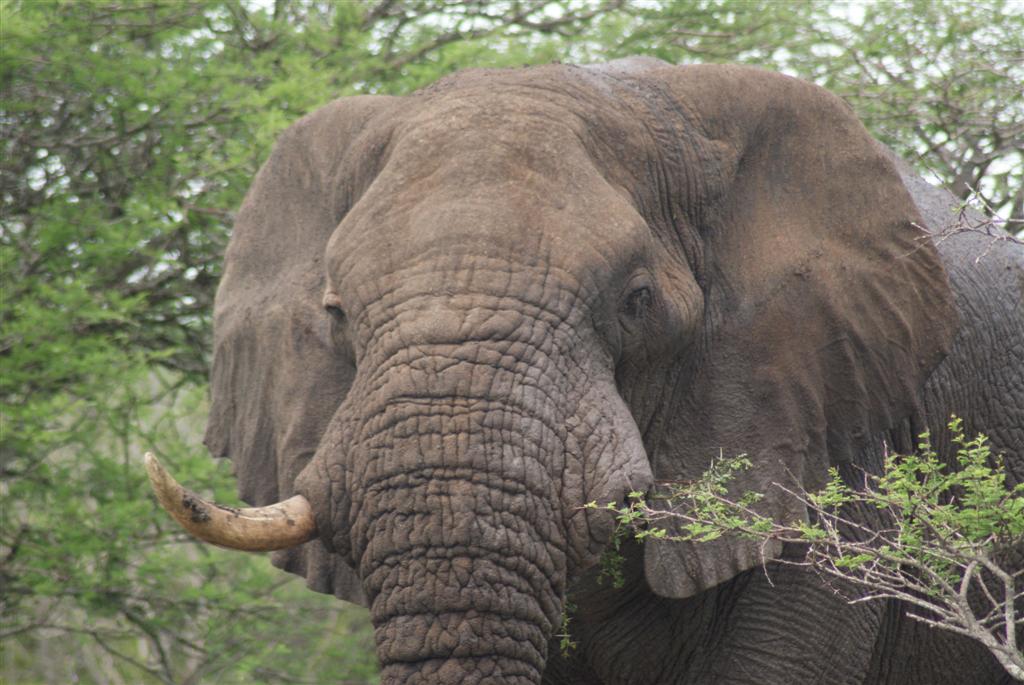
So handsome (taken with the zoom lens, we weren’t that close)

‘What big ears you have’.
His ears were so big. The Asian elephants have smaller ears but the African elephant’s ears are much larger.
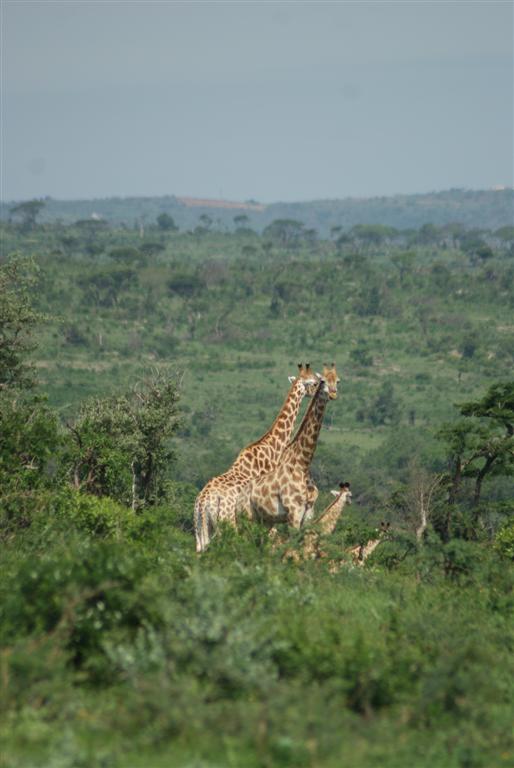
Mum and Dad and 2 baby giraffes
As we drove on we came across a family of giraffes, a little closer this time.

A male lion
We drove for about an hour without any sightings then suddenly Steve stopped the jeep and started reversing. ‘What’s he seen’ we were all thinking. Steve said to look through the bush to see what we could see. It was a lion – A REAL LION our 4th Big 5. A wonderfully handsome male lion. How Steve saw it from the cab I don’t know but that’s why we had paid for a guide. We watched him for a while through the bush then realised there were two of them.

A pair of lions
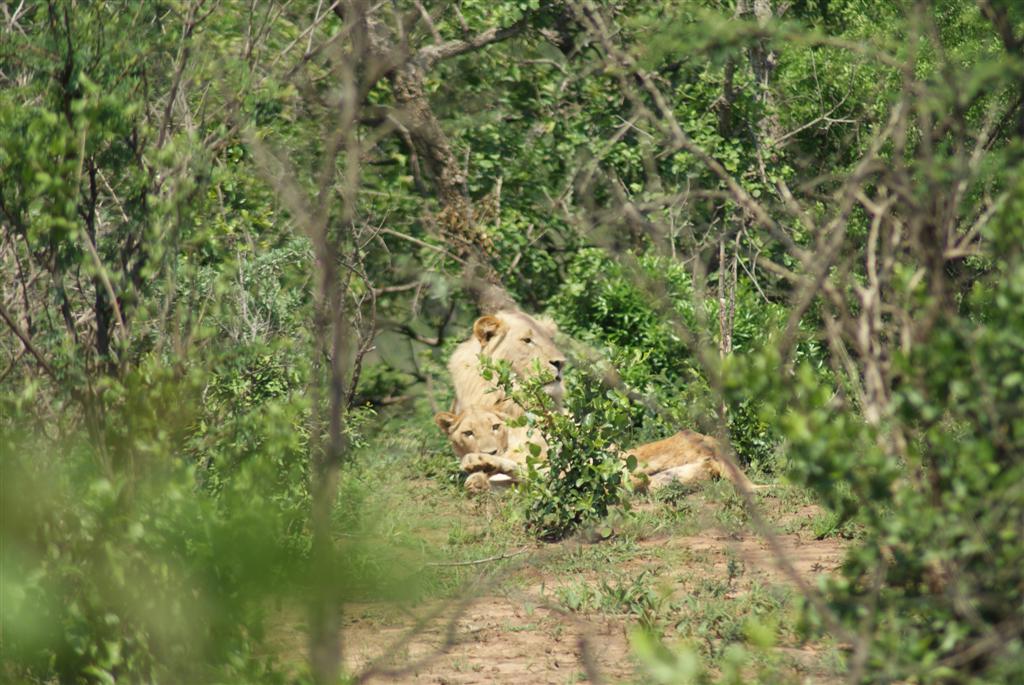
Starting to look around
Steve said they were probably a mating pair the way the female was behaving, she kept rolling around and putting her legs in the air. It was difficult to photograph them because we just had a shielded view through the bush. Sadly some cars came along and stopped to see what we were looking at but didn’t turn their engines off, an absolute golden rule. So the lions got suspicious and started looking around. Steve said they mate every 20 minutes when the female is season!! But there were too many cars and they were getting distracted so we carried on.

Magnificent beast
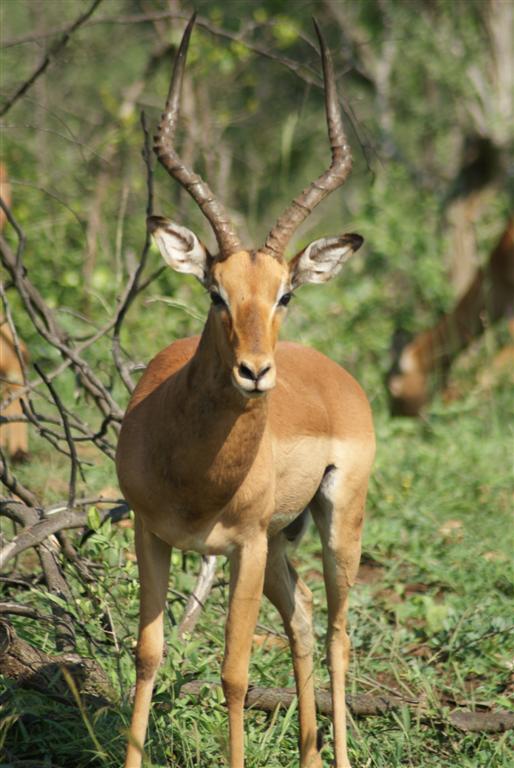
A magnificent male impala
All we needed now was the leopard to complete the 5 but Steve was doubtful because it was coming up to midday and although it wasn’t that hot it was sunny and the leopards go for shade that time of day. There were lots more impala with their stunning horns….
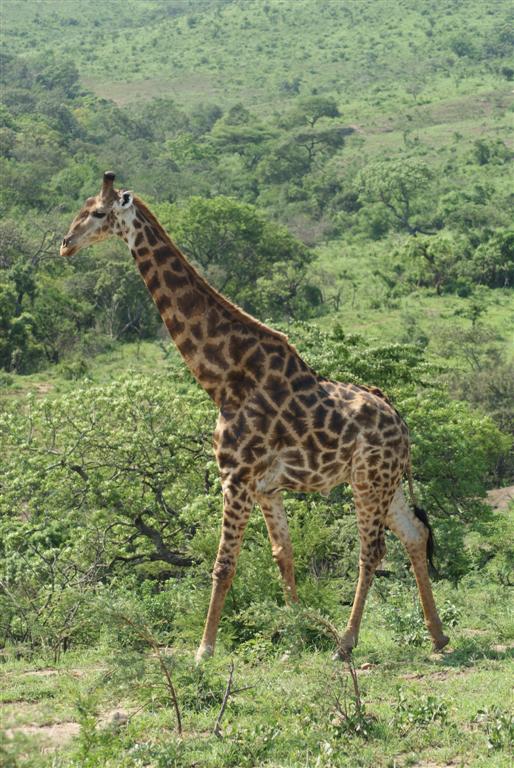
A wonderful giraffe
…. and an even closer giraffe. They are such elegant creature. They walk like solders – both the left feet forward followed by both the right feet. This one is a female because she’s got little pom poms on her mini antlers.
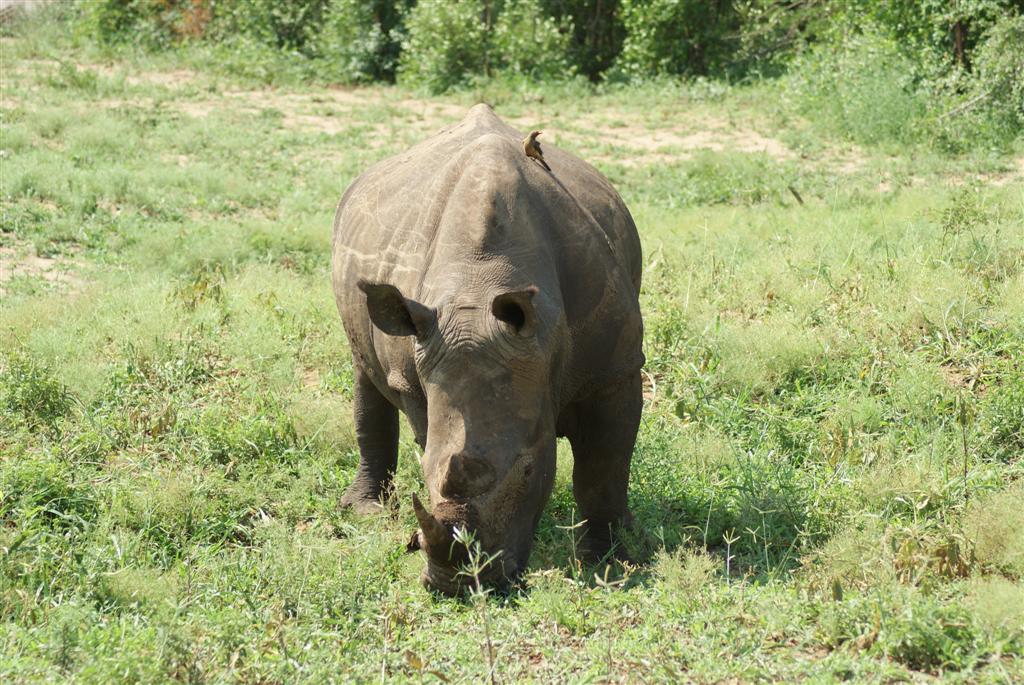
Our last rhino of the day
We had completed our circuit and it was time for lunch. Steve cooked a delicious braai (bbq) with steak, sausages, salad and a bottle of wine. We were so lucky because right next to our braai site by the river there were a pair of rhinos grazing completely ignoring us although Steve warned against going any where near them. As we drove back towards the gate Steve was scanning the trees for a leopard but sadly we didn’t spot on. Maybe another day.

Our group Emma, Sue, Antony, Davina, Bill and Andy
St Lucia in the iSimangaliso wetland park.
Great excitement, we were going on a mini holiday. Having been in South Africa for 2 weeks and just spending it working on the boat, it was now time for some fun! Richards bay is only an hours drive from the wonderful game parks of Hluhluwe and iMfolozi and I had planned a safari trip.
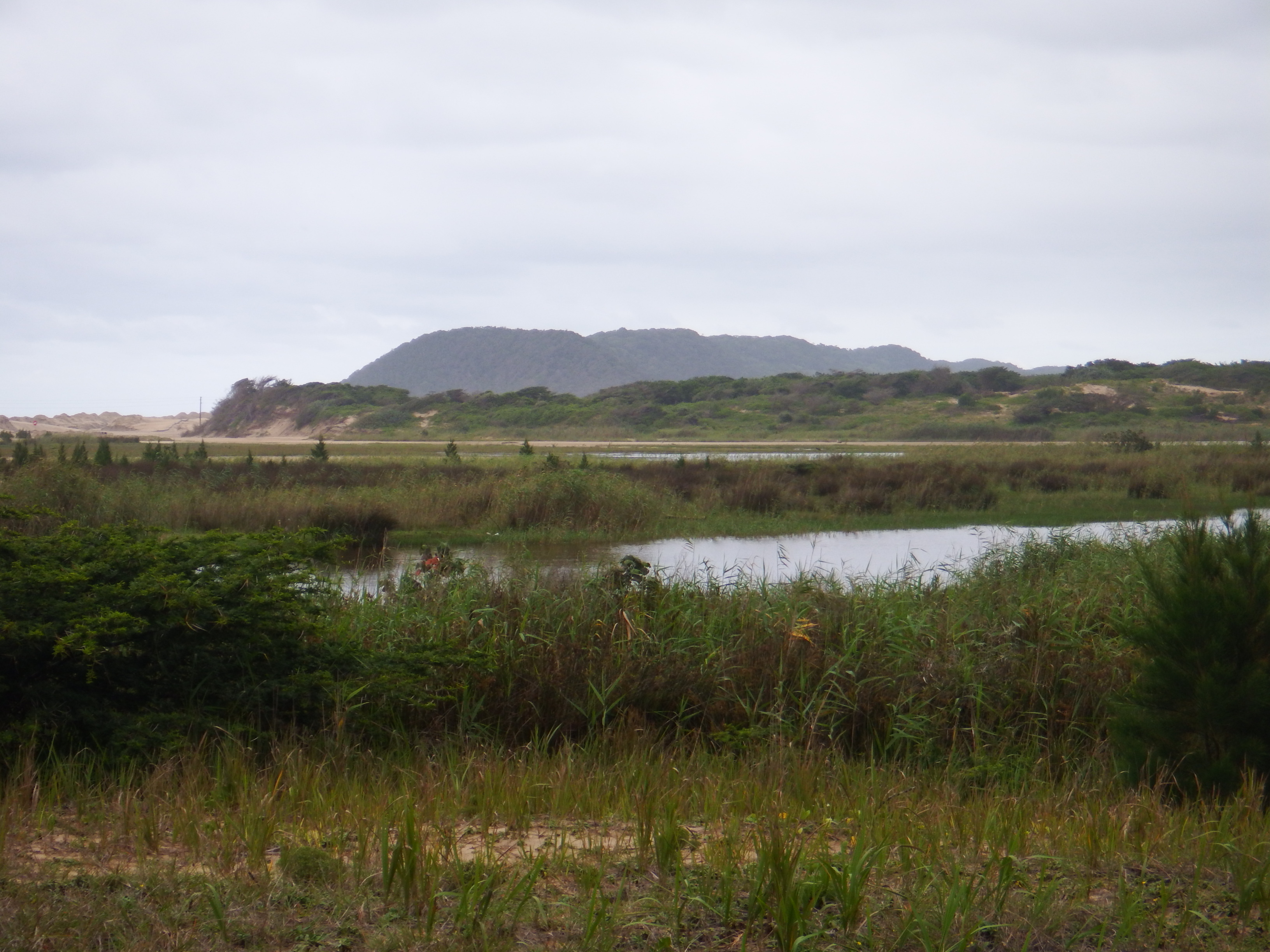
The southern end of the iSimangaliso wetland park
Monday 7th November was a poignant date because it would have been my Dad’s 85th birthday but as I feel he’s traveling with me I was taking him to see the hippos at the iSimangaliso wetland park. A UNESCO world heritage site it stretches for 220 kms from the Mozambique border to the white iMfolozi river at the southern end. It’s bordered by the Indian ocean on its eastern side and the park protects five distinct ecosystems. St Lucia is the main settlement. We left Camomile first thing in the morning and were taken by taxi to the Richards bay airport to pick up a hire car. It’s only R100 by taxi and the airport was the cheapest place to hire a car here.
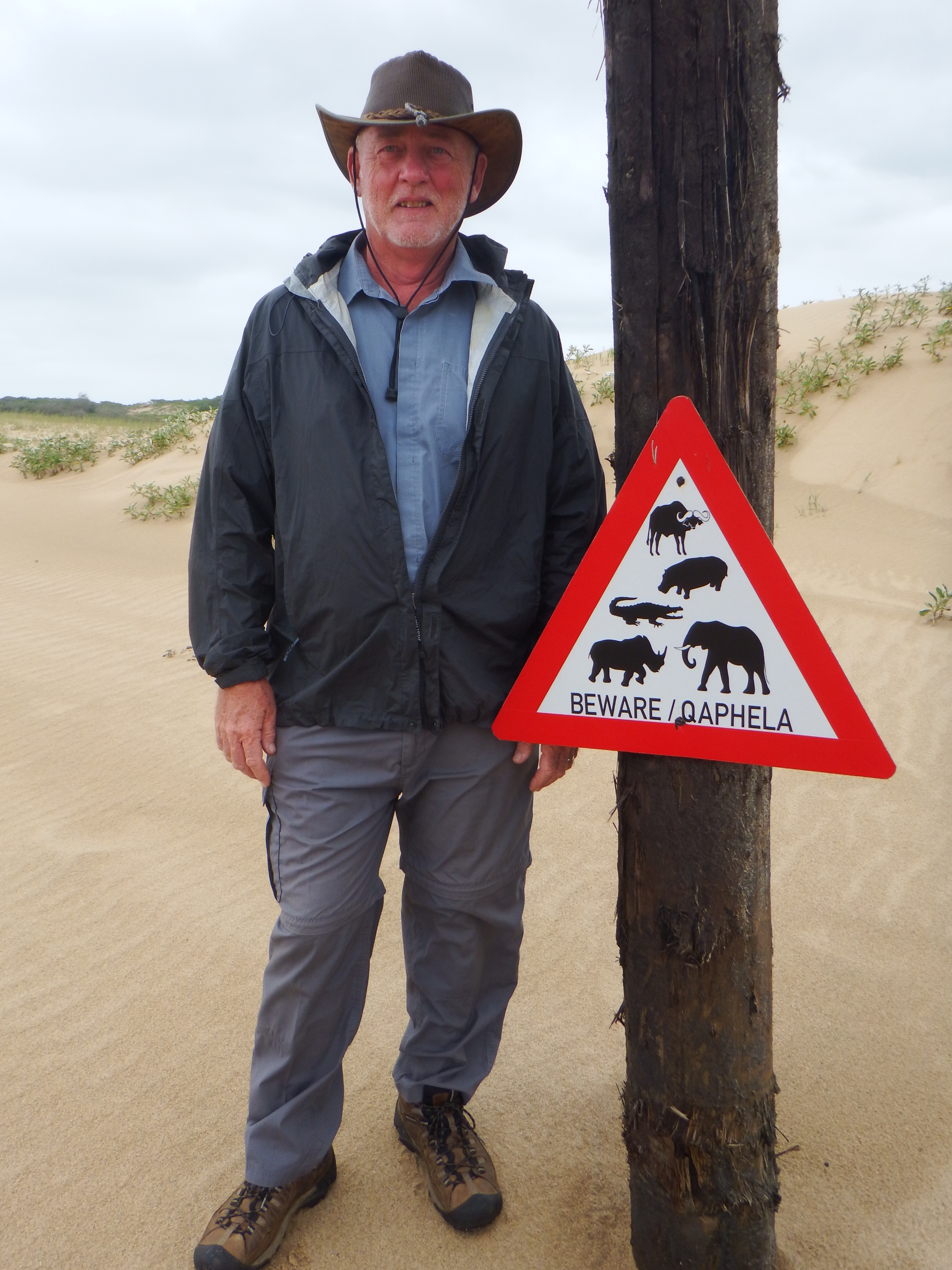
Bill standing beside one of the many warning signs
After a short trip to the mall to sort out a few bits we were on the road north. Our first night was to be spent in St Lucia, a pleasant village and a useful base for exploring the southern are of the park. We were too early to check into our accommodation so decided to have lunch at the ski boat club restaurant that had been recommend to us. The restaurant garden overlooked the southern end of the St Lucia estuary and croc island in the middle. After a delicious lunch it was recommended we take a stroll along the boardwalk that leads through the sand dunes to the beach. The Indian ocean looked very wild that day.
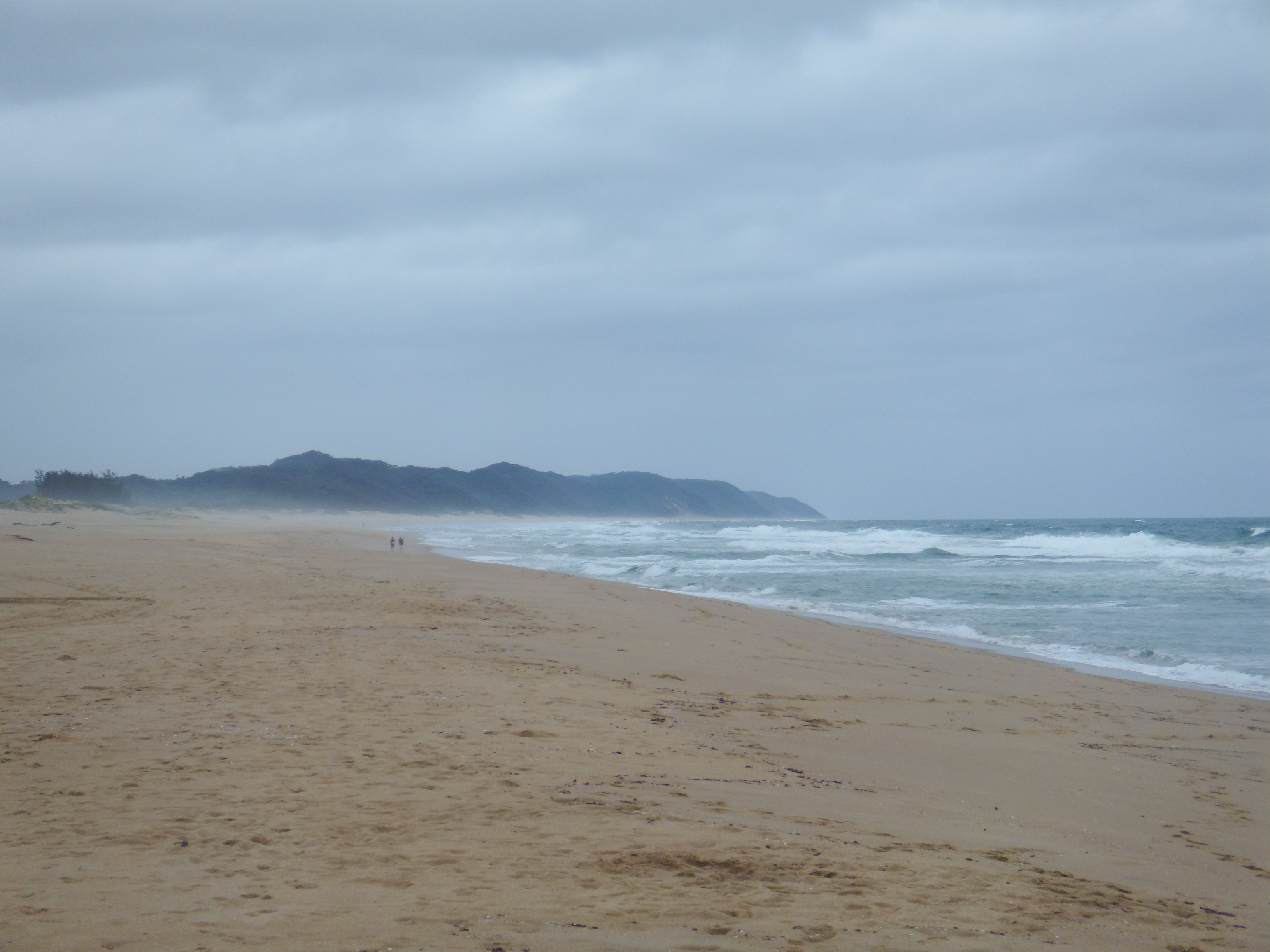
The wild Indian ocean

As we walked back along the boardwalk we saw this snake on the ground below. It was about a metre and a half long and could possibly have been a black mamba but we kept our distance and just watched it slither along. We also managed to spot a crocodile swimming in the water and it’s in the middle of this photo but difficult to see.

The southern estuary with a croc in the middle of the photo
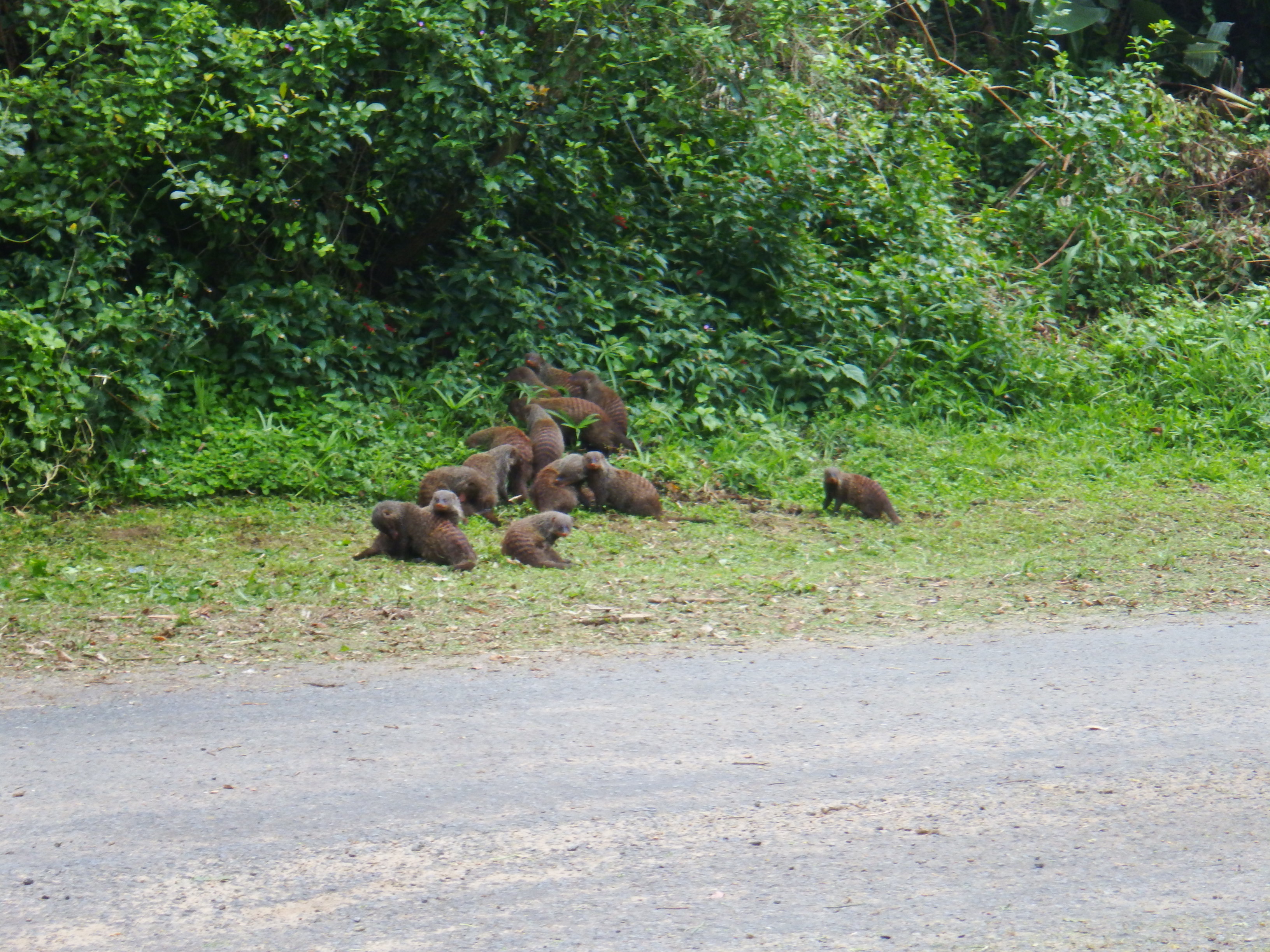
Striped mongoose
As we made our way back to the car park this little group of striped mongoose were sitting on the side of the road.

backpackers accommodation
We drove back to the main road of McKenzie street to the Monzi Safaris Tented lodge. It’s behind the Monzi Safaris backpackers although they share the same reception and car park. The backpackers is basically the old dormitory area that has been cleared and a series of ‘tents’ erected about a foot apart from each other on a ‘shelf’ with bathroom facilities downstairs. They looked ok but not sure what happens at night when someone starts snoring.

Our ‘tent’

The bathroom built on the back
Our ‘tent’ was very nice and had a proper bed that was very comfotable with a two seater settee in the main section. There was a shower room with toilet and handbasin built on the back in a log cabin section which also housed a full sized fridge and a sink and the wardrobe. They were well designed.

A comfy bed
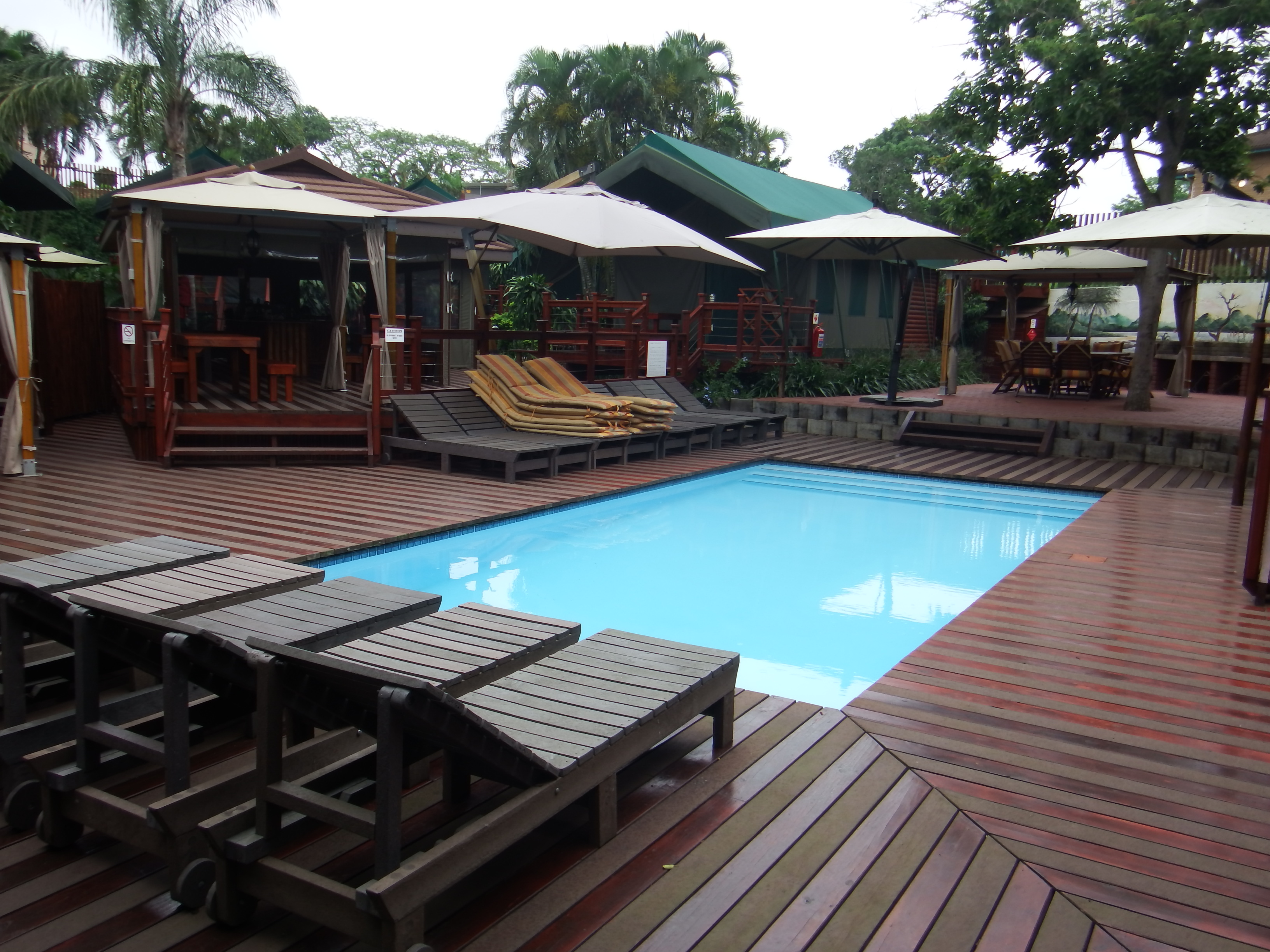
The lovely pool in the rain
The ‘tents’ were arranged around a lovely pool but by the time we checked in it had started raining and I didn’t feel like standing in a cold pool in the rain! There were also 2 lovely kitchen areas, one for our section and one for the backpacker tents, so it was possible to cook your own meals if you wanted to.

The main bar
I would recommend either of these accommodations. Our main problem was we were staying in hut 1 which had the path to the other huts right next to us and we backed onto this nice bar area which also had tented sides and was about 6ft away from our hut. It had music playing until 10pm which I don’t usually mind but we had to get up at 4am to join the safari and had planned to go to bed early but after 10pm it did become very quiet.

Standing on the top deck with hippos all around us.
Although Monzi do safaris we had booked our safari with Eurozulu who had their offices next door. Earlier we had visited them to pick up our safari tickets plus our tickets for the 2 hour hippo and croc that was booked for 4pm. This would normally be a good time because as the sun goes down it shows the colours of the hippos nicely – the problem was there wasn’t any sunshine and it was still raining. It would have been a nice walk from Monzi to the sunset jetty but it wouldn’t have been very nice sitting soaking wet so we drove the short distance to the jetty. Once there we were shown to one of four boats waiting for its passengers. Our friends Antony and Davina were already aboard. We set off north along the St Lucia estuary. At first I didn’t think we were going to see anything but then the hippos started bobbing up and appearing all around us.

A hippos yawning.
This group were tucked under the greenery. One of them gave an enormous yawn. It had very big teeth.
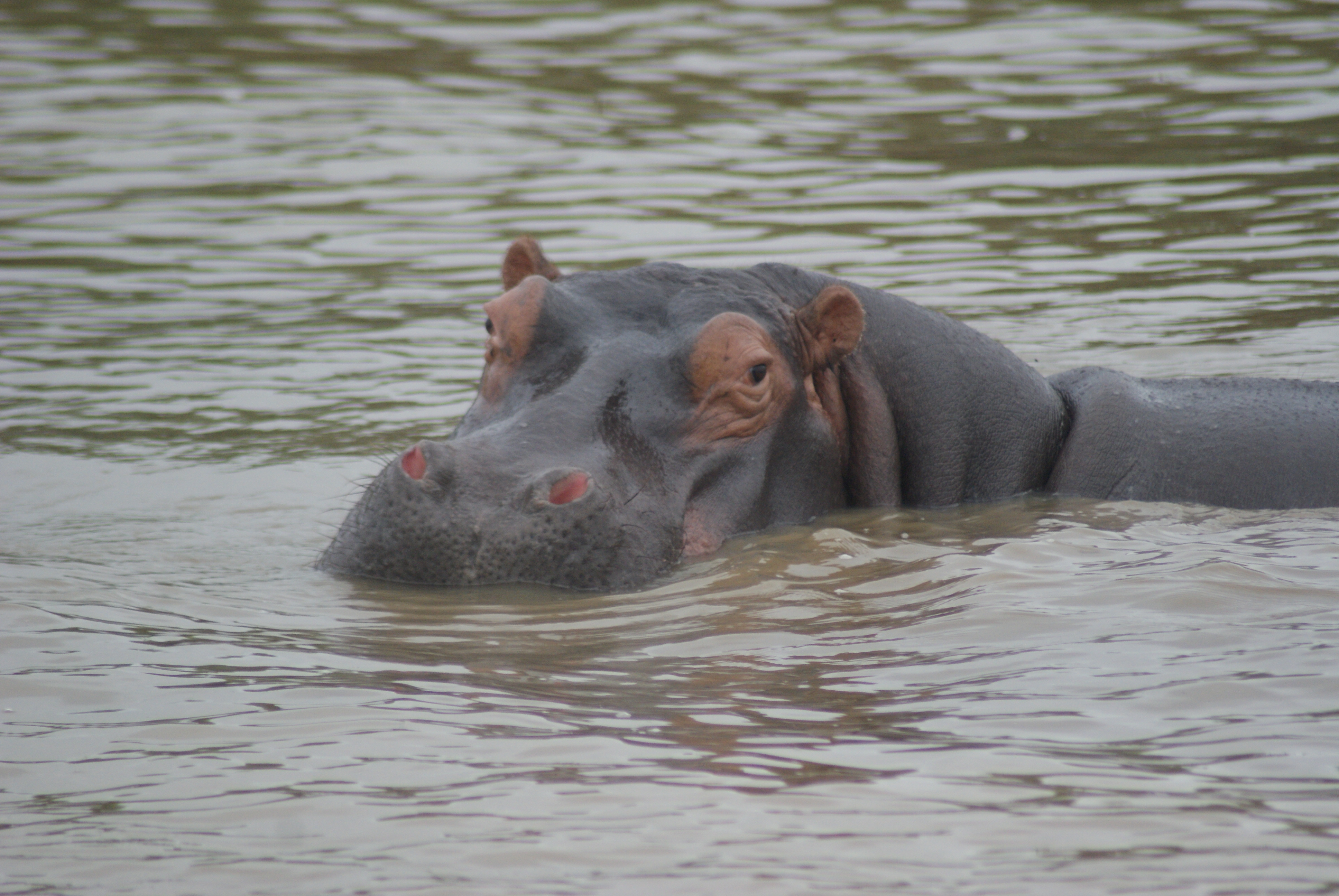
They had lovely little faces
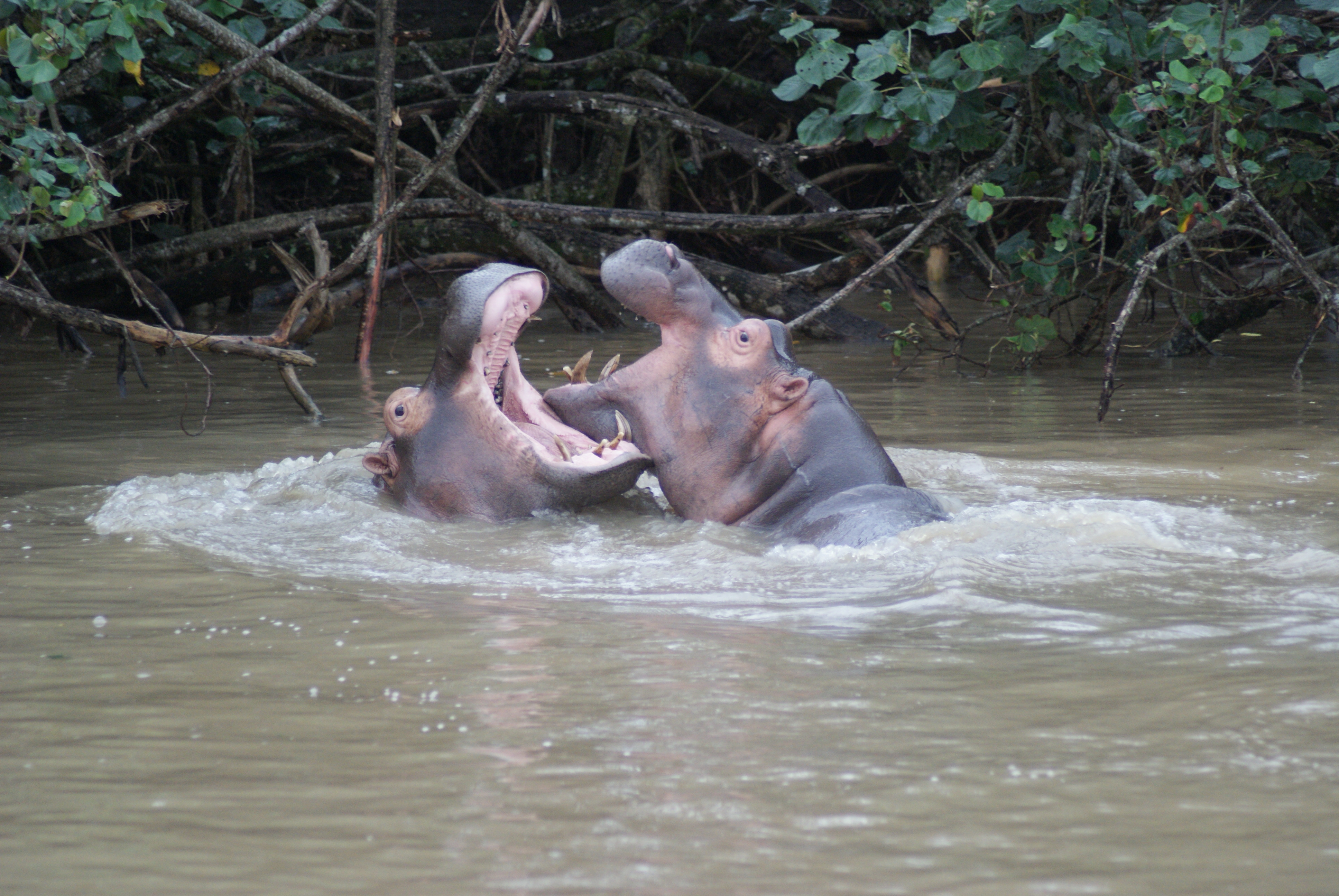
These ones were having a bit of a fight
Apparently they can’t really swim but push themselves off from the edge and glide along. Most of them were along the edge of the estuary.
These two didn’t seem very happy with each other. Although the hippos looked quite friendly they are vicious and shouldn’t be approached.

Getting out of the water
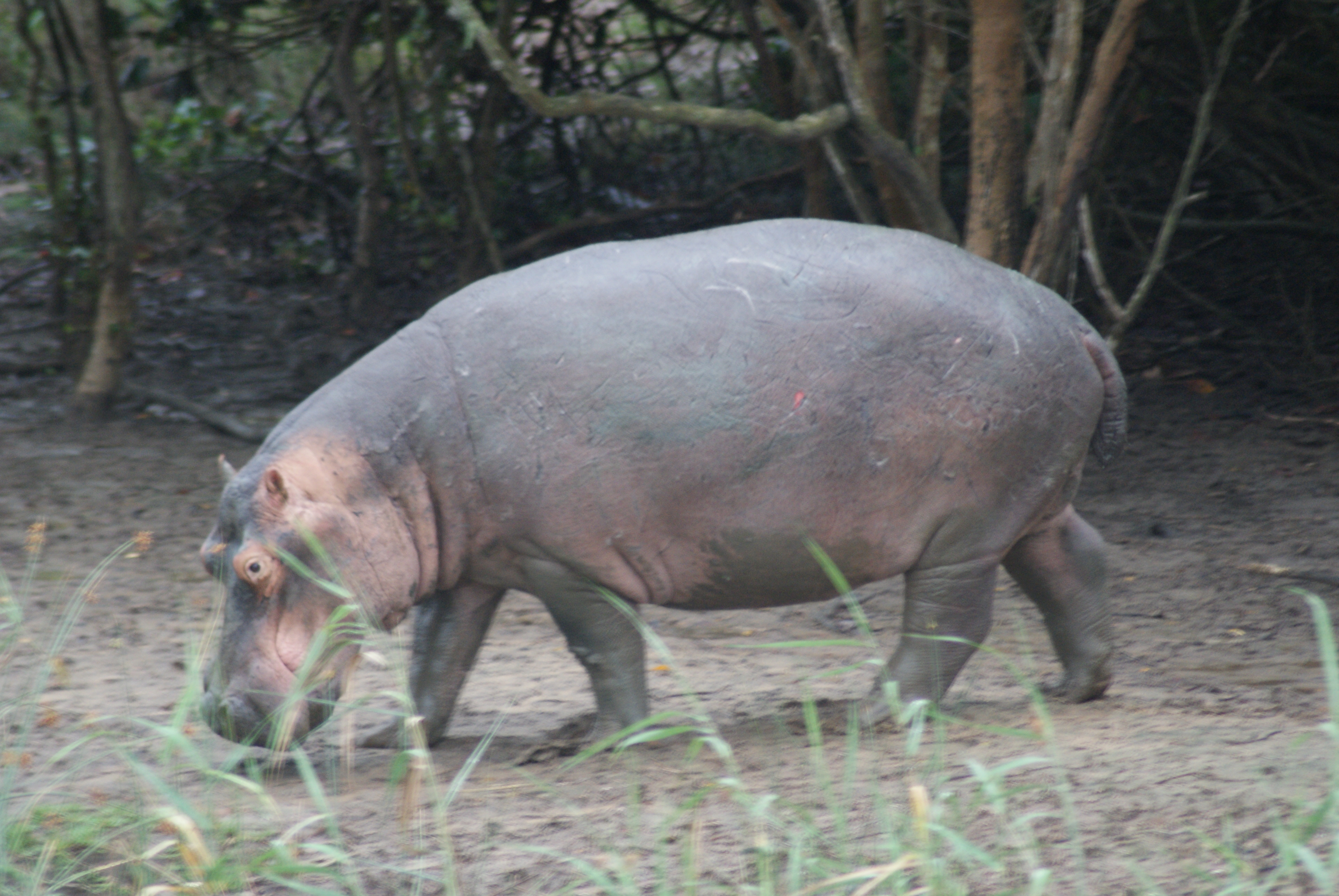
Grazing
Further up the river the land flattened out and a couple of the hippos had got out of the water to stretch their legs. It was fairly swampy but there was a bit of grass for them to graze on. The rain had been drizzling on and off but it didn’t seem to matter to the hippos they were enjoying the mud. After an hour or so our boat turned round and motored back to the jetty. We didn’t see any crocs on the tour because it was mating season and they were all in the swamps further north. Once along side we returned to our hut to get ready for our safari the next day.
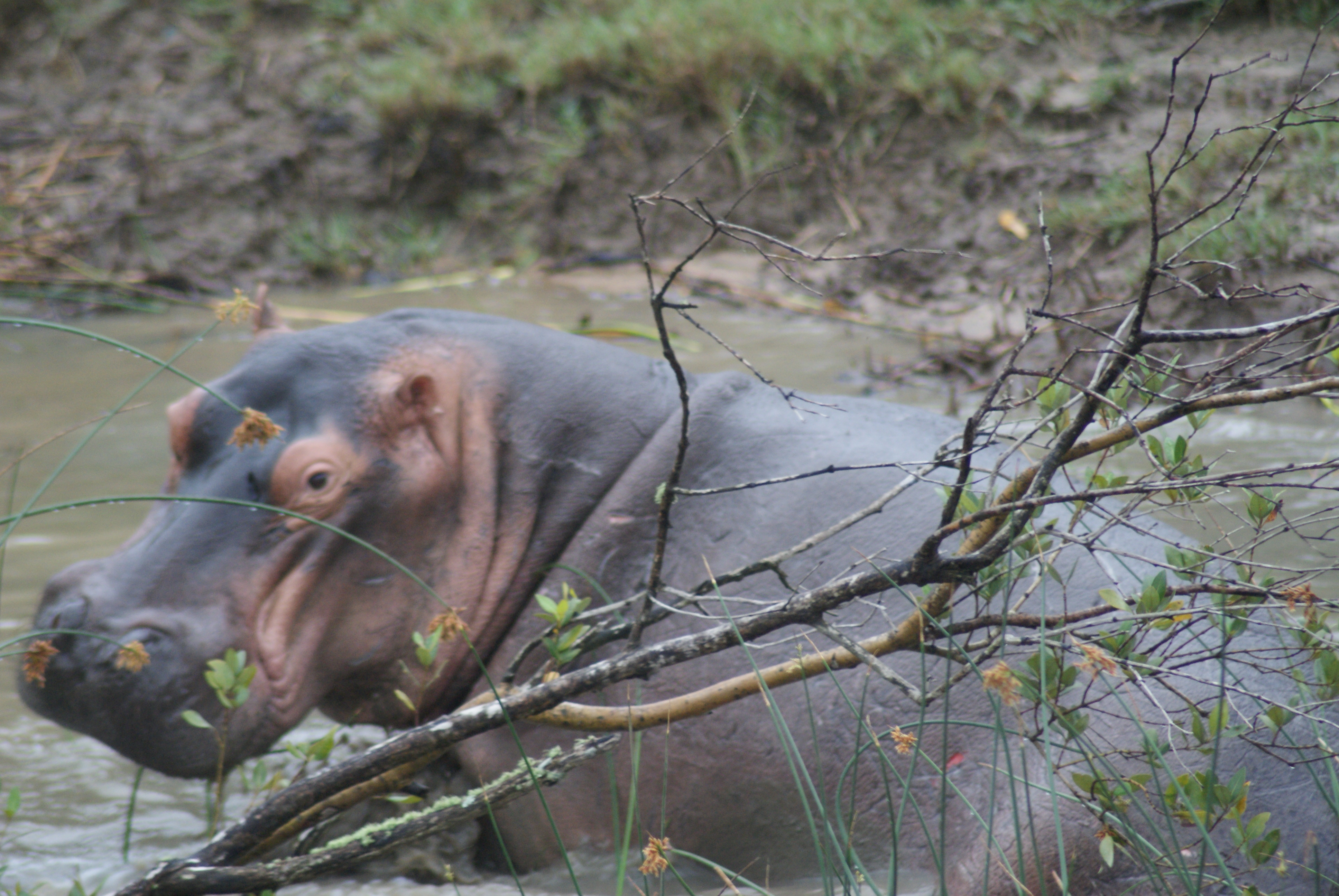
One more hippo for you.
We made it
We have arrived in Richards Bay, South Africa, wahoo!
Our position is
28 47.6S
032 04.7E
Our 24 hours up to 10.00 today was 162 miles.
The whole journey was 1188 miles in 8 days 13 hours or 205 hours giving an average speed of 5.8kts. Really pleased with that.
Yesterday we sailed with 2 reefs in the main and the genny poled out to stop it slatting. We had F4 most of the day from the north east with the wind increasing during the evening to F5 but again from the north east so all good. The current was giving us an extra knot or two and our boat speed was 7 – 9 kts most of the day.
Last night was very dark and black without the moon and with the added worry of squall clouds. Bill took the early evening watch as the wind was forecast to increase and he experienced several 35kt gusts, although from the north east, with a bit of thunder and lightening in the distance but by 03.00 the wind died completely, as forecast, and the engine went on. It was very important we kept our speed up because the forecast showed a southerly creeping up the coast although it wasn’t due until after midnight but we wanted to arrive in daylight.
While on the early watch this morning at 07.00 the wind generator suddenly sprang into life and the wind anemometer spun round to the south. Sam had told us of this yesterday so we were waiting for it. Fortunately it didn’t go higher than about 10 knots and only for about 3 or 4 hours but in that time the sea started to mount. I changed course slightly and all was ok but I wouldn’t have wanted the wind to go up to 20 or 30 kts. The engine stayed on all day even though the wind backed to the north east later.
I went for a sleep mid morning and when I got up at midday the land was within sight. The smells that come off the land after you’ve been at sea for 8 days are interesting; here it was coal dust (big mining area). We spent the rest of the day motoring down the coast and arrived at the marina at 18.30 which was 17.30 south African time, after calling the harbour port control on vhf 12 to ask for permission to enter. The pontoons at Tuzigazi marina are in a bit of a state and I think we’ll just stay here long enough to check in and go round to the Zuluyacht club.
The next couple of days will be taken up with checking in with immigration (passports stamped), customs and maybe the harbour master, (each country varies), sorting out sim cards for the phones, cleaning the boat inside and out, washing, and restocking our food cupboards and the fridge. Once we’ve got internet I’ll add some photos to the blogs.
So we are in South Africa, WOW. Bring on Hluhluwe-iMfolozi wildlife park and game reserve, the hippos at iSimangaliso wetland park, Knysa harbour, Cape Town and maybe the Kruger national park with James and Hailey at Christmas to name but a few of the sites here.
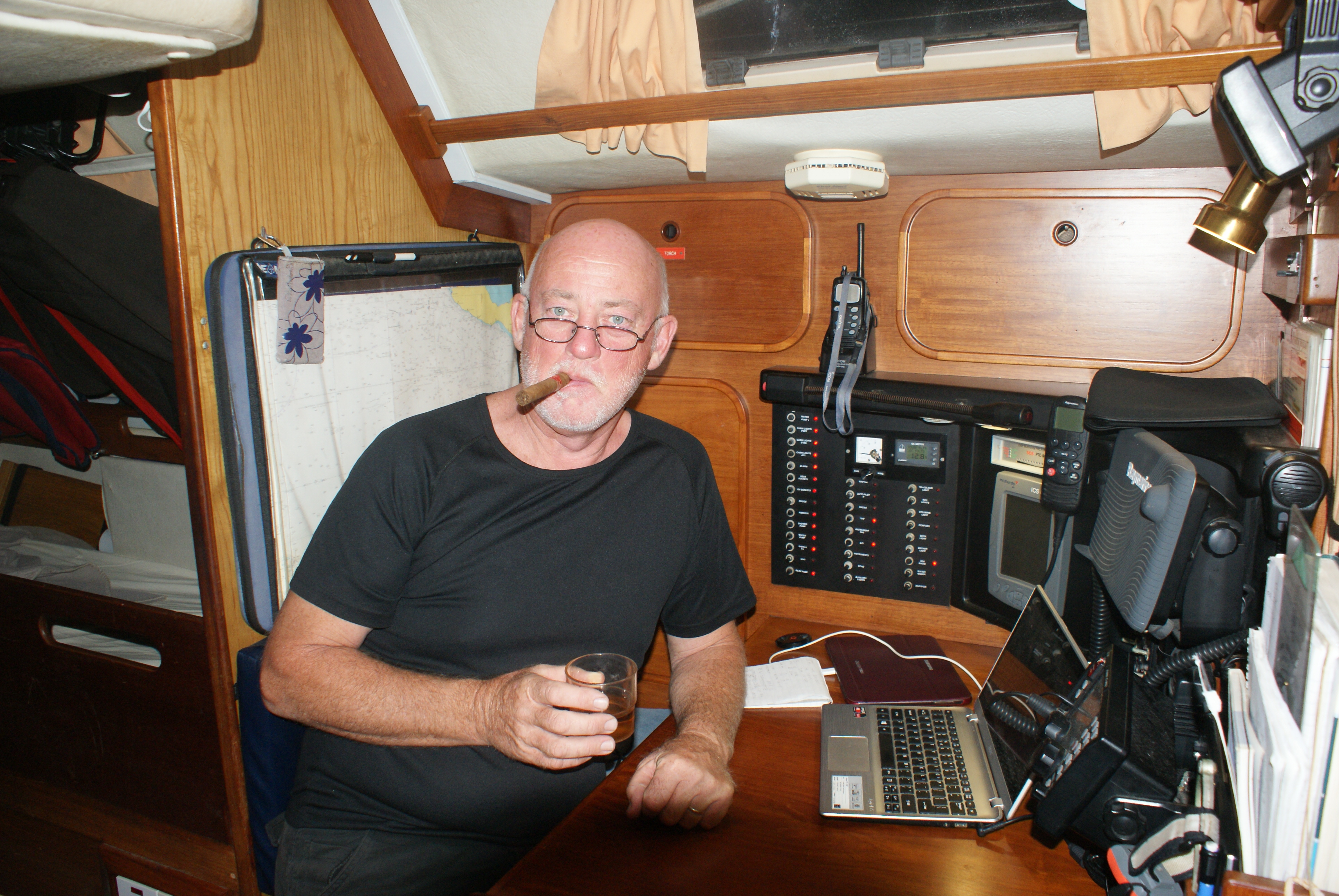
Bill having a well deserved whisky and the cigar he’d been saving. x
 Camomile