Category Archives: Port posts
We made it to South Island
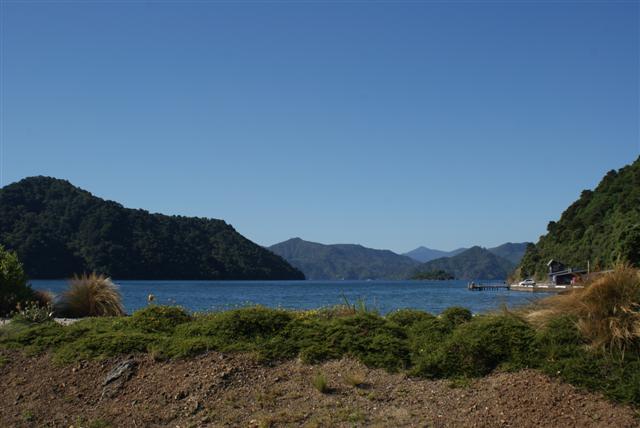
Queen Charlotte sound from Picton marina
12th January 2011
41º 17.2 south
174º 00.5 east
We’re moored at Picton marina overlooking the beautiful Queen Charlotte sound
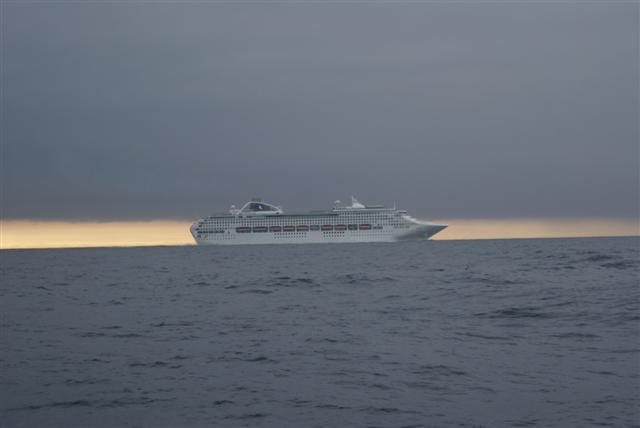
The Sun Princess
We made it to South Island but we can see why everyone says don’t bother to sail there. We flew back to the boat on the 1st with a 3 to 4 day weather window ahead of us as a high moved over North Island. We did a quick shop, filled the water tanks, fuelled up and left Gulf harbour the next day. We had a wonderful 5-hour sail across to Barrier island and anchored in Puriri bay overnight. It’s a shame we can’t stay longer on this coast but we have decided to head south this year. We left the anchorage at dawn the following day with the Sun Princess for company and motored across the Bay of Plenty with only 2 kts of wind.

East cape
I put the fishing line out and within a couple of hours had hooked a beautiful tuna. Bill reeled it in and gutted it and we had delicious tuna for supper. The wind returned at 3pm and we sailed into the night before it dropped just before 11pm. It was a very dark night without any land or boats in sight. The next day we rounded the notorious East Cape in a gentle Northerly without any problems. After all the horror stories it turned out to be a pussycat. A pod of 100+ dolphins crossed our bow just before the cape and the seas boiled with the joyful, leaping, twisting, jumping forms passing us as if we were standing still. This was as far east as we planned to go and as we turned south we took the main down and poled out the genny. Our timing was just right as the tide turned in our favour and we notched up speeds of 8 and 9kts.

It’s getting colder
The northerly wind continued to blow and gave us a lovely sail all through the night although it was now starting to get really cold. We heard on the weather forecast that a gale was starting to blow in the Cook Strait so we decided to put into Napier. The East coast of NZ is very inhospitable because it doesn’t have any where to shelter. Napier was our only chance to stop. We sailed across Napier bay and arrived at 8pm that evening.
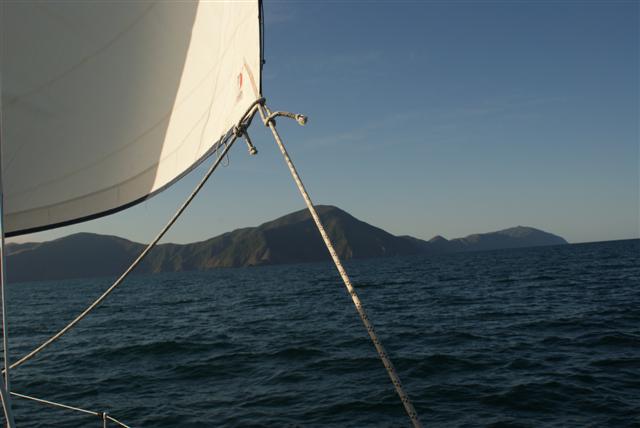
Sailing around Cape Palliser
We stayed there for 4 days until the Sunday when we heard on the forecast that there was a small weather window to get round Cape Palliser and into the Cooks Strait or we would have to wait until at least Thursday. We left at 6.30 pm Sunday along with a kiwi boat and spent the first night beating into a 20kt southerly which was b*****y cold coming straight off the Antarctic. Unfortunately Pete and Simon decided to go back as they didn’t have an auto helm and hand steering into the heavy seas would have been very uncomfortable; we think they made the right decision. We pressed on as the wind gradually abated and arrived off Cape Palliser at 9am on the Tuesday just as the tide was turning in our favour.
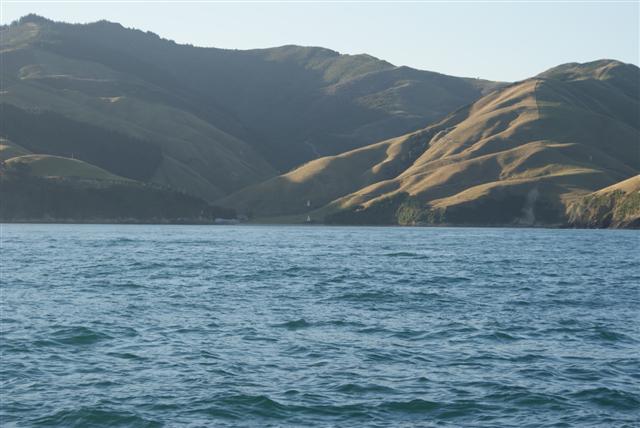
Lining up the day marks at the entrance to the Tory channel
The forecast south-easterly didn’t appear and unbelievably we motored across the Straits with the sea like a millpond. (We didn’t complain!) We entered Queen Charlotte sound through the Tory channel at 6pm on a beautiful sunny evening and anchored in a quiet bay overnight.
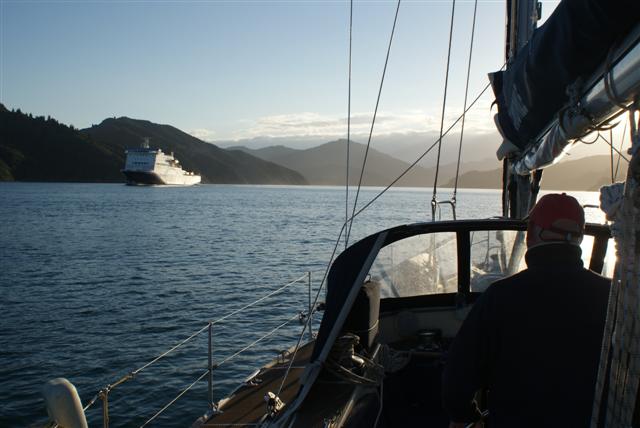
Sharing the sound with the ferry
We sailed on down into Picton on the Wednesday morning.
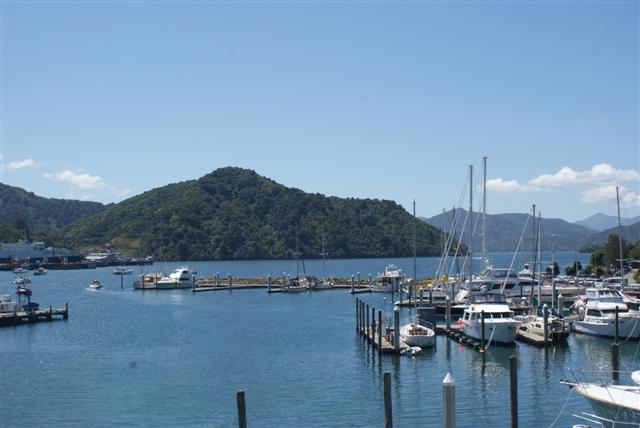
Camomile in the centre of the picture in Picton marina
So we made it but I think we’ve found the Kiwi Scotland. The scenery is stunning but it’s much colder here than it was in North Island. Luckily I bought those UGG boots in Fiji! Is it worth coming all this way? For us it was because Kate and family here and we’ve got several things planned but it’s a long way to come and there’s either too much wind, which is dangerous to travel in, or no wind, and then you need to motor, so I would probably say no. Having made it down here we’ve decided to stay in this area and not return to Auckland. We can start our trip East much better from somewhere like Napier. As we missed a lot of North Island we’ve decided to come back to NZ in November for another Southern summer here.
Christmas at the Tomkinsons
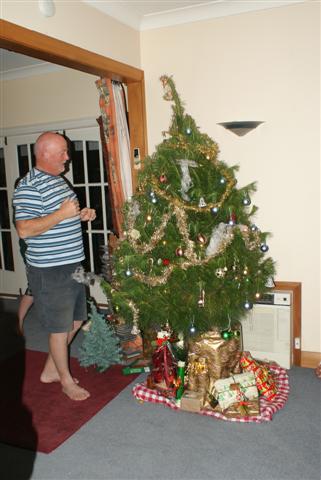
The Christmas tree
172º 28.55 East
Monday 13th December we packed our bags, closed up the boat and flew down to Christchurch from Auckland. After having to wait a week for the gearbox drive plate to be repaired we missed our weather window. We arrived quite late but it was lovely to see Kate’s smiling face when we arrived. The first job I was given was decorating the Christmas tree. Will and Daisy helped me and Bill was given the job of putting the fairy on top because he’s the tallest. Daisy turned the lights on and the Christmas season started although it was difficult to feel Christmassy with lovely long sunny and warm days.
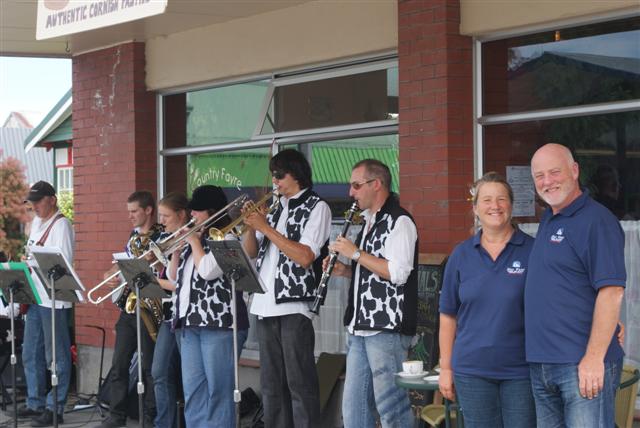
Our official welcome to NZ
Thursday and Friday Kate and I got up early to open the café. It was really good fun. I made Muffins and sandwiches while Kate cooked pies and pasties. She also taught me how to make a proper coffee.
On the Saturday Barry went and opened the café and Kate, Bill and I and the children went along later to enjoy a delicious brunch cooked by Barry. This was followed by the dixie band that Kate plays in setting up and playing outside the café in our honour. It was the best welcome we’ve received throughout our journey so far. Do you recognise the trombonist?

Ellesmere Dixie band with Will, Daisy, Barry and Bill outside the café
The band was also playing a fond farewell to the café. Kate and Barry have been working there 7 days a week but have decided they don’t want to spend all their time there any more. Barry cooks the most amazing pies, pasties, muffins and slices but the locals seem to ignore them and just order meals with chips! Barry has a nice new job and they are going to concentrate on perfecting their clotted cream business. The celebrations continued in the afternoon and evening with a welcome party consisting of 30 – 40 of Kates friends, many of whom were interested in hearing about our travels so far.
The next day was Sunday and we went to church in the afternoon for a carol service. It wasn’t like any thing we’ve been to before. It started with a sausage sizzle outside. We were all dressed in nice summer clothes instead of thick winter coats. There was no candles or snow. The Ellesmere Dixies played again and accompanied all the carols including a Maori carol. The minister was dressed in ‘plain clothes’ but conducted a very nice service before we emerged into bright sunlight at 7pm!
Bill got himself oily doing a temporary fix on Kate & Barry’s little van but it needed replacing with a new car so for several days Bill had the poor salesman dangling with the sale tantalisingly close while he squeezed more and more off the price. On the Monday the salesman finally gave in and we went to pick it up, a nice Toyota Camry estate, which we will be able to borrow to tour South island. We had a double celebration that day when we learnt that James was safely home from Afghanistan. The MOD had shipped a number of men home early because the jets they were working on had left and James was lucky enough to be one of them. It was a huge relief to Bill and I that he was home safely.
We spent the rest of the week preparing for Christmas.
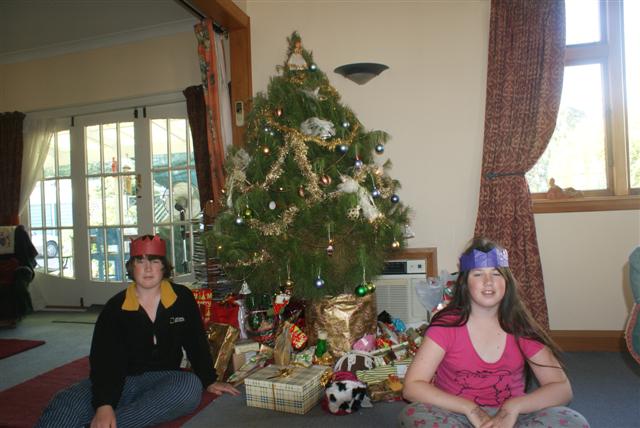
Christmas morning
Christmas morning saw us sitting around the Christmas tree with piles of presents. It took half the day to open them.

Bill with Will and Daisy
We then partook of a Kiwi tradition – we all got in the pool while Barry cooked the most magnificent BBQ for Christmas dinner followed by Pavlova with strawberries and chocolates on top.
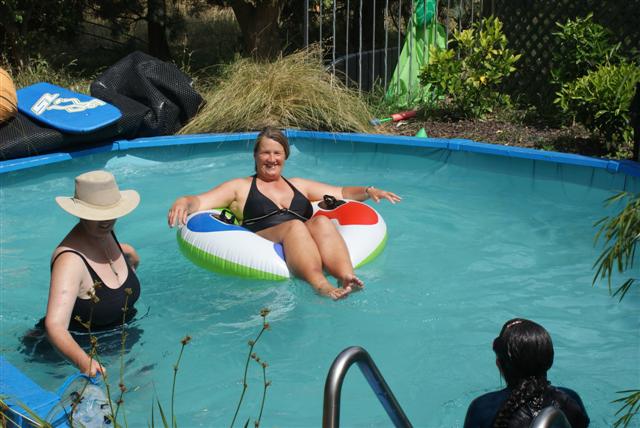
Kate and Sue in the pool
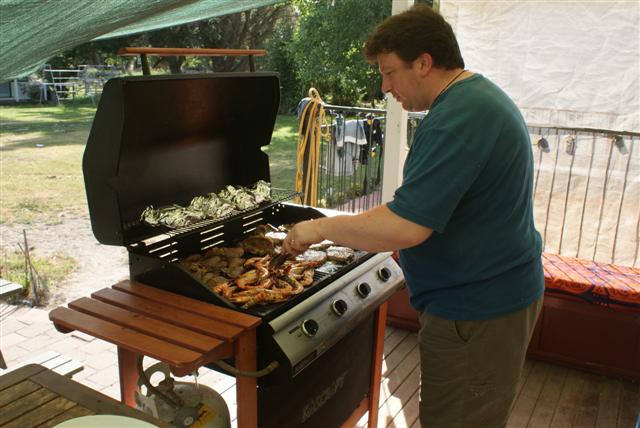
Barry cooking the Christmas BBQ
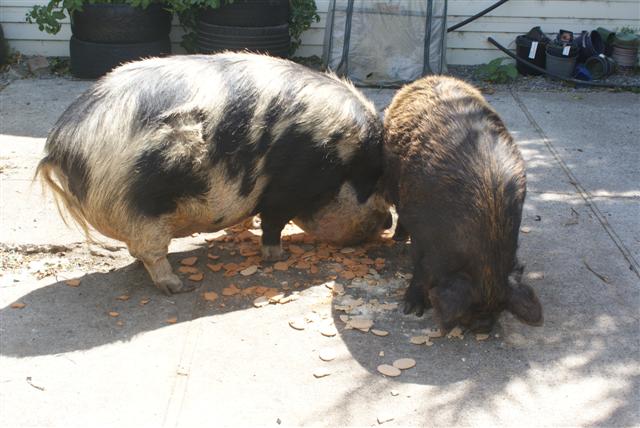
Paris and Ginger having their Christmas treat
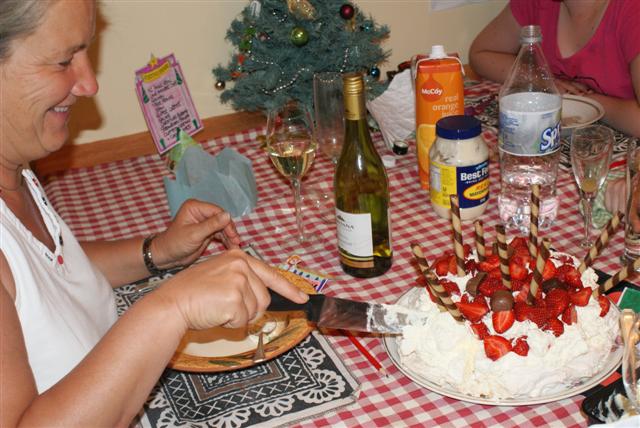
Strawberry Pavola with Chocolates
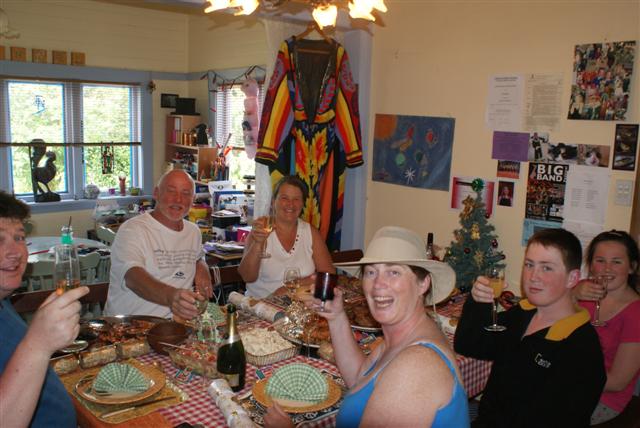
Happy Christmas from everyone
Happy Christmas from us all in New Zealand.
Passage from Fiji to New Zealand
Bill’s log and Sue’s diary including Wendy attacking Harry!!

Beach at musket cove
The waiting was over, finally there was a weather window that looked reasonable so I emailed Bob McDavit and requested a voyage plan/forecast. Bob is the local weather guru working for the NZ met office and he provides a wind and wave forecast along with waypoints for the optimum weather route.
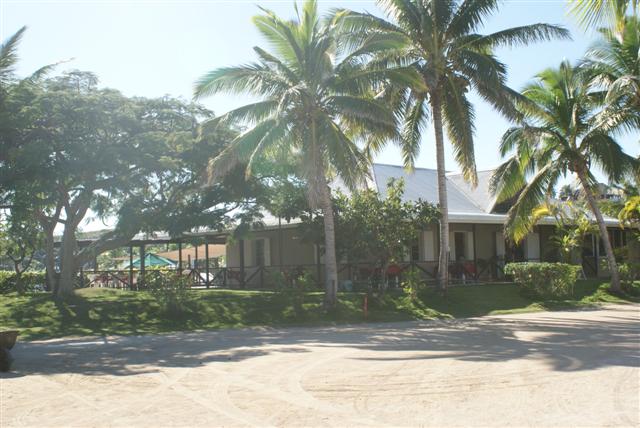
Shop & café at Musket cove
We left Musket Cove and motored to Lautoka to check out of Fiji. Then we motored down to the entrance to the reef to anchor over night to get a good nights sleep before starting on our passage.
Day 1 First light brought a clear sunny day with very little breeze at the anchorage so we motored towards the passage putting the sails up on the way. As we exited the reef at 06:00 we were treated to a goodbye visit by a pod of Risso’s dolphins. I had put two reefs in the main based on Bob’s report, which promised 23 knots gusting 34, but there was no sign of it yet. I wondered how good this guy was. I didn’t have to wait long to find out because as soon as we cleared the lee of the island we got the full force of a strong trade wind along with 4.5 metre seas. Deeply reefed though we were Camomile felt the beam reach, dropped her starboard gunnels into the water and took off like a rocket. It was fast but not very comfortable and was the first time yet we have actually had to ‘hove to’ just to go to the heads!
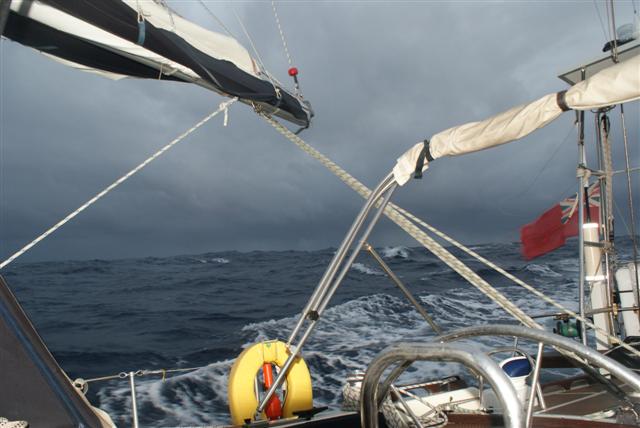
Rough seas
Why do I keep doing this, it’s been 4 months since we’ve done any proper sailing and I seem to have lost my sea legs. I’ve spent the day horizontal on the saloon bunk. I’ve been up twice, first to go to the loo and I was sick at the same time, second time to cook the dinner. Fortunately I had prepared and cooked a number of meals before we left so I didn’t have to spend too long in the galley. I considered just throwing mine over the side and cutting out the middle man but decided to try some. I took 2 mouthfuls and realised the first plan would have been better!
Day 2 As we romped along through the big seas well forward of our beam we logged our position and speed against Bob’s voyage plan, which was already proving to be very accurate. This was encouraging because it was forecasting for both the wind and sea to drop to more sensible levels. Sure enough, right on time, the wind eased slightly and, some time later, the sea followed it. Even so, it was still hard work and very wet on deck as we topped waves with breaking crests they would swoosh across the deck and even got past the spray hood, dripping down the companion way making it damp down below where there was little ventilation as all the hatches and vents were sealed. I decided to put my dry suit on so that I could nap on deck overnight during Sue’s watch to be ready to react if we took a rogue wave or encountered some other excitement.
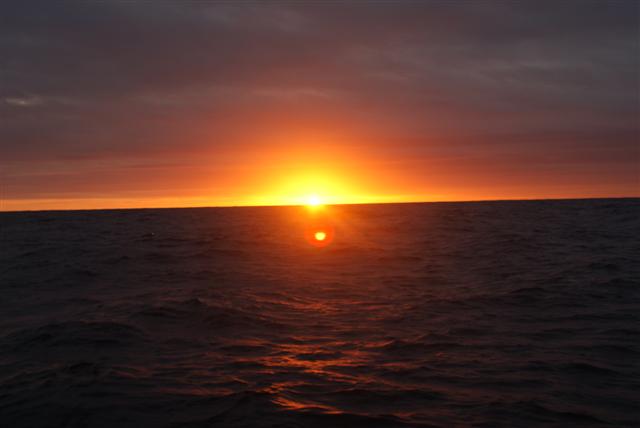
Beautiful sunrise
It was a long and uncomfortable night but, as the dawn bled into the sky, I eased a couple of turns out of the genoa which, until then had just been showing a tiny scrap.
I feel a bit better today, managed to get some sleep last night and the sea is calming down. I think my sea legs are returning. Watched the most beautiful sunrise this morning.
Day 3 As we powered on through the ocean Bob’s report continued to predict the conditions well, as the wind dropped further I was finally able to shake a reef out of the main.
Getting back into routine now. James’ birthday today – hope he’s safe in Afghanistan. Saw a yacht on horizon this evening, the first one since leaving.
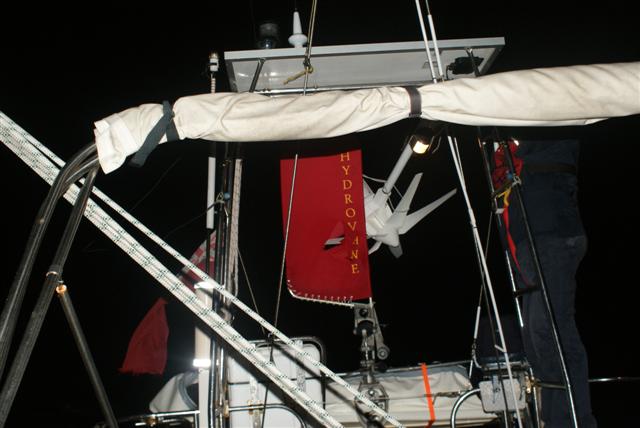
Wendy attacks Harry
Day 4 Up until now our wind generator nicknamed “Wendy” (when de wind blows) had been able to supply all our power with no need to run the engine to top the batteries up but that was all about to change. At 03:00 she fell backwards off her perch on the aft gantry and still spinning attacked Harry (our Hydrovane wind self steering gear). At a stroke we had lost both our steering and our power supply. Why do these things always happen in the dark of the early hours? I powered up the electric autopilot and reluctantly woke Sue so she could back me up as I left the cockpit to deal with the mess at the stern. Wendy weighs in at 15 kilos and the sea was still pitching and rolling us a lot so I decided it was too dangerous to deal with this in the dark. I stabilised the situation by lashing her to the gantry and disengaged the self steering drive.
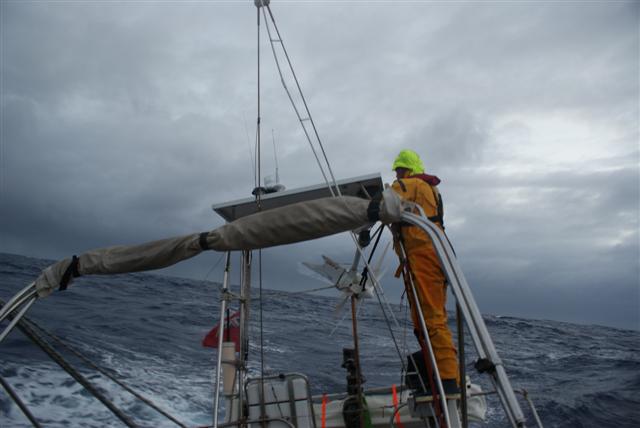
Bill dismantles Wendy
By the following morning we had dug out our spare wind pilot sail to repair Harry and, very, very carefully I dismantled Wendy from her broken mast and brought her back to the cockpit to stow her down below. In doing I broke one of her blades….. She was going to be a passenger for the rest of this trip!
After we lost Wendy the wind picked up again so the reefs are back in. The wind is coming from the south east and we are close hauled which means we’re sailing on our ear. The sea is up again and coming over the top all the time, the decks are awash.
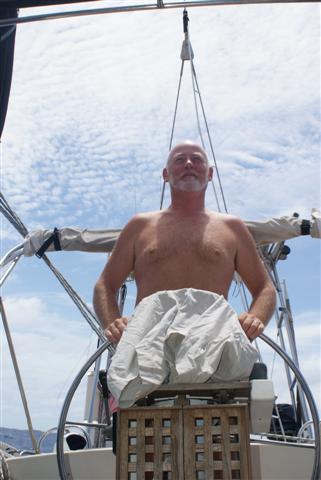
From nearly no clothes ......
After managing to get the wind generator down safely Bill was disappointed when it broke. I’ve finally stopped feeling sick so I made some chocolate brownies to cheer him up which wasn’t easy while we’re heeling so badly.
Bill has gone from nearly no clothes …..
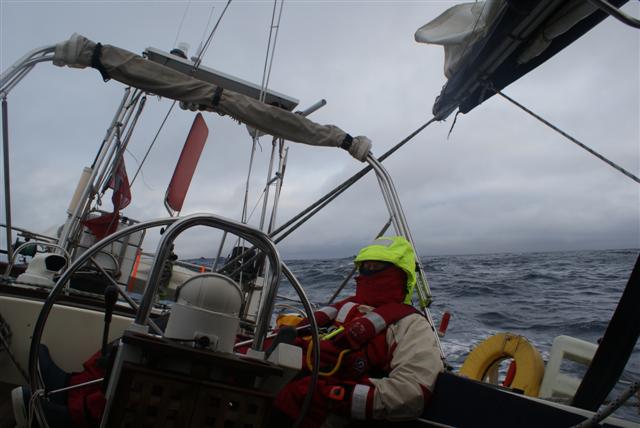
...... to full foullies
…… to full foullies.
Day 5 Our fast passage continues as we shake out the reefs and keep Camomile surging on at 7-7½kts even though the wind is now 15kts on the beam.
As the wind starts dropping I managed to sleep properly for the first time last night and had a shower this morning. We passed 17000 miles since leaving the UK today.
Day 6 And the wind backs round to the northeast. That’s on our tail so without our twin headsails in place I rigged a prevented and poled Goosewing to keep us moving but as the wind decreases with the approaching front and no power coming from Wendy it’s not long before I have to fire up the engine and motor overnight under an increasingly damp sky.
Bill has started eating the tins of condensed milk because he’s convinced the NZ customs are going to take them away. Came across a yacht sailing ahead of us today and discovered it was our Canadian friends on Sedna 1 who were supposed to be on their way to Australia but have decided to go to NZ. The world is such a small place. We passed 30ºsouth today and it’s starting to get cold, I’ve put the duvet back on the bed after nearly a year of sleeping with just a sheet. This afternoon while Bill and I were talking I looked over his shoulder to see a whale swimming by not 6ft from the boat and waving his fin!! It was truly a Monty Python moment
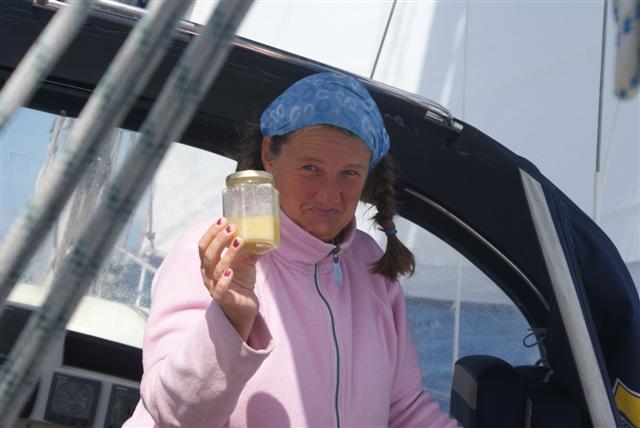
My best honey ….
Day 7 Well Bob’s prediction is finally failing as the forecast westerly turns out to be a south easter – almost on the nose. With reefed sails we thump through the squalls but have to run the engine to keep us on track. Within an hour or so our engine alarm sounds to warn of overheating. I shut her down and check the waterflow to find that we are heeled so far over that the raw water intake, placed starboard of the keel is sucking in air. No option now, we must bear away and sail as close hauled as possible, not comfortable but needs must.
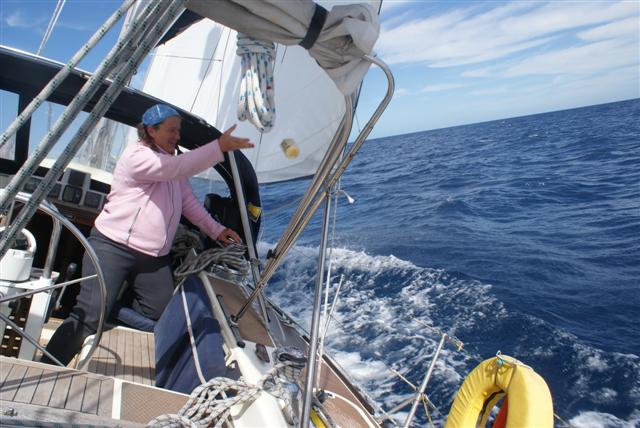
…. had to go over the side
Full foullies on today with long sleeves and socks, it’s turned so cold, we’re just not used to this. We’re gradually using up any food the NZ customs are likely to take away. I used the last eggs today and my last tin of M&S chunky chicken. I won’t be able to eat the last of the honey, which is an absolute no-no in NZ. You can just picture the scene; SAS in full combat with guns pointed ‘Put the honey on the pontoon and step away from the jar’. So it went over the side!
Day 8 The southerly is still pushing us east. It’s true then, you really don’t need to worry how much westing you get in on your way to New Zealand, you can always use it on your final approach. Tacking to get towards land is proving very slow as the sea has a short chop. Motoring made even less progress at first but as the wind dropped we picked up speed towards the Bay of Islands

Raising the NZ flag
I spotted land at 8.00 this morning while Bill was sleeping. One little hilltop peaked out of the morning mist, New Zealand at last. The wind was still coming from the wrong direction and thankfully Bill took the sails in and we motored the last bit. Bill raised our NZ courtesy flag along with the yellow ‘Q’ flag ready for the customs clearance. The Bay of Islands looked beautiful and green after hot and dry Fiji. The water was a serene green. It took the rest of the day to round the headland and motor down the channel to Opua.
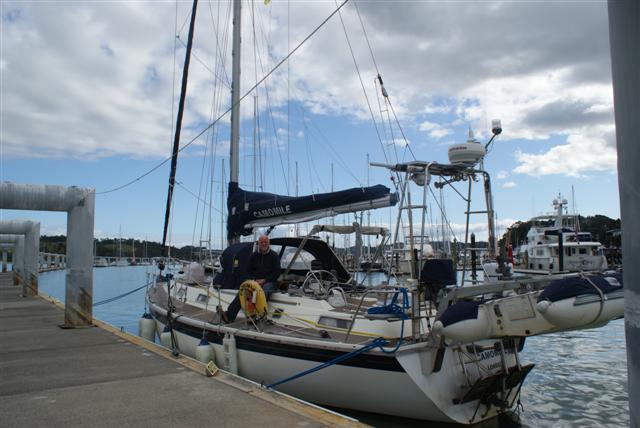
Camomile on the Q dock
We called the customs to announce our arrival at 17.30.
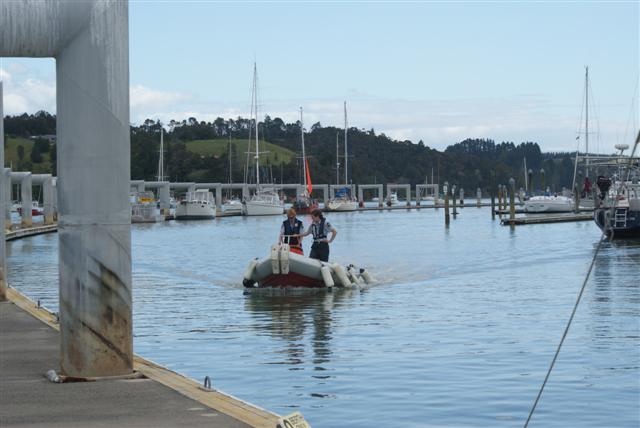
2 nice customs ladies
Two very nice customs officers came on board to complete our paper work. Fortunately the only things they took away were some tomatoes that I was going to eat for my lunch but didn’t, some white beans that they thought might sprout, the rubbish bin and the contents of the vacuum cleaner. They didn’t seem interested in any thing in tins or our over the limit but declared alchohol.
So we made it to New Zealand.
Our position is 34º 47.2 south 174º 34.3 east
We covered 1173 miles in 180 hours which gave us an average speed of 6.2 kts
Musket cove marina, Fiji
17 46.2 south 177 11.5 east
I’m posting this report on Yachtplot too.
We made our way back to Suva and successfully sorted out Bill’s passport. We have also spent 2 weeks out in the Exploring Isles in the Lau group, which was probably the most spectacular anchorage we have anchored in in the whole of the South Pacific if not our trip so far. We returned to Savusavu where we originally checked in with the BWR to wait for yet more rigging spares and then spent 3 days day-sailing back to Musket cove. That’s where we are now waiting for a weather window to NZ. There’s quite a lot of other boats here also waiting. Sadly we missed a perfect one by 2 days and it now looks like the next one won’t be until 1st November so we’ll just have to hang out in the Island bar and keep cool in the pool – it’s going to be tough!!
I now have full control of the website (blogsite) and both Bill and I are busy updating it. You should see reports appear most days until we bring it up to date. We are putting on the reports that have been written during the year so you’ll be able to see our photos and find out what we’ve been up to.
(If it comes up with a strange message about viewing at the beginning click ‘no’ or else the photos won’t display properly)
Huahine, Raitaia & Bora Bora
I’ve written an article for the Westerly Owners Association magazine which included a report on Raitaia and Bora Bora so I’m posting it on the website for you to read. I’ll leave it at the top for a day or two before correcting the date.

Archaeological site of the royal Maeva
We sailed overnight to Huahine, the least touristy of the Society Islands, and anchored close to the village of Fare just inside the reef. Hiring a car for the day with two American friends we were able to explore the island and visit the famous archaeological site of the royal Maeva, seat of the island’s eight chieftains. The backdrop of a beautiful blue lagoon enhances this interesting collection of aligned stone slabs, paving and terraced platforms.

Bill feeding the Sacred Eels
Driving on to visit the village of Faie, home to a colony of sacred eels; an amazing sight as they wriggled out of the holes in the bank of the river for the fish food we bought to feed them. Some were more than a metre long and came right up out of the water to eat. One of our days was used to explore the reef behind us that had some beautiful coral and lots of fish.
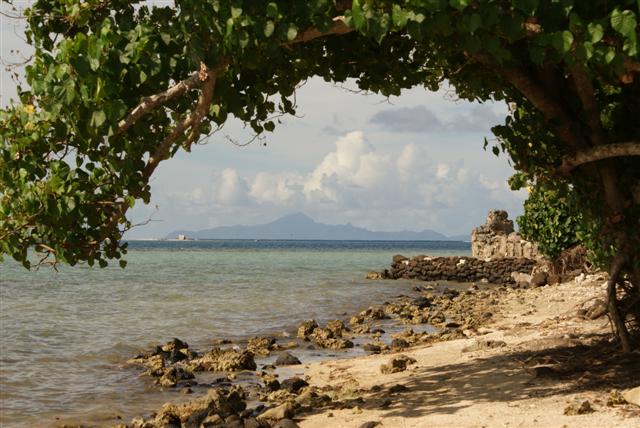
The reef off of Raiatia
The next island we sailed to was Raiatea. Mooring on the main town quay of Uturoa was easy and it turned out to be a nice town with some good shops and an excellent market. It was great to get away from the normal tourist centres to discover a more remote and enjoyable South Pacific. The pace of life was getting much slower.
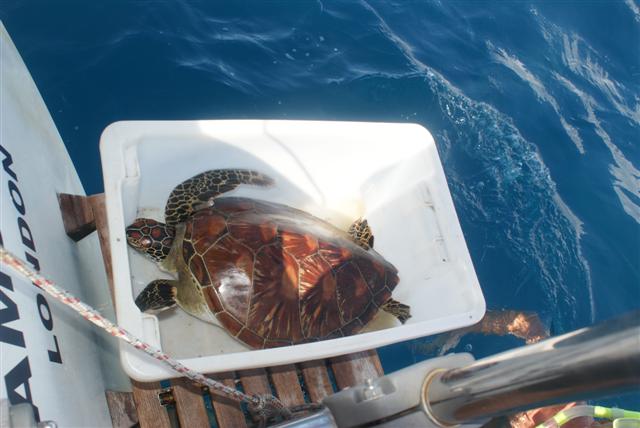
Nike the Turtle
Raiatea shares a transparent lagoon with its neighbour and sister island, Tahaa. We Motored across the lagoon and picked up a buoy outside the Turtle sanctuary. While in French Polynesia we heard that our beloved spaniel Nike had died. Our goodbyes had all been said before leaving but it was still hard to accept. We wanted to do something to commemorate him and decided to ‘buy’ a turtle. The turtles are rescued from local fishermen and nursed back to health. When they are ready to release back in the wild they are tagged and measured and ‘sold’. One was a beautiful reddish brown, the same colour as Nike, so we chose that one and called him Nike. We took him out to one of the islands that surround the lagoon to release him; it was a very emotional moment. Nike lives on.

Vanilla plantation on Tahaa
Tahaa is known as the Vanilla Island. The potent pods of this orchid species produce 80% of the famous Tahitian vanilla. Joining a tour with some other cruisers it was explained how the flowers are pollinated and the pods are selected for quality and dried. The aroma of vanilla was intoxicating. On the north west corner of the lagoon surrounding Tahaa was the most amazing snorkel site. It was very shallow so care was needed but the colours of the coral and the amount of fish life was amazing. We anchored off the site for several days watching the sun go down over Bora Bora each evening and pinching ourselves to make sure it was not just a dream, being surrounded by such beauty.
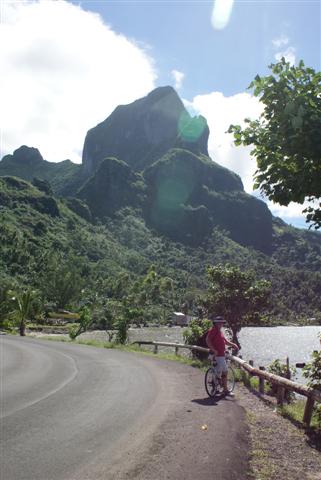
Cycling around Raiatia
Our standing rig had further problems in French Polynesia, which may have been a result of the jury rig we had to set up after our lower shroud broke on the way to the Galapagos Islands. During a routine rigging check Bill discovered a loose strand of wire close to one of the upper terminals of the lower shrouds, which meant that all three had to be replaced before we could put to sea again. They had to be sent for from Tahiti both delaying us and preventing us from continuing on with the rally for the time being. We took Camomile carefully back across the lagoon to a small marina on the other side of the island of Raiatea. While waiting for the rigging to arrive Bill unpacked our bikes for the first time since the Caribbean. We “enjoyed” several bike rides around the island one of which was 60kms long though when invited onto an Australian boat for drinks that same evening I took my soft cushion to sit on! After a week the rigging turned up but unfortunately the upper terminals were the wrong shape and Bill had to spend a further day modifying them. Finally they were fitted and Camomile was safely able to set out for Bora Bora.
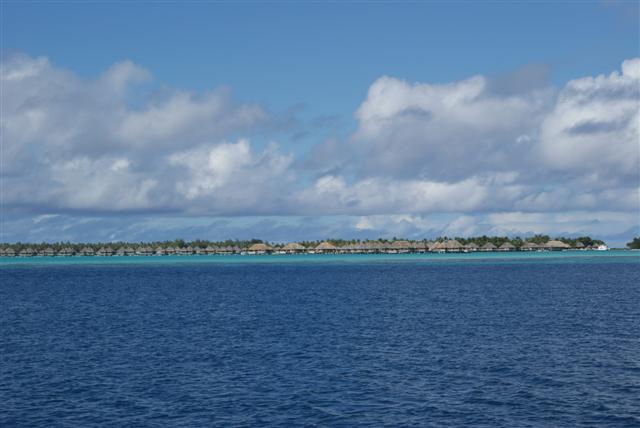
The over commercialised hotels surrounding the Bora Bora lagoon
We were disappointed with Bora Bora; it’s very commercialised and expensive. It was a day sail from Raiatea and we picked up a buoy at the Bora Bora yacht club. The lagoon is a dazzling blue with beautiful coral reefs but the surrounding ‘motus’ were all covered by hotel complexes with over water bungalows, many of which have closed down during the recession and the main town of Vaitape mostly consisted of shops selling tourist tat or they were empty.

'Bloody Mary's' on Bora Bora
We cycled around the island and enjoyed lunch at ‘Bloody Mary’s’ where the film stars eat and drink. Despite the wall being covered in photos of ‘celebrities’ eating there we didn’t see any one famous.

The bathroom at Bloody Mary's
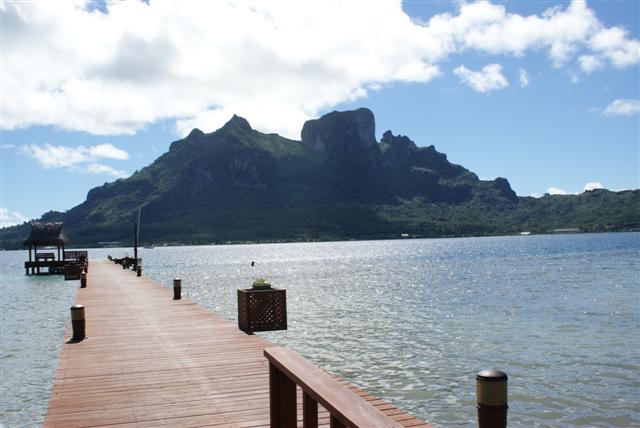
The lagoon of Bora Bora
The weather was not kind to us during our stay in Bora Bora, there were several rainy days then it closed in on us, predicting high winds and steep seas for our 2 week passage to Fiji. Although the main rally were well ahead of us now, three other rally boats who were also behind caught us up and, together with three Australian boats, we formed the ‘Tail End Charlie’s’ rally. During our 10 day stay we celebrated two birthdays and a 40th Wedding Anniversary at the yacht club within our little group. On the day of the Anniversary we had planned a barbeque at the Yacht club but rain threatened again. It was suggested that we call it off but with true British grit we continued to barbeque in the rain, I think the Aussies thought we were mad! The usual round of conversations about the weather took place every day until finally on 22nd June a window opened up and we could get away.

Coral reef off of Bora Bora
Our time in French Polynesia was really enjoyable but it was over all too quickly. The lagoons were bluer than we imagined but the weather wasn’t as good as we had hoped for. The people were very friendly and welcoming; we have a lot of good memories.
Tahiti and Moorea
This is the story of our stopover in Tahiti and Moorea, the windward isles of the Society Islands.
- BWR boats in Papeete harbour
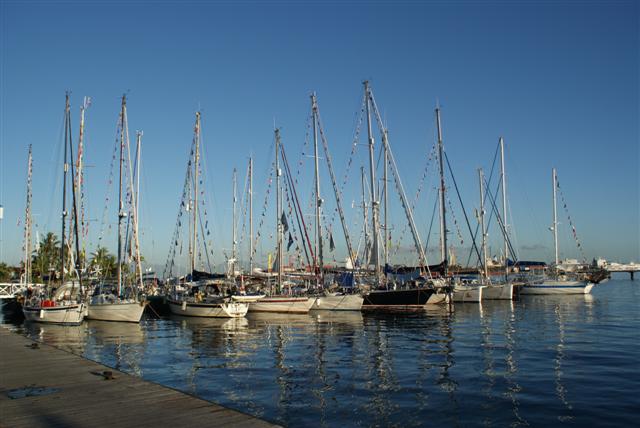
17º32.4 south
149º34.2 west
Tahiti is French Polynesia’s largest island and Papeete, it’s capital, was where the BWR made its base. We were moored next to the main boulevard alongside cruise liners and inter-island ferry boats.
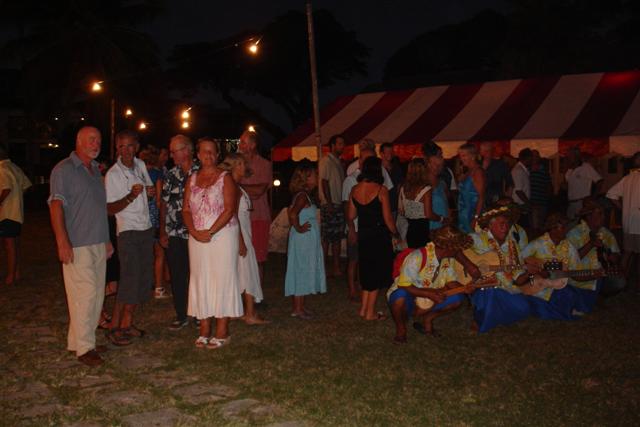
Welcome reception
We arrived in Papeete in the dark at 1am on Monday 10th May. We managed to moor up ok with the help of other rally boats. The city beyond the waterfront is a jumble of colonial buildings, churches, small stores and modern shopping complexes with a backdrop of jagged volcanic slopes soaring into the clouds. Our first job, as always, was to sort out our customs and immigration entry, which took all morning. We then went for a nice lunch followed by the usual trail around chandleries to fix anything that’s dropped off on the journey. As we were alongside a pontoon for a change it was nice to be able to get the boat sorted out.

Polynesian dancers
The following day we were entertained very well by the local tourist board with the presentation of leis in the afternoon followed by a delightful reception in the evening. We were ‘summoned’ to attend by some Polynesian musicians and everyone followed ‘Pied Piper’ style through the town to the charming French colonial style city hall for a delicious buffet. We were then treated to a wonderful display of Polynesian dancers performing some traditional dancing. Beautiful men and women performed dances that have been handed down through the generations.
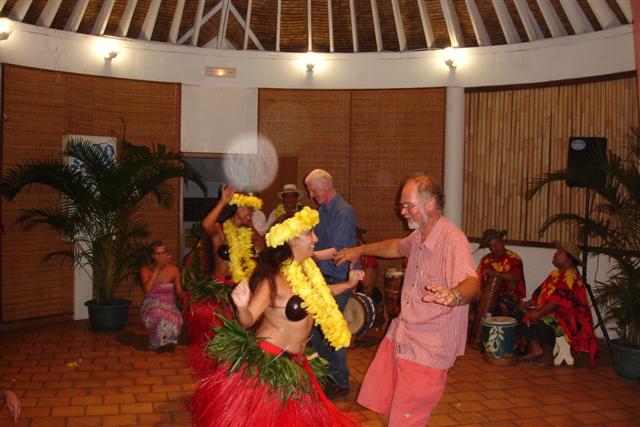
Ian enjoying the dancing
After their performance we were invited to join in. Some people really enjoyed themselves. This is our friend Ian from Lucy Alice showing off his dancing skills! The evening was rounded off with the presentation of beautiful engraved oyster shells to each of the boats.

Point Venus
The next day was spent in a coach touring the island but as it was raining most of the time we didn’t see the island at it’s best. Our first stop was at Point Venus the location where Captain Cook set up an observatory to study the transit of Venus in 1769. The lighthouse later built on the sight in 1867 marks the northern most point of the island. It overlooks a beautiful black sand beach where it is thought the first missionaries landed at the end of the 18th century but as we were admiring it the rain started coming down
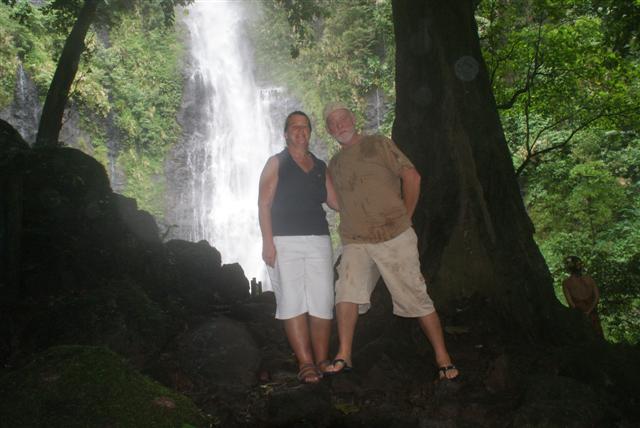
Faarumai Waterfall
We continued around the island to the Faarumai waterfall. It was only a five-minute walk from the road and a very impressive sight. The rain continued but at least liquid sunshine was warm!
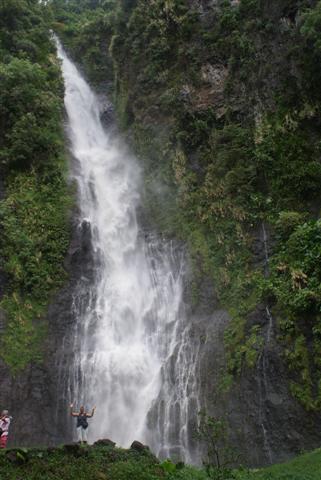
Sue at base of waterfall
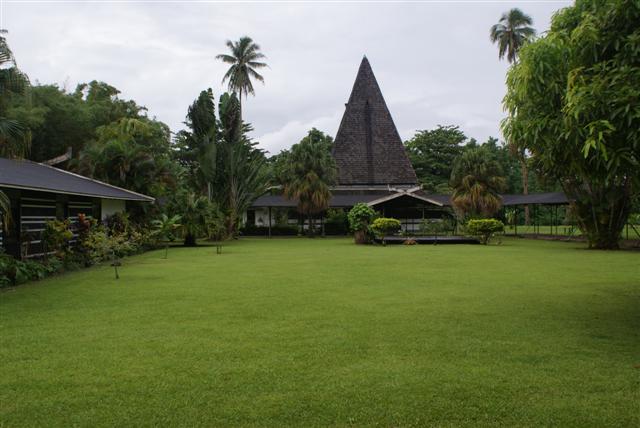
Gauguin museum
We continued around the island to the Gauguin museum restaurant on the south side for lunch and then onto the museum. It features Paul Gauguin’s original work; paintings, sculptures and engravings, as well as documents, photographs and household items belonging to the famous artist. The gardens overlook the picturesque lagoon and the smaller island of Tahiti Iti in the distance. On the return journey the coach stopped at various places but the rain really started to hammer down. Our final stop was at the Marae Arahurahu, the most significant, and beautiful, ancient stone temple of the island. Unexceptional in its day, it was one of dozens of pre-christian shines. In modern times it was chosen for reconstruction to keep the memory of old Tahiti alive. It remains a magical setting, peaceful in the shadow of the mountains but sadly unexciting in the rain.
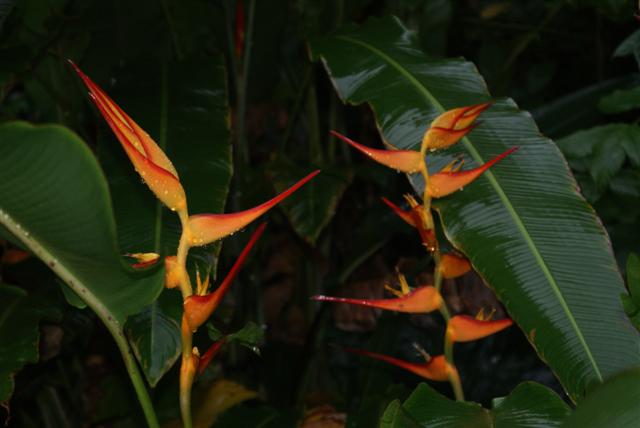
Beautiful flowersHeliconia
We spent the next couple of days continuing the usual round of washing, shopping and boat maintenance. This included a visit to the colourful market in the centre of the town; a quintessential South Seas covered market, vivid with colour and commerce. Here they sell everything from straw bags to sticky desserts, from live pigs to bananas to fresh fish from the days catch and beautiful Heliconias.
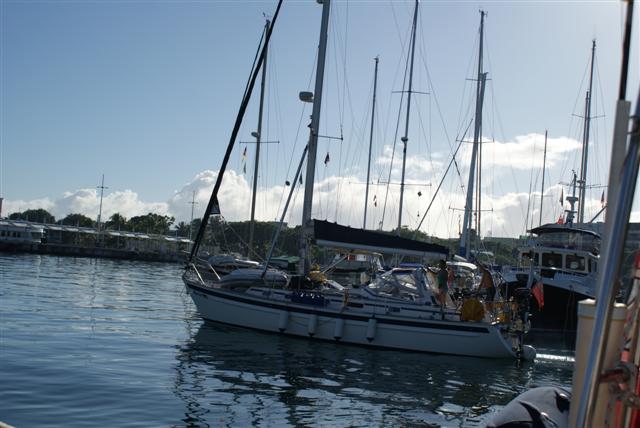
Norsa leaving
All the boats were tied to one jetty so on the last evening, which was a Friday, we had an impromptu pontoon party where we all brought a plate of food and we followed it with a heat of the Blue Water Master Millionaire challenge aka ‘Friday night is quiz night’. It was great fun, I organised the crews into teams, they had to think of an inventive name and each team was asked 10 questions. Although it was ‘just for fun’ some people took it seriously and some even dressed up, the vision of Stuart (Gaultine III) and Paul (Jackamy) dressed in sarongs and blue wigs will stay with us for a long time!! We had a really fun time and it ended with a tie between the ‘Tippyies’ and ‘Balibou’ (Bali Blue and Natibou). The following morning we all waved goodbye to Norsa as Norman and Sara were leaving the rally.

Going through the Tahiti reef
After our 5 day stay in Tahiti we checked out ready for our trip to Tahiti’s sister island of Moorea on Sunday morning. Although it’s only 12 miles from Papeete, we had a bit of a choppy crossing with some uncomfortable cross swells coming from the southeast and the north. We arrived in Cooks bay, Moorea just in time for Sunday lunchtime drinks, what perfect timing!

Mt Rotui
17º30.1 south
149º49.0 west
Cooks Bay, Moorea
Moorea is an island of volcanic origin and was populated by navigators who arrived in large double outrigger canoes from south east Asia 1000 years ago. The first Europeans arrived during the 18th century, one of whom was Captain Cook in 1777, followers by the missionaries. The French Protectorate was established in 1842. Moorea benefits from a beautiful turquoise lagoon that completely surrounds the island. Cook’s bay framed by lush green jagged mountains, which is dominated by Mt Rotui, the sacred mountain of the Ancient Polynesians, was our base for the next 5 days.
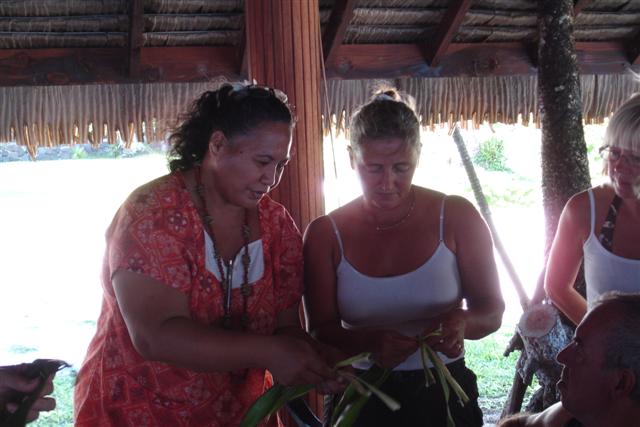
Mama teaching Susan how to make a flower crown
We anchored next to the Club Bali Hai, a lovely resort that allowed us to use their pool and facilities. The next morning the ladies were invited over to the resort for a demonstration of how to make the beautiful Polynesian flower crowns, here is ‘Mama’ showing my friend Susan how it’s done.
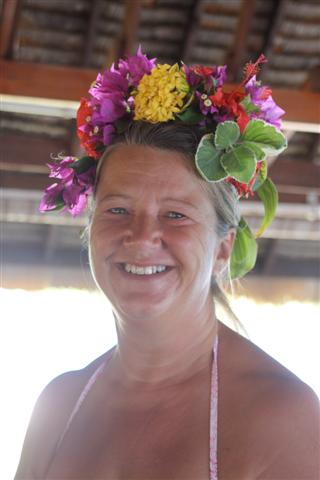
‘I made it all myself’
She also taught us how to tie a pareo properly. The pareo is the basic article of clothing for all Polynesians. It’s simply a large rectangle of printed cotton fabric. Both men and women wear it and it seems there are a thousand and one ways to tie it, even elegantly for the evening. ‘Mama’ taught us lots of different ways. It was a very interesting morning. As it was Susan’s birthday that day I made her a cake. Later Bill and I were invited on board Enchantress for a delicious meal.

The girls in their crowns and pareos, I'm 4th from the left.
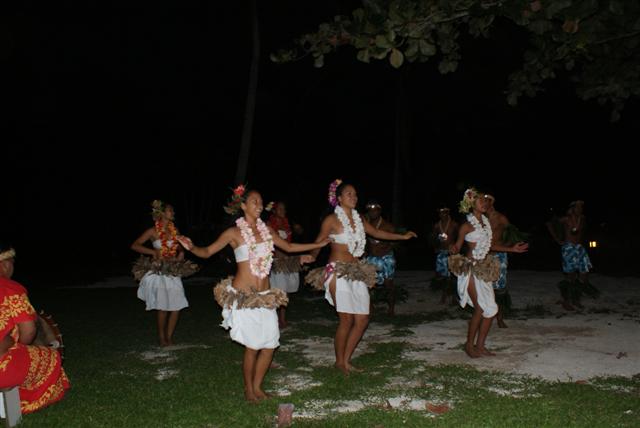
Local dancing girls
The next day we were going to hire mopeds but it was raining so we stayed on the boat and did jobs instead. The following day we had a breakfast briefing for the next leg in the morning and then in the evening the hotel organised a delicious bbq followed by a spectacular dance show. We were able to show off our pareo tying skills again. After the show we all had our photos taken with the dancers.
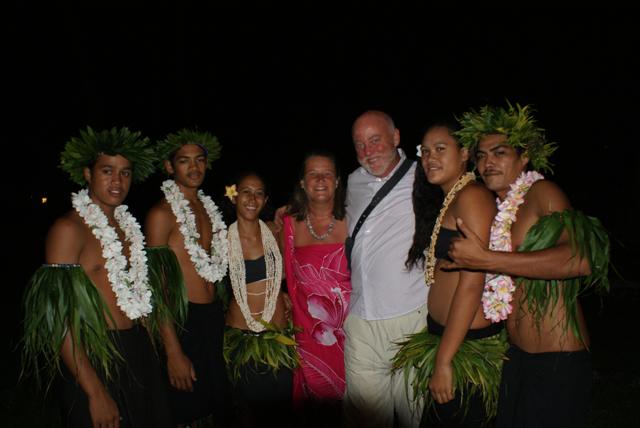
Bill and I after the show
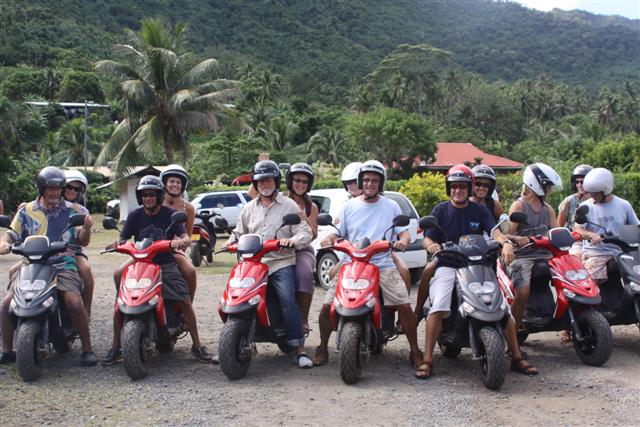
Blue Water Angels, we are 3rd from the left
On the Thursday, despite the fact that it was forecast to rain again, a group of us decided to hire mopeds for the day. Bill and I haven’t been on anything like that for about 30 years but it was good fun. It took a while to get us all kitted out but finally we were ready to go. We called ourselves the Blue Water Angels. The circular road around the outside of the island is 62km so we could easily do it in a day.
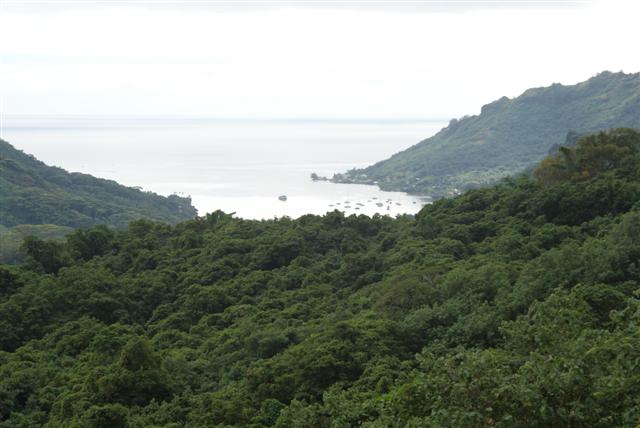
The view from the Belvadere
We set off around the edge of Cooks bay and then up to Belvedere view point which gives a spectacular panoramic view point over the two bays separated by Mt Rotui. We stopped at several archaeological sites (marae) on the way down – just as it started raining. We continued around Opunohu bay with its thatched huts extending down to and beyond the water’s edge. Most of Moorea’s 11,000 inhabitants live near the coast fishing or farming. There are no real towns only loosely knit settlements with a post office, a school, a church or two, and a general store trailing off into the next hamlet.

Learning how to dance
We continued around anti clockwise until we came to the Tiki Village Theatre on the western side. Polynesians love to dance, sing and play music but most of all enjoy performing on stage. We decided to stop for some lunch, which meant we were entitled to watch the afternoon performance. They put on a great show including more ideas for tying the pareo. Afterwards we were invited to join in, we all had a great time. We had a look around the village in the afternoon before continuing on our way. We had been told about a beautiful waterfall on the south side of the island. We found the track leading to it and the men decided to ride the mopeds up them. By this time the rain was coming down heavily and the track was very muddy. We left the bikes and walked some of the way but abandoned the idea after realising it was still a mile or two away.
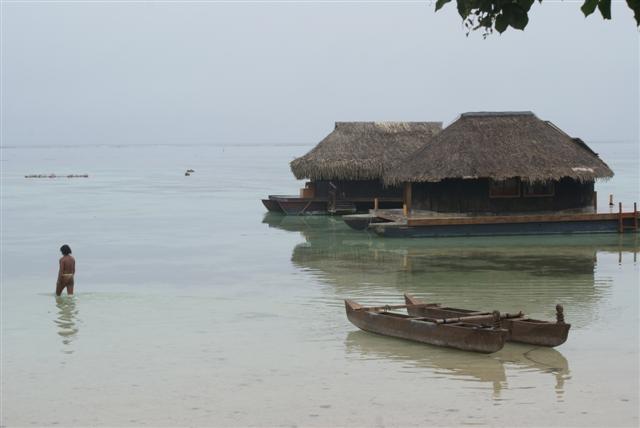
Tahitian hut
We had planned to stop at a beach for a swim but we just decided we wanted to go home because we were getting wetter and wetter. Although it was warm rain it was quite painful as it beat into our faces. We got back to the boats absolutely soaked.
We stayed one more day to join in the 60th birthday party of Peter on Peregrina and then on the Saturday we lifted the anchor and motored around to Opunohu bay, the next bay along. The water was much clearer and we enjoyed some wonderful snorkelling over the reef.
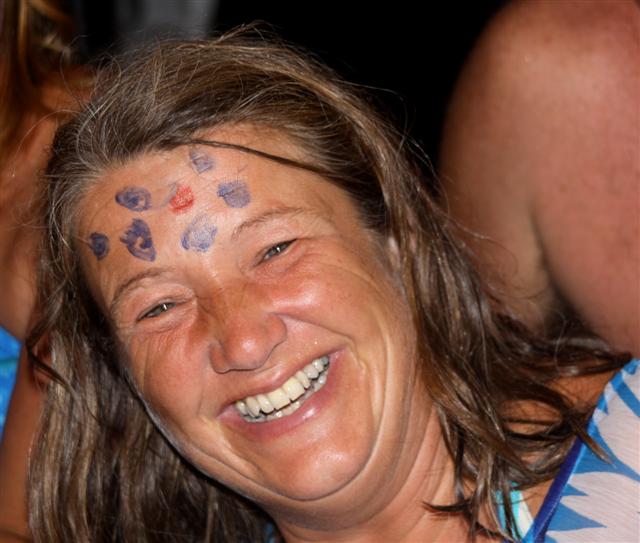
Someone had too many sherbets
After our snorkel we joined the crews of Blue Magic, Miss Tippy, Jackamy and Bali Blue on board Chsalonina with our friends David and Susan and Fai Tira’s Pete. Paul on Jackamy is a very bad influence and suggested we play a drinking game called Cardinal Puff. This entailed you individually performing a sequence of hand movements while finishing your drink but if you got the sequence wrong your glass was topped up and you had to start again. I decided it looked easy and I was going to have a go! A half hour later having consumed a whole litre of wine I gave up but not before I was completely legless!!

David's turn with the infamous Paul behind him
David decided he was going to have a go too and also failed. The dots on my face were from another game I don’t even remember playing but I obviously got it wrong!! Neither David or I could sit up and Bill had to take us back to the boats in our dinghy while towing Susan in theirs. I don’t remember a lot but There were a lot of sore heads in the morning!!
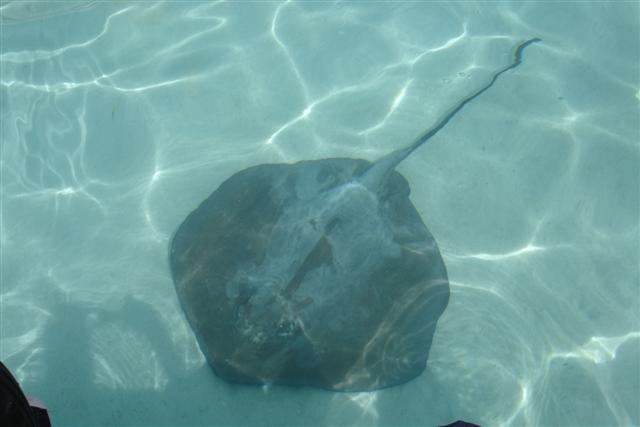
Stingrays by our feet
The next day we dinghyed over to the other side of the bay because we had been told it’s possible to swim with rays and sharks. It was an amazing sight. We got out of the dinghies and stood in the water up to our chest while several rays were swimming around our feet. There were also black tipped reef sharks too. It was possible to snorkel over a deeper area to see all the wildlife waiting to be fed. We had the place to ourselves for about an hour until the tourist boats arrived with the shark food … and the fish bait!!

Feeding the sharks
Pearl collection and birthday celebrations in the Tuamotus

With Susan and Glenda at the Pearl Lodge resort
14º27.9 south
146º02.3 west
Tuamotu islands

An atoll in paradise viewed from inside the lagoon
We’ve found paradise! The atolls of French Polynesia are beautiful. The Tuamotu archipelago consists of 76 islands and atolls spread over more than 20,000 square kms. Born from coral, emerging just enough to create the most mythical lagoons in the world. They offer a Robinson Crusoe lifestyle that dreams are made of. Manihi is an elliptic atoll containing a stunning lagoon sprinkled with pearl farms. We arrived off the entrance to the Turipaoa passé after a 3-day sail from Nuka Hiva at 10am. The tide was still ebbing quite strongly but as that slowed us down it ensured we could enter at a controllable rate without bumping into anything. Once inside the view was breath taking. The water was an amazing azure blue which matched the sky perfectly. There were already 2 BWR boats there and another 5 followed us in so it was a bit crowded.
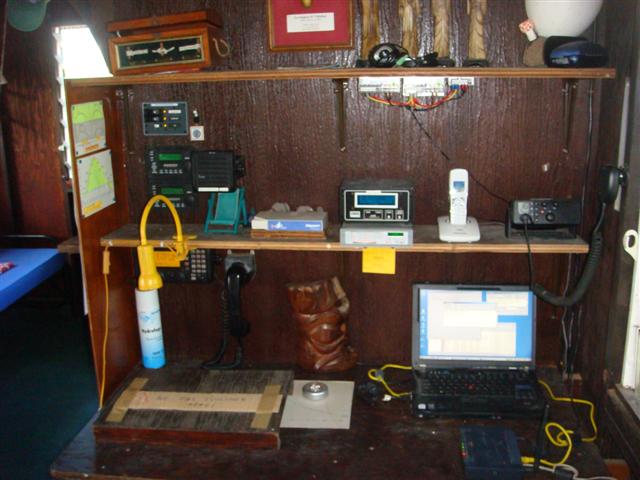
Sailmail station
Our sailmail email server is run by sailmail who have radio broadcasting stations throughout the world that enable emails to get from the internet to our boat using our SSB radio. One of those stations is based on Manihi and Xavier who runs it welcomes visitors. Ian from Lucy Alice and David from Enchantress and Bill were very keen to see it. Glenda, Susan and I wanted to see the house he’s building on one of the atolls. We jumped in the dinghies and motored for about 30 minutes to his atoll.
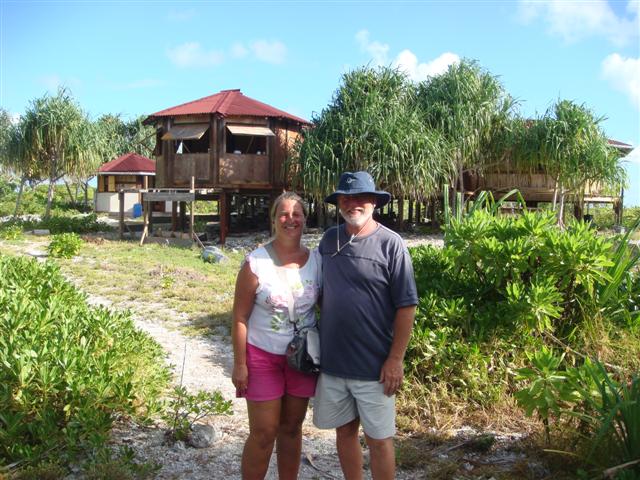
Xavier’s island paradise
Xavier and his wife bought one of the atolls (didn’t like to ask for how much) and they are building a home on it in true Robinson Crusoe style. The building behind us houses the kitchen with the bathroom off to the left. It’s built on stilts in modules; the bathroom was wonderful with its outside shower.
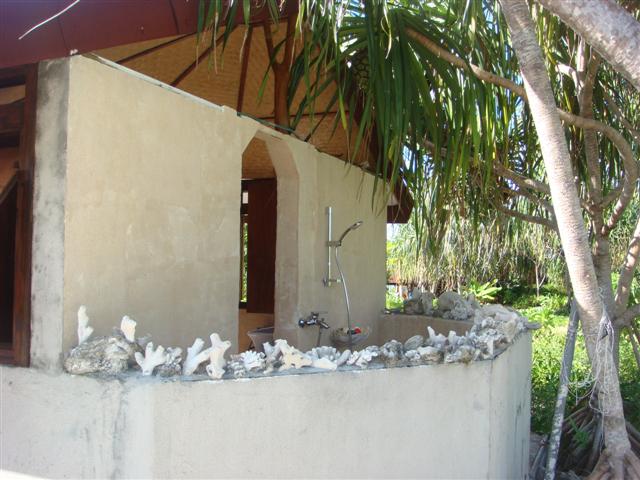
The outside shower
The island has it’s own borehole for water and is self sufficient for power. There are 3 forms of power, a wind generator, a massive bank of solar panels that tilts towards the sun as it moves and a mini water turbine powered by the water flooding over the reef. These all feed a huge bank of batteries giving him 1000’s of amp hours. The men were fascinated. Xavier was a wonderful host and gave an interesting guided tour accompanied by Fletcher Christian, his beautiful cocker spaniel. That evening all the crews joined together on the beach for a bbq followed by a Camomile quiz. The teams were English men, International men and Women. The women won.

Bill collecting my oyster shells
The next day Fernando, the local pearl farmer cum baker cum Mormon preacher cum Chinese delivery man, picked Ian, Glenda, David, Susan, Bill and me up from our boats to take us to his pearl farm in the middle of the lagoon. We were enjoying the ride in his fast boat when he suddenly stopped and tied it to a buoy. When we asked where the pearls were he pointed down below. So Bill, Susan and Glenda got in the water, Ian, David and I can’t swim under water. Bill went down first and found a string of oyster shells 4m below the surface. After several attempts he brought a string to the surface.
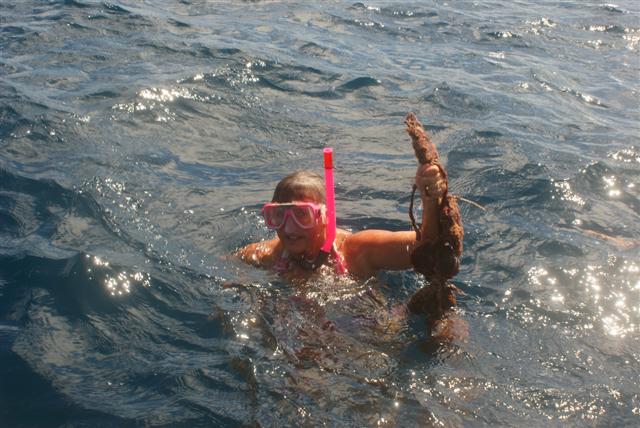
Susan collecting her pearls
Susan was next and, with Fernando’s help, also produced a string. Glenda was next and bravely tried but Fernando did it for her. Everyone got back in the boat and then we headed back to his pearl farm on stilts on the edge of the lagoon. The deal is you pay per person for the trip and keep the oysters that are produced from your shells. The next step was to cut them out. Glenda cut open 2 of hers first but sadly they were quite small.

Fernanado helping me open the oyster shell
Next it was my turn. It was very hard because the shells have been in the water for a year or more and have lots of barnacles growing on them. Fernando helped me and hey presto the most beautiful black pearl emerged followed by an equally beautiful one in my next shell. We continued in turn until Glenda, Susan and I each had 6 or 7 beautiful pearls of varying quality.

Two little beauties
Later we went back to his house where he had 1000’s more in bnoxes to purchase at cost price. I choose another 10 to go with mine in varying colours and size and I’ve sent them to Claire to make into a necklace and ear-rings.
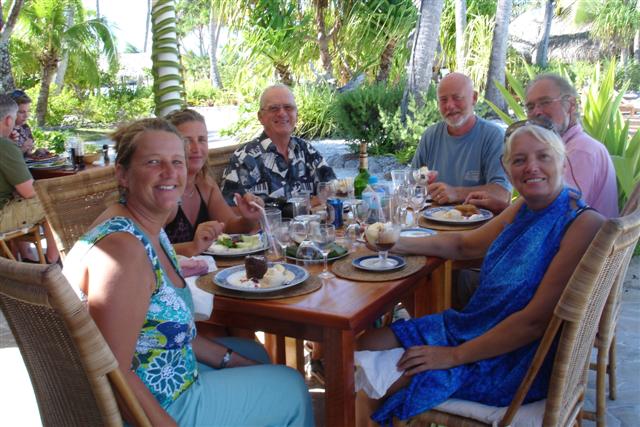
Birthday lunch with Susan, David, Bill, Ian and Glenda
The next day was my birthday and our best friends David and Susan, Ian and Glenda joined us at the Pearl Lodge resort across the lagoon for a sumptuous birthday lunch. It was wonderful and I was so lucky to spend my birthday in such a beautiful place with such good friends.
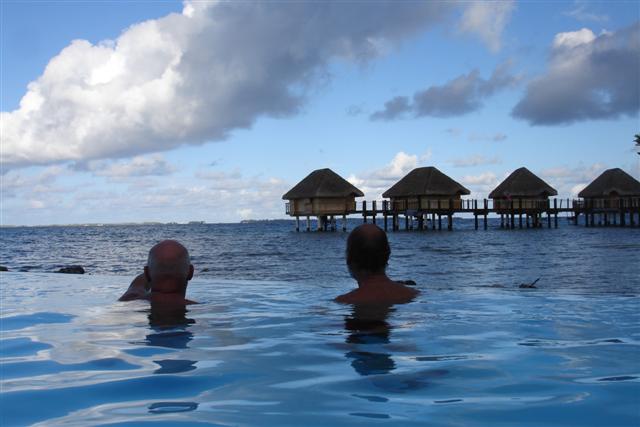
Two wise old owls
After lunch we got changed and relaxed in their infinity pool for the afternoon. We went back to the boats where we were joined by quite a few of the other crews making 13 in total, Glenda produced a lovely chocolate birthday cake, Peter from Bali Blue brought some rum, others brought more alcohol and, from what I can remember, we all had a great time … I think!

Camomile on her way to the Blue Lagoon
The next day Enchantress, Lucy Alice and Camomile motored inside the atoll to the other end, which was known as the Blue Lagoon. We had difficulty finding it expecting the water to be bluer but I think we were in the right place, the water was still very blue and it’s had some large coral heads which we all explored with our snorkels. We watched a black tipped reef shark doing a circuit and the colours of the coral create a superb underwater landscape. We had the place to ourselves and enjoyed a lovely walk along the beach and across one of the gaps to the edge of the reef on the other side. The breakers could be seen crashing onto the outer edge of the reef.
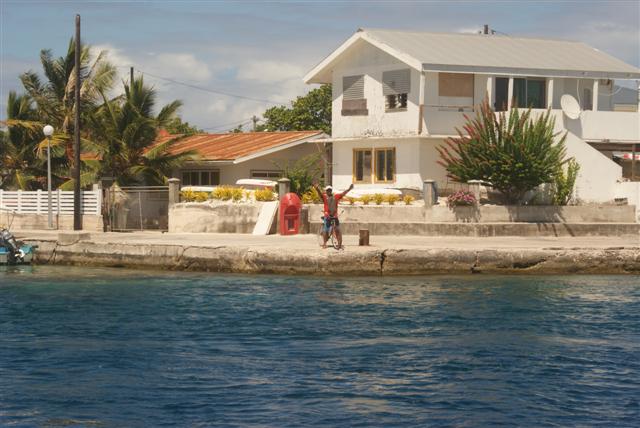
Fernando waving goodbye as we leave through the passé
We stayed for 2 days but then decided to move on to see another atoll. We left together and motor-sailed back down the lagoon to the passé. Enchantress went through first followed by Lucy Alice and then it was our turn. The ebb tide pulled us out with hundreds of fish beneath us. Fernando waved us off from the quayside as we sped by.
We put the twizzle up and enjoyed a wonderful overnight sail to Tikehau. We arrived at 4pm the next day along with the other two boats and we were joined by Norsa.

The entrance to Tikehau
Tikehau is about 15 miles across the middle. It’s full of coral heads but there’s a buoyed channel around the edge. We came in through the pass with about 2kts of tide against us. Unfortunately the wind picked up and was creating quite a swell within the atoll. We were anchored in the southwest corner and the wind was coming from the northeast so it was creating quite a fetch across the lagoon. We were next to the Pearl Beach resort with it’s over water bungalows looking across the atoll. The residents paid £100s if not £1000s for this view and we have it for free. As it was Friday and ‘Friday night is quiz night’ the others came over to Camomile for a trivial pursuit evening. We mixed up the teams but it was too clever for us and it went on long into the evening. I’m afraid to say alcohol was involved again!!!
We stayed for 2 nights but decided to leave and make our passage to Tahiti.
The Marquesas – our first French Polynesian Islands
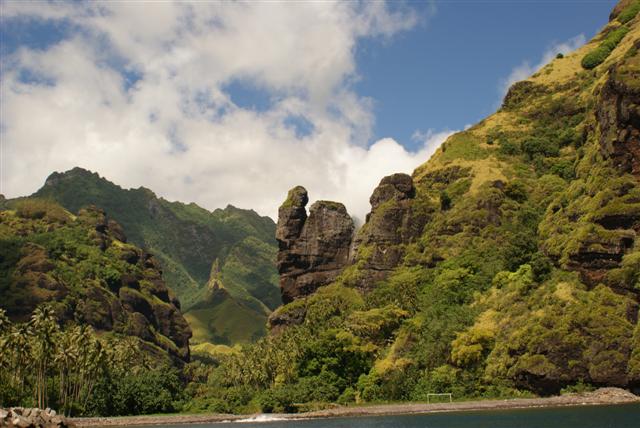
The Bay of Virgins
10°27.8 South 138°40.1 West
After our long Pacific crossing we were looking forward to starting our travels through French Polynesia.
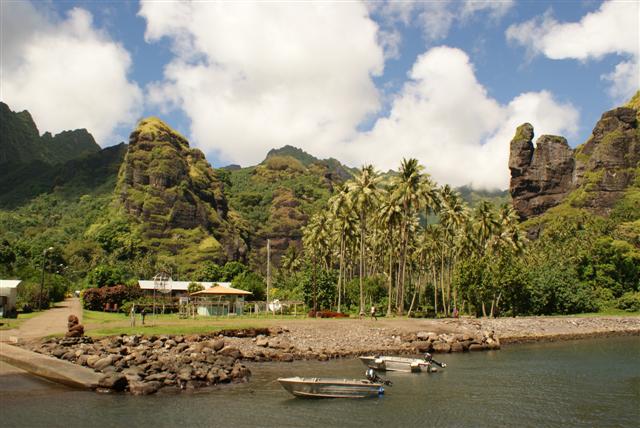
The little harbour at Fatu Hiva
So the everlasting journey was over and we made landfall at the Bay of Virgins on the island of Fatu Hiva, which has the most beautiful anchorage with superb rock formations at the entrance. Fatu Hiva is an authentic island where life is very simple. It’s the most southern, wettest, lushest and the most untouched of the Marquesas. It’s made of two volcanoes joined together with extreme geology. There are only two villages on the island and the Bay of Virgins surrounds Hanavave on the western side.
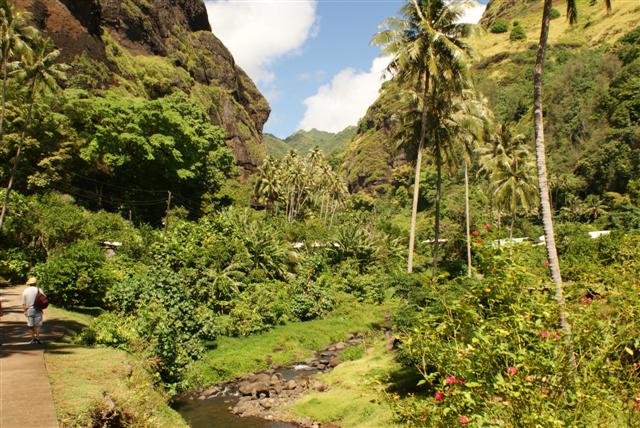
Walking to the waterfall
We spent the first afternoon on Bali Blue which started off as ‘come over and have a beer’ but quickly became the welcome boat with more BWR yachts arriving with champagne to share. It was wonderful to celebrate the achievement of crossing the great Pacific ocean. The next day we went ashore with Peter and Carol from Bali Blue and David and Susan from Enchantress to find the famous waterfall. We walked through the village with lots of smiling happy faces looking at us, shadowed by the impressive over hanging rock formations.
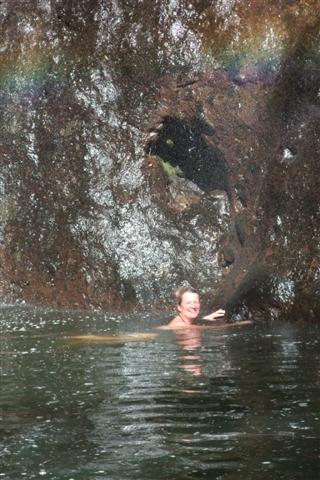
Enjoying a swim in the waterfall pool
The walk was only about 3 or 4 miles but it was through jungle terrain and the last half-mile would have been more suitable for a mountain goat, but eventually we found it and couldn’t wait to strip off our sweaty clothes (costumes underneath) and jump in the cool mountain water. We sat around on the rocks for a while to dry off and then started the trek back down the hill. We were invited to join a local family for a meal that evening along with the crews of Chsalonina, Norsa and a lovely swiss couple in the anchorage. The locals don’t deal in money but are pleased to accept ropes, fishing tackle, toiletries and alcohol, which we were happy to supply.
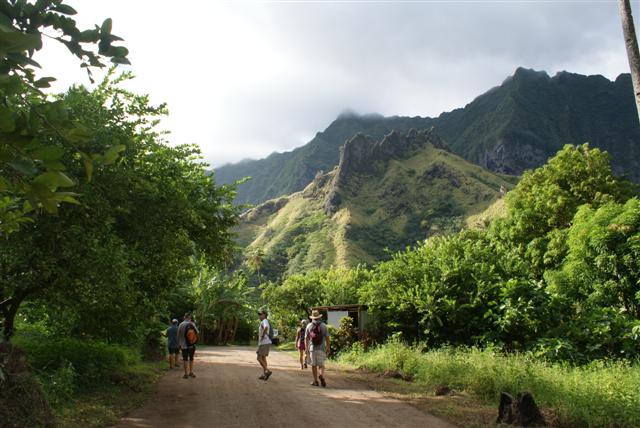
The walk back
I took some little necklaces and hair slides for the little girls in the family. They made us feel really welcome and we enjoyed fish in coconut milk, chicken, and an assortment of vegetables, some of which we had never seen.
Technically we were there illegally because there isn’t a check-in post in Fatu Hiva so the next day we left to go north to join the rest of the BWR fleet that had gone straight to Nuka Hiva. We stopped at the island of Tahuata over night on the way and got to Taiohae bay, Nuka Hiva the following evening so we were able to take part in the official welcome that was starting the next day.

Welcome dance
Fionn from BWR was there to welcome us as well as the local mayor, we were supposed to be presented with the Polynesian leis but apparently the rain had spoiled all the flowers. The mayor officially welcomed us while the locals performed a welcome dance and had laid out a fruit platter for us to enjoy.

Welcome fruit platter
Nuka Hiva is the largest of the Marquesas at 345 square kms and the most populous with over 2000 inhabitants. The Marquesans are among the most creative in the Pacific. The traditional arts of tattooing, carving and tapa cloth are all evident in Taiohae. The bay is a flooded volcanic crater with jagged walls that plunge into the ocean below. It doesn’t have a fringing reef or many beaches. The few beaches they have got are black sand and they are full of no-no flies, which leave a nasty bite so we’ll stay away from them.
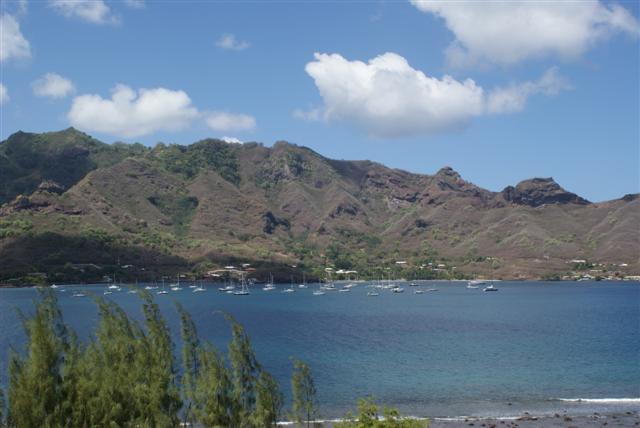
BWR yachts at anchor in Taiohae bay
We walked up to the big hotel for Sunday lunch, which was a nice treat after 3 weeks at sea. It had a veranda overlooking the bay giving stunning views of the yachts at anchor in the bay. In the evening we were invited to a ‘lovo’ supper at Rose Corser’s restaurant just below the hotel. This consists of a whole pig cooked in the ground, covered in banana leaves and hot stones. It had a strange taste but we all enjoyed it. Afterwards there was more dancing from the locals by both the men and the women and then our men were invited to join in.

The men joined in
Bill decided to have a go. I managed to get some photos in between rolling on the ground laughing; they looked more like apes than Polynesian dancers!
Monday morning Bill went to customs to check-in while I went to find a supermarket. We still had a lot of our Panama goods but it was nice to pick up some fresh fruit and veg although we found French Polynesia very expensive.

BWR boats in Daniels bay
In the afternoon we sailed to Daniels bay a couple of miles along the coast. There wasn’t much room but we all managed to squeeze in. We went ashore in the evening for a bbq and a sing-song but we all looked like german dancers as we kept lifting our feet to slap the flies off our legs. In the morning a lot of the crews went ashore to walk to a waterfall but after seeing the stunning one in Fatu Hiva we decided not to join them and Bill set about his jobs list instead. We sailed back to Taiohae bay in the afternoon.
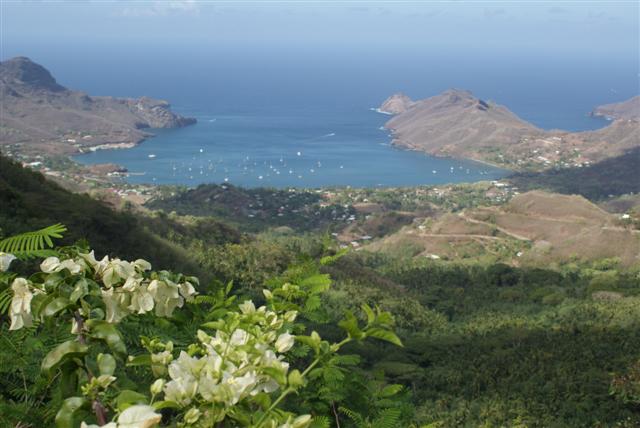
Looking south over Taiohae
The best way to see Nuka Hiva is by 4×4 vehicle so on the Wednesday the crews of Enchantress, Fai Tira and Aspen (USA) joined us as we got into 2 vehicles and set off with our guide Richard to see the sights. We started off by driving up the Muake at 864 meters high for a sweeping view across the bay. We continued on to Houmi past the vanilla plants that grow wild across the valley to stop to look at a magical church on the banks of Controller bay. We zig-zaged back up the winding road to Taipivai, whose ancient warriors were cannibals, for a magnificent view out to sea with the island of Ua Pou in the distance.
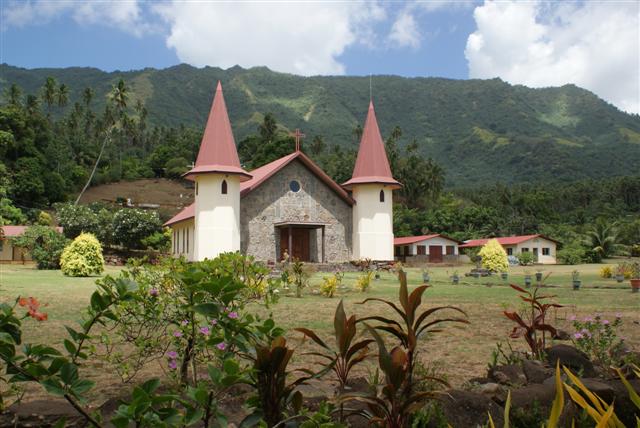
Beautiful Hatiheu church
We continued across the mountainous terrain to Hatiheu on the north coast with its black sand beach for a delicious lunch at Chez Yvonnes. The Hatiheu church stands majestically overlooking the village.
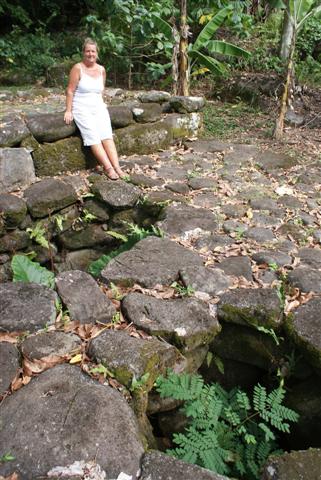
Sue by ‘bones’ hole
We drove up into the jungle to the restored archaeological site of Hikoku’a Tohua home to many ‘paepae’ or stone platforms and a huge ‘tohu’a’, an ancient gathering place decorated with many petroglyphs. The me’ae or ancient cult worship site consisted of several terraces of large blocks of stone next to a sacred Banyan tree, where in ancient times the Marquesians would have held dances and banquets. Many human sacrifices were made to the goddess Te Vana’uau’a. The victims were kept in a ‘bone’ hole until it was their turn to be consumed at the cannibal feast.
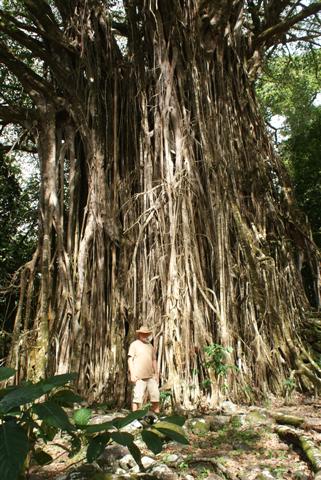
Bill by giant Banyan tree
The Banyan tree in the photo is a famous one that’s featured in many books because when it was discovered by the first missionaries it was full of skulls. We continued through the jungle to find many more me’ae sites some with ancient hiamoe or sleeping platforms watched over by sculptured stone tikis or phallic fertility statues that keep the secrets of the ancient rites once practised there. The site is among the largest and most intriguing in the Marquesas and as with all archaeology I found them fascinating. Richard was very informative but intrigued at my interest in everything. We drove back across the island to the boats.

Ua Pou from a distance
We spent the next few days sorting out the boats ready for the next leg of the journey and doing boring stuff like laundry, wifi, etc. We left early Saturday morning for Ua Pou, the third largest island in the Marquesas, which lies about 25 miles south of Nuka Hiva. The weather wasn’t very good and the anchorage looked very rolly so we decided to continue on our journey to the Tuamotus. Sadly we turned south away from the beautiful Marquesan islands, our visit had been far too short.
The Stunning Galapagos Islands

What a beautiful boy
00° 44.8 South 090°18.4 West The Galalpagos Islands otherwise known as The Enchanted Isles because they certainly were. We took a 5-day holiday aboard Daphne with air-conditioning while someone else did the driving.
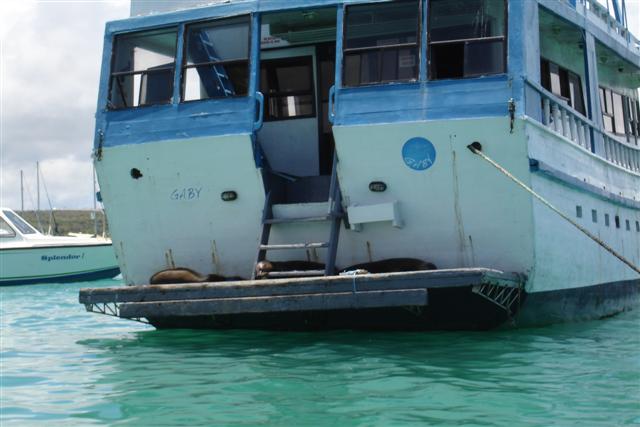
Sea-lions asleep on a local boat
We arrived Wednesday 10thMarch at 10am – what a relief. We found a space to anchor and Tony from BWR came on board to complete our check-in process. Bill wanted to put the temporary fix on the shroud straight away. I again found myself holding on to the mast but in the anchorage I felt more in control. Bill had to spend quite a bit of time filing the bottle screw so we made the right decision not to attempt it at sea. That evening Enchantress and Lucy Alice joined us for champagne to celebrate our safe arrival and then we all went ashore to The rock for happy hour; a big cheer went up when Bill walked in. We ate out in the kiosks, a row of ramshackle restaurants with tables and chairs in the street; it was good value and nice food. We slept well that night.
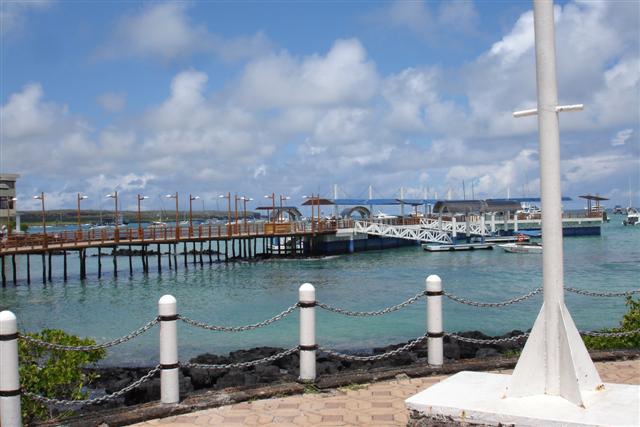
Water taxi rank with BWR boats in background
Puerto Ayora on the island of Santa Cruz was established in the early 1970’s and is full of multi-ethic contrasts between the Ecuadorians and immigrants of European decent. It thrives well on the passing yacht trade and visitors flying in to join the many island cruises available. It has a very good water taxi system so it wasn’t necessary to put the dinghy down.
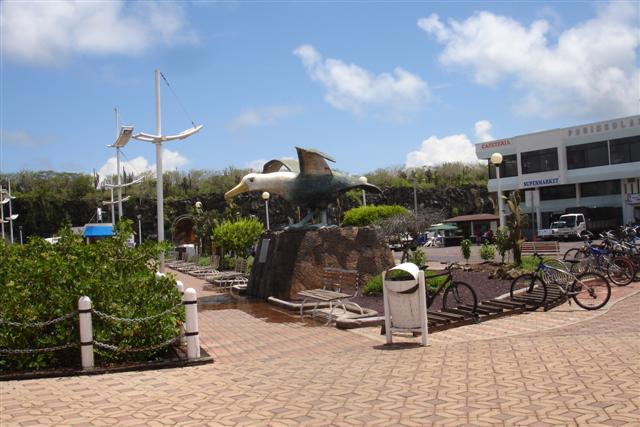
The supermarket next to the dock
There was a good supermarket by the dock and a good market further up in the town. I spent the next few days back and forth from the internet café trying to log on to a very slow connection to download our mail and various other tasks. The cost of living seemed cheap in the Galapagos so we enjoyed several meals out for a change.
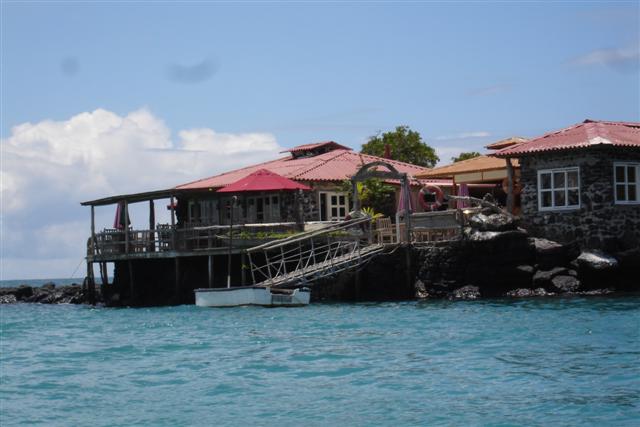
The restaurant at Angermeyer
On the Sunday Tony from BWR had arranged for us all to have Sunday lunch in a lovely restaurant at Angermeyer point just across the bay. Luckily it was on the water taxi route so we didn’t have to take our dinghies, which was probably just as well because it had a very small landing stage. It was a lovely day but very hot as usual. We all had a delicious barbeque meal with some wonderful salads. Afterwards we walked to the beach but as it was Sunday the beach was a bit crowded so we went back to the boat.
We had an ‘out and about’ day on the Monday. It started with a taxi ride to the Darwin centre. There is a very good breeding programme involving giant tortoises to try to prevent them from becoming extinct.

Lonesome George
We were able to walk around the raised walkway overlooking their pens. We found Lonesome George in one of them with his girlfriends but sadly he wasn’t showing any interest. There’s a possibly that once he dies that particular breed of Tortoise will become extinct. We spent a couple of hours wandering around there. We walked back into town and, after spending a bit of time in the internet café, we joined the rest of the BWR crews for a coach trip to a nearby farm for a briefing for the next leg. The farm was also a resort hotel with a pool so after the briefing some of us got changed and enjoyed a refreshing dip in the water. The bar was opened and ‘all was happiness’ to quote Tony from BWR.
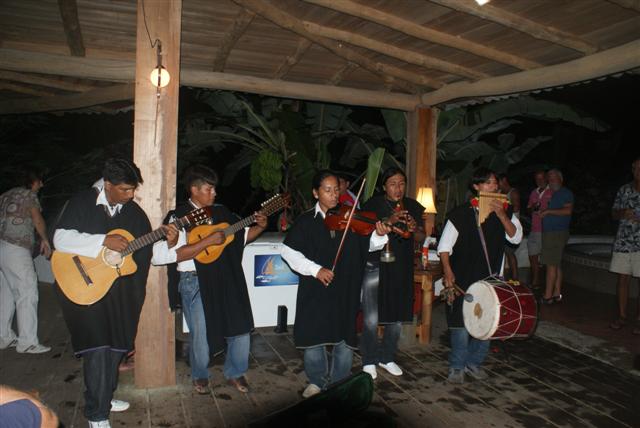
A local band entertained us
A local band came to entertain us and played some traditional pipe music. We all enjoyed a delicious barbeque before returning to the boats by coach.
On Tuesday our new rigging parts arrived in the afternoon and Bill was anxious to fit them before we left Camomile at anchor while we were on Daphne. Ian and David came over to help. I spent the afternoon packing our bags for our mini holiday.

Daphne
Wednesday morning we locked the boat, got in a water taxi and went ashore. We were met by Charlie our guide and naturalist and left in a coach at 11.00 with the crews of Enchantress, Lucy Alice, Mercury Rising, Fai Tira, 2 of Roundabouts crew and 3 Canadians. We were off on our holiday and guess what – it was raining. We drove for an hour to the other side of the island where Daphne was waiting for us. She was a really nice boat and had just had a refit. We were shown to our cabins, ours was really nice on the upper deck. It had a double bed, a nice shower room but best of all, air-conditioning. We sat down to a nice lunch while the crew gently motored us round to the next bay.
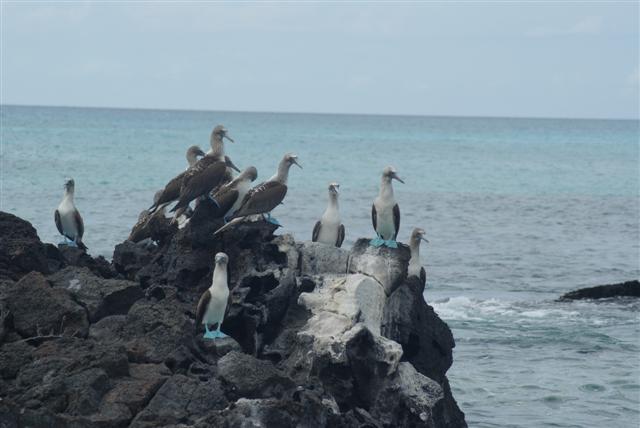
Blue-footed boobies
We all got into the large dinghy and were taken ashore. We went for a walk along the beach and saw lots of blue-footed boobies. We snorkelled off the beach where there were lots of fish. We returned to the boat to relax for a few hours and have a long shower.
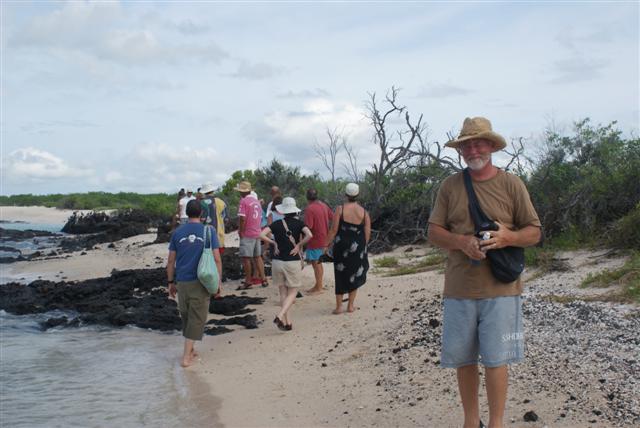
Our group walking along the beach
We got changed and joined everyone in the little lounge, which was beautifully finished in wood with new seating. We were offered a welcome cocktail and introduced to the crew. There were seven, all men, including the captain plus Charlie who spoke perfect English. We introduced ourselves while Charlie translated for us. We sat down to a delicious dinner in the little dining room/bar before retiring to our air-conditioned cabin. Heaven!
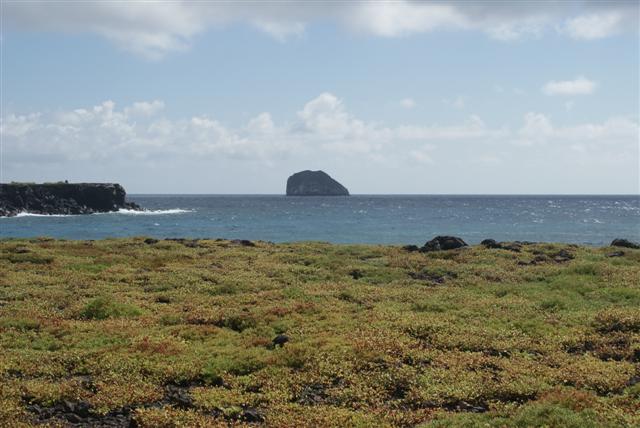
The carpets of red sesuvium
We awoke to a beautiful day. During the night we had motored to the small island South Plaza. Located on the east of Santa Cruz, the main characteristics are the Opuntia cacti and the carpets of red sesuvium, a succulent plant that turns green in the rainy season. The cactus is the main food of land iguanas. We landed on a jetty and went for a nice walk to see the land iguanas sunbathing under the cacti.

A land Iguana
The more you looked the more you saw, there were so many and they weren’t bothered by us walking past at all. As they approached each other they would nod their heads up and down which is their sign to say ‘this is my bit of land’. We had a beautiful walk up over the hills. We saw swallow-tailed gulls and red-billed tropicbirds nesting, and boobies roosting on the south cliff of the island.
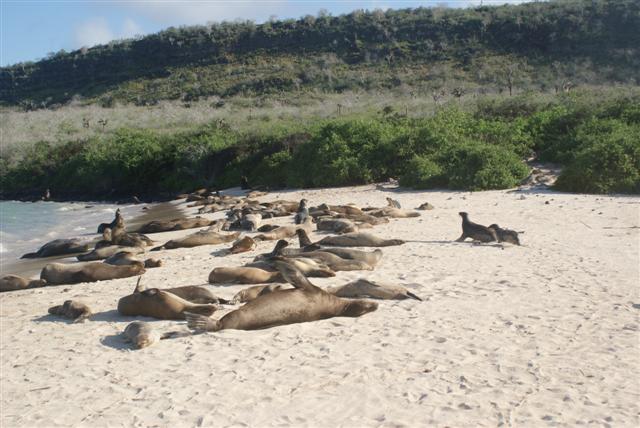
Sea lions lying in the sun
As we walked back to the jetty we saw lots of sea lions playing in the water below and sunbathing on the rocks around us. We were taken back to Daphne where the bar man had fruit juice and cookies waiting for us. I could get used to this.
We weighed anchor and motored 2 hours to Santa Fe, which has one of the most beautiful coves in the archipelago.

A beautiful cove with pelicans on the beach
A turquoise lagoon with two small white sand beaches which are protected by a peninsula where sea lions lie in the sun. After lunch we swam near the boat and saw lots of fish. We were taken outside the cove in the dinghy and snorkelled back. We saw a sea lion in the water and swam with 2 big turtles. At the entrance to the cove there was a fish ball below us. I’ve never seen so many fish together; there were literally millions of them. Later in the afternoon we landed on the beach.
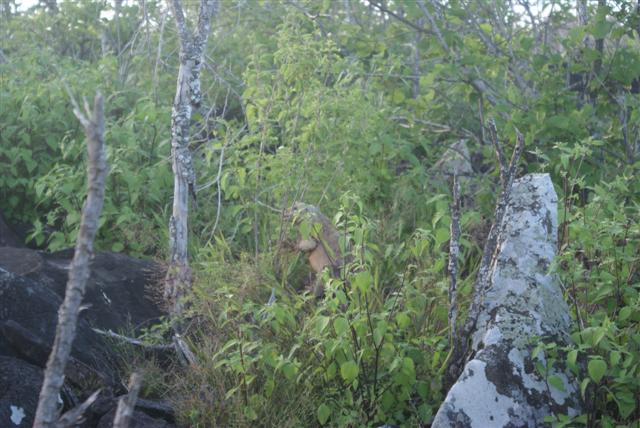
A land Iguana hiding
The island contains one of the largest sea lion colonies. A trail runs alongside the coast and then crosses through an Opuntia Forest. The Santa Fe species of land iguanas are larger and of a paler yellow than on the other island but we only saw one. On our way back we walked passed the sea lions lying on the beach with out a care in the world and they weren’t the slightest bit bothered by us wandering amongst them.
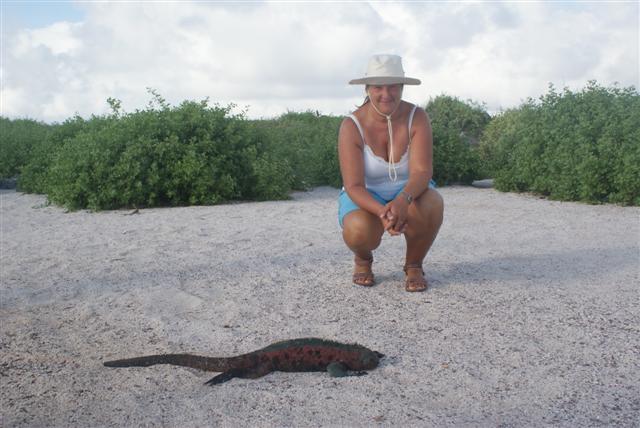
A marine Iguana on the beach
On Friday morning we found ourselves anchored off the island of Española that, as one of the smallest islands, is flat with no visible volcanic crater or vent. We landed on the beach for our daily walk. There were lots of brilliantly coloured marine iguanas lying in the sun on the rocks and walking across the beach, again oblivious to our existence. We continued to the seaward side of the island and saw lots of nesting birds including Nasca boobies, Mockingbirds, Galapagos doves and Galapagos hawks.

A Nasca boobie with her baby
It was amazing to be so close to birds with their young. This photo of a Nasca boobie with her baby was taken right next to them and not with the zoom lens, they were sitting in the cliff just above our heads. We stopped on top of the cliffs for a photo opportunity. With the heavy swell running below it was creating a spectacular blowhole with thundering spray shooting 30 metres into the air.
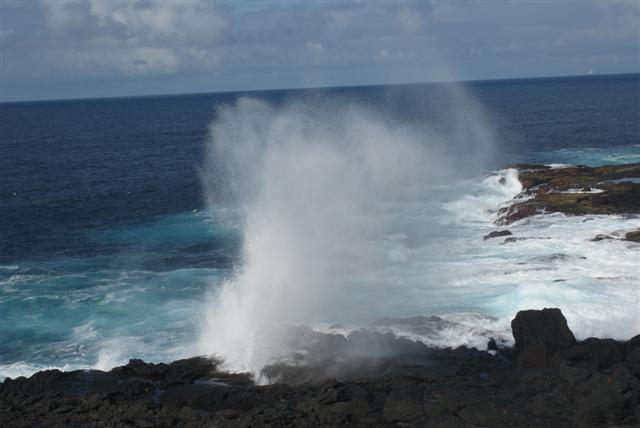
Spectacular blow hole
The spray was forming beautiful rainbows as it fell back onto the rocks. It was a spectacular sight. We returned to Daphne for lunch and motored round to Gardner bay on the eastern side of the island with its magnificent beach again full of sea-lions. In the afternoon we went for our usual snorkel. We were dropped off about 1km away and drift snorkelled back. We swan into a cave where lots of fish were collecting in the entrance. The captain and some of the crew were in the water with us and spotted a shark and several turtles for us. We returned to Daphne to relax on the sun deck before dinner. We motored to the island of Floreana over night.
Saturday was our last full day on Daphne and they seemed to have saved the best for last. We were anchored off Floreana, perceived as one of the most exotic islands of the archipelago.

Posting cards in the whalers post barrel
We were in Post Office bay, home to the legendary post barrel that whalers used to send their mail. There were letters and postcards in the barrel. Traditionally if you put an item in to be posted then you take one out to post. We all choose some postcards to be sent on from our next destination. I took one for New Zealand, which I’m going to hand deliver, one each for Sweden, US and Ireland, which I’ll send from the Marquesas. We continued on to the lava tube. We had to climb down a ladder to enter and it was very dark inside. We paddled in the pool but Susan and Glenda very bravely waded deeper and swam in it. I’ve seen too many creepy films to venture further forward in the dark.

A Galapagos penguin
We came back to the surface and walked back to the beach. Just as we were leaving in the dinghies we caught sight of some rare Galapagos penguins swimming close to the boat.
The crew moved Daphne nearer to an eroded volcanic vent called the devils crown.
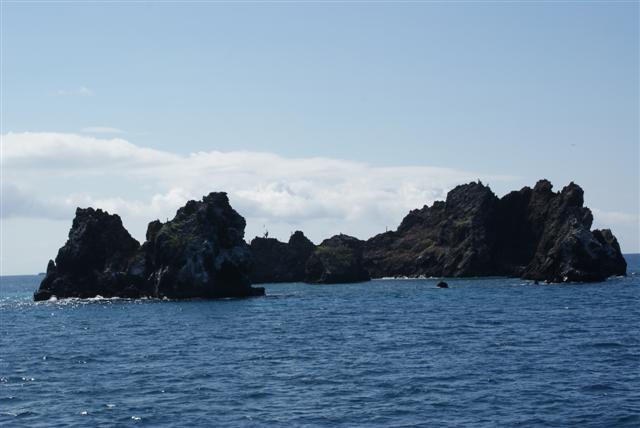
The devil’s crown
We were all loaded into the dinghies for a snorkel. It was probably the best snorkel we have ever had. There was a fantastic array of wildlife, white tipped and black tipped sharks, manta ray, octopus, starfish, turtles and hundreds of different kinds of fish. We were dropped off at one end and drifted with the current over the top of all the wildlife. It was like looking down into an aquarium, just out of this world.
Not believing they could top the devil’s crown, after lunch we were taken on our last walk.

Flamingos in the pink lagoon
We walked past a lagoon, which seemed to have a pink hue to it. It had lots of elegant flamingos standing on their slender legs; we stopped for a while to watch these graceful birds wading through the water picking at the tasty morsels beneath them. We continued along the trail to a beautiful white sand beach made from ground coral so fine it looked like flour. This is the nesting sight of the green sea turtle.
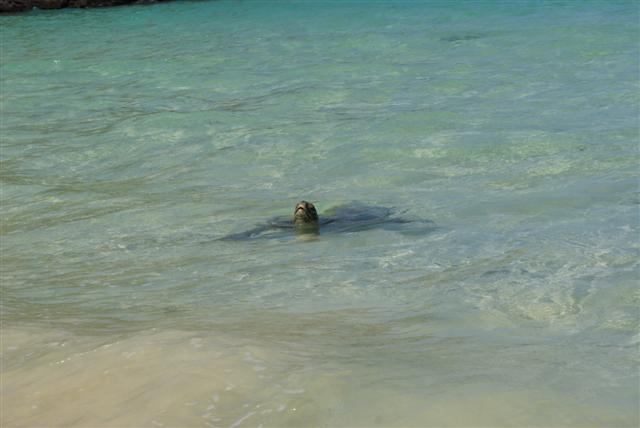
A turtle waiting to come in to lay her eggs
Tracks were evident across the beach where the turtles had dragged themselves above the waterline to lay their precious eggs. Sadly we watched a Frigate bird repeatedly dive into the sand dunes trying to grab the baby turtles as they were emerging from their nest. The Galapagos policy is not to interfere with nature and we weren’t allowed to chase the birds away. We turned our attentions back towards the water and saw several turtles waiting to land on the beach, which they would do after dark.
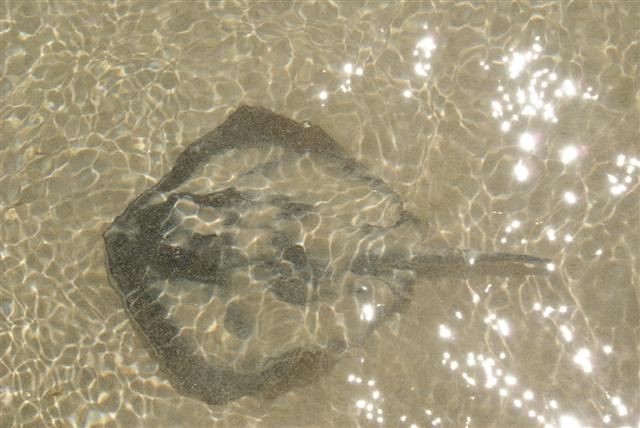
A ray swimming around our feet
We also had rays swimming around our feet, there were so many we had to be careful where we stepped. The fine sand was lying on their backs.
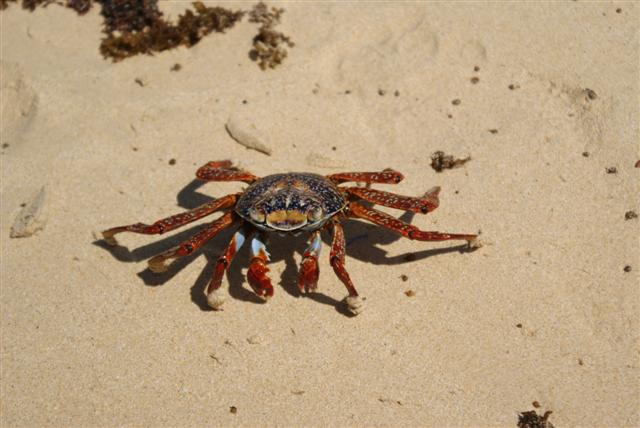
A Sally light foot crab
We wandered over to the rocks around the edge and saw many Sally Light foot crabs with their beautiful red and white spotted legs attached to their blue spotted bodies running sideways across the beach.
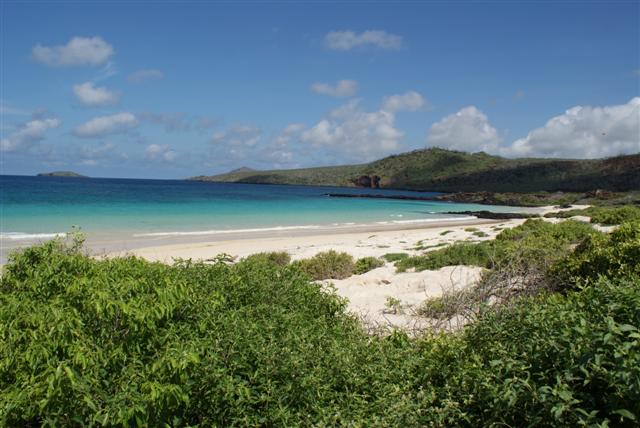
A last view of the cove
It was probably the beautiful beach we had been on, it certainly had the most wildlife. We reluctantly left the beach and walked back across the island looking over our shoulders many times to get one last view of the stunning blue water.
We returned to Daphne ready for the journey back to Santa Cruz. Bill wanted to have a look at the bridge and was welcomed in. Pictures were taken with the Captain and we asked him if they ever see Dolphins.
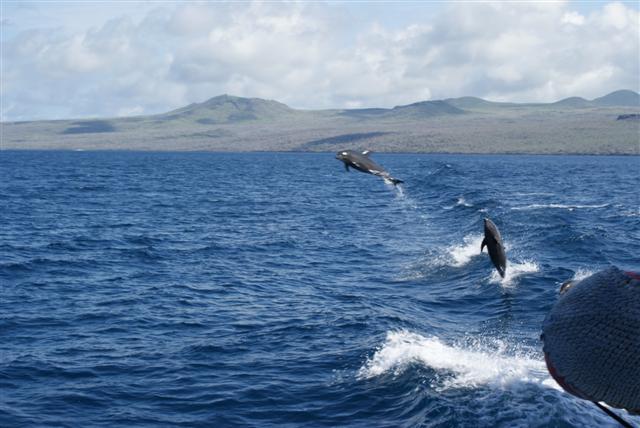
Dolphins leaping out of our wake
As if on cue the call of “Dolphins” was called out and everyone rushed to the bow of the boat to watch them. We’ve had Dolphins many times swimming in our bow wave but Daphne was travelling at 15kts which is twice as fast as Camomile and the Dolphins were still managing to keep up. The extra speed seemed to excite them more because they were also leaping right out of the water in our wake. It was going to take quite a while to get back so we watched a BBC Galapagos documentary, which was very interesting. We arrived back to a cloudy evening.
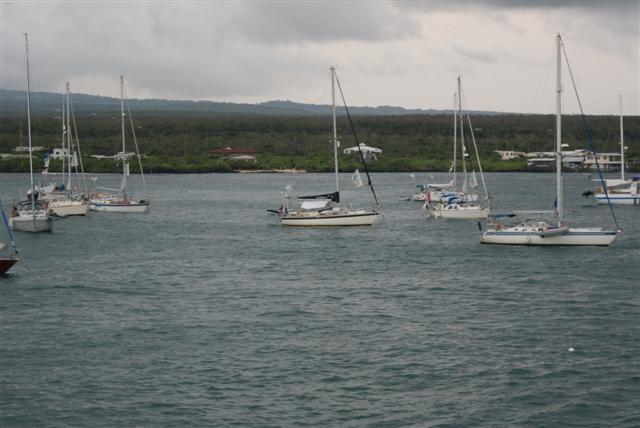
Camomile was still where we had left her
Camomile was still where we had left her. The crew kindly took all the men round to check on their boats and they managed to bring back various bottles of alcohol. Most of the crew went off duty leaving us all to have a party on board. The next morning we reluctantly packed our bags and enjoyed one last breakfast together. Sue and David, crew from Roundabout had finished their time with the BWR and headed to the airport. The rest of us went on our final excursion to the Highlands to visit a Tortoise Sanctuary.
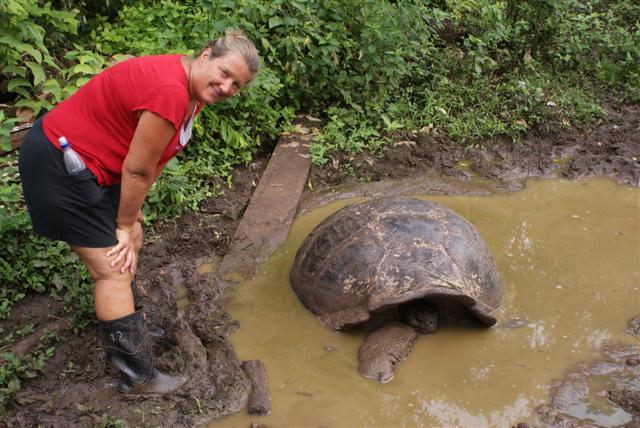
Wallowing in mud
We donned Wellie boots and went to find the tortoises, who were wallowing in the mud. We went back to the dock for our luggage and were taken back to our boats. What a fabulous time we’d all had. We spent the next few days getting ready for our longest passage …… across the Pacific Ocean.
Crossing the Equator
There’s one final part to this story. To reach the Galapagos we had to cross the equator. The ‘Crossing the line’ ceremony is an initiation rite which commemorates a sailor’s first crossing.

Bill dressed ready for the shellback ceremony nursing the broken shroud
We were all Pollywogs and needed to become Shellbacks or sons of Neptune. After crossing the line Pollywogs receive a summons to appear before King Neptune. This is preceded by a beauty contest of men dressed as woman and then Pollywogs have to go through a number of disgusting ordeals. So we decided to organise our own ceremony on each of our boats. The men would dress as woman, the woman would wear their clothes inside out and back to front and we would perform our own ceremony on the front of our boats for the entertainment of the others.
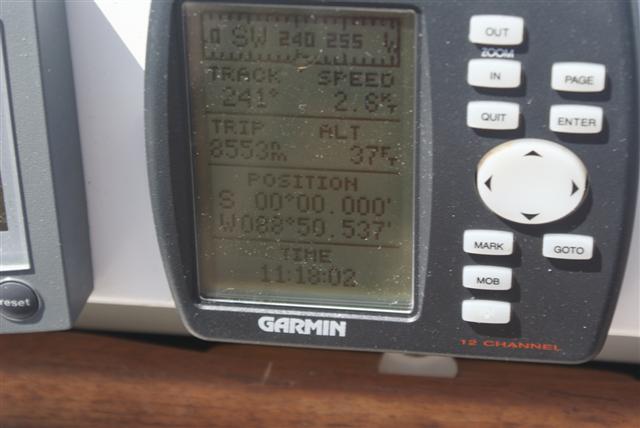
Crossing the equator as the GPS reads 00.00 south
We had a 4th boat join us called Briet and the skipper Duco was already a shellback so he was Neptune. Bill, David and Ian dressed in our clothes and we all crossed the line together with Duco, as King Neptune, counting down the degrees. Then the fun could begin. Bill squirted water at me from the super soaker.
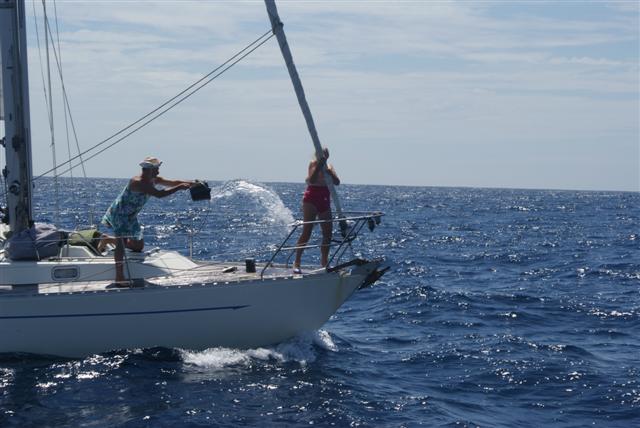
Ian and Glenda performing shellback ceremony
Ian threw several buckets of water over Glenda and she threw several back but David and Susan carried out the works. David doesn’t like Couscous so he threw that at Susan then she squirted cream on his feet and had to kiss it,
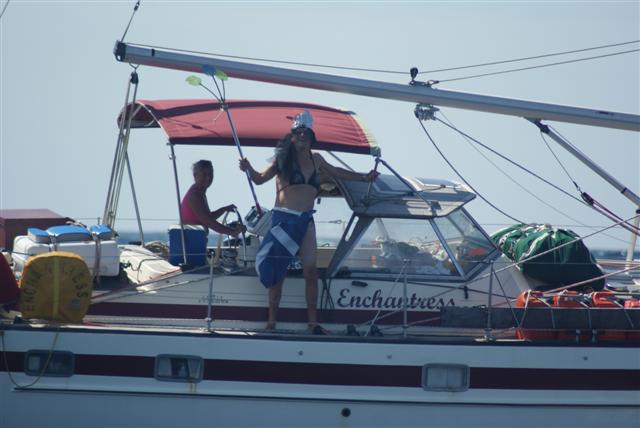
David and Susan ready for their ceremony
then came the buckets of water and then finally they opened cans of beer and tipped some over the bow of their boat and drank the rest. It was all a lot of fun. The funniest part of the afternoon was when Ian turned round to go back on deck and the wind got up lifting his dress to reveal nothing underneath. His excuse was that, as he couldn’t fit into any of Glenda’s kickers he thought he wasn’t allowed to wear any! After the fun we continued on our journey because we still had another 100 miles to go. Lucy Alice, Enchantress and Briet were able to sail and they adjusted their speed to match ours, their support was invaluable. We arrived the following day having motored 491 miles in 104 hrs. We had used all our jerry cans of fuel but we still had our mast.
 Camomile